

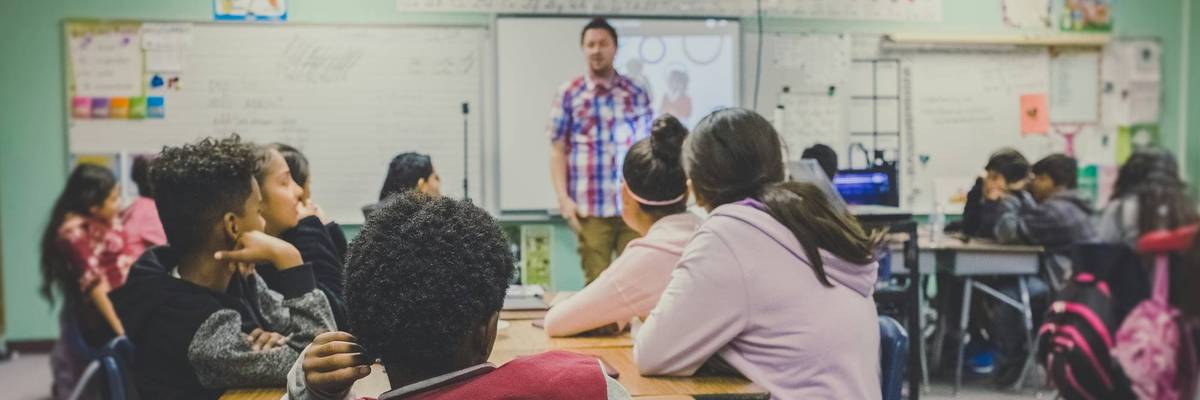
"Education is more than a good, it's for the common good," writes Goodwin.
Want to Celebrate America’s 250th? Uplift Public Schools!
Just as the founders of the country drew inspiration from European enlightenment thinkers, we too must now renew our own democracy by demanding our students and schools be supported.
July 4th, 2026 will be the 250th anniversary of the Declaration of Independence. One of the foundational documents of the United States, the declaration has been taught many ways: as America’s break up letter, as a rallying cry for freedom and as an example of the legal assertion of a right to rebellion—derived from common law and biblical teaching. Influenced by the Protestant reformation, the Great Awakening and enlightenment thinking, the Declaration is an example of the complexity of our founding and a reminder of the important work of educating for democracy.
Yet, many teachers feel like it’s getting more difficult to teach today, on the eve of the 250th. Just like in the era that gave us the “Spirit of ‘76,” teachers, who are striving to keep the spirit alive, must both stay rooted in local life and draw inspiration from Europe.
In 1776, local life in the rebellious colonies was much more defined by geographic dispersion. It took time for word to travel between the population hubs. Reading was essential to revolutionary activity and democratic participation as the written word could travel with greater reliability to all corners of the colonies, including the backwoods of the likes of New Hampshire, my home state.
It was a sign of the times when far off places like New Hampshire joined the struggle for independence, just as it is a sign today that teachers in Granite State feel the string of modern issues that for so long have been more acutely felt closer to urban population centers. Consequently, it bears reporting that Hampshire was recently hit by a series of newly proposed legislation aimed at destroying the bedrock of our democracy, our public school system. These new developments trace their way back to 2021 when the state saw the start of a transfer of public resources to private and religious schools with the enactment of a voucher program. That program then expanded over several years, quickly eliminating a cap that limited participation based on income, becoming a universal and unregulated giveaway.
Those celebrating the special anniversary year of our state and country would be remiss to not also honor the legacy that binds education to our experiment in self governance. This can be found in the written text of New Hampshire’s constitution as a call to provide for the general diffusion of knowledge among of the citizenry (the link above from the Education Law Center identifies similar constitutional clauses in states across the country).
It is this constitutional text that the state Supreme Court relied on as it issued important rulings clarifying the state's obligation to provide adequate funding to all public school students—something the state had historically resisted. New Hampshire is consistently at the bottom of the list in terms of state contribution to public schools, forcing an overreliance on local property tax.
Determined to subvert the court's ruling, the legislature has opted instead to launch a full-on assault on the public school system. One proposed bill would push a rapid consolidation of local school districts—something that would cut against the very local control that New Hampshire has lauded since it created its own state government in 1776.
Another bill tried to replace the power of locally elected school boards by shifting decision making away to publicly unaccountable boards by converting local public schools to charter schools. Diminishing local democratic decision making through conversions also opens the door to Charter Management Organizations (CMOs), which are privately held profit motivated companies that have been notorious actors in other places, including New Orleans. The fast pace of the potential law has many concerned that the measure is truly meant to seed confusion and destabilize the existing school system.
Here, I should note that according to most measures New Hampshire's schools rank in the top quintile in the nation despite the destructive policies of several extreme legislatures.
Yet, the pressure has been especially palpable on schools that historically are already stretched thin. Administrators in these districts have tried to navigate rushed new regulations and the ensuing confusion, as well as changes to the already limited state funding formula. One district was forced to take out a $4 million private loan to cover its operating budget rather than face mass staff layoffs. The state has offered what some call predatory lending to financially distressed districts—all while threatening state takeovers of the very places that they have refused to provide adequate funding, despite the ruling of multiple courts over decades.
Most of this will sound familiar to those who have followed the broader privatization movement. Efforts to privatize the schools of New Hampshire are a collection of ideas recycled from failed “experiments” in defunding educational opportunities for students across the country from Chicago to Los Angeles (and many in between). Similar policies have been pursued nationwide, sadly. These policies based on a neoliberal theory, propose to slash taxes and reduce services, commodifying education to a good, another product to be bought and sold.
The thing is, education is more than a good, it's for the common good. By this, I mean, we all benefit when young people become better learners and it is fundamental to our continued self-governance to have the next generation experienced in the arts of democratic life. We need students to develop discernment, practice reasoning and decision making and learn to collaborate with peers from a wide variety of backgrounds and experiences.
Communities want quality public schools—and it’s time to rally around our community schools. Just as the founders of the country drew inspiration from European enlightenment thinkers, we too must now renew our own democracy by demanding our students and schools be supported.
To do so, we should redouble our investment in early childhood education, resource all schools to provide early interventions (a proven way to help students and a wise use of public funds over the long term as studies have shown the students who receive personalized support early in life are less likely to require intensive needs later in their educational lives). We must raise the status of the teaching profession; a career as a kindergarten teacher should be seen as equally as important as a doctor or lawyer. The professional status of teachers can vest us with classroom autonomy and respect for professional judgement. This contributes to school cultures of collective respect and responsibility and wellbeing.
Celebrating the 250th is about uplifting our democratic institutions—especially schools. While the private interests of a few have used dark money to fuel campaigns to defund our shared schools and shrink schools as common gathering places, too many well meaning folks have missed the point that the big money backers of school privatization grasp: providing proven policy examples at a small scale initially can be enough to grow the momentum needed to scale up and grow policy.
That’s why we need to be in touch with local educators, to support them, and to find ways to share what’s working at scale. It is that kind of resolve that makes democracy actionable and not just a wish. Don’t close your eyes to make a wish on the 250th anniversary of the Declaration, recommit to protecting our schools, the cradles of our democracy, with policies inspired to help all flourish.
We are at a crossroads
This country and this world are at a monumental crossroads. In a few short weeks, US voters will have an opportunity to beat back the forces of fascism and confront the billionaires who are rigging the economy, our media system, and our democracy, making it increasingly impossible for ordinary people to get by. We’re not just talking about the election. We’re talking about what must be done once these fascist elements are vanquished from power. We need a bolder set of solutions than what either major party has so far been willing to offer and a working-class movement ready to fight like hell for it. Trump didn't emerge from nowhere. The conditions that fueled MAGA authoritarianism were created by decades of radical neoliberal economic policies and a corrupt political system dominated by corporate interests. They slashed taxes on the super-rich, promising that the benefits would trickle down. They said giveaways to the corporate titans would make life more affordable for the rest of us. It was all bullshit. And when a bitter, betrayed populace searches for someone to blame, right-wing demagogues have little trouble finding scapegoats. People know when they're being lied to, but you won't hear any of this from the corporate media. Only independent journalism—powered and funded by people who believe in building a better world—can deliver truly trustworthy daily news. Our Fall Campaign is underway, and we need your help. To power our newsroom through the rest of the year, we need to raise $125,000 by midnight on October 31. So if you share our vision, please contribute whatever you can to sustain our work. |
July 4th, 2026 will be the 250th anniversary of the Declaration of Independence. One of the foundational documents of the United States, the declaration has been taught many ways: as America’s break up letter, as a rallying cry for freedom and as an example of the legal assertion of a right to rebellion—derived from common law and biblical teaching. Influenced by the Protestant reformation, the Great Awakening and enlightenment thinking, the Declaration is an example of the complexity of our founding and a reminder of the important work of educating for democracy.
Yet, many teachers feel like it’s getting more difficult to teach today, on the eve of the 250th. Just like in the era that gave us the “Spirit of ‘76,” teachers, who are striving to keep the spirit alive, must both stay rooted in local life and draw inspiration from Europe.
In 1776, local life in the rebellious colonies was much more defined by geographic dispersion. It took time for word to travel between the population hubs. Reading was essential to revolutionary activity and democratic participation as the written word could travel with greater reliability to all corners of the colonies, including the backwoods of the likes of New Hampshire, my home state.
It was a sign of the times when far off places like New Hampshire joined the struggle for independence, just as it is a sign today that teachers in Granite State feel the string of modern issues that for so long have been more acutely felt closer to urban population centers. Consequently, it bears reporting that Hampshire was recently hit by a series of newly proposed legislation aimed at destroying the bedrock of our democracy, our public school system. These new developments trace their way back to 2021 when the state saw the start of a transfer of public resources to private and religious schools with the enactment of a voucher program. That program then expanded over several years, quickly eliminating a cap that limited participation based on income, becoming a universal and unregulated giveaway.
Those celebrating the special anniversary year of our state and country would be remiss to not also honor the legacy that binds education to our experiment in self governance. This can be found in the written text of New Hampshire’s constitution as a call to provide for the general diffusion of knowledge among of the citizenry (the link above from the Education Law Center identifies similar constitutional clauses in states across the country).
It is this constitutional text that the state Supreme Court relied on as it issued important rulings clarifying the state's obligation to provide adequate funding to all public school students—something the state had historically resisted. New Hampshire is consistently at the bottom of the list in terms of state contribution to public schools, forcing an overreliance on local property tax.
Determined to subvert the court's ruling, the legislature has opted instead to launch a full-on assault on the public school system. One proposed bill would push a rapid consolidation of local school districts—something that would cut against the very local control that New Hampshire has lauded since it created its own state government in 1776.
Another bill tried to replace the power of locally elected school boards by shifting decision making away to publicly unaccountable boards by converting local public schools to charter schools. Diminishing local democratic decision making through conversions also opens the door to Charter Management Organizations (CMOs), which are privately held profit motivated companies that have been notorious actors in other places, including New Orleans. The fast pace of the potential law has many concerned that the measure is truly meant to seed confusion and destabilize the existing school system.
Here, I should note that according to most measures New Hampshire's schools rank in the top quintile in the nation despite the destructive policies of several extreme legislatures.
Yet, the pressure has been especially palpable on schools that historically are already stretched thin. Administrators in these districts have tried to navigate rushed new regulations and the ensuing confusion, as well as changes to the already limited state funding formula. One district was forced to take out a $4 million private loan to cover its operating budget rather than face mass staff layoffs. The state has offered what some call predatory lending to financially distressed districts—all while threatening state takeovers of the very places that they have refused to provide adequate funding, despite the ruling of multiple courts over decades.
Most of this will sound familiar to those who have followed the broader privatization movement. Efforts to privatize the schools of New Hampshire are a collection of ideas recycled from failed “experiments” in defunding educational opportunities for students across the country from Chicago to Los Angeles (and many in between). Similar policies have been pursued nationwide, sadly. These policies based on a neoliberal theory, propose to slash taxes and reduce services, commodifying education to a good, another product to be bought and sold.
The thing is, education is more than a good, it's for the common good. By this, I mean, we all benefit when young people become better learners and it is fundamental to our continued self-governance to have the next generation experienced in the arts of democratic life. We need students to develop discernment, practice reasoning and decision making and learn to collaborate with peers from a wide variety of backgrounds and experiences.
Communities want quality public schools—and it’s time to rally around our community schools. Just as the founders of the country drew inspiration from European enlightenment thinkers, we too must now renew our own democracy by demanding our students and schools be supported.
To do so, we should redouble our investment in early childhood education, resource all schools to provide early interventions (a proven way to help students and a wise use of public funds over the long term as studies have shown the students who receive personalized support early in life are less likely to require intensive needs later in their educational lives). We must raise the status of the teaching profession; a career as a kindergarten teacher should be seen as equally as important as a doctor or lawyer. The professional status of teachers can vest us with classroom autonomy and respect for professional judgement. This contributes to school cultures of collective respect and responsibility and wellbeing.
Celebrating the 250th is about uplifting our democratic institutions—especially schools. While the private interests of a few have used dark money to fuel campaigns to defund our shared schools and shrink schools as common gathering places, too many well meaning folks have missed the point that the big money backers of school privatization grasp: providing proven policy examples at a small scale initially can be enough to grow the momentum needed to scale up and grow policy.
That’s why we need to be in touch with local educators, to support them, and to find ways to share what’s working at scale. It is that kind of resolve that makes democracy actionable and not just a wish. Don’t close your eyes to make a wish on the 250th anniversary of the Declaration, recommit to protecting our schools, the cradles of our democracy, with policies inspired to help all flourish.
July 4th, 2026 will be the 250th anniversary of the Declaration of Independence. One of the foundational documents of the United States, the declaration has been taught many ways: as America’s break up letter, as a rallying cry for freedom and as an example of the legal assertion of a right to rebellion—derived from common law and biblical teaching. Influenced by the Protestant reformation, the Great Awakening and enlightenment thinking, the Declaration is an example of the complexity of our founding and a reminder of the important work of educating for democracy.
Yet, many teachers feel like it’s getting more difficult to teach today, on the eve of the 250th. Just like in the era that gave us the “Spirit of ‘76,” teachers, who are striving to keep the spirit alive, must both stay rooted in local life and draw inspiration from Europe.
In 1776, local life in the rebellious colonies was much more defined by geographic dispersion. It took time for word to travel between the population hubs. Reading was essential to revolutionary activity and democratic participation as the written word could travel with greater reliability to all corners of the colonies, including the backwoods of the likes of New Hampshire, my home state.
It was a sign of the times when far off places like New Hampshire joined the struggle for independence, just as it is a sign today that teachers in Granite State feel the string of modern issues that for so long have been more acutely felt closer to urban population centers. Consequently, it bears reporting that Hampshire was recently hit by a series of newly proposed legislation aimed at destroying the bedrock of our democracy, our public school system. These new developments trace their way back to 2021 when the state saw the start of a transfer of public resources to private and religious schools with the enactment of a voucher program. That program then expanded over several years, quickly eliminating a cap that limited participation based on income, becoming a universal and unregulated giveaway.
Those celebrating the special anniversary year of our state and country would be remiss to not also honor the legacy that binds education to our experiment in self governance. This can be found in the written text of New Hampshire’s constitution as a call to provide for the general diffusion of knowledge among of the citizenry (the link above from the Education Law Center identifies similar constitutional clauses in states across the country).
It is this constitutional text that the state Supreme Court relied on as it issued important rulings clarifying the state's obligation to provide adequate funding to all public school students—something the state had historically resisted. New Hampshire is consistently at the bottom of the list in terms of state contribution to public schools, forcing an overreliance on local property tax.
Determined to subvert the court's ruling, the legislature has opted instead to launch a full-on assault on the public school system. One proposed bill would push a rapid consolidation of local school districts—something that would cut against the very local control that New Hampshire has lauded since it created its own state government in 1776.
Another bill tried to replace the power of locally elected school boards by shifting decision making away to publicly unaccountable boards by converting local public schools to charter schools. Diminishing local democratic decision making through conversions also opens the door to Charter Management Organizations (CMOs), which are privately held profit motivated companies that have been notorious actors in other places, including New Orleans. The fast pace of the potential law has many concerned that the measure is truly meant to seed confusion and destabilize the existing school system.
Here, I should note that according to most measures New Hampshire's schools rank in the top quintile in the nation despite the destructive policies of several extreme legislatures.
Yet, the pressure has been especially palpable on schools that historically are already stretched thin. Administrators in these districts have tried to navigate rushed new regulations and the ensuing confusion, as well as changes to the already limited state funding formula. One district was forced to take out a $4 million private loan to cover its operating budget rather than face mass staff layoffs. The state has offered what some call predatory lending to financially distressed districts—all while threatening state takeovers of the very places that they have refused to provide adequate funding, despite the ruling of multiple courts over decades.
Most of this will sound familiar to those who have followed the broader privatization movement. Efforts to privatize the schools of New Hampshire are a collection of ideas recycled from failed “experiments” in defunding educational opportunities for students across the country from Chicago to Los Angeles (and many in between). Similar policies have been pursued nationwide, sadly. These policies based on a neoliberal theory, propose to slash taxes and reduce services, commodifying education to a good, another product to be bought and sold.
The thing is, education is more than a good, it's for the common good. By this, I mean, we all benefit when young people become better learners and it is fundamental to our continued self-governance to have the next generation experienced in the arts of democratic life. We need students to develop discernment, practice reasoning and decision making and learn to collaborate with peers from a wide variety of backgrounds and experiences.
Communities want quality public schools—and it’s time to rally around our community schools. Just as the founders of the country drew inspiration from European enlightenment thinkers, we too must now renew our own democracy by demanding our students and schools be supported.
To do so, we should redouble our investment in early childhood education, resource all schools to provide early interventions (a proven way to help students and a wise use of public funds over the long term as studies have shown the students who receive personalized support early in life are less likely to require intensive needs later in their educational lives). We must raise the status of the teaching profession; a career as a kindergarten teacher should be seen as equally as important as a doctor or lawyer. The professional status of teachers can vest us with classroom autonomy and respect for professional judgement. This contributes to school cultures of collective respect and responsibility and wellbeing.
Celebrating the 250th is about uplifting our democratic institutions—especially schools. While the private interests of a few have used dark money to fuel campaigns to defund our shared schools and shrink schools as common gathering places, too many well meaning folks have missed the point that the big money backers of school privatization grasp: providing proven policy examples at a small scale initially can be enough to grow the momentum needed to scale up and grow policy.
That’s why we need to be in touch with local educators, to support them, and to find ways to share what’s working at scale. It is that kind of resolve that makes democracy actionable and not just a wish. Don’t close your eyes to make a wish on the 250th anniversary of the Declaration, recommit to protecting our schools, the cradles of our democracy, with policies inspired to help all flourish.