SUBSCRIBE TO OUR FREE NEWSLETTER
Daily news & progressive opinion—funded by the people, not the corporations—delivered straight to your inbox.
5
#000000
#FFFFFF
To donate by check, phone, or other method, see our More Ways to Give page.
Daily news & progressive opinion—funded by the people, not the corporations—delivered straight to your inbox.
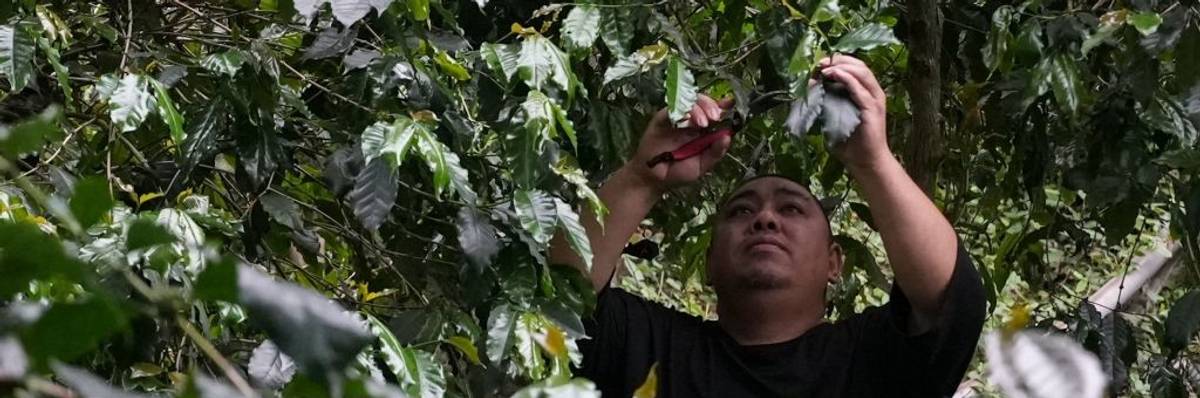
This picture taken on May 13, 2023 shows Voyo Yulunana, 43, trimming dry twigs off his coffee shrubs in Chiayi County, Taiwan.
The U.N. should address issues such as land concentration, so that peasant agroecology can have a real chance to flourish and make a significant contribution to tackling hunger, climate change, and biodiversity loss.
A U.N. summit on global food systems should be an opportunity to address structural inequalities and tackle hunger. It should be a chance to learn from small-scale producers whose sustainable food practices feed 70% of the world. Instead, next week’s conference in Rome will be a festival of greenwashing, allowing Big Agriculture corporations to tighten their grip on food systems.
This will be the second Food Systems Summit (UNFSS). The first, in 2021 was supposed to address the lack of progress towards the U.N.’s sustainable development goals. It was dubbed a “people’s summit” by the organizers, but caused an outcry among local producers when their calls to roll back the power of transnational corporations were cynically ignored.
Corporations that dominate global food systems, such as Bayer and Nestlé, used the summit to promote greenwashing initiatives rather than address pressing problems such as food speculation and the impact of Covid-19 on world hunger.
The U.N.’s special rapporteur on the right to food Michael Fakhri described it as “inviting the fox right into the henhouse.”
Discussions on eradicating hunger were hosted by the Global Alliance for Improved Nutrition (GAIN), a foundation partly funded by processed food and consumer goods giant Unilever, while transnational corporations were invited to discuss solutions to problems they had largely created. The whole event was an excellent opportunity for them to identify new profit-making ventures and to “capture the global narrative of ‘food systems transformation.’”
More than a thousand small-scale food producer associations and Indigenous Peoples’ groups, academics, and social movements boycotted the event, which was also widely criticized by U.N/ human rights experts and others.
The U.N.’s special rapporteur on the right to food Michael Fakhri described it as “inviting the fox right into the henhouse.”
Food is a common good and access to healthy and nutritious food is a basic human right enshrined in U.N. covenants. These are the issues that governments and the U.N. should focus resources on, and next week’s summit provided a perfect opportunity.
Sadly, it looks set to simply consolidate corporate control over food and natural resources.
Hundreds of grassroots groups have called out the U.N., saying they are still being excluded and claiming the summit is “poised to repeat the failures” of two years ago and want to see fundamental change in food systems.
Here’s the picture as it stands. A handful of agribusinesses control more than 70% of the world’s farmland. Smallholder farmers, fisherfolk, pastoralists, and Indigenous peoples, who use agroecology and other sustainable practices, feed 70% of the world’s population with just 10% of global farmland.
In just the last five years, the world’s nine largest fertilizer companies—with nearly 40% of global synthetic fertilizer sales— have tripled their profits.
Agriculture is responsible for nearly 40% of global greenhouse gas emissions, almost 90% of deforestation, and 80% of biodiversity loss, the bulk of which can be attributed to industrial agriculture and agribusiness operations.
The disruption of global fertilizer supply chains has been a major focus of the U.N.’s response to the global food crisis. But the dangers of market concentration, which make food systems extremely fragile to shocks, have been largely ignored.
In just the last five years, the world’s nine largest fertilizer companies—with nearly 40% of global synthetic fertilizer sales— have tripled their profits. Rocketing fertilizer prices have less to do with disrupted supply chains than quasi-monopolies.
Despite all this—and the growing global obesity pandemic, for which consumption of ultra-processed industrial food bears a major responsibility—the U.N. continues to empower corporations. What it should be doing is addressing issues such as land concentration, so that peasant agroecology can have a real chance to flourish and make a significant contribution to tackling hunger, climate change, and biodiversity loss.
A dystopian future where a handful of corporations control everything we eat is just around the corner, if we do not resist now.
About 60% of all calories consumed worldwide come from just four crops: rice, wheat, corn, and soy. Everyone is vulnerable if we are over-dependent on global corporate-controlled supply chains. Industrial agriculture has failed to address rising levels of hunger and malnutrition across the world, which are now at an estimated 828 million people.
We are facing a stark choice between unsustainable, exploitative, corporate-controlled food systems and diverse, locally sourced ecological food.
The global governance of food is being hijacked by corporate interests. The U.N.’s Food and Agriculture Organization receives less than a third of its $3.25bn budget from the world’s governments, making it dependent on “voluntary contributions”—including from corporations and their proxies—for the rest.
We are facing a stark choice between unsustainable, exploitative, corporate-controlled food systems and diverse, locally sourced ecological food that prioritises the needs and rights of those most affected by the hunger, climate, and health crises.
Dear Common Dreams reader, It’s been nearly 30 years since I co-founded Common Dreams with my late wife, Lina Newhouser. We had the radical notion that journalism should serve the public good, not corporate profits. It was clear to us from the outset what it would take to build such a project. No paid advertisements. No corporate sponsors. No millionaire publisher telling us what to think or do. Many people said we wouldn't last a year, but we proved those doubters wrong. Together with a tremendous team of journalists and dedicated staff, we built an independent media outlet free from the constraints of profits and corporate control. Our mission has always been simple: To inform. To inspire. To ignite change for the common good. Building Common Dreams was not easy. Our survival was never guaranteed. When you take on the most powerful forces—Wall Street greed, fossil fuel industry destruction, Big Tech lobbyists, and uber-rich oligarchs who have spent billions upon billions rigging the economy and democracy in their favor—the only bulwark you have is supporters who believe in your work. But here’s the urgent message from me today. It's never been this bad out there. And it's never been this hard to keep us going. At the very moment Common Dreams is most needed, the threats we face are intensifying. We need your support now more than ever. We don't accept corporate advertising and never will. We don't have a paywall because we don't think people should be blocked from critical news based on their ability to pay. Everything we do is funded by the donations of readers like you. When everyone does the little they can afford, we are strong. But if that support retreats or dries up, so do we. Will you donate now to make sure Common Dreams not only survives but thrives? —Craig Brown, Co-founder |
A U.N. summit on global food systems should be an opportunity to address structural inequalities and tackle hunger. It should be a chance to learn from small-scale producers whose sustainable food practices feed 70% of the world. Instead, next week’s conference in Rome will be a festival of greenwashing, allowing Big Agriculture corporations to tighten their grip on food systems.
This will be the second Food Systems Summit (UNFSS). The first, in 2021 was supposed to address the lack of progress towards the U.N.’s sustainable development goals. It was dubbed a “people’s summit” by the organizers, but caused an outcry among local producers when their calls to roll back the power of transnational corporations were cynically ignored.
Corporations that dominate global food systems, such as Bayer and Nestlé, used the summit to promote greenwashing initiatives rather than address pressing problems such as food speculation and the impact of Covid-19 on world hunger.
The U.N.’s special rapporteur on the right to food Michael Fakhri described it as “inviting the fox right into the henhouse.”
Discussions on eradicating hunger were hosted by the Global Alliance for Improved Nutrition (GAIN), a foundation partly funded by processed food and consumer goods giant Unilever, while transnational corporations were invited to discuss solutions to problems they had largely created. The whole event was an excellent opportunity for them to identify new profit-making ventures and to “capture the global narrative of ‘food systems transformation.’”
More than a thousand small-scale food producer associations and Indigenous Peoples’ groups, academics, and social movements boycotted the event, which was also widely criticized by U.N/ human rights experts and others.
The U.N.’s special rapporteur on the right to food Michael Fakhri described it as “inviting the fox right into the henhouse.”
Food is a common good and access to healthy and nutritious food is a basic human right enshrined in U.N. covenants. These are the issues that governments and the U.N. should focus resources on, and next week’s summit provided a perfect opportunity.
Sadly, it looks set to simply consolidate corporate control over food and natural resources.
Hundreds of grassroots groups have called out the U.N., saying they are still being excluded and claiming the summit is “poised to repeat the failures” of two years ago and want to see fundamental change in food systems.
Here’s the picture as it stands. A handful of agribusinesses control more than 70% of the world’s farmland. Smallholder farmers, fisherfolk, pastoralists, and Indigenous peoples, who use agroecology and other sustainable practices, feed 70% of the world’s population with just 10% of global farmland.
In just the last five years, the world’s nine largest fertilizer companies—with nearly 40% of global synthetic fertilizer sales— have tripled their profits.
Agriculture is responsible for nearly 40% of global greenhouse gas emissions, almost 90% of deforestation, and 80% of biodiversity loss, the bulk of which can be attributed to industrial agriculture and agribusiness operations.
The disruption of global fertilizer supply chains has been a major focus of the U.N.’s response to the global food crisis. But the dangers of market concentration, which make food systems extremely fragile to shocks, have been largely ignored.
In just the last five years, the world’s nine largest fertilizer companies—with nearly 40% of global synthetic fertilizer sales— have tripled their profits. Rocketing fertilizer prices have less to do with disrupted supply chains than quasi-monopolies.
Despite all this—and the growing global obesity pandemic, for which consumption of ultra-processed industrial food bears a major responsibility—the U.N. continues to empower corporations. What it should be doing is addressing issues such as land concentration, so that peasant agroecology can have a real chance to flourish and make a significant contribution to tackling hunger, climate change, and biodiversity loss.
A dystopian future where a handful of corporations control everything we eat is just around the corner, if we do not resist now.
About 60% of all calories consumed worldwide come from just four crops: rice, wheat, corn, and soy. Everyone is vulnerable if we are over-dependent on global corporate-controlled supply chains. Industrial agriculture has failed to address rising levels of hunger and malnutrition across the world, which are now at an estimated 828 million people.
We are facing a stark choice between unsustainable, exploitative, corporate-controlled food systems and diverse, locally sourced ecological food.
The global governance of food is being hijacked by corporate interests. The U.N.’s Food and Agriculture Organization receives less than a third of its $3.25bn budget from the world’s governments, making it dependent on “voluntary contributions”—including from corporations and their proxies—for the rest.
We are facing a stark choice between unsustainable, exploitative, corporate-controlled food systems and diverse, locally sourced ecological food that prioritises the needs and rights of those most affected by the hunger, climate, and health crises.
A U.N. summit on global food systems should be an opportunity to address structural inequalities and tackle hunger. It should be a chance to learn from small-scale producers whose sustainable food practices feed 70% of the world. Instead, next week’s conference in Rome will be a festival of greenwashing, allowing Big Agriculture corporations to tighten their grip on food systems.
This will be the second Food Systems Summit (UNFSS). The first, in 2021 was supposed to address the lack of progress towards the U.N.’s sustainable development goals. It was dubbed a “people’s summit” by the organizers, but caused an outcry among local producers when their calls to roll back the power of transnational corporations were cynically ignored.
Corporations that dominate global food systems, such as Bayer and Nestlé, used the summit to promote greenwashing initiatives rather than address pressing problems such as food speculation and the impact of Covid-19 on world hunger.
The U.N.’s special rapporteur on the right to food Michael Fakhri described it as “inviting the fox right into the henhouse.”
Discussions on eradicating hunger were hosted by the Global Alliance for Improved Nutrition (GAIN), a foundation partly funded by processed food and consumer goods giant Unilever, while transnational corporations were invited to discuss solutions to problems they had largely created. The whole event was an excellent opportunity for them to identify new profit-making ventures and to “capture the global narrative of ‘food systems transformation.’”
More than a thousand small-scale food producer associations and Indigenous Peoples’ groups, academics, and social movements boycotted the event, which was also widely criticized by U.N/ human rights experts and others.
The U.N.’s special rapporteur on the right to food Michael Fakhri described it as “inviting the fox right into the henhouse.”
Food is a common good and access to healthy and nutritious food is a basic human right enshrined in U.N. covenants. These are the issues that governments and the U.N. should focus resources on, and next week’s summit provided a perfect opportunity.
Sadly, it looks set to simply consolidate corporate control over food and natural resources.
Hundreds of grassroots groups have called out the U.N., saying they are still being excluded and claiming the summit is “poised to repeat the failures” of two years ago and want to see fundamental change in food systems.
Here’s the picture as it stands. A handful of agribusinesses control more than 70% of the world’s farmland. Smallholder farmers, fisherfolk, pastoralists, and Indigenous peoples, who use agroecology and other sustainable practices, feed 70% of the world’s population with just 10% of global farmland.
In just the last five years, the world’s nine largest fertilizer companies—with nearly 40% of global synthetic fertilizer sales— have tripled their profits.
Agriculture is responsible for nearly 40% of global greenhouse gas emissions, almost 90% of deforestation, and 80% of biodiversity loss, the bulk of which can be attributed to industrial agriculture and agribusiness operations.
The disruption of global fertilizer supply chains has been a major focus of the U.N.’s response to the global food crisis. But the dangers of market concentration, which make food systems extremely fragile to shocks, have been largely ignored.
In just the last five years, the world’s nine largest fertilizer companies—with nearly 40% of global synthetic fertilizer sales— have tripled their profits. Rocketing fertilizer prices have less to do with disrupted supply chains than quasi-monopolies.
Despite all this—and the growing global obesity pandemic, for which consumption of ultra-processed industrial food bears a major responsibility—the U.N. continues to empower corporations. What it should be doing is addressing issues such as land concentration, so that peasant agroecology can have a real chance to flourish and make a significant contribution to tackling hunger, climate change, and biodiversity loss.
A dystopian future where a handful of corporations control everything we eat is just around the corner, if we do not resist now.
About 60% of all calories consumed worldwide come from just four crops: rice, wheat, corn, and soy. Everyone is vulnerable if we are over-dependent on global corporate-controlled supply chains. Industrial agriculture has failed to address rising levels of hunger and malnutrition across the world, which are now at an estimated 828 million people.
We are facing a stark choice between unsustainable, exploitative, corporate-controlled food systems and diverse, locally sourced ecological food.
The global governance of food is being hijacked by corporate interests. The U.N.’s Food and Agriculture Organization receives less than a third of its $3.25bn budget from the world’s governments, making it dependent on “voluntary contributions”—including from corporations and their proxies—for the rest.
We are facing a stark choice between unsustainable, exploitative, corporate-controlled food systems and diverse, locally sourced ecological food that prioritises the needs and rights of those most affected by the hunger, climate, and health crises.