SUBSCRIBE TO OUR FREE NEWSLETTER
Daily news & progressive opinion—funded by the people, not the corporations—delivered straight to your inbox.
5
#000000
#FFFFFF
To donate by check, phone, or other method, see our More Ways to Give page.
Daily news & progressive opinion—funded by the people, not the corporations—delivered straight to your inbox.
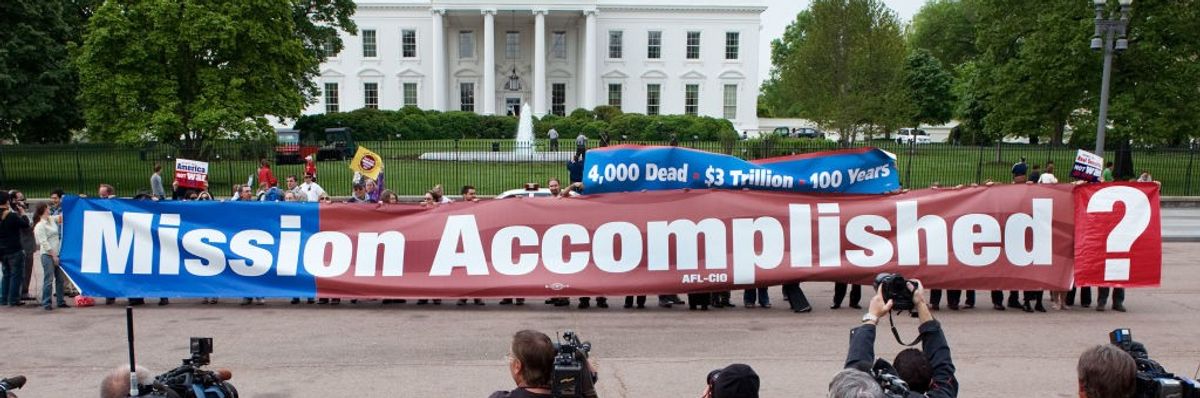
Members of the "The Iraq Campaign 2008" hold a large replica of the "Mission Accomplished" banner on Pennsylvania Avenue in front of the White House in Washington, DC May 1, 2008, marking the fifth anniversary of President Bush's "Mission Accomplished" speech after landing on board a US aircraft carrier, proclaiming the end of major combat operations in Iraq.
The disgraced former president's rhetorical victory lap that came before protracted bloodshed deserves all of its notoriety 20 years later.
Twenty years ago, President George W. Bush landed in a twin-engine Navy jet on an aircraft carrier, strode across the deck in a bulky flight suit and proceeded to give a televised victory speech under a huge red-white-and-blue banner announcing “Mission Accomplished.” For Bush, the optics on May 1, 2003 could hardly have been more triumphant. From the USS Abraham Lincoln, he delivered a stirring coda, proclaiming that “major combat operations in Iraq have ended” just six weeks after the United States led the invasion of that country.
But Bush’s jubilant claim unraveled as combat escalated between Iraqi insurgents and occupying forces. During the next nine years, the official death toll among U.S. troops went from under 200 to more than 4,400, while the deaths of Iraqi people surged into the hundreds of thousands. The physical wounds were even more numerous, the emotional injuries incalculable.
The “Mission Accomplished” banner and Bush’s speech going with it have become notorious. But focusing only on his faulty claim that the war was over ignores other key untruths in the oratory.
“We have fought for the cause of liberty,” Bush declared. He did not mention the cause of oil.
By dodging inconvenient truths about the impacts of U.S. warfare on “the innocent,” Bush was reasserting the usual pretenses of presidents who elide the actual human toll of their wars while predicting successful outcomes.
A few months before the invasion, a soft-spoken Iraqi man who was my driver in Baghdad waited until we were alone at a picnic table in a park before saying that he wished Iraq had no oil—because then there would be no reason to fear an invasion. Years later, some U.S. authorities were candid about Iraq’s massive oil reserves as an incentive for the war.
“I am saddened that it is politically inconvenient to acknowledge what everyone knows: the Iraq war is largely about oil,” former Federal Reserve chairman Alan Greenspan wrote in his 2007 memoir. That same year, a former head of the U.S. Central Command in Iraq, Gen. John Abizaid, had this to say: “Of course it’s about oil, we can’t really deny that.” And Sen. Chuck Hagel, who later became Defense Secretary, commented: “People say we’re not fighting for oil. Of course we are.”
While touting the war effort as entirely noble, Bush’s “mission accomplished” speech credited the Pentagon’s “new tactics and precision weapons” for avoiding “violence against civilians.” The president added that “it is a great moral advance when the guilty have far more to fear from war than the innocent.”
Such soothing words masked brutal realities. Civilian deaths accounted for 40 percent of “people killed directly in the violence of the U.S. post-9/11 wars,” according to the Costs of War project at Brown University. In fact, a large majority of the casualties of those wars have been civilians. “Several times as many more have been killed as a reverberating effect of the wars—because, for example, of water loss, sewage and other infrastructural issues, and war-related disease.”
By dodging inconvenient truths about the impacts of U.S. warfare on “the innocent,” Bush was reasserting the usual pretenses of presidents who elide the actual human toll of their wars while predicting successful outcomes.
On May 1, 2012, exactly nine years after Bush’s speech on the aircraft carrier, President Barack Obama spoke to the American people from Bagram Air Base north of Kabul. With U.S. troop levels in Afghanistan near a peak of 100,000, Obama expressed confidence that “we will complete our mission and end the war in Afghanistan.”
Both Bush and Obama would later be widely faulted for voicing undue optimism about fulfilling a war’s “mission.” But the critiques have rarely devoted much attention to scrutinizing the assumptions that propelled support for the missions.
The U.S. government’s inherent prerogative to intervene militarily in other countries has seldom been directly challenged in America’s mainstream media and official discourse. Instead, debates have routinely revolved around whether, where, when, and how intervention is prudent and likely to prevail.
But we might want to ask ourselves: What if Bush had been correct in May 2003—and U.S. forces really were at the end of major combat operations in Iraq? What if Obama had been correct in May 2012—and U.S. forces were able to “complete our mission” in Afghanistan? In each case, conventional wisdom would have gauged success in terms of military victory rather than such matters as adherence to international law or regard for human life.
Today, it's a wonder to behold the fully justified denunciations of Russia’s horrific invasion of Ukraine from some of the same U.S. government leaders who avidly supported the horrific invasion of Iraq. The concept that might makes right doesn’t sound good, but in practice it has repeatedly been the basis of U.S. policy. Wayne Morse, the senator from Oregon who opposed the Vietnam War from the outset, was cogent when he said: “I don’t know why we think, just because we’re mighty, that we have the right to try to substitute might for right.”
George W. Bush’s performance with the “Mission Accomplished” banner—a rhetorical victory lap that came before protracted bloodshed—deserves all of its notoriety 20 years later. His claims of success for the Iraq war mission are now easy grounds for derision. But the more difficult truths to plow through have to do with why the mission should never have been attempted in the first place.
Dear Common Dreams reader, It’s been nearly 30 years since I co-founded Common Dreams with my late wife, Lina Newhouser. We had the radical notion that journalism should serve the public good, not corporate profits. It was clear to us from the outset what it would take to build such a project. No paid advertisements. No corporate sponsors. No millionaire publisher telling us what to think or do. Many people said we wouldn't last a year, but we proved those doubters wrong. Together with a tremendous team of journalists and dedicated staff, we built an independent media outlet free from the constraints of profits and corporate control. Our mission has always been simple: To inform. To inspire. To ignite change for the common good. Building Common Dreams was not easy. Our survival was never guaranteed. When you take on the most powerful forces—Wall Street greed, fossil fuel industry destruction, Big Tech lobbyists, and uber-rich oligarchs who have spent billions upon billions rigging the economy and democracy in their favor—the only bulwark you have is supporters who believe in your work. But here’s the urgent message from me today. It's never been this bad out there. And it's never been this hard to keep us going. At the very moment Common Dreams is most needed, the threats we face are intensifying. We need your support now more than ever. We don't accept corporate advertising and never will. We don't have a paywall because we don't think people should be blocked from critical news based on their ability to pay. Everything we do is funded by the donations of readers like you. When everyone does the little they can afford, we are strong. But if that support retreats or dries up, so do we. Will you donate now to make sure Common Dreams not only survives but thrives? —Craig Brown, Co-founder |
Norman Solomon is the national director of RootsAction.org and executive director of the Institute for Public Accuracy. The paperback edition of his latest book, War Made Invisible: How America Hides the Human Toll of Its Military Machine, includes an afterword about the Gaza war.
Twenty years ago, President George W. Bush landed in a twin-engine Navy jet on an aircraft carrier, strode across the deck in a bulky flight suit and proceeded to give a televised victory speech under a huge red-white-and-blue banner announcing “Mission Accomplished.” For Bush, the optics on May 1, 2003 could hardly have been more triumphant. From the USS Abraham Lincoln, he delivered a stirring coda, proclaiming that “major combat operations in Iraq have ended” just six weeks after the United States led the invasion of that country.
But Bush’s jubilant claim unraveled as combat escalated between Iraqi insurgents and occupying forces. During the next nine years, the official death toll among U.S. troops went from under 200 to more than 4,400, while the deaths of Iraqi people surged into the hundreds of thousands. The physical wounds were even more numerous, the emotional injuries incalculable.
The “Mission Accomplished” banner and Bush’s speech going with it have become notorious. But focusing only on his faulty claim that the war was over ignores other key untruths in the oratory.
“We have fought for the cause of liberty,” Bush declared. He did not mention the cause of oil.
By dodging inconvenient truths about the impacts of U.S. warfare on “the innocent,” Bush was reasserting the usual pretenses of presidents who elide the actual human toll of their wars while predicting successful outcomes.
A few months before the invasion, a soft-spoken Iraqi man who was my driver in Baghdad waited until we were alone at a picnic table in a park before saying that he wished Iraq had no oil—because then there would be no reason to fear an invasion. Years later, some U.S. authorities were candid about Iraq’s massive oil reserves as an incentive for the war.
“I am saddened that it is politically inconvenient to acknowledge what everyone knows: the Iraq war is largely about oil,” former Federal Reserve chairman Alan Greenspan wrote in his 2007 memoir. That same year, a former head of the U.S. Central Command in Iraq, Gen. John Abizaid, had this to say: “Of course it’s about oil, we can’t really deny that.” And Sen. Chuck Hagel, who later became Defense Secretary, commented: “People say we’re not fighting for oil. Of course we are.”
While touting the war effort as entirely noble, Bush’s “mission accomplished” speech credited the Pentagon’s “new tactics and precision weapons” for avoiding “violence against civilians.” The president added that “it is a great moral advance when the guilty have far more to fear from war than the innocent.”
Such soothing words masked brutal realities. Civilian deaths accounted for 40 percent of “people killed directly in the violence of the U.S. post-9/11 wars,” according to the Costs of War project at Brown University. In fact, a large majority of the casualties of those wars have been civilians. “Several times as many more have been killed as a reverberating effect of the wars—because, for example, of water loss, sewage and other infrastructural issues, and war-related disease.”
By dodging inconvenient truths about the impacts of U.S. warfare on “the innocent,” Bush was reasserting the usual pretenses of presidents who elide the actual human toll of their wars while predicting successful outcomes.
On May 1, 2012, exactly nine years after Bush’s speech on the aircraft carrier, President Barack Obama spoke to the American people from Bagram Air Base north of Kabul. With U.S. troop levels in Afghanistan near a peak of 100,000, Obama expressed confidence that “we will complete our mission and end the war in Afghanistan.”
Both Bush and Obama would later be widely faulted for voicing undue optimism about fulfilling a war’s “mission.” But the critiques have rarely devoted much attention to scrutinizing the assumptions that propelled support for the missions.
The U.S. government’s inherent prerogative to intervene militarily in other countries has seldom been directly challenged in America’s mainstream media and official discourse. Instead, debates have routinely revolved around whether, where, when, and how intervention is prudent and likely to prevail.
But we might want to ask ourselves: What if Bush had been correct in May 2003—and U.S. forces really were at the end of major combat operations in Iraq? What if Obama had been correct in May 2012—and U.S. forces were able to “complete our mission” in Afghanistan? In each case, conventional wisdom would have gauged success in terms of military victory rather than such matters as adherence to international law or regard for human life.
Today, it's a wonder to behold the fully justified denunciations of Russia’s horrific invasion of Ukraine from some of the same U.S. government leaders who avidly supported the horrific invasion of Iraq. The concept that might makes right doesn’t sound good, but in practice it has repeatedly been the basis of U.S. policy. Wayne Morse, the senator from Oregon who opposed the Vietnam War from the outset, was cogent when he said: “I don’t know why we think, just because we’re mighty, that we have the right to try to substitute might for right.”
George W. Bush’s performance with the “Mission Accomplished” banner—a rhetorical victory lap that came before protracted bloodshed—deserves all of its notoriety 20 years later. His claims of success for the Iraq war mission are now easy grounds for derision. But the more difficult truths to plow through have to do with why the mission should never have been attempted in the first place.
Norman Solomon is the national director of RootsAction.org and executive director of the Institute for Public Accuracy. The paperback edition of his latest book, War Made Invisible: How America Hides the Human Toll of Its Military Machine, includes an afterword about the Gaza war.
Twenty years ago, President George W. Bush landed in a twin-engine Navy jet on an aircraft carrier, strode across the deck in a bulky flight suit and proceeded to give a televised victory speech under a huge red-white-and-blue banner announcing “Mission Accomplished.” For Bush, the optics on May 1, 2003 could hardly have been more triumphant. From the USS Abraham Lincoln, he delivered a stirring coda, proclaiming that “major combat operations in Iraq have ended” just six weeks after the United States led the invasion of that country.
But Bush’s jubilant claim unraveled as combat escalated between Iraqi insurgents and occupying forces. During the next nine years, the official death toll among U.S. troops went from under 200 to more than 4,400, while the deaths of Iraqi people surged into the hundreds of thousands. The physical wounds were even more numerous, the emotional injuries incalculable.
The “Mission Accomplished” banner and Bush’s speech going with it have become notorious. But focusing only on his faulty claim that the war was over ignores other key untruths in the oratory.
“We have fought for the cause of liberty,” Bush declared. He did not mention the cause of oil.
By dodging inconvenient truths about the impacts of U.S. warfare on “the innocent,” Bush was reasserting the usual pretenses of presidents who elide the actual human toll of their wars while predicting successful outcomes.
A few months before the invasion, a soft-spoken Iraqi man who was my driver in Baghdad waited until we were alone at a picnic table in a park before saying that he wished Iraq had no oil—because then there would be no reason to fear an invasion. Years later, some U.S. authorities were candid about Iraq’s massive oil reserves as an incentive for the war.
“I am saddened that it is politically inconvenient to acknowledge what everyone knows: the Iraq war is largely about oil,” former Federal Reserve chairman Alan Greenspan wrote in his 2007 memoir. That same year, a former head of the U.S. Central Command in Iraq, Gen. John Abizaid, had this to say: “Of course it’s about oil, we can’t really deny that.” And Sen. Chuck Hagel, who later became Defense Secretary, commented: “People say we’re not fighting for oil. Of course we are.”
While touting the war effort as entirely noble, Bush’s “mission accomplished” speech credited the Pentagon’s “new tactics and precision weapons” for avoiding “violence against civilians.” The president added that “it is a great moral advance when the guilty have far more to fear from war than the innocent.”
Such soothing words masked brutal realities. Civilian deaths accounted for 40 percent of “people killed directly in the violence of the U.S. post-9/11 wars,” according to the Costs of War project at Brown University. In fact, a large majority of the casualties of those wars have been civilians. “Several times as many more have been killed as a reverberating effect of the wars—because, for example, of water loss, sewage and other infrastructural issues, and war-related disease.”
By dodging inconvenient truths about the impacts of U.S. warfare on “the innocent,” Bush was reasserting the usual pretenses of presidents who elide the actual human toll of their wars while predicting successful outcomes.
On May 1, 2012, exactly nine years after Bush’s speech on the aircraft carrier, President Barack Obama spoke to the American people from Bagram Air Base north of Kabul. With U.S. troop levels in Afghanistan near a peak of 100,000, Obama expressed confidence that “we will complete our mission and end the war in Afghanistan.”
Both Bush and Obama would later be widely faulted for voicing undue optimism about fulfilling a war’s “mission.” But the critiques have rarely devoted much attention to scrutinizing the assumptions that propelled support for the missions.
The U.S. government’s inherent prerogative to intervene militarily in other countries has seldom been directly challenged in America’s mainstream media and official discourse. Instead, debates have routinely revolved around whether, where, when, and how intervention is prudent and likely to prevail.
But we might want to ask ourselves: What if Bush had been correct in May 2003—and U.S. forces really were at the end of major combat operations in Iraq? What if Obama had been correct in May 2012—and U.S. forces were able to “complete our mission” in Afghanistan? In each case, conventional wisdom would have gauged success in terms of military victory rather than such matters as adherence to international law or regard for human life.
Today, it's a wonder to behold the fully justified denunciations of Russia’s horrific invasion of Ukraine from some of the same U.S. government leaders who avidly supported the horrific invasion of Iraq. The concept that might makes right doesn’t sound good, but in practice it has repeatedly been the basis of U.S. policy. Wayne Morse, the senator from Oregon who opposed the Vietnam War from the outset, was cogent when he said: “I don’t know why we think, just because we’re mighty, that we have the right to try to substitute might for right.”
George W. Bush’s performance with the “Mission Accomplished” banner—a rhetorical victory lap that came before protracted bloodshed—deserves all of its notoriety 20 years later. His claims of success for the Iraq war mission are now easy grounds for derision. But the more difficult truths to plow through have to do with why the mission should never have been attempted in the first place.