SUBSCRIBE TO OUR FREE NEWSLETTER
Daily news & progressive opinion—funded by the people, not the corporations—delivered straight to your inbox.
5
#000000
#FFFFFF
To donate by check, phone, or other method, see our More Ways to Give page.
Daily news & progressive opinion—funded by the people, not the corporations—delivered straight to your inbox.
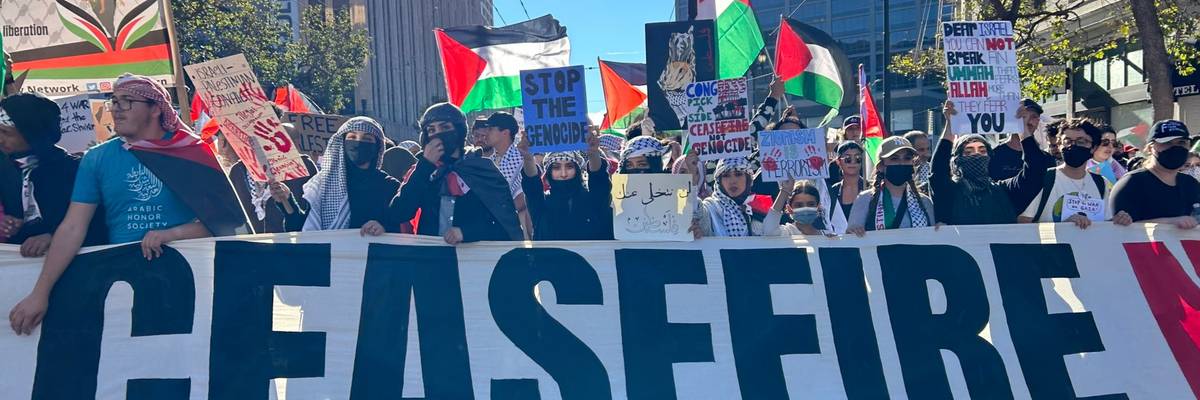
Protesters march for a Gaza cease-fire in San Francisco, California, on November 18, 2023.
As the Nuremberg Tribunal and U.S. law make clear, it is the responsibility of the people to halt crimes that the courts have proved impotent to prevent.
In a decision issued January 31, the United States District Court for the Northern District of California found that there is a credible case that Israel is committing genocide in Gaza and that the U.S. is supporting its actions. It called on the Biden administration to “examine the results of their unflagging support of the military siege against the Palestinians in Gaza.” While it said it had no authority to order the U.S. to stop, it called on ordinary individuals to “confront the current siege in Gaza.” This commentary is offered as a starting point for thinking about the implications of this decision for all of us.
The court’s decision began by laying out the background of the case:
On October 7, 2023, Hamas attacked Israel, killing approximately 1,200 people and taking 240 citizens hostage. Since that time, Israel has mounted a military campaign against Hamas in the Gaza Strip. During this military campaign, there have been roughly 26,000 people killed and over 63,000 wounded in Israeli attacks.
It then summarized the findings of the International Court of Justice (ICJ) on the genocide charges brought against Israel by South Africa. The ICJ found that the “acts and omissions” charged by South Africa appear to be capable of “falling within the provisions of the Genocide Convention.”
The military operation being conducted by Israel following the attack of 7 October 2023 has resulted in a large number of deaths and injuries, as well as the massive destruction of homes, forcible displacement of the vast majority of the population, and extensive damage to civilian infrastructure. While figures relating to the Gaza Strip cannot be independently verified, recent information indicates that 25,700 Palestinians have been killed, over 63,000 injuries have been reported, over 360,000 housing units have been destroyed or partially damaged and approximately 1.7 million persons have been internally displaced.
The ICJ further ruled that
Israel must, in accordance with its obligations under the Genocide Convention, in relation to Palestinians in Gaza, take all measures within its power to prevent the commission of all acts within the scope of article II of this Convention, in particular: (a) killing members of the group; (b) causing serious bodily or mental harm to members of the group; (c) deliberately inflicting on the group conditions of life calculated to bring about its physical destruction in whole or in part; and (d) imposing measures intended to prevent births.
The US District Court decision endorsed the ICJ’s findings:
The undisputed evidence before this court comports with the finding of the ICJ and indicates that the current treatment of the Palestinians in the Gaza Strip by the Israeli military may plausibly constitute a genocide in violation of international law. Both the uncontroverted testimony of the plaintiffs and the expert opinion proffered at the hearing on these motions as well as statements made by various officers of the Israeli government indicate that the ongoing military siege in Gaza is intended to eradicate a whole people and therefore plausibly falls within the international prohibition against genocide.
In deference to the legal doctrine that courts have no authority on “political questions” assigned by the Constitution to other branches of government, the court declined to order the Biden administration to modify its complicity. But it did issue a plea: “This court implores defendants to examine the results of their unflagging support of the military siege against the Palestinians in Gaza.”
And in an implicit appeal for the people to act where the court believed it could not, the decision stated: “It is every individual’s obligation to confront the current siege in Gaza.”
While the court did not elaborate on the obligation of individuals, there is a long history to the moral and legal responsibility of all, governments and individuals alike, to prevent war crimes.
As the Nuremberg Tribunal after World War II stated, “Complicity in the commission of a crime against peace, a war crime, or a crime against humanity” is “a crime under international law.”
In the Zykon B case, the Nuremberg Tribunal found that “the provisions of the laws and customs of war are addressed not only to combatants and to members of state and other public authorities, but to anybody who is in a position to assist their violations.” In the Flick case the tribunal ruled that international law “binds every citizen just as does ordinary municipal law.”
Since the horrors of Nazi war crimes led to the Nuremberg Tribunal at the end of World War II, many war opponents have grounded their action specifically in the international law prohibition of war crimes.
There is a reason this is necessary. Who will enforce the law when a government violates it with impunity? Judge Bernard Victor A. Roling of the Tokyo War Crimes Tribunal provided the answer: The world “has to rely on individuals to oppose the criminal commands of the government.”
By virtue of the U.S. Constitution, international law and international treaties are explicitly a part of U.S. law. U.S. Supreme Court Justice and Nuremberg prosecutor Robert Jackson stated, “The very essence of the Nuremberg Charter is that individuals have international duties which transcend national obligations of obedience imposed by the individual state.” So, obligations under international law are also obligations under U.S. law.
Nonviolent civil disobedience in protest of war has a long tradition in the United States, dating back at least to Henry David Thoreau’s going to jail to protest the U.S. war against Mexico. Since the horrors of Nazi war crimes led to the Nuremberg Tribunal at the end of World War II, many war opponents have grounded their action specifically in the international law prohibition of war crimes.
U.S. war crimes in Vietnam were a major motivation for the emergence of “The Resistance,” a loose-knit group of young men who returned their draft cards to the government with a pledge to refuse induction. Within a year several thousand returned their draft cards, and hundreds had refused induction. That in turn inspired the Call to Resist Illegitimate Authority, led by famous pediatrician Dr. Benjamin Spock and others, who eventually were prosecuted by the administration of Lyndon Johnson. Military physician Howard Levy’s refusal in 1967 to train Green Berets for Vietnam and the Vietnam Veterans Against the War’s Winter Soldier Investigation of war crimes in 1971 also played significant roles in highlighting U.S. war crimes in Vietnam and furthering the development of the movement against the Vietnam War.
Resistance based on international law emerged again in the Iraq war. For example, on St. Patrick’s Day 2003, four members of the Catholic Worker community in Ithaca, New York, entered the army-marine recruiting center in Lansing, New York, and poured their own blood on the walls, the windows, the posters, cardboard mannequins of soldiers, the door, and the American flag. They were arrested and charged with felony criminal damage to property.
All of us have a duty to prevent war crimes and complicity in them by our government.
According to Bill Quigley, an advisory counsel to what came to be known as the “St. Patrick’s Four,” their trial strategy was to put the legality of the war in Iraq on trial. They maintained that their actions were absolutely legal under international law because they were trying to stop an illegal war. The invasion of Iraq was a series of serious illegal acts that constituted war crimes. Under the Nuremberg principles they had a right to try to stop war crimes. To the horror of the prosecutor and the amazement of the press, the jury deadlocked 9-3 in favor of acquitting the defendants.
On June 7, 2006, U.S. infantry officer First Lieutenant Ehren Watada held a press conference announcing that he refused to deploy to Iraq because the war there was illegal. Watada argued that the administration’s invasion and occupation of Iraq was “manifestly illegal” because it “violates our democratic system of checks and balances. It usurps international treaties and conventions that by virtue of the Constitution become American law.” Watada said, “As the order to take part in an illegal act is ultimately unlawful as well, I must as an officer of honor and integrity refuse that order.” He added, “participation would make me party to war crimes.” After three years of trying to convict him by court martial, the Army finally gave up and allowed Lt. Watada to resign. Despite his direct refusal of an order to deploy, Watada did not spend a single day in jail.
Resistance to U.S. complicity in war crimes in Gaza has grown rapidly—largely because the Israeli actions in Gaza have been the most visible as-it-happens embodiments of genocide the world has ever seen. From the start this resistance has focused on genocide and other crimes under international law. With the decision of the International Court of Justice and the Northern California Federal District Court, the issue of war crimes—and specifically of genocide—has rapidly become central to that resistance.
These courts may lack the power or the will to implement their findings. But, as the Nuremberg Tribunal and U.S. law make clear, it is the responsibility of the people to halt crimes that the courts have proved impotent to prevent. All of us have a duty to prevent war crimes and complicity in them by our government. As the California court decisively concluded, “It is every individual’s obligation to confront the current siege in Gaza.”
Dear Common Dreams reader, It’s been nearly 30 years since I co-founded Common Dreams with my late wife, Lina Newhouser. We had the radical notion that journalism should serve the public good, not corporate profits. It was clear to us from the outset what it would take to build such a project. No paid advertisements. No corporate sponsors. No millionaire publisher telling us what to think or do. Many people said we wouldn't last a year, but we proved those doubters wrong. Together with a tremendous team of journalists and dedicated staff, we built an independent media outlet free from the constraints of profits and corporate control. Our mission has always been simple: To inform. To inspire. To ignite change for the common good. Building Common Dreams was not easy. Our survival was never guaranteed. When you take on the most powerful forces—Wall Street greed, fossil fuel industry destruction, Big Tech lobbyists, and uber-rich oligarchs who have spent billions upon billions rigging the economy and democracy in their favor—the only bulwark you have is supporters who believe in your work. But here’s the urgent message from me today. It's never been this bad out there. And it's never been this hard to keep us going. At the very moment Common Dreams is most needed, the threats we face are intensifying. We need your support now more than ever. We don't accept corporate advertising and never will. We don't have a paywall because we don't think people should be blocked from critical news based on their ability to pay. Everything we do is funded by the donations of readers like you. When everyone does the little they can afford, we are strong. But if that support retreats or dries up, so do we. Will you donate now to make sure Common Dreams not only survives but thrives? —Craig Brown, Co-founder |
In a decision issued January 31, the United States District Court for the Northern District of California found that there is a credible case that Israel is committing genocide in Gaza and that the U.S. is supporting its actions. It called on the Biden administration to “examine the results of their unflagging support of the military siege against the Palestinians in Gaza.” While it said it had no authority to order the U.S. to stop, it called on ordinary individuals to “confront the current siege in Gaza.” This commentary is offered as a starting point for thinking about the implications of this decision for all of us.
The court’s decision began by laying out the background of the case:
On October 7, 2023, Hamas attacked Israel, killing approximately 1,200 people and taking 240 citizens hostage. Since that time, Israel has mounted a military campaign against Hamas in the Gaza Strip. During this military campaign, there have been roughly 26,000 people killed and over 63,000 wounded in Israeli attacks.
It then summarized the findings of the International Court of Justice (ICJ) on the genocide charges brought against Israel by South Africa. The ICJ found that the “acts and omissions” charged by South Africa appear to be capable of “falling within the provisions of the Genocide Convention.”
The military operation being conducted by Israel following the attack of 7 October 2023 has resulted in a large number of deaths and injuries, as well as the massive destruction of homes, forcible displacement of the vast majority of the population, and extensive damage to civilian infrastructure. While figures relating to the Gaza Strip cannot be independently verified, recent information indicates that 25,700 Palestinians have been killed, over 63,000 injuries have been reported, over 360,000 housing units have been destroyed or partially damaged and approximately 1.7 million persons have been internally displaced.
The ICJ further ruled that
Israel must, in accordance with its obligations under the Genocide Convention, in relation to Palestinians in Gaza, take all measures within its power to prevent the commission of all acts within the scope of article II of this Convention, in particular: (a) killing members of the group; (b) causing serious bodily or mental harm to members of the group; (c) deliberately inflicting on the group conditions of life calculated to bring about its physical destruction in whole or in part; and (d) imposing measures intended to prevent births.
The US District Court decision endorsed the ICJ’s findings:
The undisputed evidence before this court comports with the finding of the ICJ and indicates that the current treatment of the Palestinians in the Gaza Strip by the Israeli military may plausibly constitute a genocide in violation of international law. Both the uncontroverted testimony of the plaintiffs and the expert opinion proffered at the hearing on these motions as well as statements made by various officers of the Israeli government indicate that the ongoing military siege in Gaza is intended to eradicate a whole people and therefore plausibly falls within the international prohibition against genocide.
In deference to the legal doctrine that courts have no authority on “political questions” assigned by the Constitution to other branches of government, the court declined to order the Biden administration to modify its complicity. But it did issue a plea: “This court implores defendants to examine the results of their unflagging support of the military siege against the Palestinians in Gaza.”
And in an implicit appeal for the people to act where the court believed it could not, the decision stated: “It is every individual’s obligation to confront the current siege in Gaza.”
While the court did not elaborate on the obligation of individuals, there is a long history to the moral and legal responsibility of all, governments and individuals alike, to prevent war crimes.
As the Nuremberg Tribunal after World War II stated, “Complicity in the commission of a crime against peace, a war crime, or a crime against humanity” is “a crime under international law.”
In the Zykon B case, the Nuremberg Tribunal found that “the provisions of the laws and customs of war are addressed not only to combatants and to members of state and other public authorities, but to anybody who is in a position to assist their violations.” In the Flick case the tribunal ruled that international law “binds every citizen just as does ordinary municipal law.”
Since the horrors of Nazi war crimes led to the Nuremberg Tribunal at the end of World War II, many war opponents have grounded their action specifically in the international law prohibition of war crimes.
There is a reason this is necessary. Who will enforce the law when a government violates it with impunity? Judge Bernard Victor A. Roling of the Tokyo War Crimes Tribunal provided the answer: The world “has to rely on individuals to oppose the criminal commands of the government.”
By virtue of the U.S. Constitution, international law and international treaties are explicitly a part of U.S. law. U.S. Supreme Court Justice and Nuremberg prosecutor Robert Jackson stated, “The very essence of the Nuremberg Charter is that individuals have international duties which transcend national obligations of obedience imposed by the individual state.” So, obligations under international law are also obligations under U.S. law.
Nonviolent civil disobedience in protest of war has a long tradition in the United States, dating back at least to Henry David Thoreau’s going to jail to protest the U.S. war against Mexico. Since the horrors of Nazi war crimes led to the Nuremberg Tribunal at the end of World War II, many war opponents have grounded their action specifically in the international law prohibition of war crimes.
U.S. war crimes in Vietnam were a major motivation for the emergence of “The Resistance,” a loose-knit group of young men who returned their draft cards to the government with a pledge to refuse induction. Within a year several thousand returned their draft cards, and hundreds had refused induction. That in turn inspired the Call to Resist Illegitimate Authority, led by famous pediatrician Dr. Benjamin Spock and others, who eventually were prosecuted by the administration of Lyndon Johnson. Military physician Howard Levy’s refusal in 1967 to train Green Berets for Vietnam and the Vietnam Veterans Against the War’s Winter Soldier Investigation of war crimes in 1971 also played significant roles in highlighting U.S. war crimes in Vietnam and furthering the development of the movement against the Vietnam War.
Resistance based on international law emerged again in the Iraq war. For example, on St. Patrick’s Day 2003, four members of the Catholic Worker community in Ithaca, New York, entered the army-marine recruiting center in Lansing, New York, and poured their own blood on the walls, the windows, the posters, cardboard mannequins of soldiers, the door, and the American flag. They were arrested and charged with felony criminal damage to property.
All of us have a duty to prevent war crimes and complicity in them by our government.
According to Bill Quigley, an advisory counsel to what came to be known as the “St. Patrick’s Four,” their trial strategy was to put the legality of the war in Iraq on trial. They maintained that their actions were absolutely legal under international law because they were trying to stop an illegal war. The invasion of Iraq was a series of serious illegal acts that constituted war crimes. Under the Nuremberg principles they had a right to try to stop war crimes. To the horror of the prosecutor and the amazement of the press, the jury deadlocked 9-3 in favor of acquitting the defendants.
On June 7, 2006, U.S. infantry officer First Lieutenant Ehren Watada held a press conference announcing that he refused to deploy to Iraq because the war there was illegal. Watada argued that the administration’s invasion and occupation of Iraq was “manifestly illegal” because it “violates our democratic system of checks and balances. It usurps international treaties and conventions that by virtue of the Constitution become American law.” Watada said, “As the order to take part in an illegal act is ultimately unlawful as well, I must as an officer of honor and integrity refuse that order.” He added, “participation would make me party to war crimes.” After three years of trying to convict him by court martial, the Army finally gave up and allowed Lt. Watada to resign. Despite his direct refusal of an order to deploy, Watada did not spend a single day in jail.
Resistance to U.S. complicity in war crimes in Gaza has grown rapidly—largely because the Israeli actions in Gaza have been the most visible as-it-happens embodiments of genocide the world has ever seen. From the start this resistance has focused on genocide and other crimes under international law. With the decision of the International Court of Justice and the Northern California Federal District Court, the issue of war crimes—and specifically of genocide—has rapidly become central to that resistance.
These courts may lack the power or the will to implement their findings. But, as the Nuremberg Tribunal and U.S. law make clear, it is the responsibility of the people to halt crimes that the courts have proved impotent to prevent. All of us have a duty to prevent war crimes and complicity in them by our government. As the California court decisively concluded, “It is every individual’s obligation to confront the current siege in Gaza.”
In a decision issued January 31, the United States District Court for the Northern District of California found that there is a credible case that Israel is committing genocide in Gaza and that the U.S. is supporting its actions. It called on the Biden administration to “examine the results of their unflagging support of the military siege against the Palestinians in Gaza.” While it said it had no authority to order the U.S. to stop, it called on ordinary individuals to “confront the current siege in Gaza.” This commentary is offered as a starting point for thinking about the implications of this decision for all of us.
The court’s decision began by laying out the background of the case:
On October 7, 2023, Hamas attacked Israel, killing approximately 1,200 people and taking 240 citizens hostage. Since that time, Israel has mounted a military campaign against Hamas in the Gaza Strip. During this military campaign, there have been roughly 26,000 people killed and over 63,000 wounded in Israeli attacks.
It then summarized the findings of the International Court of Justice (ICJ) on the genocide charges brought against Israel by South Africa. The ICJ found that the “acts and omissions” charged by South Africa appear to be capable of “falling within the provisions of the Genocide Convention.”
The military operation being conducted by Israel following the attack of 7 October 2023 has resulted in a large number of deaths and injuries, as well as the massive destruction of homes, forcible displacement of the vast majority of the population, and extensive damage to civilian infrastructure. While figures relating to the Gaza Strip cannot be independently verified, recent information indicates that 25,700 Palestinians have been killed, over 63,000 injuries have been reported, over 360,000 housing units have been destroyed or partially damaged and approximately 1.7 million persons have been internally displaced.
The ICJ further ruled that
Israel must, in accordance with its obligations under the Genocide Convention, in relation to Palestinians in Gaza, take all measures within its power to prevent the commission of all acts within the scope of article II of this Convention, in particular: (a) killing members of the group; (b) causing serious bodily or mental harm to members of the group; (c) deliberately inflicting on the group conditions of life calculated to bring about its physical destruction in whole or in part; and (d) imposing measures intended to prevent births.
The US District Court decision endorsed the ICJ’s findings:
The undisputed evidence before this court comports with the finding of the ICJ and indicates that the current treatment of the Palestinians in the Gaza Strip by the Israeli military may plausibly constitute a genocide in violation of international law. Both the uncontroverted testimony of the plaintiffs and the expert opinion proffered at the hearing on these motions as well as statements made by various officers of the Israeli government indicate that the ongoing military siege in Gaza is intended to eradicate a whole people and therefore plausibly falls within the international prohibition against genocide.
In deference to the legal doctrine that courts have no authority on “political questions” assigned by the Constitution to other branches of government, the court declined to order the Biden administration to modify its complicity. But it did issue a plea: “This court implores defendants to examine the results of their unflagging support of the military siege against the Palestinians in Gaza.”
And in an implicit appeal for the people to act where the court believed it could not, the decision stated: “It is every individual’s obligation to confront the current siege in Gaza.”
While the court did not elaborate on the obligation of individuals, there is a long history to the moral and legal responsibility of all, governments and individuals alike, to prevent war crimes.
As the Nuremberg Tribunal after World War II stated, “Complicity in the commission of a crime against peace, a war crime, or a crime against humanity” is “a crime under international law.”
In the Zykon B case, the Nuremberg Tribunal found that “the provisions of the laws and customs of war are addressed not only to combatants and to members of state and other public authorities, but to anybody who is in a position to assist their violations.” In the Flick case the tribunal ruled that international law “binds every citizen just as does ordinary municipal law.”
Since the horrors of Nazi war crimes led to the Nuremberg Tribunal at the end of World War II, many war opponents have grounded their action specifically in the international law prohibition of war crimes.
There is a reason this is necessary. Who will enforce the law when a government violates it with impunity? Judge Bernard Victor A. Roling of the Tokyo War Crimes Tribunal provided the answer: The world “has to rely on individuals to oppose the criminal commands of the government.”
By virtue of the U.S. Constitution, international law and international treaties are explicitly a part of U.S. law. U.S. Supreme Court Justice and Nuremberg prosecutor Robert Jackson stated, “The very essence of the Nuremberg Charter is that individuals have international duties which transcend national obligations of obedience imposed by the individual state.” So, obligations under international law are also obligations under U.S. law.
Nonviolent civil disobedience in protest of war has a long tradition in the United States, dating back at least to Henry David Thoreau’s going to jail to protest the U.S. war against Mexico. Since the horrors of Nazi war crimes led to the Nuremberg Tribunal at the end of World War II, many war opponents have grounded their action specifically in the international law prohibition of war crimes.
U.S. war crimes in Vietnam were a major motivation for the emergence of “The Resistance,” a loose-knit group of young men who returned their draft cards to the government with a pledge to refuse induction. Within a year several thousand returned their draft cards, and hundreds had refused induction. That in turn inspired the Call to Resist Illegitimate Authority, led by famous pediatrician Dr. Benjamin Spock and others, who eventually were prosecuted by the administration of Lyndon Johnson. Military physician Howard Levy’s refusal in 1967 to train Green Berets for Vietnam and the Vietnam Veterans Against the War’s Winter Soldier Investigation of war crimes in 1971 also played significant roles in highlighting U.S. war crimes in Vietnam and furthering the development of the movement against the Vietnam War.
Resistance based on international law emerged again in the Iraq war. For example, on St. Patrick’s Day 2003, four members of the Catholic Worker community in Ithaca, New York, entered the army-marine recruiting center in Lansing, New York, and poured their own blood on the walls, the windows, the posters, cardboard mannequins of soldiers, the door, and the American flag. They were arrested and charged with felony criminal damage to property.
All of us have a duty to prevent war crimes and complicity in them by our government.
According to Bill Quigley, an advisory counsel to what came to be known as the “St. Patrick’s Four,” their trial strategy was to put the legality of the war in Iraq on trial. They maintained that their actions were absolutely legal under international law because they were trying to stop an illegal war. The invasion of Iraq was a series of serious illegal acts that constituted war crimes. Under the Nuremberg principles they had a right to try to stop war crimes. To the horror of the prosecutor and the amazement of the press, the jury deadlocked 9-3 in favor of acquitting the defendants.
On June 7, 2006, U.S. infantry officer First Lieutenant Ehren Watada held a press conference announcing that he refused to deploy to Iraq because the war there was illegal. Watada argued that the administration’s invasion and occupation of Iraq was “manifestly illegal” because it “violates our democratic system of checks and balances. It usurps international treaties and conventions that by virtue of the Constitution become American law.” Watada said, “As the order to take part in an illegal act is ultimately unlawful as well, I must as an officer of honor and integrity refuse that order.” He added, “participation would make me party to war crimes.” After three years of trying to convict him by court martial, the Army finally gave up and allowed Lt. Watada to resign. Despite his direct refusal of an order to deploy, Watada did not spend a single day in jail.
Resistance to U.S. complicity in war crimes in Gaza has grown rapidly—largely because the Israeli actions in Gaza have been the most visible as-it-happens embodiments of genocide the world has ever seen. From the start this resistance has focused on genocide and other crimes under international law. With the decision of the International Court of Justice and the Northern California Federal District Court, the issue of war crimes—and specifically of genocide—has rapidly become central to that resistance.
These courts may lack the power or the will to implement their findings. But, as the Nuremberg Tribunal and U.S. law make clear, it is the responsibility of the people to halt crimes that the courts have proved impotent to prevent. All of us have a duty to prevent war crimes and complicity in them by our government. As the California court decisively concluded, “It is every individual’s obligation to confront the current siege in Gaza.”