SUBSCRIBE TO OUR FREE NEWSLETTER
Daily news & progressive opinion—funded by the people, not the corporations—delivered straight to your inbox.
5
#000000
#FFFFFF
To donate by check, phone, or other method, see our More Ways to Give page.
Daily news & progressive opinion—funded by the people, not the corporations—delivered straight to your inbox.
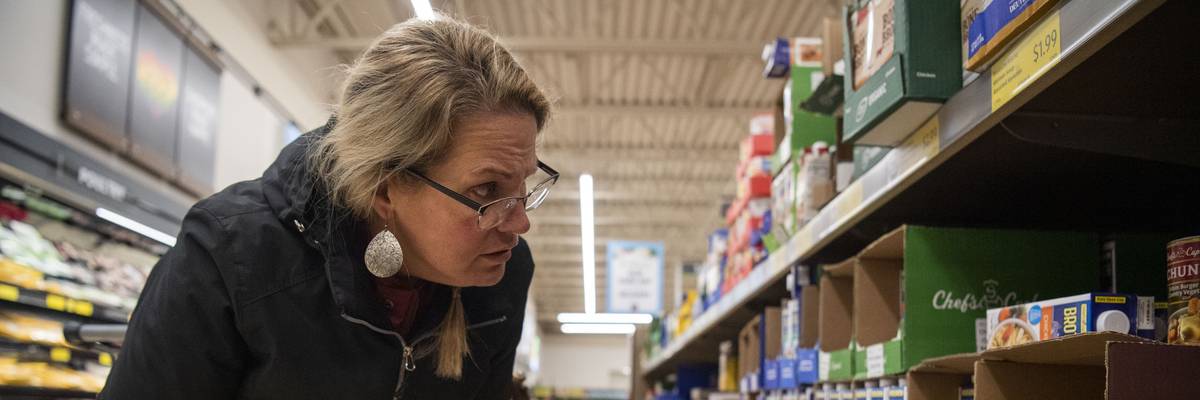
Anne Lee compares the prices of various canned goods at ALDI in Binghamton, NY on December 5, 2019.
Americans need something more ambitious and less transitory than relief at the checkout counter.
Janeese George’s recent victory in the Washington, DC, mayoral primary and wins by progressive Democrats in New York and Colorado last week are signs that Zohran Mamdani's election was not a one-off, and that populist, “eat the rich” messaging is effective across a broad swath of voters. But as the US heads toward midterm elections, Democrats are having a hard time finding a partywide motto with similar resonance. Since last fall, they have been focusing on “affordability” because the slogan resonates with working-class voters; their main message is that things are too expensive and that the cause is unchecked corporate greed.
But here’s the problem with focusing on affordability: It addresses poor and working-class Americans as consumers rather than as workers. It ignores the stagnant hiring environment and Americans’ widespread anxiety about getting and keeping jobs. And it fails to differentiate between short-run price pressures, such as the ones created by the war in Iran, and prolonged economic trends. Campaigning on affordability could leave Democrats laser-focused on unclogging temporary economic bottlenecks without a strategy for the long term. And affordability candidates must contend with the awkward fact that, by some measures, US wages have actually outpaced inflation. Some big-ticket items, including college tuition and airfare, are more affordable now than they were a decade ago.
If Democrats want to win this fall, promising to curb inflation and pinning the blame for high prices on corporate greed is not enough. Candidates should instead focus on precarity, the sense that American jobs and the future are hanging by a thread. I am a historian who studies how the economic concepts we use shape the politics we pursue. I have also seen firsthand how low-paying, precarious work and short-term contracts have engulfed higher education and how precarity has become a rallying cry for student workers and contingent faculty seeking to unionize.
If Democrats want to win this fall, promising to curb inflation and pinning the blame for high prices on corporate greed is not enough.
Precarity has great sloganeering potential. It names a phenomenon that straddles the working and the middle classes. More importantly, precarity messaging could help Democrats connect with younger voters, who are not yet fretting about childcare or housing prices but are very much worried about artificial intelligence, automation, and the lack of entry-level jobs.
Precarity sets in the moment someone begins thinking about entering the workforce. High schoolers and college students across the country ask themselves, “Will there be jobs for me? What can I add to the new A.I. economy?” Affordability rhetoric cannot answer these pressing questions. But running on an anti-precarity agenda would give Democrats the opportunity to lay out bold plans for working- and middle-class Americans, including strengthening safety nets for recent graduates, bankrolling programs that train young Americans for the many well-paying blue-collar jobs that go unfilled, and retraining workers when occupational demand shifts.
They should also capitalize on labor unions’ popularity, which has in the past decade returned to historic highs. Expanding workers’ collective bargaining rights should be a core part of the Democrats’ midterm platform. Only by empowering labor unions and strengthening worker protections will elected officials be able to deliver on eliminating precarity. Unfortunately, the Democrats’ other major campaign slogan, “abundance,” has drawn opposition from workers’ groups. Unions are wary that the push to cut red tape and supercharge new housing and infrastructure construction could come at the cost of hard-won wage and training standards.
Widespread unionization can eliminate bottlenecks and lower prices by ensuring that workers are better coordinated and trained, helping to avoid the accidents, delays, and manpower shortages that cause construction prices to soar. Lawmakers hoping to deliver on promises of abundance should start by creating stable jobs and secure futures for the workers who are expected to build new houses and energy infrastructure.
Of course, Democratic candidates do not have to choose between campaigning on increasing affordability or eliminating precarity. These are complementary messages, and they point to related problems. So far, however, Democratic pollsters have yet to fully test a worker-centered slogan and battleplan. Americans need something more ambitious and less transitory than relief at the checkout counter. Prices go up and down, but secure and satisfying jobs can last years, if not decades.
Dear Common Dreams reader, It’s been nearly 30 years since I co-founded Common Dreams with my late wife, Lina Newhouser. We had the radical notion that journalism should serve the public good, not corporate profits. It was clear to us from the outset what it would take to build such a project. No paid advertisements. No corporate sponsors. No millionaire publisher telling us what to think or do. Many people said we wouldn't last a year, but we proved those doubters wrong. Together with a tremendous team of journalists and dedicated staff, we built an independent media outlet free from the constraints of profits and corporate control. Our mission has always been simple: To inform. To inspire. To ignite change for the common good. Building Common Dreams was not easy. Our survival was never guaranteed. When you take on the most powerful forces—Wall Street greed, fossil fuel industry destruction, Big Tech lobbyists, and uber-rich oligarchs who have spent billions upon billions rigging the economy and democracy in their favor—the only bulwark you have is supporters who believe in your work. But here’s the urgent message from me today. It's never been this bad out there. And it's never been this hard to keep us going. At the very moment Common Dreams is most needed, the threats we face are intensifying. We need your support now more than ever. We don't accept corporate advertising and never will. We don't have a paywall because we don't think people should be blocked from critical news based on their ability to pay. Everything we do is funded by the donations of readers like you. When everyone does the little they can afford, we are strong. But if that support retreats or dries up, so do we. Will you donate now to make sure Common Dreams not only survives but thrives? —Craig Brown, Co-founder |
Janeese George’s recent victory in the Washington, DC, mayoral primary and wins by progressive Democrats in New York and Colorado last week are signs that Zohran Mamdani's election was not a one-off, and that populist, “eat the rich” messaging is effective across a broad swath of voters. But as the US heads toward midterm elections, Democrats are having a hard time finding a partywide motto with similar resonance. Since last fall, they have been focusing on “affordability” because the slogan resonates with working-class voters; their main message is that things are too expensive and that the cause is unchecked corporate greed.
But here’s the problem with focusing on affordability: It addresses poor and working-class Americans as consumers rather than as workers. It ignores the stagnant hiring environment and Americans’ widespread anxiety about getting and keeping jobs. And it fails to differentiate between short-run price pressures, such as the ones created by the war in Iran, and prolonged economic trends. Campaigning on affordability could leave Democrats laser-focused on unclogging temporary economic bottlenecks without a strategy for the long term. And affordability candidates must contend with the awkward fact that, by some measures, US wages have actually outpaced inflation. Some big-ticket items, including college tuition and airfare, are more affordable now than they were a decade ago.
If Democrats want to win this fall, promising to curb inflation and pinning the blame for high prices on corporate greed is not enough. Candidates should instead focus on precarity, the sense that American jobs and the future are hanging by a thread. I am a historian who studies how the economic concepts we use shape the politics we pursue. I have also seen firsthand how low-paying, precarious work and short-term contracts have engulfed higher education and how precarity has become a rallying cry for student workers and contingent faculty seeking to unionize.
If Democrats want to win this fall, promising to curb inflation and pinning the blame for high prices on corporate greed is not enough.
Precarity has great sloganeering potential. It names a phenomenon that straddles the working and the middle classes. More importantly, precarity messaging could help Democrats connect with younger voters, who are not yet fretting about childcare or housing prices but are very much worried about artificial intelligence, automation, and the lack of entry-level jobs.
Precarity sets in the moment someone begins thinking about entering the workforce. High schoolers and college students across the country ask themselves, “Will there be jobs for me? What can I add to the new A.I. economy?” Affordability rhetoric cannot answer these pressing questions. But running on an anti-precarity agenda would give Democrats the opportunity to lay out bold plans for working- and middle-class Americans, including strengthening safety nets for recent graduates, bankrolling programs that train young Americans for the many well-paying blue-collar jobs that go unfilled, and retraining workers when occupational demand shifts.
They should also capitalize on labor unions’ popularity, which has in the past decade returned to historic highs. Expanding workers’ collective bargaining rights should be a core part of the Democrats’ midterm platform. Only by empowering labor unions and strengthening worker protections will elected officials be able to deliver on eliminating precarity. Unfortunately, the Democrats’ other major campaign slogan, “abundance,” has drawn opposition from workers’ groups. Unions are wary that the push to cut red tape and supercharge new housing and infrastructure construction could come at the cost of hard-won wage and training standards.
Widespread unionization can eliminate bottlenecks and lower prices by ensuring that workers are better coordinated and trained, helping to avoid the accidents, delays, and manpower shortages that cause construction prices to soar. Lawmakers hoping to deliver on promises of abundance should start by creating stable jobs and secure futures for the workers who are expected to build new houses and energy infrastructure.
Of course, Democratic candidates do not have to choose between campaigning on increasing affordability or eliminating precarity. These are complementary messages, and they point to related problems. So far, however, Democratic pollsters have yet to fully test a worker-centered slogan and battleplan. Americans need something more ambitious and less transitory than relief at the checkout counter. Prices go up and down, but secure and satisfying jobs can last years, if not decades.
Janeese George’s recent victory in the Washington, DC, mayoral primary and wins by progressive Democrats in New York and Colorado last week are signs that Zohran Mamdani's election was not a one-off, and that populist, “eat the rich” messaging is effective across a broad swath of voters. But as the US heads toward midterm elections, Democrats are having a hard time finding a partywide motto with similar resonance. Since last fall, they have been focusing on “affordability” because the slogan resonates with working-class voters; their main message is that things are too expensive and that the cause is unchecked corporate greed.
But here’s the problem with focusing on affordability: It addresses poor and working-class Americans as consumers rather than as workers. It ignores the stagnant hiring environment and Americans’ widespread anxiety about getting and keeping jobs. And it fails to differentiate between short-run price pressures, such as the ones created by the war in Iran, and prolonged economic trends. Campaigning on affordability could leave Democrats laser-focused on unclogging temporary economic bottlenecks without a strategy for the long term. And affordability candidates must contend with the awkward fact that, by some measures, US wages have actually outpaced inflation. Some big-ticket items, including college tuition and airfare, are more affordable now than they were a decade ago.
If Democrats want to win this fall, promising to curb inflation and pinning the blame for high prices on corporate greed is not enough. Candidates should instead focus on precarity, the sense that American jobs and the future are hanging by a thread. I am a historian who studies how the economic concepts we use shape the politics we pursue. I have also seen firsthand how low-paying, precarious work and short-term contracts have engulfed higher education and how precarity has become a rallying cry for student workers and contingent faculty seeking to unionize.
If Democrats want to win this fall, promising to curb inflation and pinning the blame for high prices on corporate greed is not enough.
Precarity has great sloganeering potential. It names a phenomenon that straddles the working and the middle classes. More importantly, precarity messaging could help Democrats connect with younger voters, who are not yet fretting about childcare or housing prices but are very much worried about artificial intelligence, automation, and the lack of entry-level jobs.
Precarity sets in the moment someone begins thinking about entering the workforce. High schoolers and college students across the country ask themselves, “Will there be jobs for me? What can I add to the new A.I. economy?” Affordability rhetoric cannot answer these pressing questions. But running on an anti-precarity agenda would give Democrats the opportunity to lay out bold plans for working- and middle-class Americans, including strengthening safety nets for recent graduates, bankrolling programs that train young Americans for the many well-paying blue-collar jobs that go unfilled, and retraining workers when occupational demand shifts.
They should also capitalize on labor unions’ popularity, which has in the past decade returned to historic highs. Expanding workers’ collective bargaining rights should be a core part of the Democrats’ midterm platform. Only by empowering labor unions and strengthening worker protections will elected officials be able to deliver on eliminating precarity. Unfortunately, the Democrats’ other major campaign slogan, “abundance,” has drawn opposition from workers’ groups. Unions are wary that the push to cut red tape and supercharge new housing and infrastructure construction could come at the cost of hard-won wage and training standards.
Widespread unionization can eliminate bottlenecks and lower prices by ensuring that workers are better coordinated and trained, helping to avoid the accidents, delays, and manpower shortages that cause construction prices to soar. Lawmakers hoping to deliver on promises of abundance should start by creating stable jobs and secure futures for the workers who are expected to build new houses and energy infrastructure.
Of course, Democratic candidates do not have to choose between campaigning on increasing affordability or eliminating precarity. These are complementary messages, and they point to related problems. So far, however, Democratic pollsters have yet to fully test a worker-centered slogan and battleplan. Americans need something more ambitious and less transitory than relief at the checkout counter. Prices go up and down, but secure and satisfying jobs can last years, if not decades.