

SUBSCRIBE TO OUR FREE NEWSLETTER
Daily news & progressive opinion—funded by the people, not the corporations—delivered straight to your inbox.
5
#000000
#FFFFFF
To donate by check, phone, or other method, see our More Ways to Give page.
Daily news & progressive opinion—funded by the people, not the corporations—delivered straight to your inbox.
The Intercept is reporting: "American and British spies hacked into the internal computer network of the largest manufacturer of SIM cards in the world, stealing encryption keys used to protect the privacy of cellphone communications across the globe, according to top-secret documents provided to The Intercept by National Security Agency whistleblower Edward Snowden.
The Intercept is reporting: "American and British spies hacked into the internal computer network of the largest manufacturer of SIM cards in the world, stealing encryption keys used to protect the privacy of cellphone communications across the globe, according to top-secret documents provided to The Intercept by National Security Agency whistleblower Edward Snowden.
"The hack was perpetrated by a joint unit consisting of operatives from the NSA and its British counterpart Government Communications Headquarters, or GCHQ. The breach, detailed in a secret 2010 GCHQ document, gave the surveillance agencies the potential to secretly monitor a large portion of the world's cellular communications, including both voice and data.
"The company targeted by the intelligence agencies, Gemalto, is a multinational firm incorporated in the Netherlands that makes the chips used in mobile phones and next-generation credit cards. Among its clients are AT&T, T-Mobile, Verizon, Sprint and some 450 wireless network providers around the world. The company operates in 85 countries and has more than 40 manufacturing facilities. One of its three global headquarters is in Austin, Texas and it has a large factory in Pennsylvania.
"In all, Gemalto produces some 2 billion SIM cards a year. Its motto is 'Security to be Free.'
"With these stolen encryption keys, intelligence agencies can monitor mobile communications without seeking or receiving approval from telecom companies and foreign governments. Possessing the keys also sidesteps the need to get a warrant or a wiretap, while leaving no trace on the wireless provider's network that the communications were intercepted. Bulk key theft additionally enables the intelligence agencies to unlock any previously encrypted communications they had already intercepted, but did not yet have the ability to decrypt.
"As part of the covert operations against Gemalto, spies from GCHQ -- with support from the NSA -- mined the private communications of unwitting engineers and other company employees in multiple countries. ...
"Leading privacy advocates and security experts say that the theft of encryption keys from major wireless network providers is tantamount to a thief obtaining the master ring of a building superintendent who holds the keys to every apartment."
The following NSA whistleblowers are available for interviews.
WILLIAM BINNEY, williambinney0802 at comcast.net
Binney is a former high-level National Security Agency intelligence official who, after his 2001 retirement after 30 years, blew the whistle on NSA surveillance programs. His outspoken criticism of the NSA during the George W. Bush administration made him the subject of FBI investigations that included a raid on his home in 2007. Even before Edward Snowden's NSA whistleblowing, Binney publicly revealed that NSA had access to telecommunications companies' domestic and international billing records, and that since 9/11 the agency has intercepted some 15 to 20 trillion communications. Snowden has said: "I have tremendous respect for Binney, who did everything he could according to the rules."
J. KIRK WIEBE, jkwiebe at comcast.net, @KirkWiebe
Wiebe is a retired National Security Agency whistleblower who worked at the agency for 36 years. Wiebe's colleague William Binney developed the ThinThread information processing system that, arguably, could have detected and prevented the 9/11 terrorist attacks. NSA officials, though, ignored the program in favor of Trailblazer, a program that ended in total failure with costs of billions of dollars. Wiebe and Binney blew the whistle internally on Trailblazer, but to no avail.
THOMAS DRAKE, tadrake at earthlink.net, @Thomas_Drake1
Available for a very limited number of interviews, Drake is a former senior executive at the National Security Agency where he blew the whistle on massive multi-billion dollar fraud, waste and the widespread violations of the rights of citizens through secret mass surveillance programs after 9/11. As retaliation and reprisal, the Obama Administration indicted Drake in 2010 as the first whistleblower since Daniel Ellsberg charged with espionage, and Drake faced 35 years in prison, turning him into an Enemy of the State for his oath to defend the Constitution. In 2011, the government's case against him collapsed and he went free in a plea deal. He is the recipient of the 2011 Ridenhour Truth Telling Prize.
Binney, Wiebe and Drake are on the advisory board of Exposefacts.org, a project of the Institute for Public Accuracy.
A nationwide consortium, the Institute for Public Accuracy (IPA) represents an unprecedented effort to bring other voices to the mass-media table often dominated by a few major think tanks. IPA works to broaden public discourse in mainstream media, while building communication with alternative media outlets and grassroots activists.

Sen. Bernie Sanders also demanded "fundamental reforms" to Immigration and Customs Enforcement and Customs and Border Protection, saying they are "terrorizing" US communities.
US Sen. Bernie Sanders on Wednesday demanded the removal of Homeland Security Secretary Kristi Noem and White House Deputy Chief of Staff Stephen Miller—a key architect of President Donald Trump's violent mass deportation campaign—as well as concrete reforms in exchange for any new funding for Immigration and Customs Enforcement.
In remarks on the Senate floor, Sanders (I-Vt.) called ICE a "domestic military force" that is "terrorizing" communities across the country. The senator pointed specifically to the agency's ongoing activities in Minnesota and Maine, where officers have committed horrific—and deadly—abuses.
Sanders said that "not another penny should be given" to ICE or Customs and Border Protection (CBP) "unless there are fundamental reforms in how those agencies function—and until there is new leadership at the Department of Homeland Security and among those who run our immigration policy." The senator has proposed repealing a $75 billion ICE funding boost that the GOP approved last summer, an end to warrantless arrests, the unmasking of ICE and CBP agents, and more.
"To be clear, Kristi Noem and Stephen Miller must go," Sanders said Wednesday, condemning the administration's attempts to smear Renee Good and Alex Pretti, US citizens who were killed this month by federal agents in Minneapolis.
Watch Sanders' full remarks, which placed ICE atrocities in the context of Trump's broader "movement toward authoritarianism":
Sanders' speech came as the Senate is weighing a package of six appropriation bills that includes a DHS bill with over $64 billion in funding—with $10 billion earmarked for ICE. Democrats have called for separating the DHS measure from the broader package and pushed reforms to ICE as a condition for passage.
Punchbowl reported Thursday morning that Senate Minority Leader Chuck Schumer (D-NY) and the Trump White House are "negotiating a framework to pass five of the six outstanding FY2026 funding bills, as well as a stopgap measure for the Department of Homeland Security," ahead of a possible government shutdown at the end of the week.
"Under this framework, Congress would pass a short-term DHS patch to allow for negotiations to continue over new limits on ICE and CBP agents as they implement President Donald Trump’s immigration crackdown," the outlet added. "If Schumer and the White House come to an agreement, there would still likely be a funding lapse over the weekend. The House, which is slated to return Monday, would have to pass the five-bill spending package and the DHS stopgap."
In addition to demanding ICE reforms, a growing number of congressional Democrats are calling for Noem's ouster as DHS chief in the wake of Pretti's killing. Noem falsely claimed Pretti "arrived at the scene" in Minneapolis "to inflict maximum damage on individuals and to kill law enforcement." Noem has attempted to blame Miller—who also smeared Pretti—for the lie.
More than three-quarters of the House Democratic caucus is now backing articles of impeachment against Noem, accusing her of obstruction of Congress, violation of the public trust, and self-dealing. Trump has thus far rejected calls to remove Noem, saying they "have a very good relationship."
"The two agents who shot and killed Alex Pretti are now on leave, but Trump still backs Noem instead of firing her," Rep. Robin Kelly (D-Ill.), the leader of the impeachment push, said late Wednesday. "I’m leading 174 members with articles of impeachment against Noem. The public is crying out for change. Enough is enough."
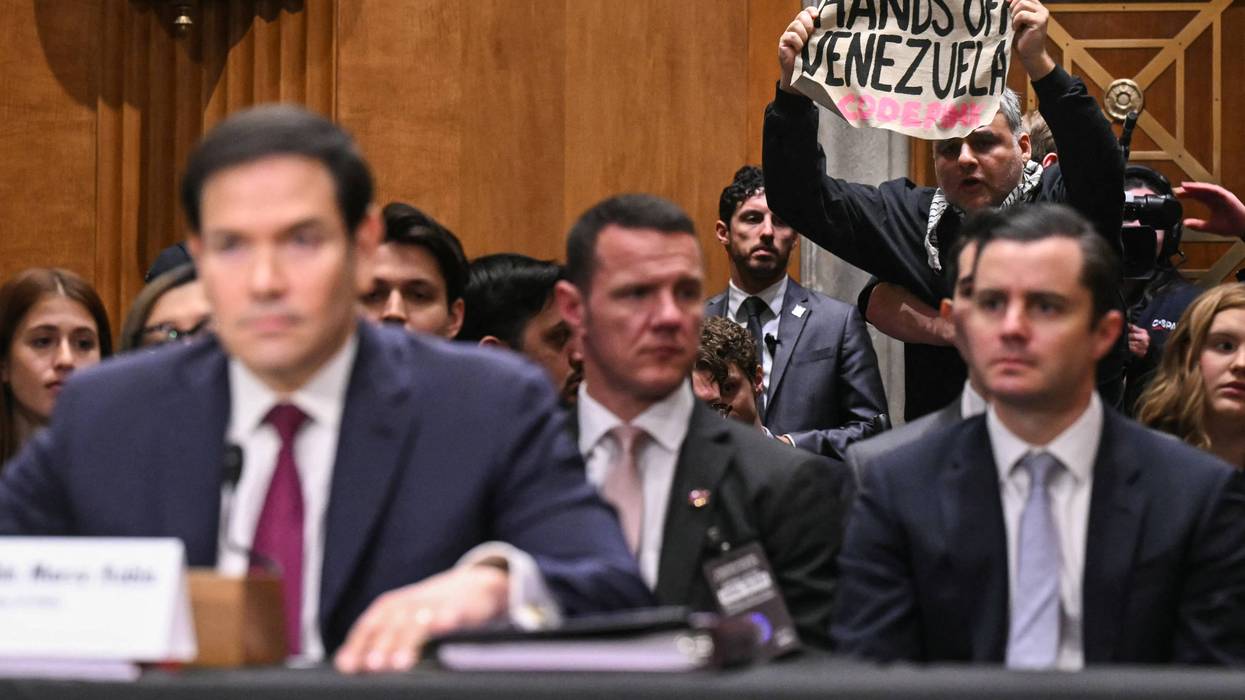
"Rubio's dangerously expansive vision to transform the United States into a colonizing power in the Americas must be challenged," one watchdog leader said of the US secretary of state.
In addition to asserting that "there is no war against Venezuela," despite US forces killing scores of people there while abducting its president earlier this month, Secretary of State Marco Rubio on Wednesday laid out for a Senate panel how the Trump administration intends to continue controlling the South American nation's oil and related profits.
Legal experts have argued that US President Donald Trump's blockade of Venezuela's oil, abduction of Venezuelan President Nicolás Maduro and his wife, Cilia Flores—who have both pleaded not guilty to federal narco-terrorism charges—and bombings of boats allegedly smuggling drugs in the Caribbean Sea and Pacific Ocean all violate international law.
"The ongoing military actions in the Caribbean and South America, including the abduction of Venezuela's president, are wrong, illegal under US and international law, and unconstitutional," Robert Weissman, co-president of the group Public Citizen, said before the Senate hearing. "Congressional Republicans have blocked war powers resolutions that would end the US aggression in Venezuela, an extremely dangerous abdication of congressional responsibility to check presidential unlawfulness."
"Marco Rubio's central role in the planning and execution of the scheme to violate the sovereignty of Venezuela and steal the country's oil merits a deep investigation by Congress, and potentially the removal of Rubio as secretary of state," Weissman continued. "Rubio's dangerously expansive vision to transform the United States into a colonizing power in the Americas must be challenged."
Testifying to the Senate Foreign Relations Committee—on which he previously served—Rubio said that "Maduro is an indicted drug trafficker, not a legal head of state," described his abduction as "an operation to aid law enforcement," and declared that "the United States is prepared to help oversee Venezuela's transition from a criminal state to a responsible partner."
Rubio, the acting national security adviser, insisted that Trump wasn't planning for any more military action in Venezuela—but also would not rule out such action, potentially without congressional authorization, in "self-defense" against an "imminent" threat.
Trump has repeatedly made clear through public statements that his Venezuela policy is focused on its petroleum reserves, seemingly to enrich the fossil fuel leaders who helped him return to power. American forces have seized several tankers in the Caribbean Sea linked to the country—which critics have condemned as "piracy"—and the first US sale of Venezuelan oil went to the company of a trader who donated millions to the president's 2024 campaign, which Sen. Cory Booker (D-NJ) last week called "yet another example of his unchecked corruption."
Describing US control of Venezuela's nationalized petroleum industry, Rubio told the committee:
Objective number one was stability... And one of the tools that's available to us is the fact that we have sanctions on oil. There is oil that is sanctioned that cannot move from Venezuela because of our quarantine. And so what we did is we entered into an arrangement with them, and the arrangement is this: On the oil that is sanctioned and quarantined, we will allow you to move it to market. We will allow you to move it to market at market prices—not at the discount China was getting. In return, the funds from that will be deposited into an account that we will have oversight over, and you will spend that money for the benefit of the Venezuelan people...
This is not going to be the permanent mechanism, but this is a short-term mechanism in which the needs of the Venezuelan people can be met through a process that we've created, where they will submit every month a budget of this is what we need funded. We will provide for them at the front end what that money cannot be used for. And they have been very cooperative in this regard. In fact, they have pledged to use a substantial amount of those funds to purchase medicine and equipment directly from the United States.
In an exchange with Senate Foreign Relations Committee Ranking Member Jeanne Shaheen (D-NH), Rubio said that an "audit process" has not yet been set up but will be, adding that "we've only made one payment" and it "retrospectively will be audited, but it was important we made that payment because they had to meet payroll. They had to keep sanitation workers, police officers, government workers on staff."
Shaheen noted that the oil reportedly sold for $500 million, but only $300 million went to Venezuela's government, now led by Maduro's former deputy, Delcy Rodríguez, and asked Rubio about the remaining $200 million. The secretary said that the rest of the money was in a temporary account in Qatar that will ultimately become a US Treasury blocked account.
Summarizing the Trump administration's plans, Sen. Chris Murphy (D-Conn.) said: "I think the scope of the project that you are undertaking in Venezuela is without precedent. You are taking their oil at gunpoint; you are holding and selling that oil; putting, for now, the receipts in an offshore Middle Eastern account; you're deciding how and for what purposes that money is gonna be used in a country of 30 million people. I think a lot of us believe that that is destined for failure."
Highlighting that "a month later, we have no information on a timetable for a democratic transition, Maduro's people are still in charge, most of the political prisoners are in jail—and by the way, those that have been let out have a gag order on them from the government—the opposition leader is still in exile," Murphy added, "this looks, already, like it is a failure."
At one point during the nearly three-hour hearing, Leonardo Flores, a Venezuelan-American with the anti-war group CodePink, shouted, "Marco Rubio, you and Trump are thugs!"
US Capitol Police removed Flores from the hearing. As he was being led away, the protester said that "sanctions are a form of collective punishment of Venezuelan citizens. That's a war crime. Hands off Venezuela! Hands off Cuba!"
Asked by Sen. Brian Schatz (D-Hawaii) on Wednesday, "Will you make a public commitment today to rule out US regime change in Cuba," Rubio—the son of Cuban immigrants—replied: "Regime change? Oh no, I think we would like to see the regime there change. That doesn't mean that we're gonna to make a change, but we would love to see a change. There's no doubt about the fact that it would be of great benefit to the United States if Cuba was no longer governed by an autocratic regime."
Since the abduction operation, there have been "free Maduro" protests in both Venezuela and Cuba, which lost 32 citizens in the Trump administration's attack on Caracas. Speaking to thousands of people gathered outside the US Embassy in Havana earlier this month, Cuban President Miguel Díaz-Canel said that "the current US administration has opened the door to an era of barbarism, plunder, and neo-fascism."
"No one here surrenders," he continued, taking aim at not only Trump but also Rubio. "The current emperor of the White House and his infamous secretary of state haven't stopped threatening me."
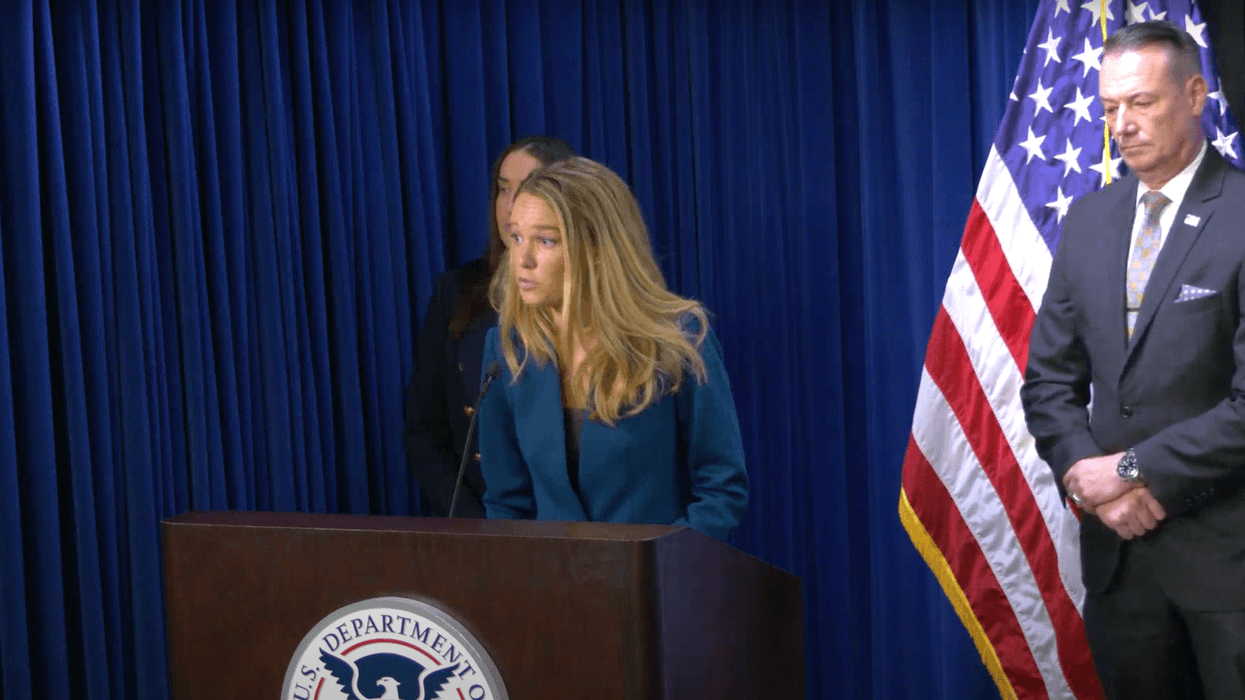
"If we don’t explore more why all of these secret lists exist," one US intelligence officer said, there could be "even more of an environment of paranoia on the ground and more tragic killings.”
Despite denials from a senior Trump administration official, secret watchlists of Americans are being used by federal agencies to track and categorize US citizens—especially protesters, activists, and critics of law enforcement—as “domestic terrorists," investigative journalist Ken Klippenstein reported Wednesday.
Klippenstein said that two senior national security officials speaking on condition of anonymity told him that there are over a dozen "secret and obscure" watchlists that the Department of Homeland Security (DHS) and the FBI are using to track anti-Immigration and Customs Enforcement (ICE) and pro-Palestine protesters, antifa-affiliated individuals, and "others who are promiscuously labeled 'domestic terrorists.'"
"I can reveal for the first time," he wrote, "that some of the secret lists and applications go by codenames like Bluekey, Grapevine, Hummingbird, Reaper, Sandcastle, Sienna, Slipstream, and Sparta (including the ominous sounding HEL-A and HEL-C reports generated by Sparta)."
"Some of these, like Hummingbird, were created to vet and track immigrants, in this case Afghans seeking to settle in the United States," Klippenstein explained. "Slipstream is a classified social media repository. Others are tools used to link people on the streets together, including collecting on friends and families who have nothing to do with any purported lawbreaking."
"There’s practically nothing available that further describes what these watchlists do, how large they are, or what they entail," he added.
Klippenstein's revelation seemingly flies in the face of DHS Assistant Secretary for Public Affairs Tricia McLaughlin's recent denial that the administration has a database containing the names of people accused of domestic terrorism.
"There's just one problem: She's lying," wrote Klippenstein.
🚨 I've obtained a list of secret watchlists the Department of Homeland Security uses to keep tabs on American citizenswww.kenklippenstein.com/p/ices-secre...
[image or embed]
— Ken Klippenstein (@kenklippenstein.bsky.social) January 28, 2026 at 1:07 PM
Many observers already thought as much, especially after a masked federal enforcer taunted an anti-ICE protester in Maine by telling her that "we have a nice little database, and now you’re considered a domestic terrorist."
White House "border czar" Tom Homan—who was recently sent to Minnesota to oversee the anti-immigrant blitz following the departure of Border Patrol commander Greg Bovino amid outrage over the killings of Renee Good and Alex Pretti—also said this month that "we’re going to create a database where those people that are arrested for interference, impeding, and assault, we’re going to make them famous."
Reporting Tuesday that Pretti—the nurse who was disarmed and then shot dead by federal enforcers in Minneapolis last week—was known to Trump officials after a previous encounter in which agents broke his rib raised further questions about government watchlists.
"We came out of 9/11 with the notion that we would have a single ‘terrorist’ watch list to eliminate confusion, duplication, and avoid bad communications, but ever since January 6, not only have we expanded exponentially into purely domestic watchlisting, but we have also created a highly secretive and compartmented superstructure that few even understand," a DHS attorney "intimately familiar" with the matter told Klippenstein on condition of anonymity, referring to the deadly January 2021 Capitol insurrection.
According to Klippenstein:
Prior to 9/11, there were nine federal agencies that maintained 12 separate watchlists. Now, officially there are just three: a watch list of 1.1 million international terrorists, a watch list of more than 10,000 domestic terrorists maintained by the FBI, and a new watch list of transnational criminals, built up to more than 85,000 over the past decade...
Among other functions, the new watchlists process tips, situation reports, and collected photographs and video submitted by both the public and from agents in the field; they create a “common operating picture” in places like Minneapolis; they allow task forces to target individuals for surveillance and arrest; and they create the capacity for intelligence people to link individuals together through geographic proximity or what is labeled “call chaining” by processing telephone numbers, emails, and other contact information.
Asked about how the Trump administration might try to legally justify these watchlists, Rachel Levinson-Waldman, the Brennan Center for Justice's Liberty and National Security Program director, cited President Donald Trump's National Security Presidential Memo 7 (NSPM-7), which mandates a “national strategy to investigate and disrupt networks, entities, and organizations that foment political violence so that law enforcement can intervene in criminal conspiracies before they result in violent political acts."
Levinson-Waldman also noted Attorney General Pam Bondi's December 5 memo directing federal agencies to expand the investigation and prosecution of "domestic terrorism," including groups "aligned" with antifa, an anti-fascist ideology that does not exist as an organization.
One senior intelligence official who confirmed the existence of the watchlists warned Klippenstein: "Lists of this and that—this social media post, that video taken of someone videoing ICE, the mere attendance at a protest—gets pulsed by federal cops on the beat to check for criminality but eventually just becomes a list itself of criminality, with the cops thinking that indeed they are dealing with criminals and terrorists. Watchlists, and the whole watchlisting process, should be as transparent as possible, not the other way around."
"If we don’t explore more why all of these secret lists exist," the official added, there could be "even more of an environment of paranoia on the ground and more tragic killings.”