SUBSCRIBE TO OUR FREE NEWSLETTER
Daily news & progressive opinion—funded by the people, not the corporations—delivered straight to your inbox.
5
#000000
#FFFFFF
To donate by check, phone, or other method, see our More Ways to Give page.


Daily news & progressive opinion—funded by the people, not the corporations—delivered straight to your inbox.

Erin Powers, Powers MediaWorks LLC, for Burke O'Neil LLC, (281) 703-6000;
and Jen Nessel, Center for Constitutional Rights, (212) 614-6449.
A Virginia federal court ruled Wednesday that four
former Abu Ghraib detainees who were tortured and later released without charge
can sue U.S. military contractor CACI International Inc. (NYSE: CAI), according
to their U.S. legal team.
U.S.
District Judge Gerald Bruce Lee, of Alexandria, Va., denied CACI's motion to dismiss the
detainees' claims which allege multiple violations of U.S.
law, including torture, war crimes and civil conspiracy.
CACI sought immunity
against the lawsuits and claimed that the actions of its contract interrogators
at Abu Ghraib were beyond judicial review. Court martial and other testimony
from the soldiers convicted of abuse link the company personnel to the abuse.
In a ruling important to
accountability for government contractors in Iraq, the Court ruled Tuesday that
"[t]he fact that CACI's business involves conducting interrogations on
the government's behalf is incidental; courts can and do entertain civil suits
against government contractors for the manner in which they carry out
government business. CACI conveniently ignores the long line of cases where
private plaintiffs were allowed to bring tort actions for wartime injuries."
The Court also rejected
CACI's effort to shield itself from accountability by invoking the
political question doctrine. The Court found "the policy is clear: what
happened at Abu Ghraib was wrong." The Court reasoned "While it is
true that the events at Abu Ghraib pose an embarrassment to this country, it is
the misconduct alleged and not the litigation surrounding that misconduct that
creates the embarrassment. This Court finds that the only potential for
embarrassment would be if the Court declined to hear these claims on political
questions grounds. Consequently, the Court holds that Plaintiffs' claims
pose no political question and are therefore justiciable."
The plaintiffs are Suhail
Najim Abdullah Al Shimari, Taha Yaseen Arraq Rashid, Sa'ad Hamza Hantoosh AI-Zuba'e
and Salah Hasan Usaif Jasim Al-Ejaili - all of whom are Iraqi citizens
who were released from Abu Ghraib between 2004 and 2008 without being charged
with any crime.
The
former detainees are represented by attorneys Susan L. Burke, William T.
O'Neil and William F. Gould of Burke
O'Neil LLC, of Washington, D.C.; Katherine
Gallagher of the Center
for Constitutional Rights; and Shereef Akeel, of Akeel & Valentine, PLC,
of Troy, Mich.
The
lawsuit alleges that the CACI defendants not only participated in physical and
mental abuse of the detainees, but also destroyed documents, videos and
photographs; prevented the reporting of the torture and abuse to the
International Committee of the Red Cross; hid detainees and other prisoners
from the International Committee of the Red Cross; and misled non-conspiring
military and government officials about the state of affairs at the Iraq
prisons.
Susan L.
Burke, of Burke O'Neil LLC, stated, "The court's ruling is
another step toward ensuring that this litigation will contribute to the true
history of Abu Ghraib. These innocent men were senselessly tortured by a U.S.
company that profited from their misery. Their stories remain untold largely
because CACI never interviewed them - or any victims - before
reaching and promoting hollow conclusions about what happened at Abu Ghraib.
These men came to U.S.
courts because our laws, as they have for generations, allow their claims to be
heard here."
Center for
Constitutional Rights attorney Katherine Gallagher
stated, "Private military contractors like CACI cannot act with impunity.
They must act within the bounds of law and must be held accountable for their participation
in the atrocities at Abu Ghraib and the other facilities in Iraq. We believe their actions and
the acts of torture of their employees clearly violated the Geneva Conventions,
the Army Field Manual, and the laws of the United States."
Shereef Akeel, of Akeel
& Valentine, stated, "This is a positive development for the torture
victims to hold CACI accountable for the atrocities committed in the Abu Ghraib
prison."
The case is "Suhail
Najim Abdullah Al Shimari, et al., v. CACI Premier Technology, Inc. and CACI
International, Inc.," in the U.S. District Court for the Eastern District
of Virginia, Alexandria Division (Case No. 1:08cv827 GBL).
The Center for Constitutional Rights is dedicated to advancing and protecting the rights guaranteed by the United States Constitution and the Universal Declaration of Human Rights. CCR is committed to the creative use of law as a positive force for social change.
(212) 614-6464“No one is safe from making these trade-offs,” said a researcher at Gallup, which found even insured Americans in higher income brackets have avoided daily expenses to pay medical bills.
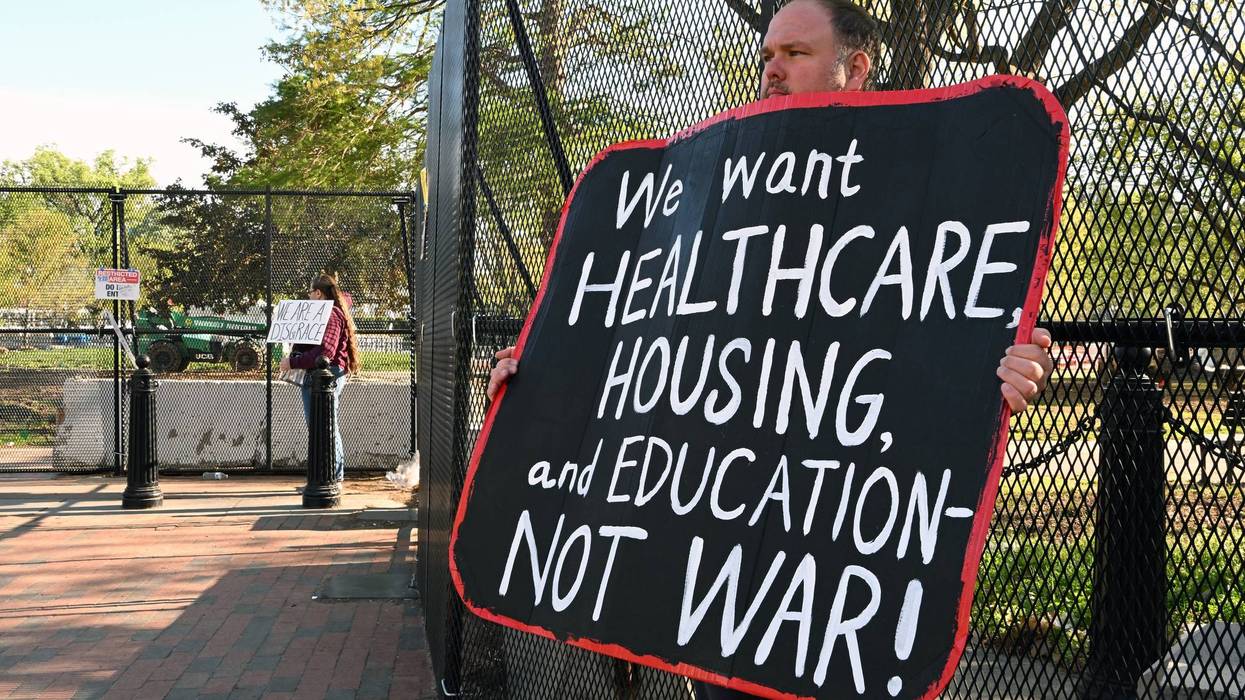
As the Trump administration spends an estimated $1 billion per day in taxpayer money bombing targets across Iran that have reportedly included an elementary school and healthcare facilities, Gallup released a survey Thursday that found one-third of Americans reported making financial trade-offs in order to pay for medical expenses last year.
The West Health-Gallup Center on Healthcare in America polled nearly 20,000 US adults between June and August 2025 and found that roughly one-third of them—equivalent to about 82 million people in the richest country in the world—were forced cut back on at least one expense in order to afford healthcare.
Eleven percent of respondents—equivalent to 28 million Americans—skipped a meal or intentionally drove less in order to pay a medical bill. Fifteen percent, the equivalent of nearly 40 million people, said they prolonged a current prescription or borrowed money, and 9% cut back on utilities.
Those numbers were strikingly similar among people who have health insurance, with 14% of insured people prolonging prescriptions to avoid paying for a new one and 9% skipping meals. Among insured Americans, 29% made at least one trade-off to afford healthcare.
The crisis is also not exclusively affecting low-income people. A quarter of people in households earning $90,000 to $120,000 per year skipped meals or other expenses to pay medical bills, and 11% of people in households earning $240,000 or more did the same.
“No one is safe from making these trade-offs,” Ellyn Maese, a senior researcher at Gallup and research director for the West Health-Gallup Center, told The New York Times.
Sixty-two percent of people without healthcare coverage were forced to make trade-offs, and 55% of people with household incomes lower than $24,000 per year as well as 47% of people earning $24,000 to $48,000 avoided expenses.
Gallup also released the results of a separate poll taken between October and December 2025, which showed how Americans are delaying major life decisions as well as altering their daily lives to afford healthcare under the for-profit insurance system.
As the Trump administration's policies slashed healthcare for 15 million Americans and raised healthcare premiums for tens of millions of people—and as the White House demanded that families have more children—6% of respondents said they had postponed having or adopting a child due to healthcare costs, equivalent to about 16 million Americans.
Nearly 30% said healthcare costs led them to avoid taking a vacation, 18% said they delayed finding a different job, 15% said they postponed pursuing education or job training, and 14% said they postponed buying a home.
The polls are “telling a consistent story here,” Maese said.
The survey results were released weeks after the Trump administration proposed new regulations for healthcare plans purchased through the Affordable Care Act marketplace that would charge deductibles as high as $15,000 for individuals and $31,000 for families to offset lower monthly premiums—underscoring how the healthcare law passed 16 years ago has left American households vulnerable to rising costs under the for-profit health insurance system.
A survey taken last November by Data for Progress found that 65% of voters support expanding the Medicare system to everyone in the US, a proposal that would save an estimated $650 billion annually.
But as Rep. Pramila Jayapal (D-Wash.)—who has sponsored Medicare for All legislation in the House—noted on Wednesday, Republicans and establishment Democrats continue to claim the proposal is unaffordable.
"When we ask for Medicare for All it’s 'too expensive,' and we 'don’t have the money,'" said Jayapal. "When the president drags us into his own personal war, no expense is spared. Our priorities are backwards."
"The very purpose of this biased and politically motivated text, which was pushed by the Israeli regime and the United States, is clear: to reverse the roles of victim and aggressor," said Iran's ambassador to the UN.
The United Nations Security Council on Wednesday adopted a resolution condemning Iran's retaliatory attacks on Gulf nations without denouncing—or even mentioning—the illegal US and Israeli bombing campaign that started the war, which has hurled the region into conflict and destabilized the global economy.
The resolution, sponsored by council member and US ally Bahrain, "condemns in the strongest terms the egregious attacks by the Islamic Republic of Iran against the territories of Bahrain, Kuwait, Oman, Qatar, Saudi Arabia, the United Arab Emirates, and Jordan," nations that host US military bases. The text calls Iranian strikes "a breach of international law and a serious threat to international peace and security," but contains no mention of the US or Israel, nations that have been accused of grave war crimes.
The council adopted Bahrain's measure by a vote of 13-0, with two abstentions—China and Russia. Both nations have veto power but declined to use it. Neither Iran nor Israel is currently a member of the Security Council.
The UN body also voted on a competing resolution, sponsored by Russia, that would have implored "all parties"—without naming any of them—to stop their military operations and avoid escalating the conflict. The resolution did not receive the nine votes necessary for adoption, with the US and Latvia voting against it and Bahrain, Colombia, the Democratic Republic of the Congo, Denmark, France, Greece, Liberia, Panama, and the United Kingdom abstaining.
Amir Saeid Iravani, Iran's ambassador to the UN, said the body's adoption of Bahrain's resolution marks "a serious setback to the council’s credibility and leaves a lasting stain on its record."
"Today’s action represents a blatant misuse of the Security Council’s mandate in pursuit of the political agendas of certain members," said Iravani. "The very state responsible for this brutal war of aggression against my country—the regime of the United States—sits on the other side of this chamber as president of the council, abusing its position while obstructing every effort to bring an end to this barbaric war against the Iranian people and preventing the Council from fulfilling its Charter-based responsibilities."
"This resolution is a manifest injustice against my country, the main victim of a clear act of aggression. It distorts the realities on the ground and deliberately ignores the root causes of the current crisis," he continued. "The very purpose of this biased and politically motivated text, which was pushed by the Israeli regime and the United States, is clear: to reverse the roles of victim and aggressor. It rewards the regimes of the United States and Israel, which have violated the UN Charter and committed acts of aggression. In doing so, it establishes impunity and sends a wrong message to the international community—emboldening the aggressors to commit further crimes."
"The UN and International Criminal Court were created for moments like this, when the most powerful decide the rules do not apply to them."
Ahead of the vote on Bahrain's resolution, which accuses Iran of "deliberate targeting of civilians and civilian objects," Iravani said US-Israeli bombing has killed more than 1,300 civilians in Iran and destroyed nearly 10,000 civilian structures across the country, including around 8,000 homes and dozens of schools and healthcare facilities.
Earlier on Wednesday, the New York Times reported that the Pentagon has reached the preliminary conclusion that US forces were responsible for the February 28 bombing of an Iranian elementary school, an attack that killed around 175 people—mostly young children.
DAWN, a nonprofit that supports human rights and democracy in the Middle East, said Wednesday that "mounting evidence" shows US and Israeli forces "have committed multiple war crimes" in Iran and Lebanon—which is facing a rapidly worsening humanitarian disaster due to Israeli attacks.
"In mere days, US and Israel forces have launched a war of choice, killed hundreds of civilians, displaced hundreds of thousands, bombed scores of schools, health facilities, and fuel depots, and dropped white phosphorus on civilian communities," Omar Shakir, DAWN's executive director, said in a statement. "The international community's failure to act when the most fundamental norms of international law are being challenged risks plunging the world further into a lawless era in which civilians across the globe are at risk."
"The UN and International Criminal Court were created for moments like this, when the most powerful decide the rules do not apply to them," said Shakir. "Governments unwilling to invoke international law when their allies commit crimes have no credibility when they invoke it against rivals."
"In less than two weeks, Israel has killed 570 people and displaced 750,000—over 10% of the entire country," the senator said of Lebanon. "Residential buildings are being bombed with no warning."
Just a day after tearing into US President Donald Trump and Israeli Prime Minister Benjamin Netanyahu for "unraveling international law, the Geneva Conventions, and the legitimacy of the United Nations" with their illegal war on Iran, Sen. Bernie Sanders stressed that "it's not just Iran."
"It's Lebanon," Sanders (I-Vt.) said on social media Wednesday. Since Trump and Netanyahu began bombing Iran a dozen days ago, Israel has also ramped up attacks against its northern neighbor—claiming to target the Lebanese political and paramilitary group Hezbollah—despite a November 2024 ceasefire deal.
That agreement to protect the Lebanese people was struck just over a year into Israel's retaliation for the October 2023 Hamas-led attack, which has also left the Gaza Strip in ruins. Despite the Lebanon truce, and another for Gaza reached this past October, Israeli forces have continued to slaughter civilians in both places.
In Lebanon, Sanders noted Wednesday, "in less than two weeks, Israel has killed 570 people and displaced 750,000—over 10% of the entire country. Residential buildings are being bombed with no warning."
"The US cannot continue to be complicit in Netanyahu's wars," declared the senator. His comments came after the White House tried to walk back Secretary of State Marco Rubio's suggestion last week that Trump followed the Israeli prime minister's lead on Iran.
Sanders has also criticized and even attempted to curb US complicity in Netanyahu's genocidal assault on Palestinians in Gaza—under the Biden and Trump administrations—by forcing unsuccessful votes to cut off some weapons to Israel.
The Israeli government has used the operation against Iran—which experts argue violates the US Constitution and UN Charter—to again cut off necessary humanitarian aid to Gaza, claiming last week that "the existing stock is expected to suffice for an extended period."
Philippe Lazzarini, commissioner-general of the United Nations Relief and Works Agency for Palestine Refugees in the Near East, called the move "a new chokehold on Gaza," adding that "after more than two years of unspeakable suffering and a spreading man-made famine, people still lack the most basic supplies, despite increases in aid since the ceasefire.
As for Lebanon, Axios reported Monday that "the Lebanese government proposed direct negotiations with Israel—through the Trump administration—aimed at ending the war and reaching a peace agreement."
However, the Financial Times reported Tuesday that "Israel has rejected diplomatic overtures by Lebanon," with one unnamed source saying that the Lebanese "are ready to talk to Israel, but under the condition of a cessation of fire. Not a ceasefire, but a cessation... so talks can get going in Cyprus."
"Israel has so far refused and says it will only negotiate 'under fire,'" according to that unnamed source.
Trump's ambassador to the United Nations, Mike Waltz, made US support for Israel's bombing of Lebanon clear in his Wednesday remarks to the UN Security Council.
"The United States condemns the attacks that Hezbollah, a long-time proxy of the Iranian regime, has launched against Israel. Hezbollah has yet again made it clear that it does not represent nor does it defend the people of Lebanon. It defends the interests of the Iranian regime," Waltz said, stressing Israel's "right to defend itself."
Waltz also welcomed the Lebanese Council of Ministers' recent decision "to immediately prohibit Hezbollah’s military and security activities," and declared that "now is the time for the government of Lebanon to take back control of the entirety of its country."
Meanwhile, Tom Fletcher, United Nations under-secretary-general for humanitarian affairs and emergency relief coordinator, noted to the Security Council that UN Secretary-General António Guterres "has insisted... we need the protection of civilians, de-escalation, an immediate cessation of hostilities, and genuine dialogue and negotiations towards a peaceful settlement, in line with the charter."
Fletcher concluded his comments at the briefing on Lebanon with calls for the protection of "all civilians throughout the region," "generous funding for a principled, scaled-up humanitarian response," and "a revival of strategic, calm, rational, hopeful diplomacy."
"Lebanon is exhausted by other people's wars," he said. "It is not asking for help, but for oxygen. Its people can defy the history, the geography, even the politics. They can be stronger than the forces pulling them apart. But they can only do that if Iran and Israel stop fighting their war in Lebanon."