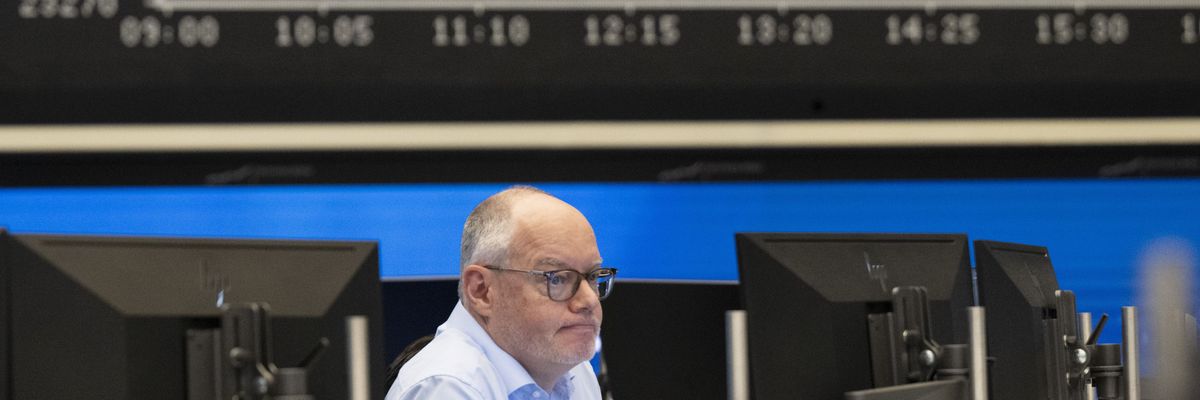
As US President Trump announced massive tariffs on goods from the EU, Germany's leading index, the DAX, plummeted.
Fed Governor Warns 'Job Growth Has Probably Been Negative' as US Labor Market Stalls
One market analyst said the US jobs market is going through "bed rot."
Christopher Waller, a Federal Reserve governor, warned on Friday that the US labor market at the moment is in poor shape and showing little sign of improvement.
In an interview on CNBC, Waller said that the data released by processing firm ADP earlier this month showing that the economy lost 32,000 jobs in September was "consistent with what we're starting to see with [Bureau of Labor Statistics] data."
"Job growth has probably been negative the last few months," he explained. "It doesn't look like it's doing much better. Anecdotally... I don't hear anybody with big hiring plans. All I ever hear is, 'We're not backfilling, we're not firing, we're holding off any job things.' That's the anecdotal evidence."
Fed Governor Christopher Waller: "Job growth has probably been negative the last few months. it doesn't look like it's doing much better. I don't hear anybody with big hiring plans." pic.twitter.com/aXDZPNTixq
— Aaron Rupar (@atrupar) October 10, 2025
Waller's analysis was shared by Ed Al-Hussainy, rates strategist with Columbia Threadneedle investments, who told Axios on Friday that the job market was "bed rotting," with employers reluctant to make any major hiring commitments in the face of economic uncertainty.
Al-Hussainy also warned that the current problems with the job market could "continue to get worse, until they reach a tipping point where consumption starts to degrade, and then you have another recession scare."
Earlier in the week, Fortune reported that Mark Zandi, chief economist at Moody's Analytics, estimated that there was "essentially no job growth" in the last month, while pointing to the Conference Board's recent report showing that US consumers haven't been this pessimistic about the labor market since the end of the Covid-19 pandemic.
"There’s no better predictor of changes in unemployment, which thus likely rose again in September," he added.
Abby McCloskey, a columnist at Bloomberg and a former economist at the conservative American Enterprise Institute, argued in a Friday column that the US economy had now slowed down so much that even supporters of President Donald Trump were rating it unfavorably.
"Only 44% of Republicans think the economy is excellent or good, according to new data from the Pew Research Center," McCloskey explained. "Compare this to the soaring approval of GOP voters in Trump’s first term before Covid hit—when 81% thought the economy was good."
She then noted that, despite a record-breaking stock market and stabilized inflation, voters' concerns about the economy appeared to be justified.
"Despite enormous tax cuts in this summer’s reconciliation bill and sweeping reductions to the federal workforce—things Republicans would typically cheer—tariffs and political uncertainty are taking a toll," she argued. "When a voter balances the tax cuts from the One Big Beautiful Bill Act against tariffs raising prices on everything from groceries to clothes, it feels like running just to stay in place."
We are at a crossroads
This country and this world are at a monumental crossroads. In a few short weeks, US voters will have an opportunity to beat back the forces of fascism and confront the billionaires who are rigging the economy, our media system, and our democracy, making it increasingly impossible for ordinary people to get by. We’re not just talking about the election. We’re talking about what must be done once these fascist elements are vanquished from power. We need a bolder set of solutions than what either major party has so far been willing to offer and a working-class movement ready to fight like hell for it. Trump didn't emerge from nowhere. The conditions that fueled MAGA authoritarianism were created by decades of radical neoliberal economic policies and a corrupt political system dominated by corporate interests. They slashed taxes on the super-rich, promising that the benefits would trickle down. They said giveaways to the corporate titans would make life more affordable for the rest of us. It was all bullshit. And when a bitter, betrayed populace searches for someone to blame, right-wing demagogues have little trouble finding scapegoats. People know when they're being lied to, but you won't hear any of this from the corporate media. Only independent journalism—powered and funded by people who believe in building a better world—can deliver truly trustworthy daily news. Our Fall Campaign is underway, and we need your help. To power our newsroom through the rest of the year, we need to raise $125,000 by midnight on October 31. So if you share our vision, please contribute whatever you can to sustain our work. |
Christopher Waller, a Federal Reserve governor, warned on Friday that the US labor market at the moment is in poor shape and showing little sign of improvement.
In an interview on CNBC, Waller said that the data released by processing firm ADP earlier this month showing that the economy lost 32,000 jobs in September was "consistent with what we're starting to see with [Bureau of Labor Statistics] data."
"Job growth has probably been negative the last few months," he explained. "It doesn't look like it's doing much better. Anecdotally... I don't hear anybody with big hiring plans. All I ever hear is, 'We're not backfilling, we're not firing, we're holding off any job things.' That's the anecdotal evidence."
Fed Governor Christopher Waller: "Job growth has probably been negative the last few months. it doesn't look like it's doing much better. I don't hear anybody with big hiring plans." pic.twitter.com/aXDZPNTixq
— Aaron Rupar (@atrupar) October 10, 2025
Waller's analysis was shared by Ed Al-Hussainy, rates strategist with Columbia Threadneedle investments, who told Axios on Friday that the job market was "bed rotting," with employers reluctant to make any major hiring commitments in the face of economic uncertainty.
Al-Hussainy also warned that the current problems with the job market could "continue to get worse, until they reach a tipping point where consumption starts to degrade, and then you have another recession scare."
Earlier in the week, Fortune reported that Mark Zandi, chief economist at Moody's Analytics, estimated that there was "essentially no job growth" in the last month, while pointing to the Conference Board's recent report showing that US consumers haven't been this pessimistic about the labor market since the end of the Covid-19 pandemic.
"There’s no better predictor of changes in unemployment, which thus likely rose again in September," he added.
Abby McCloskey, a columnist at Bloomberg and a former economist at the conservative American Enterprise Institute, argued in a Friday column that the US economy had now slowed down so much that even supporters of President Donald Trump were rating it unfavorably.
"Only 44% of Republicans think the economy is excellent or good, according to new data from the Pew Research Center," McCloskey explained. "Compare this to the soaring approval of GOP voters in Trump’s first term before Covid hit—when 81% thought the economy was good."
She then noted that, despite a record-breaking stock market and stabilized inflation, voters' concerns about the economy appeared to be justified.
"Despite enormous tax cuts in this summer’s reconciliation bill and sweeping reductions to the federal workforce—things Republicans would typically cheer—tariffs and political uncertainty are taking a toll," she argued. "When a voter balances the tax cuts from the One Big Beautiful Bill Act against tariffs raising prices on everything from groceries to clothes, it feels like running just to stay in place."
- Jobs Report Seen as 'Calm Before the Storm' as Trump Chaos Rattles US Economy ›
- 'Devastating' New Jobs Report Shows Labor Market 'Cracking' Under Trump ›
- 'Very Significant Sign of Weakening': Bad Jobs Report Sets Off Alarms About US Economy Under Trump ›
Christopher Waller, a Federal Reserve governor, warned on Friday that the US labor market at the moment is in poor shape and showing little sign of improvement.
In an interview on CNBC, Waller said that the data released by processing firm ADP earlier this month showing that the economy lost 32,000 jobs in September was "consistent with what we're starting to see with [Bureau of Labor Statistics] data."
"Job growth has probably been negative the last few months," he explained. "It doesn't look like it's doing much better. Anecdotally... I don't hear anybody with big hiring plans. All I ever hear is, 'We're not backfilling, we're not firing, we're holding off any job things.' That's the anecdotal evidence."
Fed Governor Christopher Waller: "Job growth has probably been negative the last few months. it doesn't look like it's doing much better. I don't hear anybody with big hiring plans." pic.twitter.com/aXDZPNTixq
— Aaron Rupar (@atrupar) October 10, 2025
Waller's analysis was shared by Ed Al-Hussainy, rates strategist with Columbia Threadneedle investments, who told Axios on Friday that the job market was "bed rotting," with employers reluctant to make any major hiring commitments in the face of economic uncertainty.
Al-Hussainy also warned that the current problems with the job market could "continue to get worse, until they reach a tipping point where consumption starts to degrade, and then you have another recession scare."
Earlier in the week, Fortune reported that Mark Zandi, chief economist at Moody's Analytics, estimated that there was "essentially no job growth" in the last month, while pointing to the Conference Board's recent report showing that US consumers haven't been this pessimistic about the labor market since the end of the Covid-19 pandemic.
"There’s no better predictor of changes in unemployment, which thus likely rose again in September," he added.
Abby McCloskey, a columnist at Bloomberg and a former economist at the conservative American Enterprise Institute, argued in a Friday column that the US economy had now slowed down so much that even supporters of President Donald Trump were rating it unfavorably.
"Only 44% of Republicans think the economy is excellent or good, according to new data from the Pew Research Center," McCloskey explained. "Compare this to the soaring approval of GOP voters in Trump’s first term before Covid hit—when 81% thought the economy was good."
She then noted that, despite a record-breaking stock market and stabilized inflation, voters' concerns about the economy appeared to be justified.
"Despite enormous tax cuts in this summer’s reconciliation bill and sweeping reductions to the federal workforce—things Republicans would typically cheer—tariffs and political uncertainty are taking a toll," she argued. "When a voter balances the tax cuts from the One Big Beautiful Bill Act against tariffs raising prices on everything from groceries to clothes, it feels like running just to stay in place."
- Jobs Report Seen as 'Calm Before the Storm' as Trump Chaos Rattles US Economy ›
- 'Devastating' New Jobs Report Shows Labor Market 'Cracking' Under Trump ›
- 'Very Significant Sign of Weakening': Bad Jobs Report Sets Off Alarms About US Economy Under Trump ›