5
#000000
#FFFFFF
To donate by check, phone, or other method, see our More Ways to Give page.
Daily news & progressive opinion—funded by the people, not the corporations—delivered straight to your inbox.
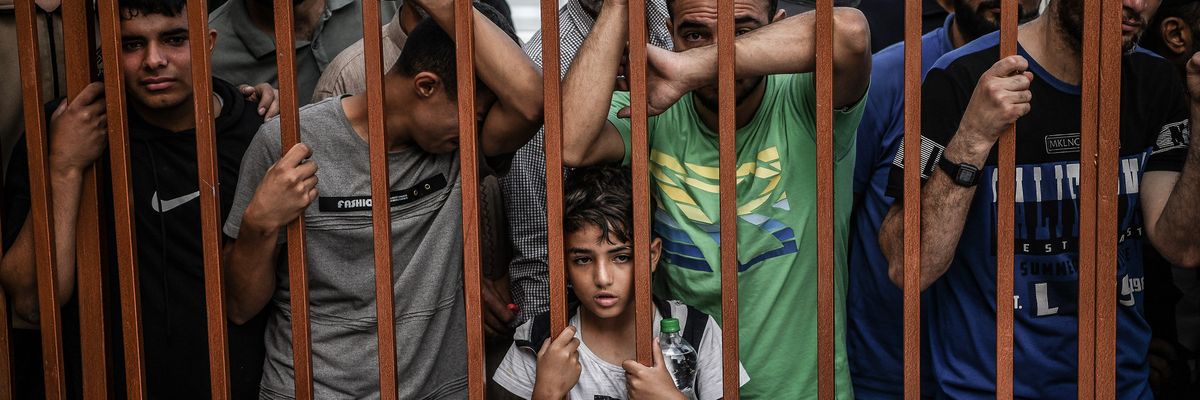
People mourn at the morgue of Nasser Hospital in Khan Yunis, Gaza on October 27, 2023.
UNRWA chief Philippe Lazzarini warned that Gaza is "on the brink of a massive health hazard" as Israel's blockade and bombing prevent the free flow of desperately needed aid.
The head of the United Nations agency for Palestinian refugees issued an urgent appeal for a cease-fire in Gaza on Friday, warning that Israel's blockade and incessant bombing are plunging the territory's population into a horrific humanitarian emergency.
During a press conference, United Nations Relief and Works Agency for Palestine Refugees in the Near East (UNRWA) commissioner-general said the Gaza Strip is "on the brink of a massive health hazard as the risks of diseases are looming."
"Medicine is running out. Food and water are running out. The streets of Gaza have started overflowing with sewage," said Lazzarini. "The siege means that food, water, and fuel—basic commodities—are being used to collectively punish more than 2 million people, among them, a majority of children and women."
Lazzarini lamented that "intensive negotiations and endless shuttle diplomacy" have only resulted in a few aid convoys reaching southern Gaza via the Egyptian border.
The Israeli government has refused to allow any aid to flow to northern Gaza, where hospitals are overwhelmed and running low on fuel and other critical supplies. Human Rights Watch stressed earlier this week that deliberately blocking humanitarian relief is a war crime.
"What is needed is meaningful and uninterrupted aid flow," he added. "To succeed, we need a humanitarian ceasefire to ensure this aid reaches those in need. This is not too much to ask for."
U.N. human rights chief Volker Türk echoed Lazzarini's call for an end to the bombing and siege on Friday, pointing to "harrowing testimonies of entire families killed by airstrikes on their homes" and "of parents writing children's names on their arms to identify their future remains."
"We mourn the loss of 57 U.N. colleagues and so many more civilians who are clearly, disproportionately impacted," said Türk. "Peace, security, and justice will not be found down this current path. The cycle of vengeance and bloodshed needs to end."
"With a low stock of medicines and extremely limited access to clean water, the rate of antibiotic resistance in Gaza is alarming."
Unnamed sources
told Al Jazeera on Friday that Qatar-mediated negotiations between Israel and Hamas are "advancing rapidly" toward an agreement on a cease-fire and prisoner-exchange deal nearly three weeks into the deadly conflict, but the specifics of such an agreement remain unclear. A Hamas attack on Israel on October 7 killed more than 1,400 people, and Israel's devastating response has killed more than 7,000.
The Israeli bombing campaign and siege have devastated Gaza's population, displacing more than a million people and obliterating the enclave's civilian infrastructure. The relentless attack is also threatening to unleash a disastrous public health crisis.
Oxfam International warned last week that Gaza is facing a possible "outbreak of deadly infectious diseases, like cholera, because water and sanitation services have completely broken down."
"All five of Gaza's wastewater treatment plants and most of its 65 sewage pumping stations have been forced to close," the humanitarian group said. "Untreated sewage is now being discharged into the sea and, in some areas, solid waste is accumulating in the streets."
Doctors Without Borders is also sounding the alarm about an impending health catastrophe in Gaza, noting that "people with open wounds and fractures caused by airstrikes and gunfire are highly susceptible to infection." The group also said the lack of clean water "further complicates poor hygiene conditions in the makeshift shelters where many displaced people are living in close quarters since fleeing northern Gaza."
"With a low stock of medicines and extremely limited access to clean water, the rate of antibiotic resistance in Gaza is alarming," the group said in a statement. "Some patients require immediate isolation to avoid the spread of bacteria with no known antibiotic treatment. All too often, amputations are required to prevent the infection from spreading and save people's lives."
Dear Common Dreams reader, It’s been nearly 30 years since I co-founded Common Dreams with my late wife, Lina Newhouser. We had the radical notion that journalism should serve the public good, not corporate profits. It was clear to us from the outset what it would take to build such a project. No paid advertisements. No corporate sponsors. No millionaire publisher telling us what to think or do. Many people said we wouldn't last a year, but we proved those doubters wrong. Together with a tremendous team of journalists and dedicated staff, we built an independent media outlet free from the constraints of profits and corporate control. Our mission has always been simple: To inform. To inspire. To ignite change for the common good. Building Common Dreams was not easy. Our survival was never guaranteed. When you take on the most powerful forces—Wall Street greed, fossil fuel industry destruction, Big Tech lobbyists, and uber-rich oligarchs who have spent billions upon billions rigging the economy and democracy in their favor—the only bulwark you have is supporters who believe in your work. But here’s the urgent message from me today. It's never been this bad out there. And it's never been this hard to keep us going. At the very moment Common Dreams is most needed, the threats we face are intensifying. We need your support now more than ever. We don't accept corporate advertising and never will. We don't have a paywall because we don't think people should be blocked from critical news based on their ability to pay. Everything we do is funded by the donations of readers like you. When everyone does the little they can afford, we are strong. But if that support retreats or dries up, so do we. Will you donate now to make sure Common Dreams not only survives but thrives? —Craig Brown, Co-founder |
The head of the United Nations agency for Palestinian refugees issued an urgent appeal for a cease-fire in Gaza on Friday, warning that Israel's blockade and incessant bombing are plunging the territory's population into a horrific humanitarian emergency.
During a press conference, United Nations Relief and Works Agency for Palestine Refugees in the Near East (UNRWA) commissioner-general said the Gaza Strip is "on the brink of a massive health hazard as the risks of diseases are looming."
"Medicine is running out. Food and water are running out. The streets of Gaza have started overflowing with sewage," said Lazzarini. "The siege means that food, water, and fuel—basic commodities—are being used to collectively punish more than 2 million people, among them, a majority of children and women."
Lazzarini lamented that "intensive negotiations and endless shuttle diplomacy" have only resulted in a few aid convoys reaching southern Gaza via the Egyptian border.
The Israeli government has refused to allow any aid to flow to northern Gaza, where hospitals are overwhelmed and running low on fuel and other critical supplies. Human Rights Watch stressed earlier this week that deliberately blocking humanitarian relief is a war crime.
"What is needed is meaningful and uninterrupted aid flow," he added. "To succeed, we need a humanitarian ceasefire to ensure this aid reaches those in need. This is not too much to ask for."
U.N. human rights chief Volker Türk echoed Lazzarini's call for an end to the bombing and siege on Friday, pointing to "harrowing testimonies of entire families killed by airstrikes on their homes" and "of parents writing children's names on their arms to identify their future remains."
"We mourn the loss of 57 U.N. colleagues and so many more civilians who are clearly, disproportionately impacted," said Türk. "Peace, security, and justice will not be found down this current path. The cycle of vengeance and bloodshed needs to end."
"With a low stock of medicines and extremely limited access to clean water, the rate of antibiotic resistance in Gaza is alarming."
Unnamed sources
told Al Jazeera on Friday that Qatar-mediated negotiations between Israel and Hamas are "advancing rapidly" toward an agreement on a cease-fire and prisoner-exchange deal nearly three weeks into the deadly conflict, but the specifics of such an agreement remain unclear. A Hamas attack on Israel on October 7 killed more than 1,400 people, and Israel's devastating response has killed more than 7,000.
The Israeli bombing campaign and siege have devastated Gaza's population, displacing more than a million people and obliterating the enclave's civilian infrastructure. The relentless attack is also threatening to unleash a disastrous public health crisis.
Oxfam International warned last week that Gaza is facing a possible "outbreak of deadly infectious diseases, like cholera, because water and sanitation services have completely broken down."
"All five of Gaza's wastewater treatment plants and most of its 65 sewage pumping stations have been forced to close," the humanitarian group said. "Untreated sewage is now being discharged into the sea and, in some areas, solid waste is accumulating in the streets."
Doctors Without Borders is also sounding the alarm about an impending health catastrophe in Gaza, noting that "people with open wounds and fractures caused by airstrikes and gunfire are highly susceptible to infection." The group also said the lack of clean water "further complicates poor hygiene conditions in the makeshift shelters where many displaced people are living in close quarters since fleeing northern Gaza."
"With a low stock of medicines and extremely limited access to clean water, the rate of antibiotic resistance in Gaza is alarming," the group said in a statement. "Some patients require immediate isolation to avoid the spread of bacteria with no known antibiotic treatment. All too often, amputations are required to prevent the infection from spreading and save people's lives."
The head of the United Nations agency for Palestinian refugees issued an urgent appeal for a cease-fire in Gaza on Friday, warning that Israel's blockade and incessant bombing are plunging the territory's population into a horrific humanitarian emergency.
During a press conference, United Nations Relief and Works Agency for Palestine Refugees in the Near East (UNRWA) commissioner-general said the Gaza Strip is "on the brink of a massive health hazard as the risks of diseases are looming."
"Medicine is running out. Food and water are running out. The streets of Gaza have started overflowing with sewage," said Lazzarini. "The siege means that food, water, and fuel—basic commodities—are being used to collectively punish more than 2 million people, among them, a majority of children and women."
Lazzarini lamented that "intensive negotiations and endless shuttle diplomacy" have only resulted in a few aid convoys reaching southern Gaza via the Egyptian border.
The Israeli government has refused to allow any aid to flow to northern Gaza, where hospitals are overwhelmed and running low on fuel and other critical supplies. Human Rights Watch stressed earlier this week that deliberately blocking humanitarian relief is a war crime.
"What is needed is meaningful and uninterrupted aid flow," he added. "To succeed, we need a humanitarian ceasefire to ensure this aid reaches those in need. This is not too much to ask for."
U.N. human rights chief Volker Türk echoed Lazzarini's call for an end to the bombing and siege on Friday, pointing to "harrowing testimonies of entire families killed by airstrikes on their homes" and "of parents writing children's names on their arms to identify their future remains."
"We mourn the loss of 57 U.N. colleagues and so many more civilians who are clearly, disproportionately impacted," said Türk. "Peace, security, and justice will not be found down this current path. The cycle of vengeance and bloodshed needs to end."
"With a low stock of medicines and extremely limited access to clean water, the rate of antibiotic resistance in Gaza is alarming."
Unnamed sources
told Al Jazeera on Friday that Qatar-mediated negotiations between Israel and Hamas are "advancing rapidly" toward an agreement on a cease-fire and prisoner-exchange deal nearly three weeks into the deadly conflict, but the specifics of such an agreement remain unclear. A Hamas attack on Israel on October 7 killed more than 1,400 people, and Israel's devastating response has killed more than 7,000.
The Israeli bombing campaign and siege have devastated Gaza's population, displacing more than a million people and obliterating the enclave's civilian infrastructure. The relentless attack is also threatening to unleash a disastrous public health crisis.
Oxfam International warned last week that Gaza is facing a possible "outbreak of deadly infectious diseases, like cholera, because water and sanitation services have completely broken down."
"All five of Gaza's wastewater treatment plants and most of its 65 sewage pumping stations have been forced to close," the humanitarian group said. "Untreated sewage is now being discharged into the sea and, in some areas, solid waste is accumulating in the streets."
Doctors Without Borders is also sounding the alarm about an impending health catastrophe in Gaza, noting that "people with open wounds and fractures caused by airstrikes and gunfire are highly susceptible to infection." The group also said the lack of clean water "further complicates poor hygiene conditions in the makeshift shelters where many displaced people are living in close quarters since fleeing northern Gaza."
"With a low stock of medicines and extremely limited access to clean water, the rate of antibiotic resistance in Gaza is alarming," the group said in a statement. "Some patients require immediate isolation to avoid the spread of bacteria with no known antibiotic treatment. All too often, amputations are required to prevent the infection from spreading and save people's lives."