

SUBSCRIBE TO OUR FREE NEWSLETTER
Daily news & progressive opinion—funded by the people, not the corporations—delivered straight to your inbox.
5
#000000
#FFFFFF
To donate by check, phone, or other method, see our More Ways to Give page.
Daily news & progressive opinion—funded by the people, not the corporations—delivered straight to your inbox.
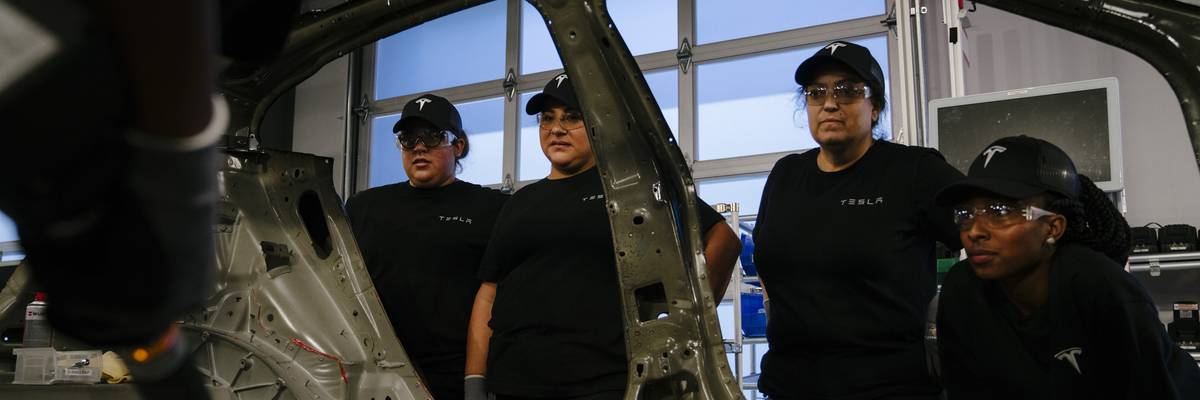
Tesla employees receive training at the company's factory in Fremont, California on July 26, 2018.
"This is the latest sign that Elon Musk is scared of the UAW push to unionize all nonunion autoworkers across the country."
The electric vehicle maker Tesla has reportedly informed workers at its California plant that it is hiking wages for factory employees across the United States, becoming the latest nonunion car manufacturer to boost worker pay following the United Auto Workers' historic strike and contract victories late last year.
Bloomberg reported Thursday that all of Tesla's production associates, material handlers, and quality inspectors will receive a "market adjustment pay increase" to start 2024, according to a flyer that company management posted at its Fremont, California plant—which employs more than 20,000 workers.
The document did not make clear the size of the raise, Bloomberg noted.
Tesla is run by billionaire Elon Musk, who has been vocally hostile toward organized labor for years—a stance that has drawn scrutiny and rebukes from the National Labor Relations Board (NLRB). In a 2018 post on Twitter, a platform he now owns and rebranded as X, Musk wrote that there is "nothing stopping Tesla team at our car plant from voting union."
"But why pay union dues & give up stock options for nothing?" he added. The NLRB said the post constituted an unlawful threat against workers considering exercising their right to organize.
After the UAW secured significant wage increases and other contract wins at the Big Three U.S. automakers following a six-week strike last year, the union launched what's been described as the largest organizing drive in modern U.S. history, targeting Volkswagen, Toyota, and other nonunion car makers. (Volkswagen and Toyota both raised workers' wages following the UAW's contract victories.)
On Wednesday, the union announced that more than 30% of the workers at a Mercedes-Benz plant in Tuscaloosa, Alabama have signed union cards.
"I feel like we're living to work when we should be working to live," said Moesha Chandler, an assembly team member at the Tuscaloosa factory. "I started as a temp making $17.50 an hour. I'm full-time now, but I'm still living paycheck to paycheck. If I have a shopping spree, it's for my work clothes, not fun clothes. If we had the union, we'd feel more protected, more at ease. We wouldn't feel like a gazelle to a lion."
Emboldened by its recent contract victories, UAW is also setting its sights on Tesla. Bloomberg reported in late October that the union has "committed to providing whatever resources are necessary" to organize Tesla's Fremont factory.
Workers at the plant have formed an organizing committee and have been discussing unionization with their fellow employees, according to Bloomberg.
Last week, dozens of Senate Democrats and Sen. Bernie Sanders (I-Vt.) sent a letter to Musk and other auto executives raising concerns over their efforts to stifle union organizing.
"For example, according to employee accounts, Volkswagen managers confiscated and destroyed pro-union materials and Hyundai supervisors unlawfully banned pro-union materials in nonwork areas outside of normal working hours," the lawmakers wrote. "In addition, the National Labor Relations Board found that Tesla employed multiple illegal tactics aimed at stopping organizing efforts including online harassment, employee interrogations, and retaliatory firings."
"These retaliatory actions are hostile to workers' rights and must not be repeated if further organizing efforts are made by these companies' workers," the senators added. "We therefore urge you to commit to implementation of a neutrality agreement at your manufacturing plants."
Dear Common Dreams reader, It’s been nearly 30 years since I co-founded Common Dreams with my late wife, Lina Newhouser. We had the radical notion that journalism should serve the public good, not corporate profits. It was clear to us from the outset what it would take to build such a project. No paid advertisements. No corporate sponsors. No millionaire publisher telling us what to think or do. Many people said we wouldn't last a year, but we proved those doubters wrong. Together with a tremendous team of journalists and dedicated staff, we built an independent media outlet free from the constraints of profits and corporate control. Our mission has always been simple: To inform. To inspire. To ignite change for the common good. Building Common Dreams was not easy. Our survival was never guaranteed. When you take on the most powerful forces—Wall Street greed, fossil fuel industry destruction, Big Tech lobbyists, and uber-rich oligarchs who have spent billions upon billions rigging the economy and democracy in their favor—the only bulwark you have is supporters who believe in your work. But here’s the urgent message from me today. It's never been this bad out there. And it's never been this hard to keep us going. At the very moment Common Dreams is most needed, the threats we face are intensifying. We need your support now more than ever. We don't accept corporate advertising and never will. We don't have a paywall because we don't think people should be blocked from critical news based on their ability to pay. Everything we do is funded by the donations of readers like you. When everyone does the little they can afford, we are strong. But if that support retreats or dries up, so do we. Will you donate now to make sure Common Dreams not only survives but thrives? —Craig Brown, Co-founder |
The electric vehicle maker Tesla has reportedly informed workers at its California plant that it is hiking wages for factory employees across the United States, becoming the latest nonunion car manufacturer to boost worker pay following the United Auto Workers' historic strike and contract victories late last year.
Bloomberg reported Thursday that all of Tesla's production associates, material handlers, and quality inspectors will receive a "market adjustment pay increase" to start 2024, according to a flyer that company management posted at its Fremont, California plant—which employs more than 20,000 workers.
The document did not make clear the size of the raise, Bloomberg noted.
Tesla is run by billionaire Elon Musk, who has been vocally hostile toward organized labor for years—a stance that has drawn scrutiny and rebukes from the National Labor Relations Board (NLRB). In a 2018 post on Twitter, a platform he now owns and rebranded as X, Musk wrote that there is "nothing stopping Tesla team at our car plant from voting union."
"But why pay union dues & give up stock options for nothing?" he added. The NLRB said the post constituted an unlawful threat against workers considering exercising their right to organize.
After the UAW secured significant wage increases and other contract wins at the Big Three U.S. automakers following a six-week strike last year, the union launched what's been described as the largest organizing drive in modern U.S. history, targeting Volkswagen, Toyota, and other nonunion car makers. (Volkswagen and Toyota both raised workers' wages following the UAW's contract victories.)
On Wednesday, the union announced that more than 30% of the workers at a Mercedes-Benz plant in Tuscaloosa, Alabama have signed union cards.
"I feel like we're living to work when we should be working to live," said Moesha Chandler, an assembly team member at the Tuscaloosa factory. "I started as a temp making $17.50 an hour. I'm full-time now, but I'm still living paycheck to paycheck. If I have a shopping spree, it's for my work clothes, not fun clothes. If we had the union, we'd feel more protected, more at ease. We wouldn't feel like a gazelle to a lion."
Emboldened by its recent contract victories, UAW is also setting its sights on Tesla. Bloomberg reported in late October that the union has "committed to providing whatever resources are necessary" to organize Tesla's Fremont factory.
Workers at the plant have formed an organizing committee and have been discussing unionization with their fellow employees, according to Bloomberg.
Last week, dozens of Senate Democrats and Sen. Bernie Sanders (I-Vt.) sent a letter to Musk and other auto executives raising concerns over their efforts to stifle union organizing.
"For example, according to employee accounts, Volkswagen managers confiscated and destroyed pro-union materials and Hyundai supervisors unlawfully banned pro-union materials in nonwork areas outside of normal working hours," the lawmakers wrote. "In addition, the National Labor Relations Board found that Tesla employed multiple illegal tactics aimed at stopping organizing efforts including online harassment, employee interrogations, and retaliatory firings."
"These retaliatory actions are hostile to workers' rights and must not be repeated if further organizing efforts are made by these companies' workers," the senators added. "We therefore urge you to commit to implementation of a neutrality agreement at your manufacturing plants."
The electric vehicle maker Tesla has reportedly informed workers at its California plant that it is hiking wages for factory employees across the United States, becoming the latest nonunion car manufacturer to boost worker pay following the United Auto Workers' historic strike and contract victories late last year.
Bloomberg reported Thursday that all of Tesla's production associates, material handlers, and quality inspectors will receive a "market adjustment pay increase" to start 2024, according to a flyer that company management posted at its Fremont, California plant—which employs more than 20,000 workers.
The document did not make clear the size of the raise, Bloomberg noted.
Tesla is run by billionaire Elon Musk, who has been vocally hostile toward organized labor for years—a stance that has drawn scrutiny and rebukes from the National Labor Relations Board (NLRB). In a 2018 post on Twitter, a platform he now owns and rebranded as X, Musk wrote that there is "nothing stopping Tesla team at our car plant from voting union."
"But why pay union dues & give up stock options for nothing?" he added. The NLRB said the post constituted an unlawful threat against workers considering exercising their right to organize.
After the UAW secured significant wage increases and other contract wins at the Big Three U.S. automakers following a six-week strike last year, the union launched what's been described as the largest organizing drive in modern U.S. history, targeting Volkswagen, Toyota, and other nonunion car makers. (Volkswagen and Toyota both raised workers' wages following the UAW's contract victories.)
On Wednesday, the union announced that more than 30% of the workers at a Mercedes-Benz plant in Tuscaloosa, Alabama have signed union cards.
"I feel like we're living to work when we should be working to live," said Moesha Chandler, an assembly team member at the Tuscaloosa factory. "I started as a temp making $17.50 an hour. I'm full-time now, but I'm still living paycheck to paycheck. If I have a shopping spree, it's for my work clothes, not fun clothes. If we had the union, we'd feel more protected, more at ease. We wouldn't feel like a gazelle to a lion."
Emboldened by its recent contract victories, UAW is also setting its sights on Tesla. Bloomberg reported in late October that the union has "committed to providing whatever resources are necessary" to organize Tesla's Fremont factory.
Workers at the plant have formed an organizing committee and have been discussing unionization with their fellow employees, according to Bloomberg.
Last week, dozens of Senate Democrats and Sen. Bernie Sanders (I-Vt.) sent a letter to Musk and other auto executives raising concerns over their efforts to stifle union organizing.
"For example, according to employee accounts, Volkswagen managers confiscated and destroyed pro-union materials and Hyundai supervisors unlawfully banned pro-union materials in nonwork areas outside of normal working hours," the lawmakers wrote. "In addition, the National Labor Relations Board found that Tesla employed multiple illegal tactics aimed at stopping organizing efforts including online harassment, employee interrogations, and retaliatory firings."
"These retaliatory actions are hostile to workers' rights and must not be repeated if further organizing efforts are made by these companies' workers," the senators added. "We therefore urge you to commit to implementation of a neutrality agreement at your manufacturing plants."

