SUBSCRIBE TO OUR FREE NEWSLETTER
Daily news & progressive opinion—funded by the people, not the corporations—delivered straight to your inbox.
5
#000000
#FFFFFF
To donate by check, phone, or other method, see our More Ways to Give page.
Daily news & progressive opinion—funded by the people, not the corporations—delivered straight to your inbox.
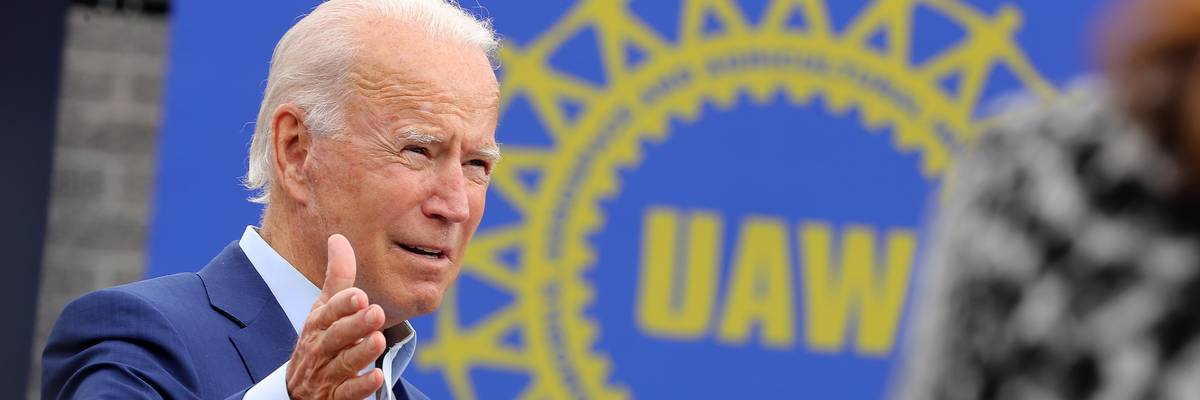
Then-Democratic presidential nominee and former U.S. Vice President Joe Biden delivers remarks in the parking lot outside the United Auto Workers Region 1 offices in Warren, Michigan on September 9, 2020.
"This is unprecedented: a sitting president showing up on the picket lines with workers," said Congressional Progressive Caucus Chair Pramila Jayapal.
In a historic move, U.S. President Joe Biden vowed Friday to travel to Michigan next week and stand with striking United Auto Workers members, an announcement that came just hours after union autoworkers widened their strike to include all U.S. General Motors and Stellantis parts distribution centers.
"Tuesday, I'll go to Michigan to join the picket line and stand in solidarity with the men and women of UAW as they fight for a fair share of the value they helped create," Biden said on social media. "It's time for a win-win agreement that keeps American auto manufacturing thriving with well-paid UAW jobs."
Last Friday, Biden called on automakers to share more of their windfall with UAW workers, who are seeking better pay and benefits.
"Auto companies have seen record profits... They have not been shared fairly with workers," the president said. "I understand the workers' frustration. Over generations, autoworkers have sacrificed so much to keep the industry alive and strong, especially during the economic crisis and the pandemic."
"The companies have made some significant offers," Biden added. "But I believe they should go further to ensure that record corporate profits mean record contracts for the UAW."
Biden—who is seeking reelection next year—is a self-described "pro-labor president" but his response to the UAW is notably different from last year, when he came under fire for signing legislation to block a nationwide rail strike.
At noon Eastern time this Friday, workers at all 38 GM and Stellantis parts distribution facilities across the U.S. walked off the job as the UAW escalated its strike.
"We will shut down parts distribution until those two companies come to their senses and come to the table with a serious offer," UAW president Shawn Fain said in a video update. "The plants that are already on strike will remain on strike."
Fain said Ford was spared the escalation because UAW and company negotiators were making "real progress" at the bargaining table.
While some striking workers said they'd prefer the president didn't join them, others welcomed the solidarity.
"Me personally, I wouldn't mind if Biden stepped up and showed some support," 55-year-old Laura Zielinski of Toledo, Ohio, told Reuters earlier this week, recalling 2010, when he was vice president and visited her city's Stellantis assembly plant.
"Support like that would put a spotlight on the talks—kind of give a nudge to the companies," she added.
Congressional Progressive Caucus Chair Pramila Jayapal (D-Wash.) said Friday on social media that it was "unprecedented" for a sitting U.S. president to join striking workers on a picket line.
Jeremi Suri, a historian and presidential scholar at the University of Texas at Austin, told Reuters the last time it happened was probably in 1902, when then-President Theodore Roosevelt invited striking coal miners to the White House.
"This would be a major, major shift for Biden to identify the presidency with striking workers," said Suri, "rather than siding with industry or staying above the fray."
Dear Common Dreams reader, It’s been nearly 30 years since I co-founded Common Dreams with my late wife, Lina Newhouser. We had the radical notion that journalism should serve the public good, not corporate profits. It was clear to us from the outset what it would take to build such a project. No paid advertisements. No corporate sponsors. No millionaire publisher telling us what to think or do. Many people said we wouldn't last a year, but we proved those doubters wrong. Together with a tremendous team of journalists and dedicated staff, we built an independent media outlet free from the constraints of profits and corporate control. Our mission has always been simple: To inform. To inspire. To ignite change for the common good. Building Common Dreams was not easy. Our survival was never guaranteed. When you take on the most powerful forces—Wall Street greed, fossil fuel industry destruction, Big Tech lobbyists, and uber-rich oligarchs who have spent billions upon billions rigging the economy and democracy in their favor—the only bulwark you have is supporters who believe in your work. But here’s the urgent message from me today. It's never been this bad out there. And it's never been this hard to keep us going. At the very moment Common Dreams is most needed, the threats we face are intensifying. We need your support now more than ever. We don't accept corporate advertising and never will. We don't have a paywall because we don't think people should be blocked from critical news based on their ability to pay. Everything we do is funded by the donations of readers like you. When everyone does the little they can afford, we are strong. But if that support retreats or dries up, so do we. Will you donate now to make sure Common Dreams not only survives but thrives? —Craig Brown, Co-founder |
In a historic move, U.S. President Joe Biden vowed Friday to travel to Michigan next week and stand with striking United Auto Workers members, an announcement that came just hours after union autoworkers widened their strike to include all U.S. General Motors and Stellantis parts distribution centers.
"Tuesday, I'll go to Michigan to join the picket line and stand in solidarity with the men and women of UAW as they fight for a fair share of the value they helped create," Biden said on social media. "It's time for a win-win agreement that keeps American auto manufacturing thriving with well-paid UAW jobs."
Last Friday, Biden called on automakers to share more of their windfall with UAW workers, who are seeking better pay and benefits.
"Auto companies have seen record profits... They have not been shared fairly with workers," the president said. "I understand the workers' frustration. Over generations, autoworkers have sacrificed so much to keep the industry alive and strong, especially during the economic crisis and the pandemic."
"The companies have made some significant offers," Biden added. "But I believe they should go further to ensure that record corporate profits mean record contracts for the UAW."
Biden—who is seeking reelection next year—is a self-described "pro-labor president" but his response to the UAW is notably different from last year, when he came under fire for signing legislation to block a nationwide rail strike.
At noon Eastern time this Friday, workers at all 38 GM and Stellantis parts distribution facilities across the U.S. walked off the job as the UAW escalated its strike.
"We will shut down parts distribution until those two companies come to their senses and come to the table with a serious offer," UAW president Shawn Fain said in a video update. "The plants that are already on strike will remain on strike."
Fain said Ford was spared the escalation because UAW and company negotiators were making "real progress" at the bargaining table.
While some striking workers said they'd prefer the president didn't join them, others welcomed the solidarity.
"Me personally, I wouldn't mind if Biden stepped up and showed some support," 55-year-old Laura Zielinski of Toledo, Ohio, told Reuters earlier this week, recalling 2010, when he was vice president and visited her city's Stellantis assembly plant.
"Support like that would put a spotlight on the talks—kind of give a nudge to the companies," she added.
Congressional Progressive Caucus Chair Pramila Jayapal (D-Wash.) said Friday on social media that it was "unprecedented" for a sitting U.S. president to join striking workers on a picket line.
Jeremi Suri, a historian and presidential scholar at the University of Texas at Austin, told Reuters the last time it happened was probably in 1902, when then-President Theodore Roosevelt invited striking coal miners to the White House.
"This would be a major, major shift for Biden to identify the presidency with striking workers," said Suri, "rather than siding with industry or staying above the fray."
In a historic move, U.S. President Joe Biden vowed Friday to travel to Michigan next week and stand with striking United Auto Workers members, an announcement that came just hours after union autoworkers widened their strike to include all U.S. General Motors and Stellantis parts distribution centers.
"Tuesday, I'll go to Michigan to join the picket line and stand in solidarity with the men and women of UAW as they fight for a fair share of the value they helped create," Biden said on social media. "It's time for a win-win agreement that keeps American auto manufacturing thriving with well-paid UAW jobs."
Last Friday, Biden called on automakers to share more of their windfall with UAW workers, who are seeking better pay and benefits.
"Auto companies have seen record profits... They have not been shared fairly with workers," the president said. "I understand the workers' frustration. Over generations, autoworkers have sacrificed so much to keep the industry alive and strong, especially during the economic crisis and the pandemic."
"The companies have made some significant offers," Biden added. "But I believe they should go further to ensure that record corporate profits mean record contracts for the UAW."
Biden—who is seeking reelection next year—is a self-described "pro-labor president" but his response to the UAW is notably different from last year, when he came under fire for signing legislation to block a nationwide rail strike.
At noon Eastern time this Friday, workers at all 38 GM and Stellantis parts distribution facilities across the U.S. walked off the job as the UAW escalated its strike.
"We will shut down parts distribution until those two companies come to their senses and come to the table with a serious offer," UAW president Shawn Fain said in a video update. "The plants that are already on strike will remain on strike."
Fain said Ford was spared the escalation because UAW and company negotiators were making "real progress" at the bargaining table.
While some striking workers said they'd prefer the president didn't join them, others welcomed the solidarity.
"Me personally, I wouldn't mind if Biden stepped up and showed some support," 55-year-old Laura Zielinski of Toledo, Ohio, told Reuters earlier this week, recalling 2010, when he was vice president and visited her city's Stellantis assembly plant.
"Support like that would put a spotlight on the talks—kind of give a nudge to the companies," she added.
Congressional Progressive Caucus Chair Pramila Jayapal (D-Wash.) said Friday on social media that it was "unprecedented" for a sitting U.S. president to join striking workers on a picket line.
Jeremi Suri, a historian and presidential scholar at the University of Texas at Austin, told Reuters the last time it happened was probably in 1902, when then-President Theodore Roosevelt invited striking coal miners to the White House.
"This would be a major, major shift for Biden to identify the presidency with striking workers," said Suri, "rather than siding with industry or staying above the fray."