SUBSCRIBE TO OUR FREE NEWSLETTER
Daily news & progressive opinion—funded by the people, not the corporations—delivered straight to your inbox.
5
#000000
#FFFFFF
To donate by check, phone, or other method, see our More Ways to Give page.
Daily news & progressive opinion—funded by the people, not the corporations—delivered straight to your inbox.
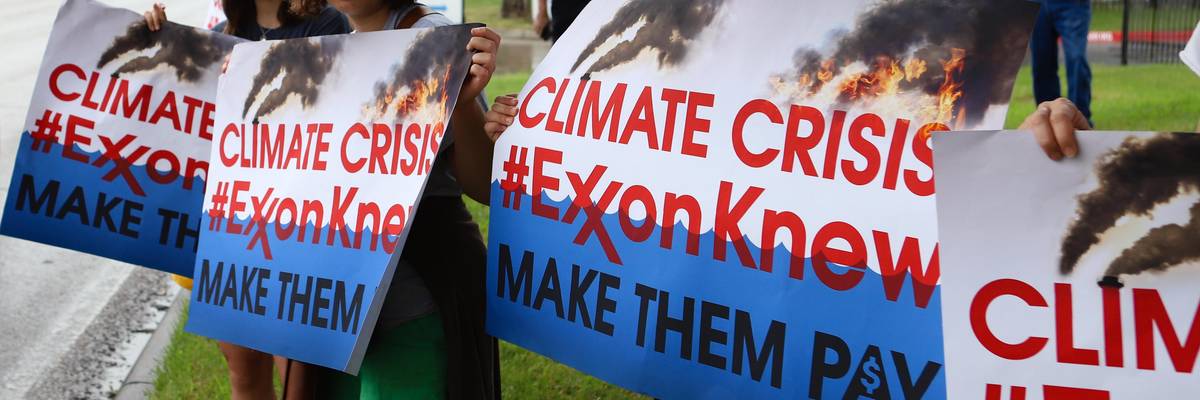
Climate activists protest outside ExxonMobil's annual shareholder meeting on May 29, 2019 in Irving, Texas.
"This ruling is a major victory for Minnesota's efforts to hold oil giants accountable for their climate lies, and a major defeat for fossil fuel companies' attempt to escape justice," said one advocate.
Minnesota on Thursday scored a significant procedural win in a lawsuit seeking to hold Big Oil accountable for lying to consumers about the dangers of burning fossil fuels and thus worsening the deadly climate crisis.
In a unanimous ruling, the U.S. Court of Appeals for the Eighth Circuit agreed with a lower court that the state's climate fraud lawsuit against the American Petroleum Institute, ExxonMobil, and Koch Industries can proceed in state court, where it was filed.
"This ruling is a major victory for Minnesota's efforts to hold oil giants accountable for their climate lies, and a major defeat for fossil fuel companies' attempt to escape justice," Richard Wiles, president of the Center for Climate Integrity, said in a statement.
"Big Oil companies have fought relentlessly to avoid facing the evidence of their climate fraud in state court, but once again judges have unanimously rejected their arguments," said Wiles. "After years of Big Oil's delay tactics, it's time for the people of Minnesota to have their day in court."
Fossil fuel corporations have known for decades that burning coal, oil, and gas generates planet-heating pollution that damages the environment and public health. But to prolong extraction and maximize profits, the industry launched a disinformation campaign to downplay the life-threatening consequences of fossil fuel combustion.
"Big Oil companies have fought relentlessly to avoid facing the evidence of their climate fraud in state court, but once again judges have unanimously rejected their arguments."
Dozens of state and local governments have filed lawsuits arguing that Big Oil's longstanding effort to sow doubt about the reality of anthropogenic climate change—and to minimize the fossil fuel industry's leading role in causing it—has delayed decarbonization of the economy, resulting in widespread harm.
Since 2017, the attorneys general of Connecticut, Delaware, Massachusetts, Minnesota, New Jersey, Rhode Island, Vermont, and the District of Columbia, along with 35 municipalities in California, Colorado, Hawaii, Maryland, New Jersey, New York, South Carolina, Washington, and Puerto Rico, have sued fossil fuel giants in an attempt to hold them financially liable for misleading the public about the destructive effects of greenhouse gas emissions from their products.
"Minnesota is not the first state or local government to file this type of climate change litigation," the Eighth Circuit declared Thursday. "Nor is this the first time" that fossil fuel producers have sought to shift jurisdiction over such suits from state courts to federal court, where they believe they will be more likely to avoid punishment.
"But our sister circuits rejected them in each case," the federal appeals court continued. "Today, we join them."
According to the Center for Climate Integrity, "Six federal appeals courts and 13 federal district courts have now unanimously ruled against the fossil fuel industry's arguments to avoid climate accountability trials in state courts."
Last week, the U.S. Department of Justice moved for the first time to support communities suing Big Oil by urging the U.S. Supreme Court to reject Exxon and Suncor Energy's request to review lower court rulings allowing a lawsuit from three Colorado communities to go forward in state court.
Dear Common Dreams reader, It’s been nearly 30 years since I co-founded Common Dreams with my late wife, Lina Newhouser. We had the radical notion that journalism should serve the public good, not corporate profits. It was clear to us from the outset what it would take to build such a project. No paid advertisements. No corporate sponsors. No millionaire publisher telling us what to think or do. Many people said we wouldn't last a year, but we proved those doubters wrong. Together with a tremendous team of journalists and dedicated staff, we built an independent media outlet free from the constraints of profits and corporate control. Our mission has always been simple: To inform. To inspire. To ignite change for the common good. Building Common Dreams was not easy. Our survival was never guaranteed. When you take on the most powerful forces—Wall Street greed, fossil fuel industry destruction, Big Tech lobbyists, and uber-rich oligarchs who have spent billions upon billions rigging the economy and democracy in their favor—the only bulwark you have is supporters who believe in your work. But here’s the urgent message from me today. It's never been this bad out there. And it's never been this hard to keep us going. At the very moment Common Dreams is most needed, the threats we face are intensifying. We need your support now more than ever. We don't accept corporate advertising and never will. We don't have a paywall because we don't think people should be blocked from critical news based on their ability to pay. Everything we do is funded by the donations of readers like you. When everyone does the little they can afford, we are strong. But if that support retreats or dries up, so do we. Will you donate now to make sure Common Dreams not only survives but thrives? —Craig Brown, Co-founder |
Minnesota on Thursday scored a significant procedural win in a lawsuit seeking to hold Big Oil accountable for lying to consumers about the dangers of burning fossil fuels and thus worsening the deadly climate crisis.
In a unanimous ruling, the U.S. Court of Appeals for the Eighth Circuit agreed with a lower court that the state's climate fraud lawsuit against the American Petroleum Institute, ExxonMobil, and Koch Industries can proceed in state court, where it was filed.
"This ruling is a major victory for Minnesota's efforts to hold oil giants accountable for their climate lies, and a major defeat for fossil fuel companies' attempt to escape justice," Richard Wiles, president of the Center for Climate Integrity, said in a statement.
"Big Oil companies have fought relentlessly to avoid facing the evidence of their climate fraud in state court, but once again judges have unanimously rejected their arguments," said Wiles. "After years of Big Oil's delay tactics, it's time for the people of Minnesota to have their day in court."
Fossil fuel corporations have known for decades that burning coal, oil, and gas generates planet-heating pollution that damages the environment and public health. But to prolong extraction and maximize profits, the industry launched a disinformation campaign to downplay the life-threatening consequences of fossil fuel combustion.
"Big Oil companies have fought relentlessly to avoid facing the evidence of their climate fraud in state court, but once again judges have unanimously rejected their arguments."
Dozens of state and local governments have filed lawsuits arguing that Big Oil's longstanding effort to sow doubt about the reality of anthropogenic climate change—and to minimize the fossil fuel industry's leading role in causing it—has delayed decarbonization of the economy, resulting in widespread harm.
Since 2017, the attorneys general of Connecticut, Delaware, Massachusetts, Minnesota, New Jersey, Rhode Island, Vermont, and the District of Columbia, along with 35 municipalities in California, Colorado, Hawaii, Maryland, New Jersey, New York, South Carolina, Washington, and Puerto Rico, have sued fossil fuel giants in an attempt to hold them financially liable for misleading the public about the destructive effects of greenhouse gas emissions from their products.
"Minnesota is not the first state or local government to file this type of climate change litigation," the Eighth Circuit declared Thursday. "Nor is this the first time" that fossil fuel producers have sought to shift jurisdiction over such suits from state courts to federal court, where they believe they will be more likely to avoid punishment.
"But our sister circuits rejected them in each case," the federal appeals court continued. "Today, we join them."
According to the Center for Climate Integrity, "Six federal appeals courts and 13 federal district courts have now unanimously ruled against the fossil fuel industry's arguments to avoid climate accountability trials in state courts."
Last week, the U.S. Department of Justice moved for the first time to support communities suing Big Oil by urging the U.S. Supreme Court to reject Exxon and Suncor Energy's request to review lower court rulings allowing a lawsuit from three Colorado communities to go forward in state court.
Minnesota on Thursday scored a significant procedural win in a lawsuit seeking to hold Big Oil accountable for lying to consumers about the dangers of burning fossil fuels and thus worsening the deadly climate crisis.
In a unanimous ruling, the U.S. Court of Appeals for the Eighth Circuit agreed with a lower court that the state's climate fraud lawsuit against the American Petroleum Institute, ExxonMobil, and Koch Industries can proceed in state court, where it was filed.
"This ruling is a major victory for Minnesota's efforts to hold oil giants accountable for their climate lies, and a major defeat for fossil fuel companies' attempt to escape justice," Richard Wiles, president of the Center for Climate Integrity, said in a statement.
"Big Oil companies have fought relentlessly to avoid facing the evidence of their climate fraud in state court, but once again judges have unanimously rejected their arguments," said Wiles. "After years of Big Oil's delay tactics, it's time for the people of Minnesota to have their day in court."
Fossil fuel corporations have known for decades that burning coal, oil, and gas generates planet-heating pollution that damages the environment and public health. But to prolong extraction and maximize profits, the industry launched a disinformation campaign to downplay the life-threatening consequences of fossil fuel combustion.
"Big Oil companies have fought relentlessly to avoid facing the evidence of their climate fraud in state court, but once again judges have unanimously rejected their arguments."
Dozens of state and local governments have filed lawsuits arguing that Big Oil's longstanding effort to sow doubt about the reality of anthropogenic climate change—and to minimize the fossil fuel industry's leading role in causing it—has delayed decarbonization of the economy, resulting in widespread harm.
Since 2017, the attorneys general of Connecticut, Delaware, Massachusetts, Minnesota, New Jersey, Rhode Island, Vermont, and the District of Columbia, along with 35 municipalities in California, Colorado, Hawaii, Maryland, New Jersey, New York, South Carolina, Washington, and Puerto Rico, have sued fossil fuel giants in an attempt to hold them financially liable for misleading the public about the destructive effects of greenhouse gas emissions from their products.
"Minnesota is not the first state or local government to file this type of climate change litigation," the Eighth Circuit declared Thursday. "Nor is this the first time" that fossil fuel producers have sought to shift jurisdiction over such suits from state courts to federal court, where they believe they will be more likely to avoid punishment.
"But our sister circuits rejected them in each case," the federal appeals court continued. "Today, we join them."
According to the Center for Climate Integrity, "Six federal appeals courts and 13 federal district courts have now unanimously ruled against the fossil fuel industry's arguments to avoid climate accountability trials in state courts."
Last week, the U.S. Department of Justice moved for the first time to support communities suing Big Oil by urging the U.S. Supreme Court to reject Exxon and Suncor Energy's request to review lower court rulings allowing a lawsuit from three Colorado communities to go forward in state court.