SUBSCRIBE TO OUR FREE NEWSLETTER
Daily news & progressive opinion—funded by the people, not the corporations—delivered straight to your inbox.
5
#000000
#FFFFFF
To donate by check, phone, or other method, see our More Ways to Give page.
Daily news & progressive opinion—funded by the people, not the corporations—delivered straight to your inbox.
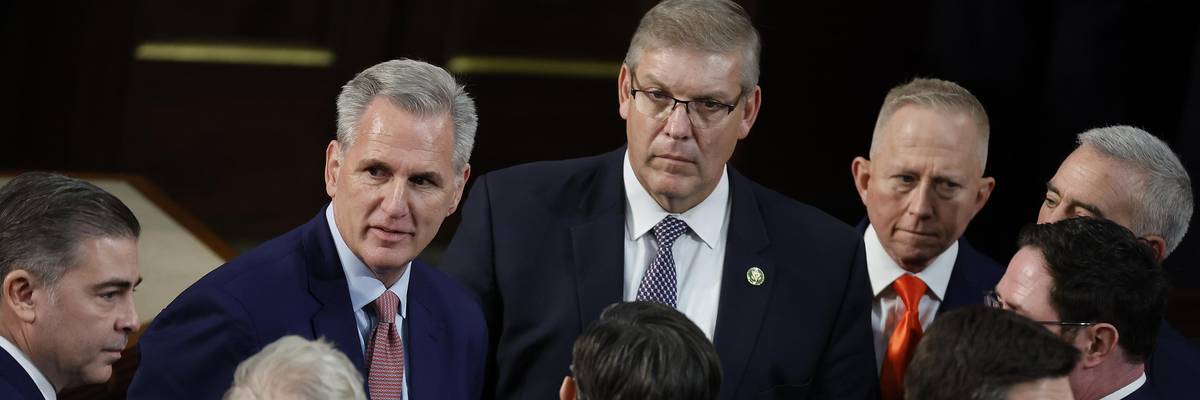
Rep. Kevin McCarthy (R-Calif.) talks with fellow Republican members of the House on January 3, 2023 in Washington, D.C.
"Democrats must stand strong and united to protect Social Security from Republican hostage-taking," said Social Security Works.
It's unclear who will ultimately wield the House speaker's gavel and lead the GOP's narrow majority in the chamber after Rep. Kevin McCarthy failed to win enough support in three consecutive votes on Tuesday.
But progressive advocates say the appearance of intense and seemingly insurmountable divisions within the Republican conference—which corporate media outlets have made the center of attention in recent days—belies the extent to which the party is united on issues of critical importance to the U.S. public.
One such issue is Social Security, a program that Republicans have targeted for cuts and privatization for years under the guise of "saving" it from insolvency even though its finances remain strong and it can't—by law—add to the deficit, rendering common GOP talking points moot.
"Republicans may be in ruins, with the lunatic extremists fighting the slightly less extreme extremists," Social Security Works PAC president Jon Bauman wrote on Twitter as Tuesday's speakership vote descended into chaos.
"But there's one thing you can count on," he added. "They ALL want to cut your Social Security."
Months before the internal GOP struggle over the top House post burst into the open, a group known as the Republican Study Committee (RSC)—comprised at the time of 158 of 212 members of the House GOP caucus, including McCarthy supporters and detractors—released a policy agenda that called for gradually raising the Social Security eligibility age to 70 and means-testing the program's benefits.
The RSC plan, unveiled in June, also called on lawmakers to "consider legislative options that allow employers and employees to reduce their payroll tax liability and use those savings to invest in private retirement options."
"There's one thing you can count on. They ALL want to cut your Social Security."
In subsequent months, including shortly before the November midterms, a number of House Republicans made plain their intention to pursue deeply unpopular cuts to Social Security and Medicare should they retake control of the chamber.
Specifically, GOP members such as Reps. Jason Smith (R-Mo.), Jodey Arrington (R-Texas), Buddy Carter (R-Ga.), and Lloyd Smucker (R-Pa.)—all of whom voted for McCarthy on Tuesday—threatened in October to use a looming fight over the debt ceiling to force long-sought cuts and changes to Social Security.
The federal government is expected to reach the borrowing limit, an arbitrary figure set by Congress, sometime early this year, once again raising the specter of default.
McCarthy, who is now locked in a struggle to lead his party's slim House majority, signaled in October that he would support attempts to enact spending cuts in exchange for any agreement to raise the debt ceiling. The California Republican also joined the far-right flank of his caucus in vocally condemning the recently passed omnibus funding package, which averted a government shutdown last month.
Additionally, in a proposed House rules package released earlier this week, the GOP "replaced Democrats' preferred pay-as-you-go rule, which requires legislation adding to the deficit to be offset with spending cuts or tax increases, with a cut-as-you-go rule that only requires offsets if bills increase mandatory spending within a five-year or ten-year budget window," Roll Call reported.
"This means Republicans can pass tax cuts that would add to the deficit," the outlet noted.
Rep. Jim McGovern (D-Mass.) denounced the proposed rule change as an attempt to "more easily cut taxes on billionaire corporations while slashing the social safety net."
In a new column, Vox's Andrew Prokop argued that the "speakership chaos," which resumed Wednesday, "could well presage a catastrophic collapse of American governance over the debt ceiling and funding issues this year—or at least a very tense situation until a deal can be worked out."
"We could be in for a dangerous showdown—one in which Biden may have to explore options for addressing the debt ceiling without congressional support at all," Prokop added.
Social Security Works echoed that warning on Tuesday, writing on Twitter that "the Republican caucus is in chaos, with their most extreme members in the driver's seat."
"In response," the group added, "Democrats must stand strong and united to protect Social Security from Republican hostage-taking."
Dear Common Dreams reader, It’s been nearly 30 years since I co-founded Common Dreams with my late wife, Lina Newhouser. We had the radical notion that journalism should serve the public good, not corporate profits. It was clear to us from the outset what it would take to build such a project. No paid advertisements. No corporate sponsors. No millionaire publisher telling us what to think or do. Many people said we wouldn't last a year, but we proved those doubters wrong. Together with a tremendous team of journalists and dedicated staff, we built an independent media outlet free from the constraints of profits and corporate control. Our mission has always been simple: To inform. To inspire. To ignite change for the common good. Building Common Dreams was not easy. Our survival was never guaranteed. When you take on the most powerful forces—Wall Street greed, fossil fuel industry destruction, Big Tech lobbyists, and uber-rich oligarchs who have spent billions upon billions rigging the economy and democracy in their favor—the only bulwark you have is supporters who believe in your work. But here’s the urgent message from me today. It's never been this bad out there. And it's never been this hard to keep us going. At the very moment Common Dreams is most needed, the threats we face are intensifying. We need your support now more than ever. We don't accept corporate advertising and never will. We don't have a paywall because we don't think people should be blocked from critical news based on their ability to pay. Everything we do is funded by the donations of readers like you. When everyone does the little they can afford, we are strong. But if that support retreats or dries up, so do we. Will you donate now to make sure Common Dreams not only survives but thrives? —Craig Brown, Co-founder |
It's unclear who will ultimately wield the House speaker's gavel and lead the GOP's narrow majority in the chamber after Rep. Kevin McCarthy failed to win enough support in three consecutive votes on Tuesday.
But progressive advocates say the appearance of intense and seemingly insurmountable divisions within the Republican conference—which corporate media outlets have made the center of attention in recent days—belies the extent to which the party is united on issues of critical importance to the U.S. public.
One such issue is Social Security, a program that Republicans have targeted for cuts and privatization for years under the guise of "saving" it from insolvency even though its finances remain strong and it can't—by law—add to the deficit, rendering common GOP talking points moot.
"Republicans may be in ruins, with the lunatic extremists fighting the slightly less extreme extremists," Social Security Works PAC president Jon Bauman wrote on Twitter as Tuesday's speakership vote descended into chaos.
"But there's one thing you can count on," he added. "They ALL want to cut your Social Security."
Months before the internal GOP struggle over the top House post burst into the open, a group known as the Republican Study Committee (RSC)—comprised at the time of 158 of 212 members of the House GOP caucus, including McCarthy supporters and detractors—released a policy agenda that called for gradually raising the Social Security eligibility age to 70 and means-testing the program's benefits.
The RSC plan, unveiled in June, also called on lawmakers to "consider legislative options that allow employers and employees to reduce their payroll tax liability and use those savings to invest in private retirement options."
"There's one thing you can count on. They ALL want to cut your Social Security."
In subsequent months, including shortly before the November midterms, a number of House Republicans made plain their intention to pursue deeply unpopular cuts to Social Security and Medicare should they retake control of the chamber.
Specifically, GOP members such as Reps. Jason Smith (R-Mo.), Jodey Arrington (R-Texas), Buddy Carter (R-Ga.), and Lloyd Smucker (R-Pa.)—all of whom voted for McCarthy on Tuesday—threatened in October to use a looming fight over the debt ceiling to force long-sought cuts and changes to Social Security.
The federal government is expected to reach the borrowing limit, an arbitrary figure set by Congress, sometime early this year, once again raising the specter of default.
McCarthy, who is now locked in a struggle to lead his party's slim House majority, signaled in October that he would support attempts to enact spending cuts in exchange for any agreement to raise the debt ceiling. The California Republican also joined the far-right flank of his caucus in vocally condemning the recently passed omnibus funding package, which averted a government shutdown last month.
Additionally, in a proposed House rules package released earlier this week, the GOP "replaced Democrats' preferred pay-as-you-go rule, which requires legislation adding to the deficit to be offset with spending cuts or tax increases, with a cut-as-you-go rule that only requires offsets if bills increase mandatory spending within a five-year or ten-year budget window," Roll Call reported.
"This means Republicans can pass tax cuts that would add to the deficit," the outlet noted.
Rep. Jim McGovern (D-Mass.) denounced the proposed rule change as an attempt to "more easily cut taxes on billionaire corporations while slashing the social safety net."
In a new column, Vox's Andrew Prokop argued that the "speakership chaos," which resumed Wednesday, "could well presage a catastrophic collapse of American governance over the debt ceiling and funding issues this year—or at least a very tense situation until a deal can be worked out."
"We could be in for a dangerous showdown—one in which Biden may have to explore options for addressing the debt ceiling without congressional support at all," Prokop added.
Social Security Works echoed that warning on Tuesday, writing on Twitter that "the Republican caucus is in chaos, with their most extreme members in the driver's seat."
"In response," the group added, "Democrats must stand strong and united to protect Social Security from Republican hostage-taking."
It's unclear who will ultimately wield the House speaker's gavel and lead the GOP's narrow majority in the chamber after Rep. Kevin McCarthy failed to win enough support in three consecutive votes on Tuesday.
But progressive advocates say the appearance of intense and seemingly insurmountable divisions within the Republican conference—which corporate media outlets have made the center of attention in recent days—belies the extent to which the party is united on issues of critical importance to the U.S. public.
One such issue is Social Security, a program that Republicans have targeted for cuts and privatization for years under the guise of "saving" it from insolvency even though its finances remain strong and it can't—by law—add to the deficit, rendering common GOP talking points moot.
"Republicans may be in ruins, with the lunatic extremists fighting the slightly less extreme extremists," Social Security Works PAC president Jon Bauman wrote on Twitter as Tuesday's speakership vote descended into chaos.
"But there's one thing you can count on," he added. "They ALL want to cut your Social Security."
Months before the internal GOP struggle over the top House post burst into the open, a group known as the Republican Study Committee (RSC)—comprised at the time of 158 of 212 members of the House GOP caucus, including McCarthy supporters and detractors—released a policy agenda that called for gradually raising the Social Security eligibility age to 70 and means-testing the program's benefits.
The RSC plan, unveiled in June, also called on lawmakers to "consider legislative options that allow employers and employees to reduce their payroll tax liability and use those savings to invest in private retirement options."
"There's one thing you can count on. They ALL want to cut your Social Security."
In subsequent months, including shortly before the November midterms, a number of House Republicans made plain their intention to pursue deeply unpopular cuts to Social Security and Medicare should they retake control of the chamber.
Specifically, GOP members such as Reps. Jason Smith (R-Mo.), Jodey Arrington (R-Texas), Buddy Carter (R-Ga.), and Lloyd Smucker (R-Pa.)—all of whom voted for McCarthy on Tuesday—threatened in October to use a looming fight over the debt ceiling to force long-sought cuts and changes to Social Security.
The federal government is expected to reach the borrowing limit, an arbitrary figure set by Congress, sometime early this year, once again raising the specter of default.
McCarthy, who is now locked in a struggle to lead his party's slim House majority, signaled in October that he would support attempts to enact spending cuts in exchange for any agreement to raise the debt ceiling. The California Republican also joined the far-right flank of his caucus in vocally condemning the recently passed omnibus funding package, which averted a government shutdown last month.
Additionally, in a proposed House rules package released earlier this week, the GOP "replaced Democrats' preferred pay-as-you-go rule, which requires legislation adding to the deficit to be offset with spending cuts or tax increases, with a cut-as-you-go rule that only requires offsets if bills increase mandatory spending within a five-year or ten-year budget window," Roll Call reported.
"This means Republicans can pass tax cuts that would add to the deficit," the outlet noted.
Rep. Jim McGovern (D-Mass.) denounced the proposed rule change as an attempt to "more easily cut taxes on billionaire corporations while slashing the social safety net."
In a new column, Vox's Andrew Prokop argued that the "speakership chaos," which resumed Wednesday, "could well presage a catastrophic collapse of American governance over the debt ceiling and funding issues this year—or at least a very tense situation until a deal can be worked out."
"We could be in for a dangerous showdown—one in which Biden may have to explore options for addressing the debt ceiling without congressional support at all," Prokop added.
Social Security Works echoed that warning on Tuesday, writing on Twitter that "the Republican caucus is in chaos, with their most extreme members in the driver's seat."
"In response," the group added, "Democrats must stand strong and united to protect Social Security from Republican hostage-taking."