SUBSCRIBE TO OUR FREE NEWSLETTER
Daily news & progressive opinion—funded by the people, not the corporations—delivered straight to your inbox.
5
#000000
#FFFFFF
To donate by check, phone, or other method, see our More Ways to Give page.
Daily news & progressive opinion—funded by the people, not the corporations—delivered straight to your inbox.
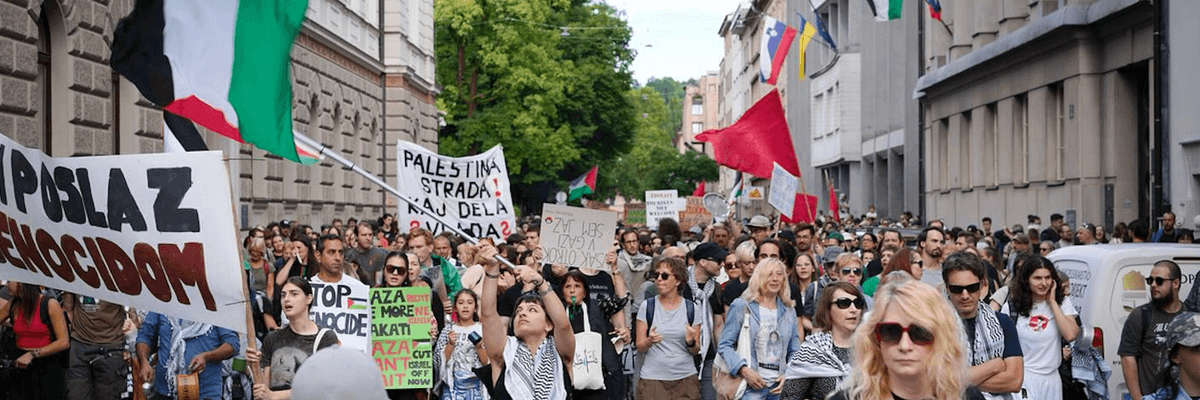
People march in an August 6, 2025 solidarity rally for Gaza in the Slovenian capital Ljubljana.
“We urge the United States and other governments around the world to follow Slovenia’s lead by implementing similar measures," said CAIR.
Slovenia on Thursday banned Israeli Prime Minister Benjamin Netanyahu—who is wanted by the International Criminal Court for alleged crimes against humanity and war crimes in Gaza—from entering the European nation, prompting calls for other countries, especially the United States, to follow suit.
The Slovenian Ministry of Foreign and European Affairs (MFEA) declared Netanyahu persona non grata, noting the ICC's outstanding arrest warrant for the Israeli leader, who is accused of crimes in Gaza, including murder and forced starvation.
"Already in July 2024, the ICJ established that several Israeli policies and practices violate international humanitarian law and human rights law," MFEA noted, referring to the International Court of Justice's advisory opinion declaring that Israel's occupation of Palestine, including Gaza, is an illegal form of apartheid that must end as soon as possible.
MFEA State Secretary Neva Grašič cited this month's confirmation by a commission of United Nations experts that Israel is committing genocide in Gaza, where nearly two years of bombardment, siege, invasion, and forced starvation have left more than 241,000 Palestinians dead, wounded, or missing and millions more forcibly displaced, sickened, and starved in an officially declared famine.
“This was the first time that the UN has called the Israeli conduct in Gaza a genocidal one,” she said.
Grašič stressed that the move against Netanyahu "does not mean a measure against the Israeli people, but sends a clear message to the government of the state of Israel that Slovenia expects strict respect for the decisions of international courts and international humanitarian law."
Slovenia had already declared Israeli National Security Minister Itamar Ben-Gvir and Israeli Finance Minister Bezalel Smotrich personae non gratae in July over their genocidal statements, advocacy of ethnic cleansing, and incitement to violence against Palestinians.
The Council on American-Islamic Relations (CAIR) was among those calling on other nations to follow Slovenia's example.
“We commend Slovenia for taking a principled stand in support of international law and human rights by barring Prime Minister Netanyahu from entering its territory while he presides over the genocide in Gaza," the Washington, DC-based group said in a statement. "This is a necessary step toward accountability and justice."
“We urge the United States and other governments around the world to follow Slovenia’s lead by implementing similar measures until those responsible for crimes against humanity are held accountable," CAIR added.
In addition to travel sanctions, Slovenia has formally recognized Palestinian statehood, supports the ICJ genocide case against Israel filed by South Africa, and took part in July's Hague Group emergency summit in Colombia—which produced a joint action plan aimed at bringing an end to the Gaza genocide.
Slovenia also announced Thursday that it is contributing €1.2 million ($1.3 million) to the Palestinian Authority as part of a European-Saudi initiative aimed at ensuring the viability of Palestine's economy.
"Given the fact that the Republic of Slovenia recognized the state of Palestine... and that it actively participates in initiatives for the implementation of two-state solutions, it is necessary to substantiate political support also with financial resources," Grašič explained.
Dear Common Dreams reader, It’s been nearly 30 years since I co-founded Common Dreams with my late wife, Lina Newhouser. We had the radical notion that journalism should serve the public good, not corporate profits. It was clear to us from the outset what it would take to build such a project. No paid advertisements. No corporate sponsors. No millionaire publisher telling us what to think or do. Many people said we wouldn't last a year, but we proved those doubters wrong. Together with a tremendous team of journalists and dedicated staff, we built an independent media outlet free from the constraints of profits and corporate control. Our mission has always been simple: To inform. To inspire. To ignite change for the common good. Building Common Dreams was not easy. Our survival was never guaranteed. When you take on the most powerful forces—Wall Street greed, fossil fuel industry destruction, Big Tech lobbyists, and uber-rich oligarchs who have spent billions upon billions rigging the economy and democracy in their favor—the only bulwark you have is supporters who believe in your work. But here’s the urgent message from me today. It's never been this bad out there. And it's never been this hard to keep us going. At the very moment Common Dreams is most needed, the threats we face are intensifying. We need your support now more than ever. We don't accept corporate advertising and never will. We don't have a paywall because we don't think people should be blocked from critical news based on their ability to pay. Everything we do is funded by the donations of readers like you. When everyone does the little they can afford, we are strong. But if that support retreats or dries up, so do we. Will you donate now to make sure Common Dreams not only survives but thrives? —Craig Brown, Co-founder |
Slovenia on Thursday banned Israeli Prime Minister Benjamin Netanyahu—who is wanted by the International Criminal Court for alleged crimes against humanity and war crimes in Gaza—from entering the European nation, prompting calls for other countries, especially the United States, to follow suit.
The Slovenian Ministry of Foreign and European Affairs (MFEA) declared Netanyahu persona non grata, noting the ICC's outstanding arrest warrant for the Israeli leader, who is accused of crimes in Gaza, including murder and forced starvation.
"Already in July 2024, the ICJ established that several Israeli policies and practices violate international humanitarian law and human rights law," MFEA noted, referring to the International Court of Justice's advisory opinion declaring that Israel's occupation of Palestine, including Gaza, is an illegal form of apartheid that must end as soon as possible.
MFEA State Secretary Neva Grašič cited this month's confirmation by a commission of United Nations experts that Israel is committing genocide in Gaza, where nearly two years of bombardment, siege, invasion, and forced starvation have left more than 241,000 Palestinians dead, wounded, or missing and millions more forcibly displaced, sickened, and starved in an officially declared famine.
“This was the first time that the UN has called the Israeli conduct in Gaza a genocidal one,” she said.
Grašič stressed that the move against Netanyahu "does not mean a measure against the Israeli people, but sends a clear message to the government of the state of Israel that Slovenia expects strict respect for the decisions of international courts and international humanitarian law."
Slovenia had already declared Israeli National Security Minister Itamar Ben-Gvir and Israeli Finance Minister Bezalel Smotrich personae non gratae in July over their genocidal statements, advocacy of ethnic cleansing, and incitement to violence against Palestinians.
The Council on American-Islamic Relations (CAIR) was among those calling on other nations to follow Slovenia's example.
“We commend Slovenia for taking a principled stand in support of international law and human rights by barring Prime Minister Netanyahu from entering its territory while he presides over the genocide in Gaza," the Washington, DC-based group said in a statement. "This is a necessary step toward accountability and justice."
“We urge the United States and other governments around the world to follow Slovenia’s lead by implementing similar measures until those responsible for crimes against humanity are held accountable," CAIR added.
In addition to travel sanctions, Slovenia has formally recognized Palestinian statehood, supports the ICJ genocide case against Israel filed by South Africa, and took part in July's Hague Group emergency summit in Colombia—which produced a joint action plan aimed at bringing an end to the Gaza genocide.
Slovenia also announced Thursday that it is contributing €1.2 million ($1.3 million) to the Palestinian Authority as part of a European-Saudi initiative aimed at ensuring the viability of Palestine's economy.
"Given the fact that the Republic of Slovenia recognized the state of Palestine... and that it actively participates in initiatives for the implementation of two-state solutions, it is necessary to substantiate political support also with financial resources," Grašič explained.
Slovenia on Thursday banned Israeli Prime Minister Benjamin Netanyahu—who is wanted by the International Criminal Court for alleged crimes against humanity and war crimes in Gaza—from entering the European nation, prompting calls for other countries, especially the United States, to follow suit.
The Slovenian Ministry of Foreign and European Affairs (MFEA) declared Netanyahu persona non grata, noting the ICC's outstanding arrest warrant for the Israeli leader, who is accused of crimes in Gaza, including murder and forced starvation.
"Already in July 2024, the ICJ established that several Israeli policies and practices violate international humanitarian law and human rights law," MFEA noted, referring to the International Court of Justice's advisory opinion declaring that Israel's occupation of Palestine, including Gaza, is an illegal form of apartheid that must end as soon as possible.
MFEA State Secretary Neva Grašič cited this month's confirmation by a commission of United Nations experts that Israel is committing genocide in Gaza, where nearly two years of bombardment, siege, invasion, and forced starvation have left more than 241,000 Palestinians dead, wounded, or missing and millions more forcibly displaced, sickened, and starved in an officially declared famine.
“This was the first time that the UN has called the Israeli conduct in Gaza a genocidal one,” she said.
Grašič stressed that the move against Netanyahu "does not mean a measure against the Israeli people, but sends a clear message to the government of the state of Israel that Slovenia expects strict respect for the decisions of international courts and international humanitarian law."
Slovenia had already declared Israeli National Security Minister Itamar Ben-Gvir and Israeli Finance Minister Bezalel Smotrich personae non gratae in July over their genocidal statements, advocacy of ethnic cleansing, and incitement to violence against Palestinians.
The Council on American-Islamic Relations (CAIR) was among those calling on other nations to follow Slovenia's example.
“We commend Slovenia for taking a principled stand in support of international law and human rights by barring Prime Minister Netanyahu from entering its territory while he presides over the genocide in Gaza," the Washington, DC-based group said in a statement. "This is a necessary step toward accountability and justice."
“We urge the United States and other governments around the world to follow Slovenia’s lead by implementing similar measures until those responsible for crimes against humanity are held accountable," CAIR added.
In addition to travel sanctions, Slovenia has formally recognized Palestinian statehood, supports the ICJ genocide case against Israel filed by South Africa, and took part in July's Hague Group emergency summit in Colombia—which produced a joint action plan aimed at bringing an end to the Gaza genocide.
Slovenia also announced Thursday that it is contributing €1.2 million ($1.3 million) to the Palestinian Authority as part of a European-Saudi initiative aimed at ensuring the viability of Palestine's economy.
"Given the fact that the Republic of Slovenia recognized the state of Palestine... and that it actively participates in initiatives for the implementation of two-state solutions, it is necessary to substantiate political support also with financial resources," Grašič explained.