SUBSCRIBE TO OUR FREE NEWSLETTER
Daily news & progressive opinion—funded by the people, not the corporations—delivered straight to your inbox.
5
#000000
#FFFFFF
To donate by check, phone, or other method, see our More Ways to Give page.
Daily news & progressive opinion—funded by the people, not the corporations—delivered straight to your inbox.
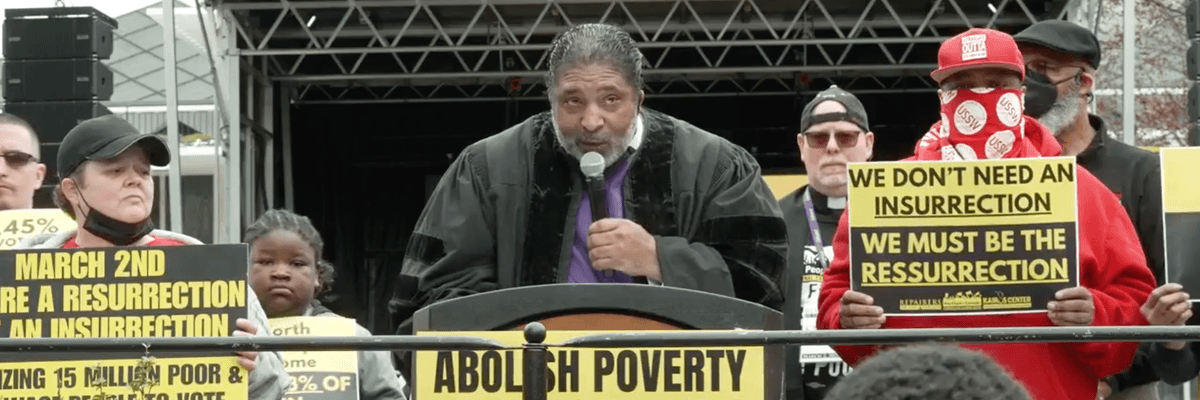
Rev. Dr. William Barber speaks during a demonstration in Raleigh, North Carolina on March 2, 2024.
"Our government's refusal to fully address poverty and low wages even after the worst days of Covid is not only killing our brothers and sisters," said Rev. Dr. William Barber. "It's killing our public conscience."
Low-wage workers, faith leaders, and allies rallied in state capitals across the United States on Saturday as part of a mass mobilization of poor voters ahead of the pivotal 2024 election.
The nationwide demonstrations were organized by the Poor People's Campaign, a multiracial movement calling on state legislators and members of the U.S. Congress to act immediately to end the "crisis of death by poverty" in the richest country in the world. Research published last year found that poverty is the fourth-leading cause of death in the United States.
Thousands gathered and marched Saturday in 32 states—from Maine to Indiana to North Carolina—and Washington, D.C., carrying signs that read "abolish poverty" and "our votes are demands." In South Carolina and other states, activists placed mock coffins on the steps of state Capitol buildings as they demanded living wages, stronger workplace protections, and universal healthcare.
William J. Barber, national co-chair of the Poor People's Campaign, said during a demonstration in Raleigh that "the low-wage voices you hear today are living testimony... telling their stories, crying out against the forces of death."
"Our government's refusal to fully address poverty and low wages even after the worst days of Covid is not only killing our brothers and sisters," added Barber. "It's killing our public conscience."
Eric Winston, a member of the Union of Southern Service Workers and a catering cook for a minor league baseball team, told the crowd in Raleigh that he's "tired of working low-wage jobs over and over thinking just working hard would get me what I need."
"I'm tired of working 70 to 80 hours a week and still not having money for the necessity of bills," said Winston. "I'm tired of getting sick and not being able to go see the doctor."
"I organize today because I'm sick and tired of fighting by myself. There's more people in my situation who may not look like me but go through the same struggles as I do," Winston continued. "As working people, we should only vote for politicians who support the rights of workers. Period."
In Columbus, Rev. Dr. Jack Sullivan noted during remarks from the steps of Ohio's Capitol building that long-term poverty kills more than 800 people per day in the United States.
"I have to believe that if 800 politicians were to die every day, if 800 CEOs were to die every day, there would be congressional hearings, Senate subcommittee gatherings, documentation to prevent the tragic deaths of those leaders," said Sullivan. "How 'bout some documentation to prevent the tragic deaths of the poor!"
The nationwide rallies came after the Poor People's Campaign launched a 42-week mobilization of low-income voters who were critical in defeating former President Donald Trump in 2020.
"There are approximately 85 million poor and low-wage eligible voters in this country who represent at least 30% of the electorate. In so-called battleground states, it's close to and over 40%," the campaign said ahead of Saturday's demonstrations. "High percentages of poor and low-wage voters don't vote because politicians fail to enact policies or address the issues that affect their lives."
On March 4, advocates with the Poor People's Campaign are planning to gather at legislative offices in state capitals across the U.S. to deliver a "package to legislators on both sides of the political aisle documenting the conditions poor people are facing in their state and the bold actions that can be taken to address these crises."
"It is not a mistake that we are meeting here before the State of the Union address in Congress, because we intend to drive this issue right into the heart of our politics," Barber said Saturday. "Two hundred and ninety-five thousand people will die this year and have died every year for the last few years from poverty. That's on our own front door."
"Nobody ever calls their name," said Barber. "Nobody challenges this political violence."
Dear Common Dreams reader, It’s been nearly 30 years since I co-founded Common Dreams with my late wife, Lina Newhouser. We had the radical notion that journalism should serve the public good, not corporate profits. It was clear to us from the outset what it would take to build such a project. No paid advertisements. No corporate sponsors. No millionaire publisher telling us what to think or do. Many people said we wouldn't last a year, but we proved those doubters wrong. Together with a tremendous team of journalists and dedicated staff, we built an independent media outlet free from the constraints of profits and corporate control. Our mission has always been simple: To inform. To inspire. To ignite change for the common good. Building Common Dreams was not easy. Our survival was never guaranteed. When you take on the most powerful forces—Wall Street greed, fossil fuel industry destruction, Big Tech lobbyists, and uber-rich oligarchs who have spent billions upon billions rigging the economy and democracy in their favor—the only bulwark you have is supporters who believe in your work. But here’s the urgent message from me today. It's never been this bad out there. And it's never been this hard to keep us going. At the very moment Common Dreams is most needed, the threats we face are intensifying. We need your support now more than ever. We don't accept corporate advertising and never will. We don't have a paywall because we don't think people should be blocked from critical news based on their ability to pay. Everything we do is funded by the donations of readers like you. When everyone does the little they can afford, we are strong. But if that support retreats or dries up, so do we. Will you donate now to make sure Common Dreams not only survives but thrives? —Craig Brown, Co-founder |
Low-wage workers, faith leaders, and allies rallied in state capitals across the United States on Saturday as part of a mass mobilization of poor voters ahead of the pivotal 2024 election.
The nationwide demonstrations were organized by the Poor People's Campaign, a multiracial movement calling on state legislators and members of the U.S. Congress to act immediately to end the "crisis of death by poverty" in the richest country in the world. Research published last year found that poverty is the fourth-leading cause of death in the United States.
Thousands gathered and marched Saturday in 32 states—from Maine to Indiana to North Carolina—and Washington, D.C., carrying signs that read "abolish poverty" and "our votes are demands." In South Carolina and other states, activists placed mock coffins on the steps of state Capitol buildings as they demanded living wages, stronger workplace protections, and universal healthcare.
William J. Barber, national co-chair of the Poor People's Campaign, said during a demonstration in Raleigh that "the low-wage voices you hear today are living testimony... telling their stories, crying out against the forces of death."
"Our government's refusal to fully address poverty and low wages even after the worst days of Covid is not only killing our brothers and sisters," added Barber. "It's killing our public conscience."
Eric Winston, a member of the Union of Southern Service Workers and a catering cook for a minor league baseball team, told the crowd in Raleigh that he's "tired of working low-wage jobs over and over thinking just working hard would get me what I need."
"I'm tired of working 70 to 80 hours a week and still not having money for the necessity of bills," said Winston. "I'm tired of getting sick and not being able to go see the doctor."
"I organize today because I'm sick and tired of fighting by myself. There's more people in my situation who may not look like me but go through the same struggles as I do," Winston continued. "As working people, we should only vote for politicians who support the rights of workers. Period."
In Columbus, Rev. Dr. Jack Sullivan noted during remarks from the steps of Ohio's Capitol building that long-term poverty kills more than 800 people per day in the United States.
"I have to believe that if 800 politicians were to die every day, if 800 CEOs were to die every day, there would be congressional hearings, Senate subcommittee gatherings, documentation to prevent the tragic deaths of those leaders," said Sullivan. "How 'bout some documentation to prevent the tragic deaths of the poor!"
The nationwide rallies came after the Poor People's Campaign launched a 42-week mobilization of low-income voters who were critical in defeating former President Donald Trump in 2020.
"There are approximately 85 million poor and low-wage eligible voters in this country who represent at least 30% of the electorate. In so-called battleground states, it's close to and over 40%," the campaign said ahead of Saturday's demonstrations. "High percentages of poor and low-wage voters don't vote because politicians fail to enact policies or address the issues that affect their lives."
On March 4, advocates with the Poor People's Campaign are planning to gather at legislative offices in state capitals across the U.S. to deliver a "package to legislators on both sides of the political aisle documenting the conditions poor people are facing in their state and the bold actions that can be taken to address these crises."
"It is not a mistake that we are meeting here before the State of the Union address in Congress, because we intend to drive this issue right into the heart of our politics," Barber said Saturday. "Two hundred and ninety-five thousand people will die this year and have died every year for the last few years from poverty. That's on our own front door."
"Nobody ever calls their name," said Barber. "Nobody challenges this political violence."
Low-wage workers, faith leaders, and allies rallied in state capitals across the United States on Saturday as part of a mass mobilization of poor voters ahead of the pivotal 2024 election.
The nationwide demonstrations were organized by the Poor People's Campaign, a multiracial movement calling on state legislators and members of the U.S. Congress to act immediately to end the "crisis of death by poverty" in the richest country in the world. Research published last year found that poverty is the fourth-leading cause of death in the United States.
Thousands gathered and marched Saturday in 32 states—from Maine to Indiana to North Carolina—and Washington, D.C., carrying signs that read "abolish poverty" and "our votes are demands." In South Carolina and other states, activists placed mock coffins on the steps of state Capitol buildings as they demanded living wages, stronger workplace protections, and universal healthcare.
William J. Barber, national co-chair of the Poor People's Campaign, said during a demonstration in Raleigh that "the low-wage voices you hear today are living testimony... telling their stories, crying out against the forces of death."
"Our government's refusal to fully address poverty and low wages even after the worst days of Covid is not only killing our brothers and sisters," added Barber. "It's killing our public conscience."
Eric Winston, a member of the Union of Southern Service Workers and a catering cook for a minor league baseball team, told the crowd in Raleigh that he's "tired of working low-wage jobs over and over thinking just working hard would get me what I need."
"I'm tired of working 70 to 80 hours a week and still not having money for the necessity of bills," said Winston. "I'm tired of getting sick and not being able to go see the doctor."
"I organize today because I'm sick and tired of fighting by myself. There's more people in my situation who may not look like me but go through the same struggles as I do," Winston continued. "As working people, we should only vote for politicians who support the rights of workers. Period."
In Columbus, Rev. Dr. Jack Sullivan noted during remarks from the steps of Ohio's Capitol building that long-term poverty kills more than 800 people per day in the United States.
"I have to believe that if 800 politicians were to die every day, if 800 CEOs were to die every day, there would be congressional hearings, Senate subcommittee gatherings, documentation to prevent the tragic deaths of those leaders," said Sullivan. "How 'bout some documentation to prevent the tragic deaths of the poor!"
The nationwide rallies came after the Poor People's Campaign launched a 42-week mobilization of low-income voters who were critical in defeating former President Donald Trump in 2020.
"There are approximately 85 million poor and low-wage eligible voters in this country who represent at least 30% of the electorate. In so-called battleground states, it's close to and over 40%," the campaign said ahead of Saturday's demonstrations. "High percentages of poor and low-wage voters don't vote because politicians fail to enact policies or address the issues that affect their lives."
On March 4, advocates with the Poor People's Campaign are planning to gather at legislative offices in state capitals across the U.S. to deliver a "package to legislators on both sides of the political aisle documenting the conditions poor people are facing in their state and the bold actions that can be taken to address these crises."
"It is not a mistake that we are meeting here before the State of the Union address in Congress, because we intend to drive this issue right into the heart of our politics," Barber said Saturday. "Two hundred and ninety-five thousand people will die this year and have died every year for the last few years from poverty. That's on our own front door."
"Nobody ever calls their name," said Barber. "Nobody challenges this political violence."