5
#000000
#FFFFFF
To donate by check, phone, or other method, see our More Ways to Give page.

The Pentagon's official estimate of the direct financial cost of the US war on Iran is a nearly threefold undercount of the actual price tag of the war, according to an expert analysis published Wednesday.
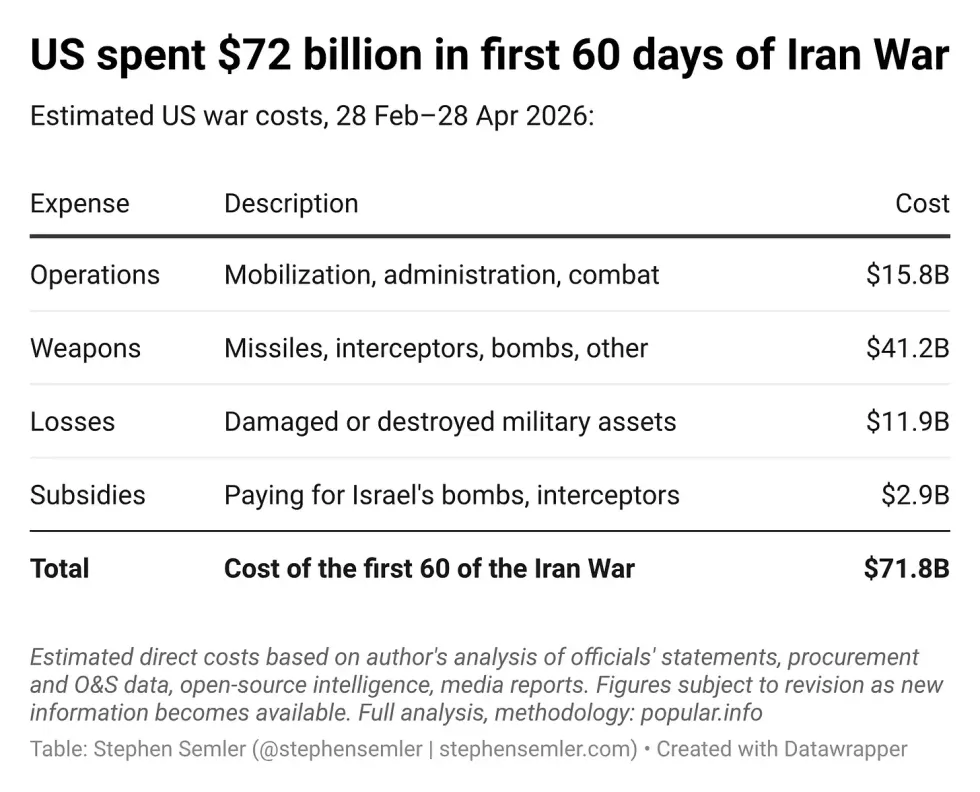
Stephen Semler, a senior fellow at the Center for International Policy, produced the new cost estimate for the Popular Information newsletter. Accounting for armament use, troop deployments, and other factors, Semler estimated that the US government spent $71.8 billion on the Iran war over the course of 60 days—an average of $1.2 billion per day.
"Like the estimates from Pentagon leadership and unnamed officials, this figure refers only to direct war costs—near-term expenses for military operations, munitions, and the like—and not indirect costs, which include broader economic impacts, interest on the national debt, and longer-term expenses like veterans’ care," explained Semler, who argued that the Pentagon's $25 billion cost estimate suffers from "incomplete accounting of damaged or destroyed military assets, the exclusion of costs outside the department (including billions of dollars in State Department-funded military aid to Israel), and a flawed method for tracking munition expenditures."
Semler, who detailed his methodology in a separate post, accused top Pentagon officials of attempting to deliberately mislead lawmakers and the American public about the true cost of the war, which is historically unpopular.
"The $25 billion war cost given by Pentagon Secretary [Pete] Hegseth and acting Comptroller [Jules] Hurst before Congress was a lie," Semler wrote Wednesday. "It was a denial of the Iran war’s spiraling costs, one of several foreseen consequences of the Trump administration’s decision to go to war. The closing of the Strait of Hormuz is another predictable consequence."
Semler's analysis was released days after unnamed Trump administration officials told CBS News that they believe the actual US cost of the Iran war is roughly double the estimate offered under oath by Pentagon leaders.
"US officials familiar with internal assessments suggested the war's price tag is closer to $50 billion so far," CBS News reported. "Much of the gap is accounted for by munitions that have been used and need to be replaced. For instance, the Pentagon has lost 24 MQ-9 Reaper drones—sophisticated unmanned aircraft that can cost $30 million or more apiece—underscoring how quickly the financial toll has mounted. Taken together, the higher estimate reflects not only the tempo of operations but also the often unseen costs of attrition, as material lost in the field reshapes the ledger."
Ongoing efforts to calculate the costs of US-Israeli war—which has killed thousands, displaced millions, sent global energy markets into chaos, and sparked fears of a worldwide food crisis—come as Trump continues to threaten Iran with an even more aggressive bombing campaign, which would send the conflict's price tag soaring further.
In a Truth Social post early Wednesday, Trump said that if Iran doesn't agree to US terms to end the war, "the bombing starts, and it will be, sadly, at a much higher level and intensity than it was before."
The Pentagon's official estimate of the direct financial cost of the US war on Iran is a nearly threefold undercount of the actual price tag of the war, according to an expert analysis published Wednesday.
Stephen Semler, a senior fellow at the Center for International Policy, produced the new cost estimate for the Popular Information newsletter. Accounting for armament use, troop deployments, and other factors, Semler estimated that the US government spent $71.8 billion on the Iran war over the course of 60 days—an average of $1.2 billion per day.
"Like the estimates from Pentagon leadership and unnamed officials, this figure refers only to direct war costs—near-term expenses for military operations, munitions, and the like—and not indirect costs, which include broader economic impacts, interest on the national debt, and longer-term expenses like veterans’ care," explained Semler, who argued that the Pentagon's $25 billion cost estimate suffers from "incomplete accounting of damaged or destroyed military assets, the exclusion of costs outside the department (including billions of dollars in State Department-funded military aid to Israel), and a flawed method for tracking munition expenditures."
Semler, who detailed his methodology in a separate post, accused top Pentagon officials of attempting to deliberately mislead lawmakers and the American public about the true cost of the war, which is historically unpopular.
"The $25 billion war cost given by Pentagon Secretary [Pete] Hegseth and acting Comptroller [Jules] Hurst before Congress was a lie," Semler wrote Wednesday. "It was a denial of the Iran war’s spiraling costs, one of several foreseen consequences of the Trump administration’s decision to go to war. The closing of the Strait of Hormuz is another predictable consequence."
Semler's analysis was released days after unnamed Trump administration officials told CBS News that they believe the actual US cost of the Iran war is roughly double the estimate offered under oath by Pentagon leaders.
"US officials familiar with internal assessments suggested the war's price tag is closer to $50 billion so far," CBS News reported. "Much of the gap is accounted for by munitions that have been used and need to be replaced. For instance, the Pentagon has lost 24 MQ-9 Reaper drones—sophisticated unmanned aircraft that can cost $30 million or more apiece—underscoring how quickly the financial toll has mounted. Taken together, the higher estimate reflects not only the tempo of operations but also the often unseen costs of attrition, as material lost in the field reshapes the ledger."
Ongoing efforts to calculate the costs of US-Israeli war—which has killed thousands, displaced millions, sent global energy markets into chaos, and sparked fears of a worldwide food crisis—come as Trump continues to threaten Iran with an even more aggressive bombing campaign, which would send the conflict's price tag soaring further.
In a Truth Social post early Wednesday, Trump said that if Iran doesn't agree to US terms to end the war, "the bombing starts, and it will be, sadly, at a much higher level and intensity than it was before."
The Pentagon's official estimate of the direct financial cost of the US war on Iran is a nearly threefold undercount of the actual price tag of the war, according to an expert analysis published Wednesday.
Stephen Semler, a senior fellow at the Center for International Policy, produced the new cost estimate for the Popular Information newsletter. Accounting for armament use, troop deployments, and other factors, Semler estimated that the US government spent $71.8 billion on the Iran war over the course of 60 days—an average of $1.2 billion per day.
"Like the estimates from Pentagon leadership and unnamed officials, this figure refers only to direct war costs—near-term expenses for military operations, munitions, and the like—and not indirect costs, which include broader economic impacts, interest on the national debt, and longer-term expenses like veterans’ care," explained Semler, who argued that the Pentagon's $25 billion cost estimate suffers from "incomplete accounting of damaged or destroyed military assets, the exclusion of costs outside the department (including billions of dollars in State Department-funded military aid to Israel), and a flawed method for tracking munition expenditures."
Semler, who detailed his methodology in a separate post, accused top Pentagon officials of attempting to deliberately mislead lawmakers and the American public about the true cost of the war, which is historically unpopular.
"The $25 billion war cost given by Pentagon Secretary [Pete] Hegseth and acting Comptroller [Jules] Hurst before Congress was a lie," Semler wrote Wednesday. "It was a denial of the Iran war’s spiraling costs, one of several foreseen consequences of the Trump administration’s decision to go to war. The closing of the Strait of Hormuz is another predictable consequence."
Semler's analysis was released days after unnamed Trump administration officials told CBS News that they believe the actual US cost of the Iran war is roughly double the estimate offered under oath by Pentagon leaders.
"US officials familiar with internal assessments suggested the war's price tag is closer to $50 billion so far," CBS News reported. "Much of the gap is accounted for by munitions that have been used and need to be replaced. For instance, the Pentagon has lost 24 MQ-9 Reaper drones—sophisticated unmanned aircraft that can cost $30 million or more apiece—underscoring how quickly the financial toll has mounted. Taken together, the higher estimate reflects not only the tempo of operations but also the often unseen costs of attrition, as material lost in the field reshapes the ledger."
Ongoing efforts to calculate the costs of US-Israeli war—which has killed thousands, displaced millions, sent global energy markets into chaos, and sparked fears of a worldwide food crisis—come as Trump continues to threaten Iran with an even more aggressive bombing campaign, which would send the conflict's price tag soaring further.
In a Truth Social post early Wednesday, Trump said that if Iran doesn't agree to US terms to end the war, "the bombing starts, and it will be, sadly, at a much higher level and intensity than it was before."