SUBSCRIBE TO OUR FREE NEWSLETTER
Daily news & progressive opinion—funded by the people, not the corporations—delivered straight to your inbox.
5
#000000
#FFFFFF
To donate by check, phone, or other method, see our More Ways to Give page.
Daily news & progressive opinion—funded by the people, not the corporations—delivered straight to your inbox.
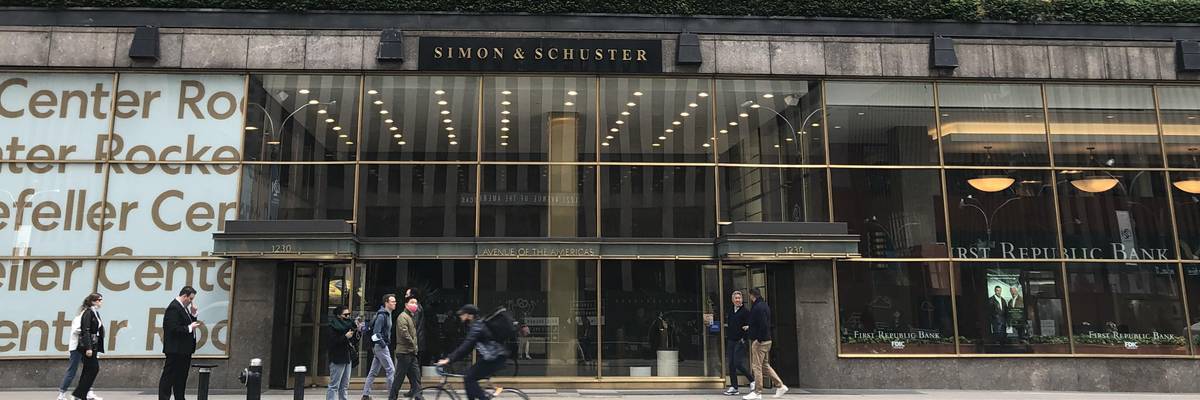
The entrance to Simon & Schuster publishing house is seen in New York City on April 27, 2022. (Photo: Lindsey Nicholson/UCG/Universal Images Group via Getty Images)
Authors and antitrust advocates alike on Tuesday celebrated a federal judge's ruling that blocked publishing company Penguin Random House from buying one of its top competitors, marking what one observer called a "major milestone" in anti-monopoly enforcement and potentially signaling future actions against retail giant Amazon.
Judge Florence Y. Pan of the U.S. Court of Appeals for the District of Columbia Circuit ruled that the proposed $2.175 billion merger would "substantially" harm competition as publishing houses compete for the rights to publish new books, which the U.S. Justice Department had argued would drive down compensation for authors.
"This decision is an enormous win for America's book publishing business--especially readers, authors, and editors," said Barry Lynn, executive director of the Open Markets Institute, which works to combat monopolization. "This is also a huge win for America's system of antitrust law--designed to protect creators, workers, independent businesses, and consumers from consolidated power and control."
The Biden administration focused its arguments on the effects the merger would have on the authors of highly-anticipated books, and government attorneys were supported by literary agents and renowned authors including Stephen King, who expressed concern for writers who are just starting out in their publishing careers.
"Publishing should be more focused on cultural growth and literary achievement and less on corporate balance sheets," King told The New York Times after the ruling was announced late Monday.
Stacy Mitchell, co-director of the Institute for Local Self-Reliance, said the DOJ's focus on potential lost income for authors was significant.
"This ruling begins to lay a path to solve our monopoly problem--a path in which enforcers and the courts block mergers and break up monopolies because they understand that concentrated power inevitably harms people, whether as consumers, producers, or citizens," said Mitchell.
The DOJ also argued that the merger could ultimately cut down on the number and diversity of books published each year--countering Penguin Random House and Simon & Schuster's claim that the merged companies would be able to reduce their costs and spend more money on books.
"Today's decision protects vital competition for books and is a victory for authors, readers, and the free exchange of ideas," Assistant Attorney General Jonathan Kanter said in a statement Monday. "The proposed merger would have reduced competition, decreased author compensation, diminished the breadth, depth, and diversity of our stories and ideas, and ultimately impoverished our democracy."
Antitrust advocates noted that the ruling could foretell antitrust enforcement against Amazon, which controls 80% of the ecommerce market share across numerous products including books.
"There's extensive evidence that Amazon's stranglehold in books has pushed down authors' incomes and reduced the range of titles that find their way into print and into readers' hands--exactly the arguments the DOJ made in this case," said Mitchell.
While Penguin Random House and its parent company, Bertelsmann, said they would appeal Pan's ruling, Lynn called on the publishers to devote their "money and time to working in tandem with other publishers to help the U.S. government prepare a winning case against Amazon's book business."
Dear Common Dreams reader, It’s been nearly 30 years since I co-founded Common Dreams with my late wife, Lina Newhouser. We had the radical notion that journalism should serve the public good, not corporate profits. It was clear to us from the outset what it would take to build such a project. No paid advertisements. No corporate sponsors. No millionaire publisher telling us what to think or do. Many people said we wouldn't last a year, but we proved those doubters wrong. Together with a tremendous team of journalists and dedicated staff, we built an independent media outlet free from the constraints of profits and corporate control. Our mission has always been simple: To inform. To inspire. To ignite change for the common good. Building Common Dreams was not easy. Our survival was never guaranteed. When you take on the most powerful forces—Wall Street greed, fossil fuel industry destruction, Big Tech lobbyists, and uber-rich oligarchs who have spent billions upon billions rigging the economy and democracy in their favor—the only bulwark you have is supporters who believe in your work. But here’s the urgent message from me today. It's never been this bad out there. And it's never been this hard to keep us going. At the very moment Common Dreams is most needed, the threats we face are intensifying. We need your support now more than ever. We don't accept corporate advertising and never will. We don't have a paywall because we don't think people should be blocked from critical news based on their ability to pay. Everything we do is funded by the donations of readers like you. When everyone does the little they can afford, we are strong. But if that support retreats or dries up, so do we. Will you donate now to make sure Common Dreams not only survives but thrives? —Craig Brown, Co-founder |
Authors and antitrust advocates alike on Tuesday celebrated a federal judge's ruling that blocked publishing company Penguin Random House from buying one of its top competitors, marking what one observer called a "major milestone" in anti-monopoly enforcement and potentially signaling future actions against retail giant Amazon.
Judge Florence Y. Pan of the U.S. Court of Appeals for the District of Columbia Circuit ruled that the proposed $2.175 billion merger would "substantially" harm competition as publishing houses compete for the rights to publish new books, which the U.S. Justice Department had argued would drive down compensation for authors.
"This decision is an enormous win for America's book publishing business--especially readers, authors, and editors," said Barry Lynn, executive director of the Open Markets Institute, which works to combat monopolization. "This is also a huge win for America's system of antitrust law--designed to protect creators, workers, independent businesses, and consumers from consolidated power and control."
The Biden administration focused its arguments on the effects the merger would have on the authors of highly-anticipated books, and government attorneys were supported by literary agents and renowned authors including Stephen King, who expressed concern for writers who are just starting out in their publishing careers.
"Publishing should be more focused on cultural growth and literary achievement and less on corporate balance sheets," King told The New York Times after the ruling was announced late Monday.
Stacy Mitchell, co-director of the Institute for Local Self-Reliance, said the DOJ's focus on potential lost income for authors was significant.
"This ruling begins to lay a path to solve our monopoly problem--a path in which enforcers and the courts block mergers and break up monopolies because they understand that concentrated power inevitably harms people, whether as consumers, producers, or citizens," said Mitchell.
The DOJ also argued that the merger could ultimately cut down on the number and diversity of books published each year--countering Penguin Random House and Simon & Schuster's claim that the merged companies would be able to reduce their costs and spend more money on books.
"Today's decision protects vital competition for books and is a victory for authors, readers, and the free exchange of ideas," Assistant Attorney General Jonathan Kanter said in a statement Monday. "The proposed merger would have reduced competition, decreased author compensation, diminished the breadth, depth, and diversity of our stories and ideas, and ultimately impoverished our democracy."
Antitrust advocates noted that the ruling could foretell antitrust enforcement against Amazon, which controls 80% of the ecommerce market share across numerous products including books.
"There's extensive evidence that Amazon's stranglehold in books has pushed down authors' incomes and reduced the range of titles that find their way into print and into readers' hands--exactly the arguments the DOJ made in this case," said Mitchell.
While Penguin Random House and its parent company, Bertelsmann, said they would appeal Pan's ruling, Lynn called on the publishers to devote their "money and time to working in tandem with other publishers to help the U.S. government prepare a winning case against Amazon's book business."
Authors and antitrust advocates alike on Tuesday celebrated a federal judge's ruling that blocked publishing company Penguin Random House from buying one of its top competitors, marking what one observer called a "major milestone" in anti-monopoly enforcement and potentially signaling future actions against retail giant Amazon.
Judge Florence Y. Pan of the U.S. Court of Appeals for the District of Columbia Circuit ruled that the proposed $2.175 billion merger would "substantially" harm competition as publishing houses compete for the rights to publish new books, which the U.S. Justice Department had argued would drive down compensation for authors.
"This decision is an enormous win for America's book publishing business--especially readers, authors, and editors," said Barry Lynn, executive director of the Open Markets Institute, which works to combat monopolization. "This is also a huge win for America's system of antitrust law--designed to protect creators, workers, independent businesses, and consumers from consolidated power and control."
The Biden administration focused its arguments on the effects the merger would have on the authors of highly-anticipated books, and government attorneys were supported by literary agents and renowned authors including Stephen King, who expressed concern for writers who are just starting out in their publishing careers.
"Publishing should be more focused on cultural growth and literary achievement and less on corporate balance sheets," King told The New York Times after the ruling was announced late Monday.
Stacy Mitchell, co-director of the Institute for Local Self-Reliance, said the DOJ's focus on potential lost income for authors was significant.
"This ruling begins to lay a path to solve our monopoly problem--a path in which enforcers and the courts block mergers and break up monopolies because they understand that concentrated power inevitably harms people, whether as consumers, producers, or citizens," said Mitchell.
The DOJ also argued that the merger could ultimately cut down on the number and diversity of books published each year--countering Penguin Random House and Simon & Schuster's claim that the merged companies would be able to reduce their costs and spend more money on books.
"Today's decision protects vital competition for books and is a victory for authors, readers, and the free exchange of ideas," Assistant Attorney General Jonathan Kanter said in a statement Monday. "The proposed merger would have reduced competition, decreased author compensation, diminished the breadth, depth, and diversity of our stories and ideas, and ultimately impoverished our democracy."
Antitrust advocates noted that the ruling could foretell antitrust enforcement against Amazon, which controls 80% of the ecommerce market share across numerous products including books.
"There's extensive evidence that Amazon's stranglehold in books has pushed down authors' incomes and reduced the range of titles that find their way into print and into readers' hands--exactly the arguments the DOJ made in this case," said Mitchell.
While Penguin Random House and its parent company, Bertelsmann, said they would appeal Pan's ruling, Lynn called on the publishers to devote their "money and time to working in tandem with other publishers to help the U.S. government prepare a winning case against Amazon's book business."