SUBSCRIBE TO OUR FREE NEWSLETTER
Daily news & progressive opinion—funded by the people, not the corporations—delivered straight to your inbox.
5
#000000
#FFFFFF
To donate by check, phone, or other method, see our More Ways to Give page.
Daily news & progressive opinion—funded by the people, not the corporations—delivered straight to your inbox.
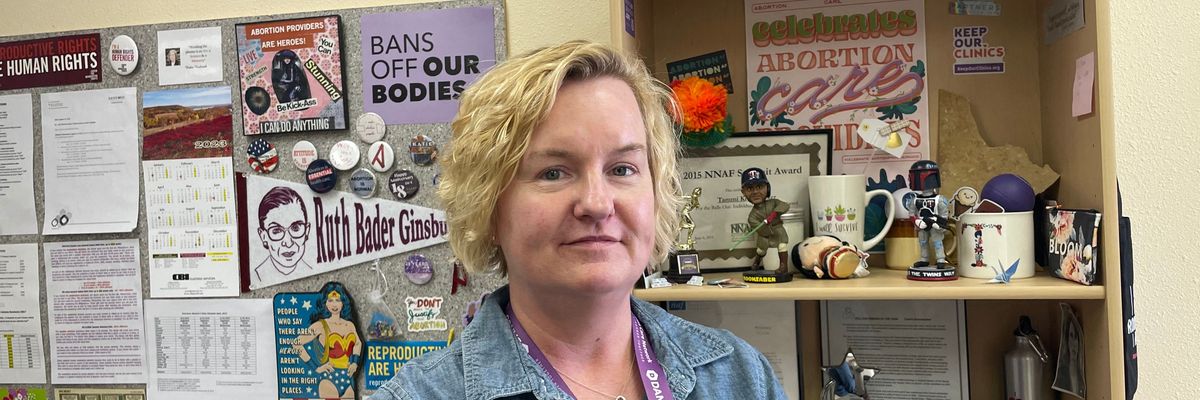
Tammi Kromenaker, director of Red River Women's Clinic, is seen in her office in Moorhead, Minnesota, on April 13, 2023. The clinic moved to Minnesota from North Dakota due to the latter state's abortion ban, and Kromenaker was a plaintiff in a case challenging the ban.
"I look forward to a new future in North Dakota and hope our lawmakers will finally give up on their crusade to force pregnancy on people against their will," said one advocate.
Two days after Republican presidential candidate Donald Trump claimed that "every Democrat, every Republican, liberal, conservative" wanted the federal right to abortion care to be overturned by the U.S. Supreme Court, a North Dakota judge became the latest on Thursday to strike down a state-level abortion ban, saying it violated residents' constitutional rights.
"The North Dakota Constitution guarantees each individual, including women, the fundamental right to make medical judgments affecting his or her bodily integrity, health, and autonomy, in consultation with a chosen healthcare provider free from government interference," wrote Judge Bruce Romanick, a District Court judge. "This section necessarily and more specifically protects a woman's right to procreative autonomy—including to seek and obtain a previability abortion."
The near-total ban on abortion care will be officially blocked in the coming days, in a move that the Center for Reproductive Rights (CRR) said could ultimately help restore access for people across the Midwest, as abortion care is currently banned in South Dakota and heavily restricted in nearby states including Nebraska and Iowa.
Meetra Mehdizadeh, a staff attorney at CRR, which filed a lawsuit against North Dakota's ban in 2023, said the ruling "is a win for reproductive freedom, and means it is now much safer to be pregnant in North Dakota," but warned that Republican lawmakers who passed the law have already done damage to pregnant people in the state that will take time to reverse.
"The damage that North Dakota's extreme abortion bans have done cannot be repaired overnight," said Mehdizadeh. "There are no abortion clinics left in North Dakota. That means most people seeking an abortion still won't be able to get one, even though it is legal. Clinics are medical facilities that need to acquire doctors, staff, equipment—they can take years to open, like most healthcare centers. The destructive impacts of abortion bans are felt long after they are struck down."
CRR argued in the case that the ban was too vague for medical providers to determine when an exception would be allowed for a pregnant patient whose life or health was at risk.
"This left physicians who provided abortions with the threat of having to defend their decision in court if someone were to question the provider's judgment," said the group. "Violating the ban was considered a class C felony, punishable by a maximum of five years of imprisonment, a fine of $10,000, or both."
Among the plaintiffs represented by CRR was Red River Women's Clinic, which was North Dakota's sole abortion care provider until a prior ban forced it to relocate from Fargo to Moorhead, Minnesota, where abortion has remained legal following the U.S. Supreme Court's overturning of Roe v. Wade.
"Today's decision gives me hope. I feel like the court heard us when we raised our voices against a law that not only ran counter to our state constitution, but was too vague for physicians to interpret and which prevented them from providing the high quality care that our communities are entitled to," said Tammi Kromenaker, director of the clinic. "Abortion is lifesaving healthcare; it should not be a crime. I look forward to a new future in North Dakota and hope our lawmakers will finally give up on their crusade to force pregnancy on people against their will."
Since Roe was overturned in 2022, numerous women have shared stories of being denied abortion care after suffering complications—including some that were life-threatening.
Judges in states including Wyoming, Utah, and Montana have blocked abortion bans in recent years, and voters have rejected anti-abortion ballot measures and approved ones that support the right to abortion in states including Kentucky, Kansas, Ohio, and Michigan.
Dear Common Dreams reader, It’s been nearly 30 years since I co-founded Common Dreams with my late wife, Lina Newhouser. We had the radical notion that journalism should serve the public good, not corporate profits. It was clear to us from the outset what it would take to build such a project. No paid advertisements. No corporate sponsors. No millionaire publisher telling us what to think or do. Many people said we wouldn't last a year, but we proved those doubters wrong. Together with a tremendous team of journalists and dedicated staff, we built an independent media outlet free from the constraints of profits and corporate control. Our mission has always been simple: To inform. To inspire. To ignite change for the common good. Building Common Dreams was not easy. Our survival was never guaranteed. When you take on the most powerful forces—Wall Street greed, fossil fuel industry destruction, Big Tech lobbyists, and uber-rich oligarchs who have spent billions upon billions rigging the economy and democracy in their favor—the only bulwark you have is supporters who believe in your work. But here’s the urgent message from me today. It's never been this bad out there. And it's never been this hard to keep us going. At the very moment Common Dreams is most needed, the threats we face are intensifying. We need your support now more than ever. We don't accept corporate advertising and never will. We don't have a paywall because we don't think people should be blocked from critical news based on their ability to pay. Everything we do is funded by the donations of readers like you. When everyone does the little they can afford, we are strong. But if that support retreats or dries up, so do we. Will you donate now to make sure Common Dreams not only survives but thrives? —Craig Brown, Co-founder |
Two days after Republican presidential candidate Donald Trump claimed that "every Democrat, every Republican, liberal, conservative" wanted the federal right to abortion care to be overturned by the U.S. Supreme Court, a North Dakota judge became the latest on Thursday to strike down a state-level abortion ban, saying it violated residents' constitutional rights.
"The North Dakota Constitution guarantees each individual, including women, the fundamental right to make medical judgments affecting his or her bodily integrity, health, and autonomy, in consultation with a chosen healthcare provider free from government interference," wrote Judge Bruce Romanick, a District Court judge. "This section necessarily and more specifically protects a woman's right to procreative autonomy—including to seek and obtain a previability abortion."
The near-total ban on abortion care will be officially blocked in the coming days, in a move that the Center for Reproductive Rights (CRR) said could ultimately help restore access for people across the Midwest, as abortion care is currently banned in South Dakota and heavily restricted in nearby states including Nebraska and Iowa.
Meetra Mehdizadeh, a staff attorney at CRR, which filed a lawsuit against North Dakota's ban in 2023, said the ruling "is a win for reproductive freedom, and means it is now much safer to be pregnant in North Dakota," but warned that Republican lawmakers who passed the law have already done damage to pregnant people in the state that will take time to reverse.
"The damage that North Dakota's extreme abortion bans have done cannot be repaired overnight," said Mehdizadeh. "There are no abortion clinics left in North Dakota. That means most people seeking an abortion still won't be able to get one, even though it is legal. Clinics are medical facilities that need to acquire doctors, staff, equipment—they can take years to open, like most healthcare centers. The destructive impacts of abortion bans are felt long after they are struck down."
CRR argued in the case that the ban was too vague for medical providers to determine when an exception would be allowed for a pregnant patient whose life or health was at risk.
"This left physicians who provided abortions with the threat of having to defend their decision in court if someone were to question the provider's judgment," said the group. "Violating the ban was considered a class C felony, punishable by a maximum of five years of imprisonment, a fine of $10,000, or both."
Among the plaintiffs represented by CRR was Red River Women's Clinic, which was North Dakota's sole abortion care provider until a prior ban forced it to relocate from Fargo to Moorhead, Minnesota, where abortion has remained legal following the U.S. Supreme Court's overturning of Roe v. Wade.
"Today's decision gives me hope. I feel like the court heard us when we raised our voices against a law that not only ran counter to our state constitution, but was too vague for physicians to interpret and which prevented them from providing the high quality care that our communities are entitled to," said Tammi Kromenaker, director of the clinic. "Abortion is lifesaving healthcare; it should not be a crime. I look forward to a new future in North Dakota and hope our lawmakers will finally give up on their crusade to force pregnancy on people against their will."
Since Roe was overturned in 2022, numerous women have shared stories of being denied abortion care after suffering complications—including some that were life-threatening.
Judges in states including Wyoming, Utah, and Montana have blocked abortion bans in recent years, and voters have rejected anti-abortion ballot measures and approved ones that support the right to abortion in states including Kentucky, Kansas, Ohio, and Michigan.
Two days after Republican presidential candidate Donald Trump claimed that "every Democrat, every Republican, liberal, conservative" wanted the federal right to abortion care to be overturned by the U.S. Supreme Court, a North Dakota judge became the latest on Thursday to strike down a state-level abortion ban, saying it violated residents' constitutional rights.
"The North Dakota Constitution guarantees each individual, including women, the fundamental right to make medical judgments affecting his or her bodily integrity, health, and autonomy, in consultation with a chosen healthcare provider free from government interference," wrote Judge Bruce Romanick, a District Court judge. "This section necessarily and more specifically protects a woman's right to procreative autonomy—including to seek and obtain a previability abortion."
The near-total ban on abortion care will be officially blocked in the coming days, in a move that the Center for Reproductive Rights (CRR) said could ultimately help restore access for people across the Midwest, as abortion care is currently banned in South Dakota and heavily restricted in nearby states including Nebraska and Iowa.
Meetra Mehdizadeh, a staff attorney at CRR, which filed a lawsuit against North Dakota's ban in 2023, said the ruling "is a win for reproductive freedom, and means it is now much safer to be pregnant in North Dakota," but warned that Republican lawmakers who passed the law have already done damage to pregnant people in the state that will take time to reverse.
"The damage that North Dakota's extreme abortion bans have done cannot be repaired overnight," said Mehdizadeh. "There are no abortion clinics left in North Dakota. That means most people seeking an abortion still won't be able to get one, even though it is legal. Clinics are medical facilities that need to acquire doctors, staff, equipment—they can take years to open, like most healthcare centers. The destructive impacts of abortion bans are felt long after they are struck down."
CRR argued in the case that the ban was too vague for medical providers to determine when an exception would be allowed for a pregnant patient whose life or health was at risk.
"This left physicians who provided abortions with the threat of having to defend their decision in court if someone were to question the provider's judgment," said the group. "Violating the ban was considered a class C felony, punishable by a maximum of five years of imprisonment, a fine of $10,000, or both."
Among the plaintiffs represented by CRR was Red River Women's Clinic, which was North Dakota's sole abortion care provider until a prior ban forced it to relocate from Fargo to Moorhead, Minnesota, where abortion has remained legal following the U.S. Supreme Court's overturning of Roe v. Wade.
"Today's decision gives me hope. I feel like the court heard us when we raised our voices against a law that not only ran counter to our state constitution, but was too vague for physicians to interpret and which prevented them from providing the high quality care that our communities are entitled to," said Tammi Kromenaker, director of the clinic. "Abortion is lifesaving healthcare; it should not be a crime. I look forward to a new future in North Dakota and hope our lawmakers will finally give up on their crusade to force pregnancy on people against their will."
Since Roe was overturned in 2022, numerous women have shared stories of being denied abortion care after suffering complications—including some that were life-threatening.
Judges in states including Wyoming, Utah, and Montana have blocked abortion bans in recent years, and voters have rejected anti-abortion ballot measures and approved ones that support the right to abortion in states including Kentucky, Kansas, Ohio, and Michigan.