SUBSCRIBE TO OUR FREE NEWSLETTER
Daily news & progressive opinion—funded by the people, not the corporations—delivered straight to your inbox.
5
#000000
#FFFFFF
To donate by check, phone, or other method, see our More Ways to Give page.

U.S. Sen. Bernie Sanders on Thursday pointed to testimony that Benjamin Netanyahu delivered to Congress more than two decades ago to help make the case that the United States should not join the Israeli prime minister's ongoing military campaign in Iran.
During a House hearing in 2002, Netanyahu—who was not then the prime minister of Israel—argued in favor of the U.S. invasion of Iraq, predicting it would "have enormous positive reverberations on the region."
Netanyahu also said confidently that then-Iraqi President Saddam Hussein was "seeking" and "advancing toward the development of nuclear weapons"—a claim that the Israeli leader has made repeatedly, for decades, about Iran's government.
Sanders (I-Vt.), who opposed the 2003 U.S. invasion of Iraq, said in a statement Thursday that Netanyahu "was wrong. Very wrong."
"The war in Iraq resulted in 4,492 U.S. military deaths, over 32,000 wounded, and a cost of roughly three trillion dollars. Hundreds of thousands of Iraqis also died as a result of that tragic war," Sanders continued. "Netanyahu was wrong regarding the war in Iraq. He is wrong now. We must not get involved in Netanyahu's war against Iran."
Sanders' statement comes as the Trump administration is seriously considering intervening in the war Israel started last week with a barrage of airstrikes in Iran, an assault that has since escalated and killed more than 600 people, including many civilians.
Netanyahu and other Israeli leaders have justified the unlawful assault by claiming that Iran is on the brink of developing a nuclear weapon—a narrative that Israel's prime minister has peddled for decades, even as U.S. intelligence agencies and international inspectors say there's no evidence to support it.
"Since 1992, when Netanyahu addressed Israel's Knesset as an MP, he has consistently claimed that Tehran is only years away from acquiring a nuclear bomb," Al Jazeera reported Wednesday. "'Within three to five years, we can assume that Iran will become autonomous in its ability to develop and produce a nuclear bomb,' he declared at the time. The prediction was later repeated in his 1995 book, Fighting Terrorism."
"In 2009, a U.S. State Department cable released by WikiLeaks revealed him telling members of Congress that Iran was just one or two years away from nuclear capability," the outlet continued. "Three years later, at the United Nations General Assembly, Netanyahu famously brandished a cartoon drawing of a bomb to illustrate his claims that Iran was closer than ever to the nuclear threshold."
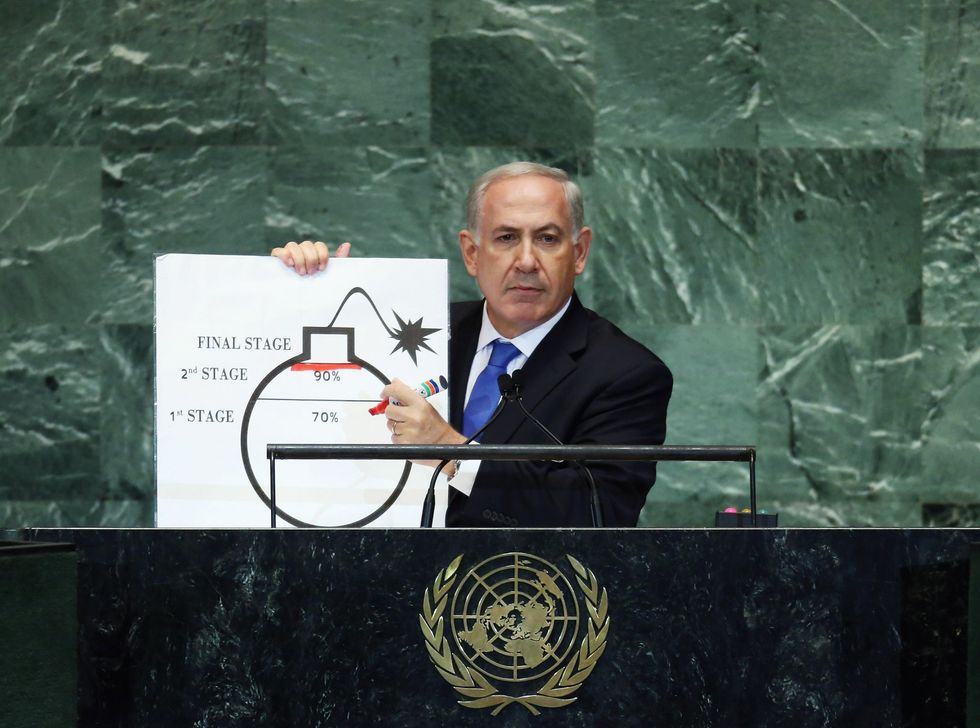 Israeli Prime Minister Benjamin Netanyahu delivered a speech to the United Nations General Assembly on September 27, 2012 in New York City. (Photo: Mario Tama/Getty Images)
Earlier this week, Trump publicly rejected U.S. intelligence assessments and echoed Netanyahu's baseless claim about Iran's nuclear weapon ambitions, telling reporters, "I think they were very close to having one."
Trump has reportedly approved plans for a U.S. attack on Iran but has so far held off on giving the final order, adding urgency to congressional efforts to avert a potentially catastrophic war.
Sanders is leading a bill that would bar the president from using federal funds for an unauthorized attack on Iran.
U.S. Sen. Bernie Sanders on Thursday pointed to testimony that Benjamin Netanyahu delivered to Congress more than two decades ago to help make the case that the United States should not join the Israeli prime minister's ongoing military campaign in Iran.
During a House hearing in 2002, Netanyahu—who was not then the prime minister of Israel—argued in favor of the U.S. invasion of Iraq, predicting it would "have enormous positive reverberations on the region."
Netanyahu also said confidently that then-Iraqi President Saddam Hussein was "seeking" and "advancing toward the development of nuclear weapons"—a claim that the Israeli leader has made repeatedly, for decades, about Iran's government.
Sanders (I-Vt.), who opposed the 2003 U.S. invasion of Iraq, said in a statement Thursday that Netanyahu "was wrong. Very wrong."
"The war in Iraq resulted in 4,492 U.S. military deaths, over 32,000 wounded, and a cost of roughly three trillion dollars. Hundreds of thousands of Iraqis also died as a result of that tragic war," Sanders continued. "Netanyahu was wrong regarding the war in Iraq. He is wrong now. We must not get involved in Netanyahu's war against Iran."
Sanders' statement comes as the Trump administration is seriously considering intervening in the war Israel started last week with a barrage of airstrikes in Iran, an assault that has since escalated and killed more than 600 people, including many civilians.
Netanyahu and other Israeli leaders have justified the unlawful assault by claiming that Iran is on the brink of developing a nuclear weapon—a narrative that Israel's prime minister has peddled for decades, even as U.S. intelligence agencies and international inspectors say there's no evidence to support it.
"Since 1992, when Netanyahu addressed Israel's Knesset as an MP, he has consistently claimed that Tehran is only years away from acquiring a nuclear bomb," Al Jazeera reported Wednesday. "'Within three to five years, we can assume that Iran will become autonomous in its ability to develop and produce a nuclear bomb,' he declared at the time. The prediction was later repeated in his 1995 book, Fighting Terrorism."
"In 2009, a U.S. State Department cable released by WikiLeaks revealed him telling members of Congress that Iran was just one or two years away from nuclear capability," the outlet continued. "Three years later, at the United Nations General Assembly, Netanyahu famously brandished a cartoon drawing of a bomb to illustrate his claims that Iran was closer than ever to the nuclear threshold."
Israeli Prime Minister Benjamin Netanyahu delivered a speech to the United Nations General Assembly on September 27, 2012 in New York City. (Photo: Mario Tama/Getty Images)
Earlier this week, Trump publicly rejected U.S. intelligence assessments and echoed Netanyahu's baseless claim about Iran's nuclear weapon ambitions, telling reporters, "I think they were very close to having one."
Trump has reportedly approved plans for a U.S. attack on Iran but has so far held off on giving the final order, adding urgency to congressional efforts to avert a potentially catastrophic war.
Sanders is leading a bill that would bar the president from using federal funds for an unauthorized attack on Iran.
U.S. Sen. Bernie Sanders on Thursday pointed to testimony that Benjamin Netanyahu delivered to Congress more than two decades ago to help make the case that the United States should not join the Israeli prime minister's ongoing military campaign in Iran.
During a House hearing in 2002, Netanyahu—who was not then the prime minister of Israel—argued in favor of the U.S. invasion of Iraq, predicting it would "have enormous positive reverberations on the region."
Netanyahu also said confidently that then-Iraqi President Saddam Hussein was "seeking" and "advancing toward the development of nuclear weapons"—a claim that the Israeli leader has made repeatedly, for decades, about Iran's government.
Sanders (I-Vt.), who opposed the 2003 U.S. invasion of Iraq, said in a statement Thursday that Netanyahu "was wrong. Very wrong."
"The war in Iraq resulted in 4,492 U.S. military deaths, over 32,000 wounded, and a cost of roughly three trillion dollars. Hundreds of thousands of Iraqis also died as a result of that tragic war," Sanders continued. "Netanyahu was wrong regarding the war in Iraq. He is wrong now. We must not get involved in Netanyahu's war against Iran."
Sanders' statement comes as the Trump administration is seriously considering intervening in the war Israel started last week with a barrage of airstrikes in Iran, an assault that has since escalated and killed more than 600 people, including many civilians.
Netanyahu and other Israeli leaders have justified the unlawful assault by claiming that Iran is on the brink of developing a nuclear weapon—a narrative that Israel's prime minister has peddled for decades, even as U.S. intelligence agencies and international inspectors say there's no evidence to support it.
"Since 1992, when Netanyahu addressed Israel's Knesset as an MP, he has consistently claimed that Tehran is only years away from acquiring a nuclear bomb," Al Jazeera reported Wednesday. "'Within three to five years, we can assume that Iran will become autonomous in its ability to develop and produce a nuclear bomb,' he declared at the time. The prediction was later repeated in his 1995 book, Fighting Terrorism."
"In 2009, a U.S. State Department cable released by WikiLeaks revealed him telling members of Congress that Iran was just one or two years away from nuclear capability," the outlet continued. "Three years later, at the United Nations General Assembly, Netanyahu famously brandished a cartoon drawing of a bomb to illustrate his claims that Iran was closer than ever to the nuclear threshold."
Israeli Prime Minister Benjamin Netanyahu delivered a speech to the United Nations General Assembly on September 27, 2012 in New York City. (Photo: Mario Tama/Getty Images)
Earlier this week, Trump publicly rejected U.S. intelligence assessments and echoed Netanyahu's baseless claim about Iran's nuclear weapon ambitions, telling reporters, "I think they were very close to having one."
Trump has reportedly approved plans for a U.S. attack on Iran but has so far held off on giving the final order, adding urgency to congressional efforts to avert a potentially catastrophic war.
Sanders is leading a bill that would bar the president from using federal funds for an unauthorized attack on Iran.