SUBSCRIBE TO OUR FREE NEWSLETTER
Daily news & progressive opinion—funded by the people, not the corporations—delivered straight to your inbox.
5
#000000
#FFFFFF
To donate by check, phone, or other method, see our More Ways to Give page.
Daily news & progressive opinion—funded by the people, not the corporations—delivered straight to your inbox.
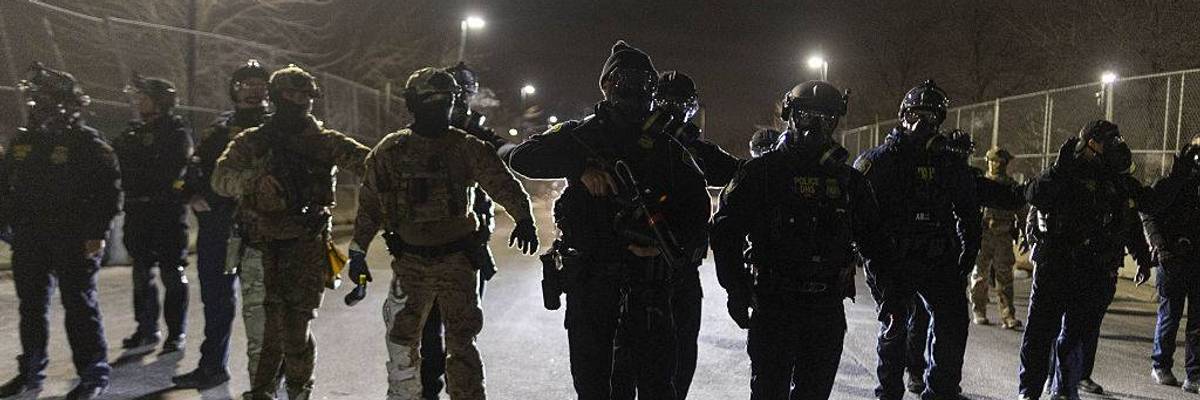
Federal immigration officers confront protesters outside Bishop Henry Whipple Federal Building in Minneapolis, Minnesota, on January 15, 2026.
"Cruelty and humiliation were probably the point," said one witness.
Several Democratic lawmakers on Friday convened a hearing in Minnesota to hear testimony from local officials and residents about the impact that the surge of federal immigration agents in the state has had on their lives.
The hearing, which was organized by Reps. Ilhan Omar (D-Minn.) and Pramila Jayapal (D-Wash.), featured elected leaders such as Minnesota Attorney General Keith Ellison and Minneapolis Mayor Jacob Frey, as well as testimony from US citizens who had been taken into custody by federal agents.
Patty O'Keefe, a 36-year-old US citizen, told lawmakers that her encounter with US Immigration and Customs Enforcement (ICE) agents began when she and a friend had received a report that legal observers in her neighborhood were being pepper sprayed.
She said they found the agents and began following them in their car while honking their horn and blowing whistles to alert others in the area to their presence.
The ICE agents subsequently stopped their vehicle, surrounded the car, discharged pepper spray into it, then smashed the car's windows and dragged out both O'Keefe and her friend.
O'Keefe said that after being detained by agents, they started taunting her, with one agent telling her, "You guys got to stop obstructing us, that's why this lesbian bitch is dead," an apparent reference to Minneapolis resident Renee Good, who was killed by an ICE agent last week.
O'Keefe said this comment left her feeling "rage and sadness," while also asking why anyone would say something like that about the victim of a horrific killing.
"Then I remembered that cruelty and humiliation were probably the point," she said.
O'Keefe was then taken to the BH Whipple Federal Building in St. Paul, where she was put into leg shackles and placed in a detention area that had been reserved for US citizens.
While in detention for eight hours at the building, she said she saw people being subjected to inhumane conditions.
"I saw holding cells with over a dozen people each, and a large holding cell of between 40 to 50 people," she said. "Most of the people there were Hispanic and East African, both women and men. Some cells had no room for people to sit or lay down. Most people I saw were staring straight ahead, not talking, despondent and grief stricken. I know I'll never forget their faces."
Mubashir, a 20-year-old US citizen of Somali descent, recounted his detention by federal immigration agents in December, when officers tackled him and took him into custody even though he offered to show them his identification proving his citizenship.
"I repeated, 'I'm a citizen, I have an ID,' the agent kept saying, 'That don't matter,'" Mubashir explained.
Like O'Keefe, Mubashir was taken to the St. Paul ICE detention facility, where he was shackled. Unlike O'Keefe, however, he was told that he was going to be deported despite having proof of his legal status.
Eventually, Mubashir was able to show a photo of his passport card to an official at the facility who instructed officers to release him from custody.
"It is difficult to believe this happened to me," he said. "I knew the president had made statements about Somali people and there would be additional ICE officers in the Twin Cities... But I did not think this would happen to me or someone in my family. We are all United States citizens, so we should not be at risk of being jailed or deported by ICE."
Mubashir also emphasized that "my citizenship did not protect me from being physically detained and hurt by ICE agents."
Dear Common Dreams reader, It’s been nearly 30 years since I co-founded Common Dreams with my late wife, Lina Newhouser. We had the radical notion that journalism should serve the public good, not corporate profits. It was clear to us from the outset what it would take to build such a project. No paid advertisements. No corporate sponsors. No millionaire publisher telling us what to think or do. Many people said we wouldn't last a year, but we proved those doubters wrong. Together with a tremendous team of journalists and dedicated staff, we built an independent media outlet free from the constraints of profits and corporate control. Our mission has always been simple: To inform. To inspire. To ignite change for the common good. Building Common Dreams was not easy. Our survival was never guaranteed. When you take on the most powerful forces—Wall Street greed, fossil fuel industry destruction, Big Tech lobbyists, and uber-rich oligarchs who have spent billions upon billions rigging the economy and democracy in their favor—the only bulwark you have is supporters who believe in your work. But here’s the urgent message from me today. It's never been this bad out there. And it's never been this hard to keep us going. At the very moment Common Dreams is most needed, the threats we face are intensifying. We need your support now more than ever. We don't accept corporate advertising and never will. We don't have a paywall because we don't think people should be blocked from critical news based on their ability to pay. Everything we do is funded by the donations of readers like you. When everyone does the little they can afford, we are strong. But if that support retreats or dries up, so do we. Will you donate now to make sure Common Dreams not only survives but thrives? —Craig Brown, Co-founder |
Several Democratic lawmakers on Friday convened a hearing in Minnesota to hear testimony from local officials and residents about the impact that the surge of federal immigration agents in the state has had on their lives.
The hearing, which was organized by Reps. Ilhan Omar (D-Minn.) and Pramila Jayapal (D-Wash.), featured elected leaders such as Minnesota Attorney General Keith Ellison and Minneapolis Mayor Jacob Frey, as well as testimony from US citizens who had been taken into custody by federal agents.
Patty O'Keefe, a 36-year-old US citizen, told lawmakers that her encounter with US Immigration and Customs Enforcement (ICE) agents began when she and a friend had received a report that legal observers in her neighborhood were being pepper sprayed.
She said they found the agents and began following them in their car while honking their horn and blowing whistles to alert others in the area to their presence.
The ICE agents subsequently stopped their vehicle, surrounded the car, discharged pepper spray into it, then smashed the car's windows and dragged out both O'Keefe and her friend.
O'Keefe said that after being detained by agents, they started taunting her, with one agent telling her, "You guys got to stop obstructing us, that's why this lesbian bitch is dead," an apparent reference to Minneapolis resident Renee Good, who was killed by an ICE agent last week.
O'Keefe said this comment left her feeling "rage and sadness," while also asking why anyone would say something like that about the victim of a horrific killing.
"Then I remembered that cruelty and humiliation were probably the point," she said.
O'Keefe was then taken to the BH Whipple Federal Building in St. Paul, where she was put into leg shackles and placed in a detention area that had been reserved for US citizens.
While in detention for eight hours at the building, she said she saw people being subjected to inhumane conditions.
"I saw holding cells with over a dozen people each, and a large holding cell of between 40 to 50 people," she said. "Most of the people there were Hispanic and East African, both women and men. Some cells had no room for people to sit or lay down. Most people I saw were staring straight ahead, not talking, despondent and grief stricken. I know I'll never forget their faces."
Mubashir, a 20-year-old US citizen of Somali descent, recounted his detention by federal immigration agents in December, when officers tackled him and took him into custody even though he offered to show them his identification proving his citizenship.
"I repeated, 'I'm a citizen, I have an ID,' the agent kept saying, 'That don't matter,'" Mubashir explained.
Like O'Keefe, Mubashir was taken to the St. Paul ICE detention facility, where he was shackled. Unlike O'Keefe, however, he was told that he was going to be deported despite having proof of his legal status.
Eventually, Mubashir was able to show a photo of his passport card to an official at the facility who instructed officers to release him from custody.
"It is difficult to believe this happened to me," he said. "I knew the president had made statements about Somali people and there would be additional ICE officers in the Twin Cities... But I did not think this would happen to me or someone in my family. We are all United States citizens, so we should not be at risk of being jailed or deported by ICE."
Mubashir also emphasized that "my citizenship did not protect me from being physically detained and hurt by ICE agents."
Several Democratic lawmakers on Friday convened a hearing in Minnesota to hear testimony from local officials and residents about the impact that the surge of federal immigration agents in the state has had on their lives.
The hearing, which was organized by Reps. Ilhan Omar (D-Minn.) and Pramila Jayapal (D-Wash.), featured elected leaders such as Minnesota Attorney General Keith Ellison and Minneapolis Mayor Jacob Frey, as well as testimony from US citizens who had been taken into custody by federal agents.
Patty O'Keefe, a 36-year-old US citizen, told lawmakers that her encounter with US Immigration and Customs Enforcement (ICE) agents began when she and a friend had received a report that legal observers in her neighborhood were being pepper sprayed.
She said they found the agents and began following them in their car while honking their horn and blowing whistles to alert others in the area to their presence.
The ICE agents subsequently stopped their vehicle, surrounded the car, discharged pepper spray into it, then smashed the car's windows and dragged out both O'Keefe and her friend.
O'Keefe said that after being detained by agents, they started taunting her, with one agent telling her, "You guys got to stop obstructing us, that's why this lesbian bitch is dead," an apparent reference to Minneapolis resident Renee Good, who was killed by an ICE agent last week.
O'Keefe said this comment left her feeling "rage and sadness," while also asking why anyone would say something like that about the victim of a horrific killing.
"Then I remembered that cruelty and humiliation were probably the point," she said.
O'Keefe was then taken to the BH Whipple Federal Building in St. Paul, where she was put into leg shackles and placed in a detention area that had been reserved for US citizens.
While in detention for eight hours at the building, she said she saw people being subjected to inhumane conditions.
"I saw holding cells with over a dozen people each, and a large holding cell of between 40 to 50 people," she said. "Most of the people there were Hispanic and East African, both women and men. Some cells had no room for people to sit or lay down. Most people I saw were staring straight ahead, not talking, despondent and grief stricken. I know I'll never forget their faces."
Mubashir, a 20-year-old US citizen of Somali descent, recounted his detention by federal immigration agents in December, when officers tackled him and took him into custody even though he offered to show them his identification proving his citizenship.
"I repeated, 'I'm a citizen, I have an ID,' the agent kept saying, 'That don't matter,'" Mubashir explained.
Like O'Keefe, Mubashir was taken to the St. Paul ICE detention facility, where he was shackled. Unlike O'Keefe, however, he was told that he was going to be deported despite having proof of his legal status.
Eventually, Mubashir was able to show a photo of his passport card to an official at the facility who instructed officers to release him from custody.
"It is difficult to believe this happened to me," he said. "I knew the president had made statements about Somali people and there would be additional ICE officers in the Twin Cities... But I did not think this would happen to me or someone in my family. We are all United States citizens, so we should not be at risk of being jailed or deported by ICE."
Mubashir also emphasized that "my citizenship did not protect me from being physically detained and hurt by ICE agents."