SUBSCRIBE TO OUR FREE NEWSLETTER
Daily news & progressive opinion—funded by the people, not the corporations—delivered straight to your inbox.
5
#000000
#FFFFFF
To donate by check, phone, or other method, see our More Ways to Give page.
Daily news & progressive opinion—funded by the people, not the corporations—delivered straight to your inbox.
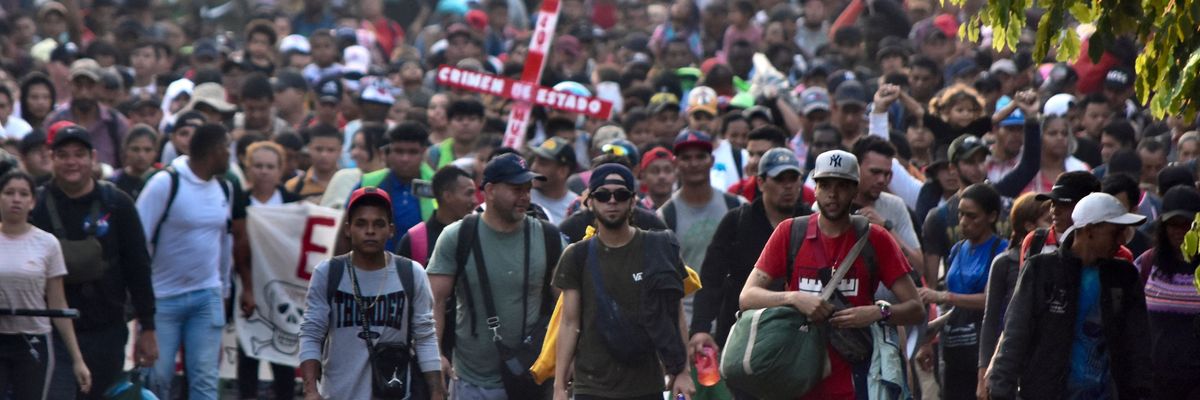
Migrants from Central and South America march in southern Mexico on April 23, 2023 to protest the deaths of 40 migrants in a fire at a detention center in the northern city of Juarez.
The march began a month after 40 people, including some who had been expelled from the U.S. and sent to Mexico, were killed in a detention center fire in Ciudad Juarez.
As the Biden administration seeks to expand its anti-immigration policies at the U.S.-Mexico border, thousands of Central and South American asylum-seekers are taking part in a march that began Sunday in southern Mexico to protest the detention centers where migrants are being held in the country—some after being expelled from the United States.
Roughly 3,000 people from countries including El Salvador, Venezuela, Ecuador, and Cuba began the march in Tapachula, near the Mexico-Guatemala border, and expect to walk for 10 days before reaching Mexico City.
Organizer Irineo Mújica of the Pueblos Sin Fronteras advocacy group told the Associated Press that the marchers are demanding the dissolution of the National Migration Institute (NMI), which runs detention centers like the one in Ciudad Juarez where 40 people were killed in a fire last month, and an end to the use of such facilities, which Mújica likened to "jails."
"In this viacrucis," said Mújica, using the word for a stations of the cross procession, "we are asking the government that justice be done to the killers, for them to stop hiding high-ranking officials. We are also asking that these jails be ended."
As Common Dreams reported after the fire, rights groups have blamed both U.S. and Mexican migration policies for the deadly blaze, which detained migrants reportedly started during a protest over guards' refusal to provide them with drinking water in their overcrowded cells. Surveillance footage showed guards walking away from the scene as smoke filled the facility.
"It could well have been any of us," Salvadoran migrant Miriam Argueta told the AP. "In fact, a lot of our countrymen died. The only thing we are asking for is justice, and to be treated like anyone else."
Mexico's top immigration official for the northern state of Chihuahua, Salvador González, faces homicide charges over the fire. Francisco Garduño, who heads the NMI, is also scheduled to appear in court this month and prosecutors have found "a pattern of irresponsibility and repeated omissions" about conditions at detention centers.
At least some of the victims had been sent back over Mexico's northern border by American immigration authorities after crossing into the United States, and according to the BBC and Reuters, the march to Mexico City is also aimed at demanding changes to the U.S. asylum system and for asylum requests to be sped up.
Some migrants taking part in the march are carrying wooden crosses, while others are carrying signs reading, "Government crime" and "The government killed them."
The marchers made it about nine miles on Sunday, stopping in Alvaro Obregon.
Earlier this year, U.S. President Joe Biden announced an expansion of Title 42, the Trump-era anti-asylum rule. Under the program, up to 30,000 people from Cuba, Haiti, and Nicaragua are being sent to Mexico each month unless they arrive in the U.S. through a humanitarian parole program that requires them to find sponsorship and afford a plane ticket to the United States.
A public comment period on another anti-immigration rule ended this month. Under the so-called "transit ban," migrants who pass through other countries and don't claim asylum there before reaching the U.S. would be deported.
Both rules have been condemned by international human rights authorities.
Dear Common Dreams reader, It’s been nearly 30 years since I co-founded Common Dreams with my late wife, Lina Newhouser. We had the radical notion that journalism should serve the public good, not corporate profits. It was clear to us from the outset what it would take to build such a project. No paid advertisements. No corporate sponsors. No millionaire publisher telling us what to think or do. Many people said we wouldn't last a year, but we proved those doubters wrong. Together with a tremendous team of journalists and dedicated staff, we built an independent media outlet free from the constraints of profits and corporate control. Our mission has always been simple: To inform. To inspire. To ignite change for the common good. Building Common Dreams was not easy. Our survival was never guaranteed. When you take on the most powerful forces—Wall Street greed, fossil fuel industry destruction, Big Tech lobbyists, and uber-rich oligarchs who have spent billions upon billions rigging the economy and democracy in their favor—the only bulwark you have is supporters who believe in your work. But here’s the urgent message from me today. It's never been this bad out there. And it's never been this hard to keep us going. At the very moment Common Dreams is most needed, the threats we face are intensifying. We need your support now more than ever. We don't accept corporate advertising and never will. We don't have a paywall because we don't think people should be blocked from critical news based on their ability to pay. Everything we do is funded by the donations of readers like you. When everyone does the little they can afford, we are strong. But if that support retreats or dries up, so do we. Will you donate now to make sure Common Dreams not only survives but thrives? —Craig Brown, Co-founder |
As the Biden administration seeks to expand its anti-immigration policies at the U.S.-Mexico border, thousands of Central and South American asylum-seekers are taking part in a march that began Sunday in southern Mexico to protest the detention centers where migrants are being held in the country—some after being expelled from the United States.
Roughly 3,000 people from countries including El Salvador, Venezuela, Ecuador, and Cuba began the march in Tapachula, near the Mexico-Guatemala border, and expect to walk for 10 days before reaching Mexico City.
Organizer Irineo Mújica of the Pueblos Sin Fronteras advocacy group told the Associated Press that the marchers are demanding the dissolution of the National Migration Institute (NMI), which runs detention centers like the one in Ciudad Juarez where 40 people were killed in a fire last month, and an end to the use of such facilities, which Mújica likened to "jails."
"In this viacrucis," said Mújica, using the word for a stations of the cross procession, "we are asking the government that justice be done to the killers, for them to stop hiding high-ranking officials. We are also asking that these jails be ended."
As Common Dreams reported after the fire, rights groups have blamed both U.S. and Mexican migration policies for the deadly blaze, which detained migrants reportedly started during a protest over guards' refusal to provide them with drinking water in their overcrowded cells. Surveillance footage showed guards walking away from the scene as smoke filled the facility.
"It could well have been any of us," Salvadoran migrant Miriam Argueta told the AP. "In fact, a lot of our countrymen died. The only thing we are asking for is justice, and to be treated like anyone else."
Mexico's top immigration official for the northern state of Chihuahua, Salvador González, faces homicide charges over the fire. Francisco Garduño, who heads the NMI, is also scheduled to appear in court this month and prosecutors have found "a pattern of irresponsibility and repeated omissions" about conditions at detention centers.
At least some of the victims had been sent back over Mexico's northern border by American immigration authorities after crossing into the United States, and according to the BBC and Reuters, the march to Mexico City is also aimed at demanding changes to the U.S. asylum system and for asylum requests to be sped up.
Some migrants taking part in the march are carrying wooden crosses, while others are carrying signs reading, "Government crime" and "The government killed them."
The marchers made it about nine miles on Sunday, stopping in Alvaro Obregon.
Earlier this year, U.S. President Joe Biden announced an expansion of Title 42, the Trump-era anti-asylum rule. Under the program, up to 30,000 people from Cuba, Haiti, and Nicaragua are being sent to Mexico each month unless they arrive in the U.S. through a humanitarian parole program that requires them to find sponsorship and afford a plane ticket to the United States.
A public comment period on another anti-immigration rule ended this month. Under the so-called "transit ban," migrants who pass through other countries and don't claim asylum there before reaching the U.S. would be deported.
Both rules have been condemned by international human rights authorities.
As the Biden administration seeks to expand its anti-immigration policies at the U.S.-Mexico border, thousands of Central and South American asylum-seekers are taking part in a march that began Sunday in southern Mexico to protest the detention centers where migrants are being held in the country—some after being expelled from the United States.
Roughly 3,000 people from countries including El Salvador, Venezuela, Ecuador, and Cuba began the march in Tapachula, near the Mexico-Guatemala border, and expect to walk for 10 days before reaching Mexico City.
Organizer Irineo Mújica of the Pueblos Sin Fronteras advocacy group told the Associated Press that the marchers are demanding the dissolution of the National Migration Institute (NMI), which runs detention centers like the one in Ciudad Juarez where 40 people were killed in a fire last month, and an end to the use of such facilities, which Mújica likened to "jails."
"In this viacrucis," said Mújica, using the word for a stations of the cross procession, "we are asking the government that justice be done to the killers, for them to stop hiding high-ranking officials. We are also asking that these jails be ended."
As Common Dreams reported after the fire, rights groups have blamed both U.S. and Mexican migration policies for the deadly blaze, which detained migrants reportedly started during a protest over guards' refusal to provide them with drinking water in their overcrowded cells. Surveillance footage showed guards walking away from the scene as smoke filled the facility.
"It could well have been any of us," Salvadoran migrant Miriam Argueta told the AP. "In fact, a lot of our countrymen died. The only thing we are asking for is justice, and to be treated like anyone else."
Mexico's top immigration official for the northern state of Chihuahua, Salvador González, faces homicide charges over the fire. Francisco Garduño, who heads the NMI, is also scheduled to appear in court this month and prosecutors have found "a pattern of irresponsibility and repeated omissions" about conditions at detention centers.
At least some of the victims had been sent back over Mexico's northern border by American immigration authorities after crossing into the United States, and according to the BBC and Reuters, the march to Mexico City is also aimed at demanding changes to the U.S. asylum system and for asylum requests to be sped up.
Some migrants taking part in the march are carrying wooden crosses, while others are carrying signs reading, "Government crime" and "The government killed them."
The marchers made it about nine miles on Sunday, stopping in Alvaro Obregon.
Earlier this year, U.S. President Joe Biden announced an expansion of Title 42, the Trump-era anti-asylum rule. Under the program, up to 30,000 people from Cuba, Haiti, and Nicaragua are being sent to Mexico each month unless they arrive in the U.S. through a humanitarian parole program that requires them to find sponsorship and afford a plane ticket to the United States.
A public comment period on another anti-immigration rule ended this month. Under the so-called "transit ban," migrants who pass through other countries and don't claim asylum there before reaching the U.S. would be deported.
Both rules have been condemned by international human rights authorities.