5
#000000
#FFFFFF
To donate by check, phone, or other method, see our More Ways to Give page.
Daily news & progressive opinion—funded by the people, not the corporations—delivered straight to your inbox.

"We can't afford more corrupt politicians bought by Big Tech," said one Democratic US House candidate.
Meta, the parent company of social media giants Facebook, Instagram, and WhatsApp, is spending big bucks to ensure that government regulations don't interfere with its ambitions in artificial intelligence.
The New York Times reported on Wednesday that Meta is planning to spend $65 million on this year's midterm elections, with one super political action committee (PAC) dedicated to electing AI-friendly Democrats, and another dedicated to electing AI-friendly Republicans.
The pro-Democratic super PAC, called Making Our Tomorrow, will work to influence congressional races in Illinois, while the pro-GOP PAC, called Forge the Future Project, will be focusing on congressional races in Texas.
The Times noted that Meta has in the past been "cautious about campaign engagements, making small donations out of a corporate political action committee and contributing to presidential inaugurations," but it has decided to ramp up its spending to defend its AI business from governmental interference.
Meta's spending splurge to elect pro-AI candidates is just one of many efforts by the AI industry to ensure a friendly regulatory environment.
CNN reported last week that Leading the Future—a super PAC backed by venture capital firm Andreessen Horowitz, Palantir co-founder Joe Lonsdale, and other AI heavyweights—is pledging to spend at least $100 million to influence the 2026 midterm election.
The goal of the PAC will be to elect lawmakers who will pass legislation to set a single set of AI regulations that will take effect throughout the US, overriding any restrictions placed on the technology by state governments.
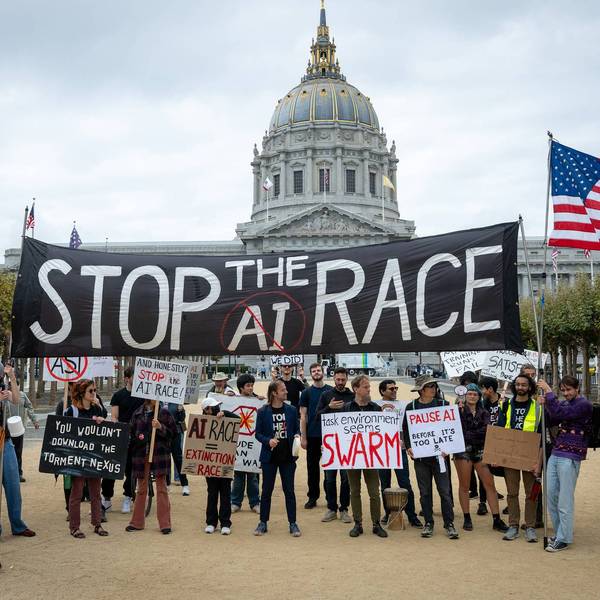
The PACs' big spending comes as a nationwide backlash to Big Tech has been forming across the US, as many communities are fighting against the construction of energy-devouring AI data centers that are raising electricity prices and have been accused of degrading the quality of local water supplies.
Reed Showalter, a Democratic US House of Representatives candidate running in Illinois' 7th Congressional District, said the report of Meta's big spending showed the importance of ensuring that voters elect leaders who will hold the major tech companies accountable.
"We deserve representatives who are going to take an honest look at AI and regulate it accordingly," he wrote in a social media post. "We can't afford more corrupt politicians bought by Big Tech."
Democratic New York congressional candidate Alex Bores, who is running on a platform of regulating AI, said during an interview with CNN on Wednesday that the tech companies' actions show they are "terrified" of being held accountable by elected officials.
He also noted that being attacked by the Leading the Future super PAC has ironically helped his candidacy.
"The fact that they're being so aggressive with it, I think, has been redounding to my benefit," he told host Dana Bash. "I've had a lot of constituents who have reached out and said, 'I hadn't even heard of you until all these text messages [from the AI super PAC]."
"These Trump megadonors who are attacking me are terrified of having someone in Congress that's already beaten them": NY-12 Dem candidate @AlexBores to @DanaBashCNN on why pro-AI groups are spending to defeat him in the crowded primary to replace Nadler. pic.twitter.com/IB3Y48Izbj
— Inside Politics (@InsidePolitics) February 18, 2026
Watchdog social media account @OilPACTracker predicted that Meta's major political spending could turn into a liability if voters are made aware of its machinations.
"We would make sure the electorate knows about it," the watchdog wrote. "Big Tech money is toxic."
Dear Common Dreams reader, It’s been nearly 30 years since I co-founded Common Dreams with my late wife, Lina Newhouser. We had the radical notion that journalism should serve the public good, not corporate profits. It was clear to us from the outset what it would take to build such a project. No paid advertisements. No corporate sponsors. No millionaire publisher telling us what to think or do. Many people said we wouldn't last a year, but we proved those doubters wrong. Together with a tremendous team of journalists and dedicated staff, we built an independent media outlet free from the constraints of profits and corporate control. Our mission has always been simple: To inform. To inspire. To ignite change for the common good. Building Common Dreams was not easy. Our survival was never guaranteed. When you take on the most powerful forces—Wall Street greed, fossil fuel industry destruction, Big Tech lobbyists, and uber-rich oligarchs who have spent billions upon billions rigging the economy and democracy in their favor—the only bulwark you have is supporters who believe in your work. But here’s the urgent message from me today. It's never been this bad out there. And it's never been this hard to keep us going. At the very moment Common Dreams is most needed, the threats we face are intensifying. We need your support now more than ever. We don't accept corporate advertising and never will. We don't have a paywall because we don't think people should be blocked from critical news based on their ability to pay. Everything we do is funded by the donations of readers like you. When everyone does the little they can afford, we are strong. But if that support retreats or dries up, so do we. Will you donate now to make sure Common Dreams not only survives but thrives? —Craig Brown, Co-founder |
Meta, the parent company of social media giants Facebook, Instagram, and WhatsApp, is spending big bucks to ensure that government regulations don't interfere with its ambitions in artificial intelligence.
The New York Times reported on Wednesday that Meta is planning to spend $65 million on this year's midterm elections, with one super political action committee (PAC) dedicated to electing AI-friendly Democrats, and another dedicated to electing AI-friendly Republicans.
The pro-Democratic super PAC, called Making Our Tomorrow, will work to influence congressional races in Illinois, while the pro-GOP PAC, called Forge the Future Project, will be focusing on congressional races in Texas.
The Times noted that Meta has in the past been "cautious about campaign engagements, making small donations out of a corporate political action committee and contributing to presidential inaugurations," but it has decided to ramp up its spending to defend its AI business from governmental interference.
Meta's spending splurge to elect pro-AI candidates is just one of many efforts by the AI industry to ensure a friendly regulatory environment.
CNN reported last week that Leading the Future—a super PAC backed by venture capital firm Andreessen Horowitz, Palantir co-founder Joe Lonsdale, and other AI heavyweights—is pledging to spend at least $100 million to influence the 2026 midterm election.
The goal of the PAC will be to elect lawmakers who will pass legislation to set a single set of AI regulations that will take effect throughout the US, overriding any restrictions placed on the technology by state governments.
The PACs' big spending comes as a nationwide backlash to Big Tech has been forming across the US, as many communities are fighting against the construction of energy-devouring AI data centers that are raising electricity prices and have been accused of degrading the quality of local water supplies.
Reed Showalter, a Democratic US House of Representatives candidate running in Illinois' 7th Congressional District, said the report of Meta's big spending showed the importance of ensuring that voters elect leaders who will hold the major tech companies accountable.
"We deserve representatives who are going to take an honest look at AI and regulate it accordingly," he wrote in a social media post. "We can't afford more corrupt politicians bought by Big Tech."
Democratic New York congressional candidate Alex Bores, who is running on a platform of regulating AI, said during an interview with CNN on Wednesday that the tech companies' actions show they are "terrified" of being held accountable by elected officials.
He also noted that being attacked by the Leading the Future super PAC has ironically helped his candidacy.
"The fact that they're being so aggressive with it, I think, has been redounding to my benefit," he told host Dana Bash. "I've had a lot of constituents who have reached out and said, 'I hadn't even heard of you until all these text messages [from the AI super PAC]."
"These Trump megadonors who are attacking me are terrified of having someone in Congress that's already beaten them": NY-12 Dem candidate @AlexBores to @DanaBashCNN on why pro-AI groups are spending to defeat him in the crowded primary to replace Nadler. pic.twitter.com/IB3Y48Izbj
— Inside Politics (@InsidePolitics) February 18, 2026
Watchdog social media account @OilPACTracker predicted that Meta's major political spending could turn into a liability if voters are made aware of its machinations.
"We would make sure the electorate knows about it," the watchdog wrote. "Big Tech money is toxic."
Meta, the parent company of social media giants Facebook, Instagram, and WhatsApp, is spending big bucks to ensure that government regulations don't interfere with its ambitions in artificial intelligence.
The New York Times reported on Wednesday that Meta is planning to spend $65 million on this year's midterm elections, with one super political action committee (PAC) dedicated to electing AI-friendly Democrats, and another dedicated to electing AI-friendly Republicans.
The pro-Democratic super PAC, called Making Our Tomorrow, will work to influence congressional races in Illinois, while the pro-GOP PAC, called Forge the Future Project, will be focusing on congressional races in Texas.
The Times noted that Meta has in the past been "cautious about campaign engagements, making small donations out of a corporate political action committee and contributing to presidential inaugurations," but it has decided to ramp up its spending to defend its AI business from governmental interference.
Meta's spending splurge to elect pro-AI candidates is just one of many efforts by the AI industry to ensure a friendly regulatory environment.
CNN reported last week that Leading the Future—a super PAC backed by venture capital firm Andreessen Horowitz, Palantir co-founder Joe Lonsdale, and other AI heavyweights—is pledging to spend at least $100 million to influence the 2026 midterm election.
The goal of the PAC will be to elect lawmakers who will pass legislation to set a single set of AI regulations that will take effect throughout the US, overriding any restrictions placed on the technology by state governments.
The PACs' big spending comes as a nationwide backlash to Big Tech has been forming across the US, as many communities are fighting against the construction of energy-devouring AI data centers that are raising electricity prices and have been accused of degrading the quality of local water supplies.
Reed Showalter, a Democratic US House of Representatives candidate running in Illinois' 7th Congressional District, said the report of Meta's big spending showed the importance of ensuring that voters elect leaders who will hold the major tech companies accountable.
"We deserve representatives who are going to take an honest look at AI and regulate it accordingly," he wrote in a social media post. "We can't afford more corrupt politicians bought by Big Tech."
Democratic New York congressional candidate Alex Bores, who is running on a platform of regulating AI, said during an interview with CNN on Wednesday that the tech companies' actions show they are "terrified" of being held accountable by elected officials.
He also noted that being attacked by the Leading the Future super PAC has ironically helped his candidacy.
"The fact that they're being so aggressive with it, I think, has been redounding to my benefit," he told host Dana Bash. "I've had a lot of constituents who have reached out and said, 'I hadn't even heard of you until all these text messages [from the AI super PAC]."
"These Trump megadonors who are attacking me are terrified of having someone in Congress that's already beaten them": NY-12 Dem candidate @AlexBores to @DanaBashCNN on why pro-AI groups are spending to defeat him in the crowded primary to replace Nadler. pic.twitter.com/IB3Y48Izbj
— Inside Politics (@InsidePolitics) February 18, 2026
Watchdog social media account @OilPACTracker predicted that Meta's major political spending could turn into a liability if voters are made aware of its machinations.
"We would make sure the electorate knows about it," the watchdog wrote. "Big Tech money is toxic."