SUBSCRIBE TO OUR FREE NEWSLETTER
Daily news & progressive opinion—funded by the people, not the corporations—delivered straight to your inbox.
5
#000000
#FFFFFF
To donate by check, phone, or other method, see our More Ways to Give page.
Daily news & progressive opinion—funded by the people, not the corporations—delivered straight to your inbox.
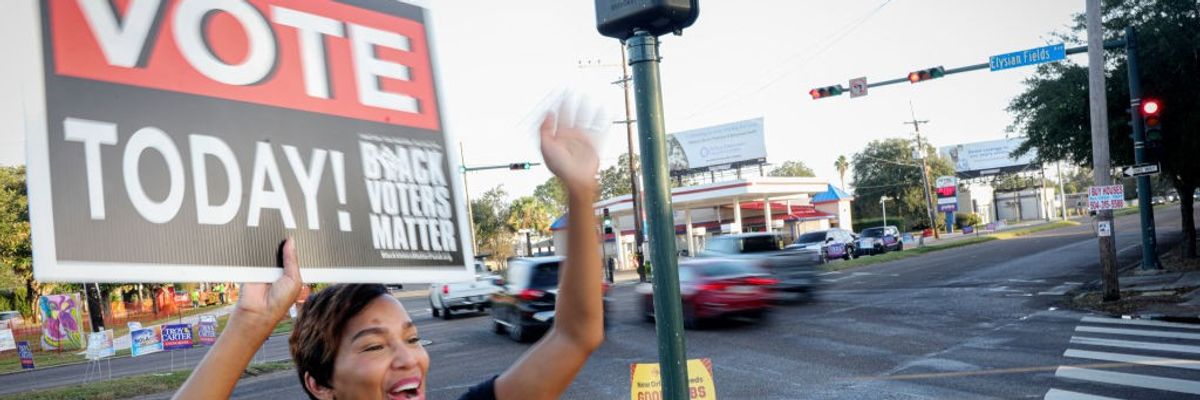
Mary Gallant waves to motorists as she encourages them to vote in New Orleans on Election Day, November 5, 2024.
One ACLU attorney said the ruling "sends a powerful message: The Voting Rights Act is still a vital safeguard against racial discrimination in our democracy."
In what the ACLU called "a victory for Black voters and democracy in Louisiana," a three-judge panel of the staunchly conservative 5th US Circuit Court of Appeals on Thursday upheld a lower court's ruling that struck down the state's racially rigged legislative maps for violating the Voting Rights Act.
The panel agreed in Nairne v. Landry that Louisiana's state Senate and House of Representatives new maps, enacted in 2022, "dilute the voting strength of Black Louisianans in violation of Section 2 of the Voting Rights Act of 1965."
The maps do so, the court wrote, "by 'packing' Black voters into a small number of majority-Black districts and 'cracking' other Black communities across multiple districts, thereby depriving them of the opportunity to form effective voting blocs."
The panel—whose members were appointed by former Presidents Bill Clinton, George W. Bush, and Joe Biden—also found "no basis" supporting Louisiana's assertion that conditions had changed enough in the state to negate the need for race-minded remedies.
🚨Big Win for Black Voters in Louisiana! ️Today, the Fifth Circuit Court of Appeals delivered a critical victory by upholding a lower court’s decision that struck down Louisiana’s state legislative maps for unlawfully diluting Black voting power.www.democracydocket.com/news-alerts/...
[image or embed]
— Black Voters Matter Fund (@blackvotersmatterfund.org) August 14, 2025 at 5:09 PM
Louisiana must now redraw legislative maps that better reflect the demography of a state in which nearly one-third of the population is Black but roughly just a quarter of its legislative districts are majority African American. However, there is a stay on the redraw until the U.S. Supreme Court issues a ruling in Louisiana v. Callais, which involves the state's racially rigged congressional map.
"I am beyond elated for this powerful win of Nairne v. Landry that touches all of Louisiana, including rural areas like Assumption Parish, where transformation has been nonexistent for far too long," plaintiff Dorothy Nairne said in a statement.
"Our people are ready to roar through our votes using legislative maps that truly represent us all," she added. "This victory ignites our desire to be involved, to uplift ourselves, and to shape the future our ancestors dreamed of."
Another plaintiff in the case, Alice Washington, said that "a unanimous win is incredible as the court clearly held Louisiana must have maps where Black voters have a fair opportunity to elect candidates of choice. We are advancing our state to a more perfect place and hopefully will inspire all to want to live here."
Alanah Odoms, executive director of the ACLU of Louisiana—which represents case plaintiffs—said that the panel "has affirmed what we've always known, Black voters in Louisiana deserve equal representation."
"This is a vital step toward correcting generations of injustice, and we will not stop until every Black Louisianan has the full and fair representation guaranteed to all Americans," Odoms added.
ACLU Voting Rights Project staff attorney Megan Keenan said the ruling "sends a powerful message: The Voting Rights Act is still a vital safeguard against racial discrimination in our democracy. The court recognized the reality that many Black voters in Louisiana have been denied full and fair representation."
ANOTHER WIN: 5th Circuit Sides with Black Louisianians, Strikes Down Racially Discriminatory State Mapwww.naacpldf.org/press-releas...
[image or embed]
— Janai Nelson (@janainelson.bsky.social) August 14, 2025 at 2:20 PM
The Legal Defense Fund also represents plaintiffs in the case. LDF assistant counsel Sara Rohani lauded "the strength and resilience of Black communities across Louisiana who have fought for years to be fairly recognized, represented, and heard."
"Fair representation is not optional in Louisiana," Rohani added. "Today's decision reaffirms that the state must pass fair and nondiscriminatory maps to comply with the Voting Rights Act. We look forward to rectifying another example of Louisiana's long history of racial voter suppression."
Louisiana Attorney General Liz Murrill, a Republican, condemned Thursday's ruling, telling the Louisiana Illuminator that "we are reviewing our options with a focus on stability in our elections and preserving state and judicial resources while the [US] Supreme Court resolves related issues."
One of those issues involves Louisiana's congressional map, which was drawn by Republican state lawmakers to include just one majority Black district. The justices are set to hear that case, Callais v. Landry, as well as the closely related Louisiana v. Callais—which differ in procedural postures—during the high court's upcoming term.
These battles in Louisiana come as the Voting Rights Act turns 60 amid numerous Republican attacks on the landmark legislation. GOP-controlled state legislatures across the country have enacted racially rigged congressional maps, imposed restrictions on voter registration, reduced early voting options, and passed voter identification laws. These measures disproportionately disenfranchise minority voters, and some GOP officials have admitted that they are intended to give Republican candidates an electoral edge.
Dear Common Dreams reader, It’s been nearly 30 years since I co-founded Common Dreams with my late wife, Lina Newhouser. We had the radical notion that journalism should serve the public good, not corporate profits. It was clear to us from the outset what it would take to build such a project. No paid advertisements. No corporate sponsors. No millionaire publisher telling us what to think or do. Many people said we wouldn't last a year, but we proved those doubters wrong. Together with a tremendous team of journalists and dedicated staff, we built an independent media outlet free from the constraints of profits and corporate control. Our mission has always been simple: To inform. To inspire. To ignite change for the common good. Building Common Dreams was not easy. Our survival was never guaranteed. When you take on the most powerful forces—Wall Street greed, fossil fuel industry destruction, Big Tech lobbyists, and uber-rich oligarchs who have spent billions upon billions rigging the economy and democracy in their favor—the only bulwark you have is supporters who believe in your work. But here’s the urgent message from me today. It's never been this bad out there. And it's never been this hard to keep us going. At the very moment Common Dreams is most needed, the threats we face are intensifying. We need your support now more than ever. We don't accept corporate advertising and never will. We don't have a paywall because we don't think people should be blocked from critical news based on their ability to pay. Everything we do is funded by the donations of readers like you. When everyone does the little they can afford, we are strong. But if that support retreats or dries up, so do we. Will you donate now to make sure Common Dreams not only survives but thrives? —Craig Brown, Co-founder |
In what the ACLU called "a victory for Black voters and democracy in Louisiana," a three-judge panel of the staunchly conservative 5th US Circuit Court of Appeals on Thursday upheld a lower court's ruling that struck down the state's racially rigged legislative maps for violating the Voting Rights Act.
The panel agreed in Nairne v. Landry that Louisiana's state Senate and House of Representatives new maps, enacted in 2022, "dilute the voting strength of Black Louisianans in violation of Section 2 of the Voting Rights Act of 1965."
The maps do so, the court wrote, "by 'packing' Black voters into a small number of majority-Black districts and 'cracking' other Black communities across multiple districts, thereby depriving them of the opportunity to form effective voting blocs."
The panel—whose members were appointed by former Presidents Bill Clinton, George W. Bush, and Joe Biden—also found "no basis" supporting Louisiana's assertion that conditions had changed enough in the state to negate the need for race-minded remedies.
🚨Big Win for Black Voters in Louisiana! ️Today, the Fifth Circuit Court of Appeals delivered a critical victory by upholding a lower court’s decision that struck down Louisiana’s state legislative maps for unlawfully diluting Black voting power.www.democracydocket.com/news-alerts/...
[image or embed]
— Black Voters Matter Fund (@blackvotersmatterfund.org) August 14, 2025 at 5:09 PM
Louisiana must now redraw legislative maps that better reflect the demography of a state in which nearly one-third of the population is Black but roughly just a quarter of its legislative districts are majority African American. However, there is a stay on the redraw until the U.S. Supreme Court issues a ruling in Louisiana v. Callais, which involves the state's racially rigged congressional map.
"I am beyond elated for this powerful win of Nairne v. Landry that touches all of Louisiana, including rural areas like Assumption Parish, where transformation has been nonexistent for far too long," plaintiff Dorothy Nairne said in a statement.
"Our people are ready to roar through our votes using legislative maps that truly represent us all," she added. "This victory ignites our desire to be involved, to uplift ourselves, and to shape the future our ancestors dreamed of."
Another plaintiff in the case, Alice Washington, said that "a unanimous win is incredible as the court clearly held Louisiana must have maps where Black voters have a fair opportunity to elect candidates of choice. We are advancing our state to a more perfect place and hopefully will inspire all to want to live here."
Alanah Odoms, executive director of the ACLU of Louisiana—which represents case plaintiffs—said that the panel "has affirmed what we've always known, Black voters in Louisiana deserve equal representation."
"This is a vital step toward correcting generations of injustice, and we will not stop until every Black Louisianan has the full and fair representation guaranteed to all Americans," Odoms added.
ACLU Voting Rights Project staff attorney Megan Keenan said the ruling "sends a powerful message: The Voting Rights Act is still a vital safeguard against racial discrimination in our democracy. The court recognized the reality that many Black voters in Louisiana have been denied full and fair representation."
ANOTHER WIN: 5th Circuit Sides with Black Louisianians, Strikes Down Racially Discriminatory State Mapwww.naacpldf.org/press-releas...
[image or embed]
— Janai Nelson (@janainelson.bsky.social) August 14, 2025 at 2:20 PM
The Legal Defense Fund also represents plaintiffs in the case. LDF assistant counsel Sara Rohani lauded "the strength and resilience of Black communities across Louisiana who have fought for years to be fairly recognized, represented, and heard."
"Fair representation is not optional in Louisiana," Rohani added. "Today's decision reaffirms that the state must pass fair and nondiscriminatory maps to comply with the Voting Rights Act. We look forward to rectifying another example of Louisiana's long history of racial voter suppression."
Louisiana Attorney General Liz Murrill, a Republican, condemned Thursday's ruling, telling the Louisiana Illuminator that "we are reviewing our options with a focus on stability in our elections and preserving state and judicial resources while the [US] Supreme Court resolves related issues."
One of those issues involves Louisiana's congressional map, which was drawn by Republican state lawmakers to include just one majority Black district. The justices are set to hear that case, Callais v. Landry, as well as the closely related Louisiana v. Callais—which differ in procedural postures—during the high court's upcoming term.
These battles in Louisiana come as the Voting Rights Act turns 60 amid numerous Republican attacks on the landmark legislation. GOP-controlled state legislatures across the country have enacted racially rigged congressional maps, imposed restrictions on voter registration, reduced early voting options, and passed voter identification laws. These measures disproportionately disenfranchise minority voters, and some GOP officials have admitted that they are intended to give Republican candidates an electoral edge.
In what the ACLU called "a victory for Black voters and democracy in Louisiana," a three-judge panel of the staunchly conservative 5th US Circuit Court of Appeals on Thursday upheld a lower court's ruling that struck down the state's racially rigged legislative maps for violating the Voting Rights Act.
The panel agreed in Nairne v. Landry that Louisiana's state Senate and House of Representatives new maps, enacted in 2022, "dilute the voting strength of Black Louisianans in violation of Section 2 of the Voting Rights Act of 1965."
The maps do so, the court wrote, "by 'packing' Black voters into a small number of majority-Black districts and 'cracking' other Black communities across multiple districts, thereby depriving them of the opportunity to form effective voting blocs."
The panel—whose members were appointed by former Presidents Bill Clinton, George W. Bush, and Joe Biden—also found "no basis" supporting Louisiana's assertion that conditions had changed enough in the state to negate the need for race-minded remedies.
🚨Big Win for Black Voters in Louisiana! ️Today, the Fifth Circuit Court of Appeals delivered a critical victory by upholding a lower court’s decision that struck down Louisiana’s state legislative maps for unlawfully diluting Black voting power.www.democracydocket.com/news-alerts/...
[image or embed]
— Black Voters Matter Fund (@blackvotersmatterfund.org) August 14, 2025 at 5:09 PM
Louisiana must now redraw legislative maps that better reflect the demography of a state in which nearly one-third of the population is Black but roughly just a quarter of its legislative districts are majority African American. However, there is a stay on the redraw until the U.S. Supreme Court issues a ruling in Louisiana v. Callais, which involves the state's racially rigged congressional map.
"I am beyond elated for this powerful win of Nairne v. Landry that touches all of Louisiana, including rural areas like Assumption Parish, where transformation has been nonexistent for far too long," plaintiff Dorothy Nairne said in a statement.
"Our people are ready to roar through our votes using legislative maps that truly represent us all," she added. "This victory ignites our desire to be involved, to uplift ourselves, and to shape the future our ancestors dreamed of."
Another plaintiff in the case, Alice Washington, said that "a unanimous win is incredible as the court clearly held Louisiana must have maps where Black voters have a fair opportunity to elect candidates of choice. We are advancing our state to a more perfect place and hopefully will inspire all to want to live here."
Alanah Odoms, executive director of the ACLU of Louisiana—which represents case plaintiffs—said that the panel "has affirmed what we've always known, Black voters in Louisiana deserve equal representation."
"This is a vital step toward correcting generations of injustice, and we will not stop until every Black Louisianan has the full and fair representation guaranteed to all Americans," Odoms added.
ACLU Voting Rights Project staff attorney Megan Keenan said the ruling "sends a powerful message: The Voting Rights Act is still a vital safeguard against racial discrimination in our democracy. The court recognized the reality that many Black voters in Louisiana have been denied full and fair representation."
ANOTHER WIN: 5th Circuit Sides with Black Louisianians, Strikes Down Racially Discriminatory State Mapwww.naacpldf.org/press-releas...
[image or embed]
— Janai Nelson (@janainelson.bsky.social) August 14, 2025 at 2:20 PM
The Legal Defense Fund also represents plaintiffs in the case. LDF assistant counsel Sara Rohani lauded "the strength and resilience of Black communities across Louisiana who have fought for years to be fairly recognized, represented, and heard."
"Fair representation is not optional in Louisiana," Rohani added. "Today's decision reaffirms that the state must pass fair and nondiscriminatory maps to comply with the Voting Rights Act. We look forward to rectifying another example of Louisiana's long history of racial voter suppression."
Louisiana Attorney General Liz Murrill, a Republican, condemned Thursday's ruling, telling the Louisiana Illuminator that "we are reviewing our options with a focus on stability in our elections and preserving state and judicial resources while the [US] Supreme Court resolves related issues."
One of those issues involves Louisiana's congressional map, which was drawn by Republican state lawmakers to include just one majority Black district. The justices are set to hear that case, Callais v. Landry, as well as the closely related Louisiana v. Callais—which differ in procedural postures—during the high court's upcoming term.
These battles in Louisiana come as the Voting Rights Act turns 60 amid numerous Republican attacks on the landmark legislation. GOP-controlled state legislatures across the country have enacted racially rigged congressional maps, imposed restrictions on voter registration, reduced early voting options, and passed voter identification laws. These measures disproportionately disenfranchise minority voters, and some GOP officials have admitted that they are intended to give Republican candidates an electoral edge.