SUBSCRIBE TO OUR FREE NEWSLETTER
Daily news & progressive opinion—funded by the people, not the corporations—delivered straight to your inbox.
5
#000000
#FFFFFF
To donate by check, phone, or other method, see our More Ways to Give page.
Daily news & progressive opinion—funded by the people, not the corporations—delivered straight to your inbox.
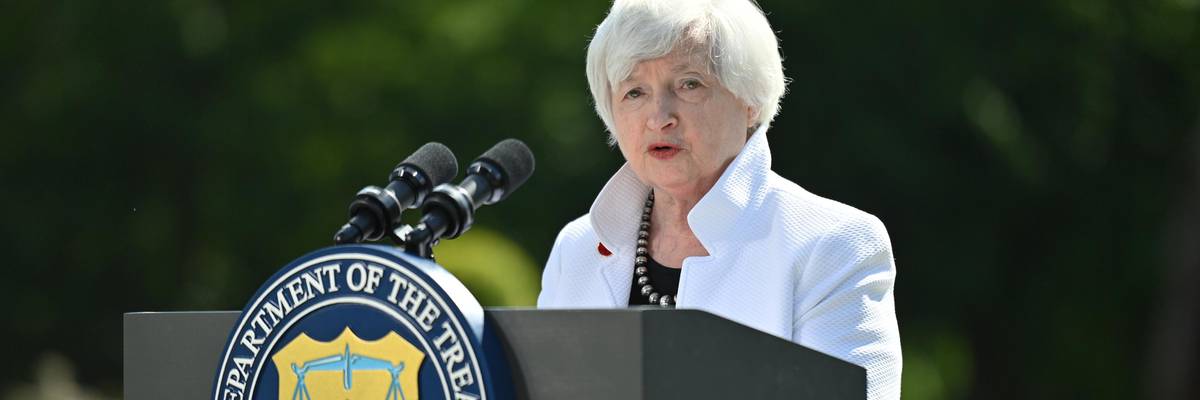
U.S. Treasury Secretary Janet Yellen speaks during a press conference on June 5, 2021 in London, England.
Treasury Secretary Janet Yellen implored Congress to "protect the full faith and credit of the United States" or face imposition of "extraordinary measures."
U.S. Treasury Secretary Janet Yellen warned Congress on Friday that—absent imminent action to raise or suspend the nation's debt limit—her agency would likely have to take "extraordinary measures" as soon as January 14 to avert hitting the debt ceiling.
"As you know, the debt limit is the total amount of money that the United States government is authorized to borrow to meet its existing legal obligations, including Social Security and Medicare benefits, military salaries, interest on the national debt, tax refunds, and other payments," Yellen wrote in a letter sent to congressional leaders. "In June 2023, the Fiscal Responsibility Act of 2023 was enacted, suspending the debt limit through January 1, 2025."
DEBT LIMIT: New letter this afternoon from Treasury Secretary Janet Yellen projects debt limit will be reached a bit later than the earlier projection of Jan. 1; new limit to be reached between Jan 14-23 at which point Treasury will have to take extraordinary measures
[image or embed]
— Jane Norman (@janenorman.bsky.social) December 27, 2024 at 1:53 PM
Yellen continued:
On January 2, 2025, the new debt limit will be established at the amount of outstanding debt subject to the statutory limit at the end of the previous day. However, on January 2, the outstanding debt subject to the limit is projected to decrease by approximately $54 billion, mostly due to a scheduled redemption of nonmarketable securities held by a federal trust fund associated with Medicare payments. As a result, the debt is currently projected to temporarily decrease, and accordingly, Treasury does not expect that it will be necessary to start taking extraordinary measures on January 2 to prevent the United States from defaulting on its obligations. Treasury currently expects to reach the new limit between January 14 and January 23, at which time it will be necessary for Treasury to start taking extraordinary measures.
"I respectfully urge Congress to act to protect the full faith and credit of the United States," Yellen added.
Recent past extraordinary measures—which are invoked by the U.S. Treasury Department to prevent a binding debt limit—have included the declaration of a debt issuance suspension period, suspension of new investments, and suspension of reinvestment of certain securities.
Yellen's admonition comes less than one month before Republican President-elect Donald Trump takes office. Both Trump and Yellen have called for the elimination of the debt ceiling. The end-of-year spending bill signed into law last week by U.S. President Joe Biden did not include Trump's demand to raise or suspend the debt ceiling.
According to USDebtClock.org, the nation is currently more than $36.2 trillion in debt—or more than $107,000 for each of the country's more 346.3 million people.
Dear Common Dreams reader, It’s been nearly 30 years since I co-founded Common Dreams with my late wife, Lina Newhouser. We had the radical notion that journalism should serve the public good, not corporate profits. It was clear to us from the outset what it would take to build such a project. No paid advertisements. No corporate sponsors. No millionaire publisher telling us what to think or do. Many people said we wouldn't last a year, but we proved those doubters wrong. Together with a tremendous team of journalists and dedicated staff, we built an independent media outlet free from the constraints of profits and corporate control. Our mission has always been simple: To inform. To inspire. To ignite change for the common good. Building Common Dreams was not easy. Our survival was never guaranteed. When you take on the most powerful forces—Wall Street greed, fossil fuel industry destruction, Big Tech lobbyists, and uber-rich oligarchs who have spent billions upon billions rigging the economy and democracy in their favor—the only bulwark you have is supporters who believe in your work. But here’s the urgent message from me today. It's never been this bad out there. And it's never been this hard to keep us going. At the very moment Common Dreams is most needed, the threats we face are intensifying. We need your support now more than ever. We don't accept corporate advertising and never will. We don't have a paywall because we don't think people should be blocked from critical news based on their ability to pay. Everything we do is funded by the donations of readers like you. When everyone does the little they can afford, we are strong. But if that support retreats or dries up, so do we. Will you donate now to make sure Common Dreams not only survives but thrives? —Craig Brown, Co-founder |
U.S. Treasury Secretary Janet Yellen warned Congress on Friday that—absent imminent action to raise or suspend the nation's debt limit—her agency would likely have to take "extraordinary measures" as soon as January 14 to avert hitting the debt ceiling.
"As you know, the debt limit is the total amount of money that the United States government is authorized to borrow to meet its existing legal obligations, including Social Security and Medicare benefits, military salaries, interest on the national debt, tax refunds, and other payments," Yellen wrote in a letter sent to congressional leaders. "In June 2023, the Fiscal Responsibility Act of 2023 was enacted, suspending the debt limit through January 1, 2025."
DEBT LIMIT: New letter this afternoon from Treasury Secretary Janet Yellen projects debt limit will be reached a bit later than the earlier projection of Jan. 1; new limit to be reached between Jan 14-23 at which point Treasury will have to take extraordinary measures
[image or embed]
— Jane Norman (@janenorman.bsky.social) December 27, 2024 at 1:53 PM
Yellen continued:
On January 2, 2025, the new debt limit will be established at the amount of outstanding debt subject to the statutory limit at the end of the previous day. However, on January 2, the outstanding debt subject to the limit is projected to decrease by approximately $54 billion, mostly due to a scheduled redemption of nonmarketable securities held by a federal trust fund associated with Medicare payments. As a result, the debt is currently projected to temporarily decrease, and accordingly, Treasury does not expect that it will be necessary to start taking extraordinary measures on January 2 to prevent the United States from defaulting on its obligations. Treasury currently expects to reach the new limit between January 14 and January 23, at which time it will be necessary for Treasury to start taking extraordinary measures.
"I respectfully urge Congress to act to protect the full faith and credit of the United States," Yellen added.
Recent past extraordinary measures—which are invoked by the U.S. Treasury Department to prevent a binding debt limit—have included the declaration of a debt issuance suspension period, suspension of new investments, and suspension of reinvestment of certain securities.
Yellen's admonition comes less than one month before Republican President-elect Donald Trump takes office. Both Trump and Yellen have called for the elimination of the debt ceiling. The end-of-year spending bill signed into law last week by U.S. President Joe Biden did not include Trump's demand to raise or suspend the debt ceiling.
According to USDebtClock.org, the nation is currently more than $36.2 trillion in debt—or more than $107,000 for each of the country's more 346.3 million people.
U.S. Treasury Secretary Janet Yellen warned Congress on Friday that—absent imminent action to raise or suspend the nation's debt limit—her agency would likely have to take "extraordinary measures" as soon as January 14 to avert hitting the debt ceiling.
"As you know, the debt limit is the total amount of money that the United States government is authorized to borrow to meet its existing legal obligations, including Social Security and Medicare benefits, military salaries, interest on the national debt, tax refunds, and other payments," Yellen wrote in a letter sent to congressional leaders. "In June 2023, the Fiscal Responsibility Act of 2023 was enacted, suspending the debt limit through January 1, 2025."
DEBT LIMIT: New letter this afternoon from Treasury Secretary Janet Yellen projects debt limit will be reached a bit later than the earlier projection of Jan. 1; new limit to be reached between Jan 14-23 at which point Treasury will have to take extraordinary measures
[image or embed]
— Jane Norman (@janenorman.bsky.social) December 27, 2024 at 1:53 PM
Yellen continued:
On January 2, 2025, the new debt limit will be established at the amount of outstanding debt subject to the statutory limit at the end of the previous day. However, on January 2, the outstanding debt subject to the limit is projected to decrease by approximately $54 billion, mostly due to a scheduled redemption of nonmarketable securities held by a federal trust fund associated with Medicare payments. As a result, the debt is currently projected to temporarily decrease, and accordingly, Treasury does not expect that it will be necessary to start taking extraordinary measures on January 2 to prevent the United States from defaulting on its obligations. Treasury currently expects to reach the new limit between January 14 and January 23, at which time it will be necessary for Treasury to start taking extraordinary measures.
"I respectfully urge Congress to act to protect the full faith and credit of the United States," Yellen added.
Recent past extraordinary measures—which are invoked by the U.S. Treasury Department to prevent a binding debt limit—have included the declaration of a debt issuance suspension period, suspension of new investments, and suspension of reinvestment of certain securities.
Yellen's admonition comes less than one month before Republican President-elect Donald Trump takes office. Both Trump and Yellen have called for the elimination of the debt ceiling. The end-of-year spending bill signed into law last week by U.S. President Joe Biden did not include Trump's demand to raise or suspend the debt ceiling.
According to USDebtClock.org, the nation is currently more than $36.2 trillion in debt—or more than $107,000 for each of the country's more 346.3 million people.