

SUBSCRIBE TO OUR FREE NEWSLETTER
Daily news & progressive opinion—funded by the people, not the corporations—delivered straight to your inbox.
5
#000000
#FFFFFF
To donate by check, phone, or other method, see our More Ways to Give page.
Daily news & progressive opinion—funded by the people, not the corporations—delivered straight to your inbox.
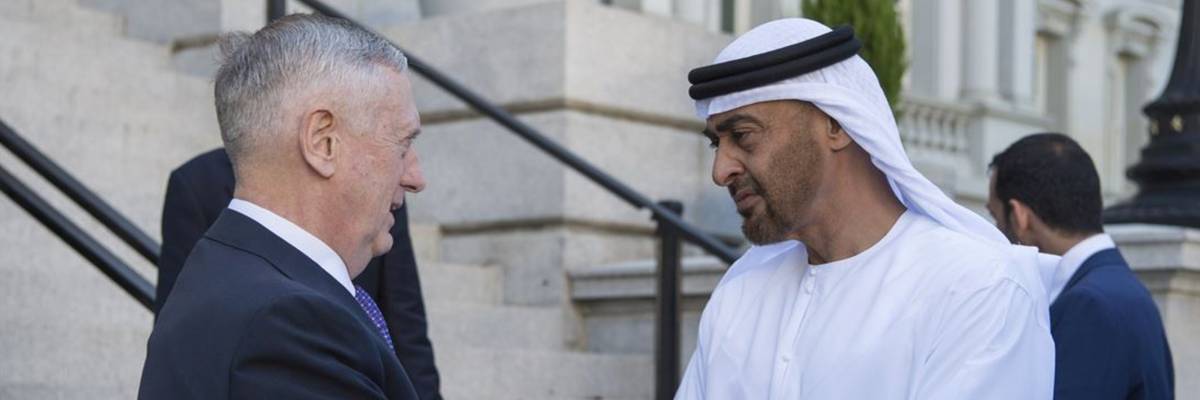
Then-U.S. Defense Secretary James Mattis shakes hands with Sheikh Mohamed bin Zayed al-Nahyan of the United Arab Emirates during a May 15, 2017 meeting in Washington, D.C.
"Guess we now know why former Defense Secretary Mattis has not been publicly critical of Trump," quipped one observer.
Before becoming former President Donald Trump's defense secretary, retired U.S. Marine Corps Gen. James Mattis secretly worked for the de facto ruler of the United Arab Emirates while the United States was supporting the monarchy in the Saudi-led war on Yemen, a Washington Post investigation revealed Tuesday.
Records obtained by the Post show that in June 2015, Mattis—then a recently retired four-star general—applied to work as a personal consultant to Sheikh Mohamed bin Zayed al-Nahyan, who at the time was also the deputy supreme commander of the UAE military.
Mohamed, who became the UAE's president following the 2022 death of his brother Sheikh Khalifa bin Zayed bin Sultan al-Nahyan, sought Mattis' counsel as the Saudi-led coalition intervening in Yemen's civil war was killing a staggering number of civilians while making little progress toward defeating Houthi rebels.
In his application to work as an agent for a foreign government, Mattis—who had earned the moniker "Mad Dog" during one of the 2004 battles for Fallujah, Iraq in which hundreds of civilians were killed or wounded by American forces—wrote that "my duties would include reviewing the UAE's military situation, focused initially on the Yemen campaign, with the purpose of providing military advice."
"The purpose of this position is to bring American military experience in warfighting and campaigning to bear in terms of strengthening UAE's efforts," he explained.
"I will be compensated," Mattis added. However, Robert Tyrer, co-president of the Cohen Group, a Washington consulting firm where Mattis works as a senior counselor, told the Post that the UAE did not pay Mattis for his work, and that the former defense secretary at the time had a "long-standing policy" of not taking payment from foreign officials.
Mattis' request was approved by Marine Corps brass, and then in August 2015 by the State Department Bureau of Political-Military Affairs. While a handful of federal officials knew of his work for Mohamed, "other national security officials said they did not—including diplomats in charge of U.S. policy in the Middle East," according to the Post.
"This whole thing is very curious," Gerald Feierstein, the U.S. deputy assistant secretary for Near East Affairs at the time, told the paper. "I find it kind of hard to believe he would never have mentioned it to any of us. Mattis as you know is a pretty straight shooter, so I would have thought he would have briefed somebody."
Mattis worked for Mohamed at the same time as the United States was participating in the Saudi-led war. Then-President Barack Obama announced in March 2015 that U.S. forces—which had already been conducting drone strikes in Yemen—would provide "logistical and intelligence support" to the coalition. That assistance included refueling the Saudi and Emirati warplanes that were bombing Yemeni targets and killing thousands of civilians.
"This whole thing is very curious. I find it kind of hard to believe he would never have mentioned it to any of us."
The secrecy surrounding Mattis' work for Mohamed continued even after he returned to the Pentagon in January 2017 to serve as Trump's defense secretary. According to the Post: "He omitted it from his public work history and financial disclosure forms that he filed with the Office of Government Ethics. Though he reported it confidentially to the Senate Armed Services Committee, multiple senators said they were not informed."
In August 2018, United Nations human rights officials reported that nearly 17,000 civilians had been killed in Yemen, mostly by Saudi-led airstrikes. In the face of mounting evidence of coalition war crimes, Mattis warned that the Trump administration was considering suspending support for the coalition if it did not reduce civilian casualties.
This, a little over a year after Mattis declared that "civilian casualties are a fact of life" and announced that U.S. forces were adopting a policy of "annihilation" in the battle against Islamic State in Syria and Iraq, where American bombs and bullets were killing thousands of noncombatants.
After resigning as defense secretary over Trump's decision to withdraw U.S. forces from Syria and dramatically reduce the number of troops in Afghanistan, Mattis returned to the private sector and again applied to work for the Emirati government, which paid him $100,000 plus airfare and lodging for a series of May 2019 talks on U.S.-UAE relations.
Dear Common Dreams reader, It’s been nearly 30 years since I co-founded Common Dreams with my late wife, Lina Newhouser. We had the radical notion that journalism should serve the public good, not corporate profits. It was clear to us from the outset what it would take to build such a project. No paid advertisements. No corporate sponsors. No millionaire publisher telling us what to think or do. Many people said we wouldn't last a year, but we proved those doubters wrong. Together with a tremendous team of journalists and dedicated staff, we built an independent media outlet free from the constraints of profits and corporate control. Our mission has always been simple: To inform. To inspire. To ignite change for the common good. Building Common Dreams was not easy. Our survival was never guaranteed. When you take on the most powerful forces—Wall Street greed, fossil fuel industry destruction, Big Tech lobbyists, and uber-rich oligarchs who have spent billions upon billions rigging the economy and democracy in their favor—the only bulwark you have is supporters who believe in your work. But here’s the urgent message from me today. It's never been this bad out there. And it's never been this hard to keep us going. At the very moment Common Dreams is most needed, the threats we face are intensifying. We need your support now more than ever. We don't accept corporate advertising and never will. We don't have a paywall because we don't think people should be blocked from critical news based on their ability to pay. Everything we do is funded by the donations of readers like you. When everyone does the little they can afford, we are strong. But if that support retreats or dries up, so do we. Will you donate now to make sure Common Dreams not only survives but thrives? —Craig Brown, Co-founder |
Before becoming former President Donald Trump's defense secretary, retired U.S. Marine Corps Gen. James Mattis secretly worked for the de facto ruler of the United Arab Emirates while the United States was supporting the monarchy in the Saudi-led war on Yemen, a Washington Post investigation revealed Tuesday.
Records obtained by the Post show that in June 2015, Mattis—then a recently retired four-star general—applied to work as a personal consultant to Sheikh Mohamed bin Zayed al-Nahyan, who at the time was also the deputy supreme commander of the UAE military.
Mohamed, who became the UAE's president following the 2022 death of his brother Sheikh Khalifa bin Zayed bin Sultan al-Nahyan, sought Mattis' counsel as the Saudi-led coalition intervening in Yemen's civil war was killing a staggering number of civilians while making little progress toward defeating Houthi rebels.
In his application to work as an agent for a foreign government, Mattis—who had earned the moniker "Mad Dog" during one of the 2004 battles for Fallujah, Iraq in which hundreds of civilians were killed or wounded by American forces—wrote that "my duties would include reviewing the UAE's military situation, focused initially on the Yemen campaign, with the purpose of providing military advice."
"The purpose of this position is to bring American military experience in warfighting and campaigning to bear in terms of strengthening UAE's efforts," he explained.
"I will be compensated," Mattis added. However, Robert Tyrer, co-president of the Cohen Group, a Washington consulting firm where Mattis works as a senior counselor, told the Post that the UAE did not pay Mattis for his work, and that the former defense secretary at the time had a "long-standing policy" of not taking payment from foreign officials.
Mattis' request was approved by Marine Corps brass, and then in August 2015 by the State Department Bureau of Political-Military Affairs. While a handful of federal officials knew of his work for Mohamed, "other national security officials said they did not—including diplomats in charge of U.S. policy in the Middle East," according to the Post.
"This whole thing is very curious," Gerald Feierstein, the U.S. deputy assistant secretary for Near East Affairs at the time, told the paper. "I find it kind of hard to believe he would never have mentioned it to any of us. Mattis as you know is a pretty straight shooter, so I would have thought he would have briefed somebody."
Mattis worked for Mohamed at the same time as the United States was participating in the Saudi-led war. Then-President Barack Obama announced in March 2015 that U.S. forces—which had already been conducting drone strikes in Yemen—would provide "logistical and intelligence support" to the coalition. That assistance included refueling the Saudi and Emirati warplanes that were bombing Yemeni targets and killing thousands of civilians.
"This whole thing is very curious. I find it kind of hard to believe he would never have mentioned it to any of us."
The secrecy surrounding Mattis' work for Mohamed continued even after he returned to the Pentagon in January 2017 to serve as Trump's defense secretary. According to the Post: "He omitted it from his public work history and financial disclosure forms that he filed with the Office of Government Ethics. Though he reported it confidentially to the Senate Armed Services Committee, multiple senators said they were not informed."
In August 2018, United Nations human rights officials reported that nearly 17,000 civilians had been killed in Yemen, mostly by Saudi-led airstrikes. In the face of mounting evidence of coalition war crimes, Mattis warned that the Trump administration was considering suspending support for the coalition if it did not reduce civilian casualties.
This, a little over a year after Mattis declared that "civilian casualties are a fact of life" and announced that U.S. forces were adopting a policy of "annihilation" in the battle against Islamic State in Syria and Iraq, where American bombs and bullets were killing thousands of noncombatants.
After resigning as defense secretary over Trump's decision to withdraw U.S. forces from Syria and dramatically reduce the number of troops in Afghanistan, Mattis returned to the private sector and again applied to work for the Emirati government, which paid him $100,000 plus airfare and lodging for a series of May 2019 talks on U.S.-UAE relations.
Before becoming former President Donald Trump's defense secretary, retired U.S. Marine Corps Gen. James Mattis secretly worked for the de facto ruler of the United Arab Emirates while the United States was supporting the monarchy in the Saudi-led war on Yemen, a Washington Post investigation revealed Tuesday.
Records obtained by the Post show that in June 2015, Mattis—then a recently retired four-star general—applied to work as a personal consultant to Sheikh Mohamed bin Zayed al-Nahyan, who at the time was also the deputy supreme commander of the UAE military.
Mohamed, who became the UAE's president following the 2022 death of his brother Sheikh Khalifa bin Zayed bin Sultan al-Nahyan, sought Mattis' counsel as the Saudi-led coalition intervening in Yemen's civil war was killing a staggering number of civilians while making little progress toward defeating Houthi rebels.
In his application to work as an agent for a foreign government, Mattis—who had earned the moniker "Mad Dog" during one of the 2004 battles for Fallujah, Iraq in which hundreds of civilians were killed or wounded by American forces—wrote that "my duties would include reviewing the UAE's military situation, focused initially on the Yemen campaign, with the purpose of providing military advice."
"The purpose of this position is to bring American military experience in warfighting and campaigning to bear in terms of strengthening UAE's efforts," he explained.
"I will be compensated," Mattis added. However, Robert Tyrer, co-president of the Cohen Group, a Washington consulting firm where Mattis works as a senior counselor, told the Post that the UAE did not pay Mattis for his work, and that the former defense secretary at the time had a "long-standing policy" of not taking payment from foreign officials.
Mattis' request was approved by Marine Corps brass, and then in August 2015 by the State Department Bureau of Political-Military Affairs. While a handful of federal officials knew of his work for Mohamed, "other national security officials said they did not—including diplomats in charge of U.S. policy in the Middle East," according to the Post.
"This whole thing is very curious," Gerald Feierstein, the U.S. deputy assistant secretary for Near East Affairs at the time, told the paper. "I find it kind of hard to believe he would never have mentioned it to any of us. Mattis as you know is a pretty straight shooter, so I would have thought he would have briefed somebody."
Mattis worked for Mohamed at the same time as the United States was participating in the Saudi-led war. Then-President Barack Obama announced in March 2015 that U.S. forces—which had already been conducting drone strikes in Yemen—would provide "logistical and intelligence support" to the coalition. That assistance included refueling the Saudi and Emirati warplanes that were bombing Yemeni targets and killing thousands of civilians.
"This whole thing is very curious. I find it kind of hard to believe he would never have mentioned it to any of us."
The secrecy surrounding Mattis' work for Mohamed continued even after he returned to the Pentagon in January 2017 to serve as Trump's defense secretary. According to the Post: "He omitted it from his public work history and financial disclosure forms that he filed with the Office of Government Ethics. Though he reported it confidentially to the Senate Armed Services Committee, multiple senators said they were not informed."
In August 2018, United Nations human rights officials reported that nearly 17,000 civilians had been killed in Yemen, mostly by Saudi-led airstrikes. In the face of mounting evidence of coalition war crimes, Mattis warned that the Trump administration was considering suspending support for the coalition if it did not reduce civilian casualties.
This, a little over a year after Mattis declared that "civilian casualties are a fact of life" and announced that U.S. forces were adopting a policy of "annihilation" in the battle against Islamic State in Syria and Iraq, where American bombs and bullets were killing thousands of noncombatants.
After resigning as defense secretary over Trump's decision to withdraw U.S. forces from Syria and dramatically reduce the number of troops in Afghanistan, Mattis returned to the private sector and again applied to work for the Emirati government, which paid him $100,000 plus airfare and lodging for a series of May 2019 talks on U.S.-UAE relations.

