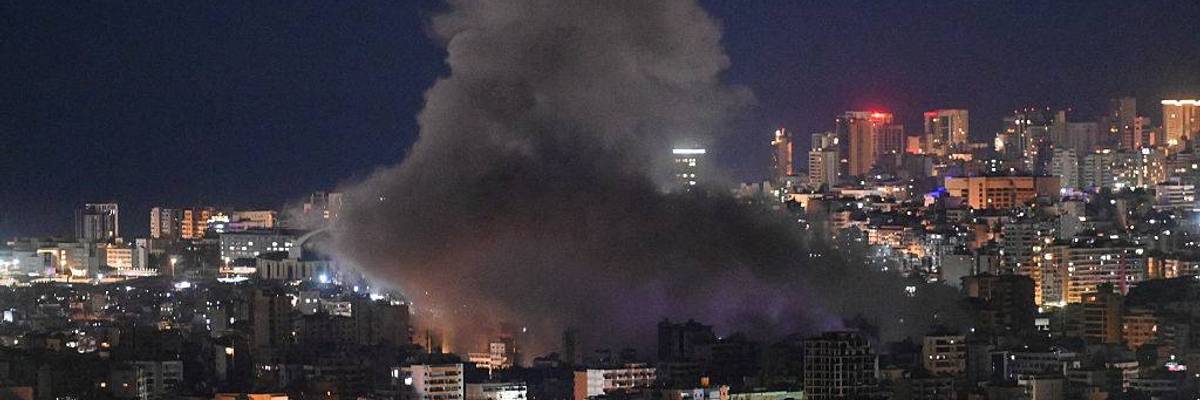
Smoke rises from the site of an Israeli airstrike that targeted Beirut's southern neighborhood on March 5, 2026.
'Total Panic' Across Beirut as Israel Issues 'Unprecedented' Mass Evacuation Warning
"They want civil chaos in this country," said one journalist of Israel's military plans in Lebanon.
The Israeli military on Thursday issued what the Times of Israel described as an "unprecedented" evacuation warning to residents in Beirut's southern suburbs ahead of planned strikes against Hezbollah.
According to the Times of Israel, the warning "covers four major neighborhoods in the southern suburbs" of the Lebanese capital, and represents a marked difference from past evacuation warnings that have typically covered specific locations where Israel intended to launch strikes.
In the warning, Israeli Army spokesman Col. Avichay Adraee told residents of the four neighborhoods to "save your lives and evacuate your homes immediately," and warned that any movement southward toward the Israeli border "may endanger your lives."
Israel has deployed soldiers and conducted airstrikes in Lebanon as its military also joins the US in attacking Iran in an operation they began late last week. The US and Israeli attacks have led to a widening conflict in the region, with the Iran-backed Hezbollah launching missiles at Israel in retaliation.
Maha Yahya, director of the Malcolm H. Kerr Carnegie Middle East Center, said in a Thursday social media post that the Israeli warning has caused "total panic across the city," as the area being targeted by Israel is home to "at least a half million people."
Lebansese-Australian journalist Rania Abouzeid similarly described "widespread panic" across Beirut in the wake of the order.
"Traffic is choked, people rushing to leave and head north," Abouzeid wrote. "Drones in the air. WhatsApp messages urging people to crack windows open to avoid shattering from expected blasts."
Ariel Oseran, senior Middle East correspondent for i24News English, posted video on social media showing packed streets filled with cars of people trying to escape the impending Israeli attack.
Residents of Beirut’s southern suburbs seen fleeing shortly after the IDF issued an evacuation warning for the entire area. https://t.co/V34p1mhCW6 pic.twitter.com/LCQfOxO59J
— Ariel Oseran أريئل أوسيران (@ariel_oseran) March 5, 2026
Mohamad Safa, executive director of PVA Patriotic Vision, an international multilateral organization with special consultative status at the United Nations Economic and Social Council, said that the evacuation order was making a dangerous situation on the ground in Lebanon even worse.
"Our teams have been on the ground assisting [internally displaced peoples] since day one," he wrote. "The humanitarian situation in Lebanon is going from bad to worse. Shelters are overcrowded, and there are no apartments available for rent. Emergency relief is insufficient. People are sleeping on the ground without blankets or mattresses in the bitter cold."
Journalist Rania Khalek of BreakThrough News said that Israel "is trying to empty out huge portions of the country," and she speculated that it was being done in a way to maximize chaos on the ground.
"The Israelis are telling Lebanese they are displacing from Shia neighborhoods to take roads to what will inevitably land them in Christian and Sunni areas," she wrote. "They want civil chaos in this country."
Philippe Lazzarini, commissioner-general of the United Nations Relief and Works Agency for Palestine Refugees in the Near East (UNRWA) said that his agency "has opened emergency shelters for displaced people—Palestine refugees, Lebanese, and Syrians alike" in the wake of Israel's evacuation warning.
Lazzarini also emphasized that "Lebanon needs peace, not more destruction, displacement, and death."
An Urgent Message From Our Co-Founder
Dear Common Dreams reader, It’s been nearly 30 years since I co-founded Common Dreams with my late wife, Lina Newhouser. We had the radical notion that journalism should serve the public good, not corporate profits. It was clear to us from the outset what it would take to build such a project. No paid advertisements. No corporate sponsors. No millionaire publisher telling us what to think or do. Many people said we wouldn't last a year, but we proved those doubters wrong. Together with a tremendous team of journalists and dedicated staff, we built an independent media outlet free from the constraints of profits and corporate control. Our mission has always been simple: To inform. To inspire. To ignite change for the common good. Building Common Dreams was not easy. Our survival was never guaranteed. When you take on the most powerful forces—Wall Street greed, fossil fuel industry destruction, Big Tech lobbyists, and uber-rich oligarchs who have spent billions upon billions rigging the economy and democracy in their favor—the only bulwark you have is supporters who believe in your work. But here’s the urgent message from me today. It's never been this bad out there. And it's never been this hard to keep us going. At the very moment Common Dreams is most needed, the threats we face are intensifying. We need your support now more than ever. We don't accept corporate advertising and never will. We don't have a paywall because we don't think people should be blocked from critical news based on their ability to pay. Everything we do is funded by the donations of readers like you. When everyone does the little they can afford, we are strong. But if that support retreats or dries up, so do we. Will you donate now to make sure Common Dreams not only survives but thrives? —Craig Brown, Co-founder |
The Israeli military on Thursday issued what the Times of Israel described as an "unprecedented" evacuation warning to residents in Beirut's southern suburbs ahead of planned strikes against Hezbollah.
According to the Times of Israel, the warning "covers four major neighborhoods in the southern suburbs" of the Lebanese capital, and represents a marked difference from past evacuation warnings that have typically covered specific locations where Israel intended to launch strikes.
In the warning, Israeli Army spokesman Col. Avichay Adraee told residents of the four neighborhoods to "save your lives and evacuate your homes immediately," and warned that any movement southward toward the Israeli border "may endanger your lives."
Israel has deployed soldiers and conducted airstrikes in Lebanon as its military also joins the US in attacking Iran in an operation they began late last week. The US and Israeli attacks have led to a widening conflict in the region, with the Iran-backed Hezbollah launching missiles at Israel in retaliation.
Maha Yahya, director of the Malcolm H. Kerr Carnegie Middle East Center, said in a Thursday social media post that the Israeli warning has caused "total panic across the city," as the area being targeted by Israel is home to "at least a half million people."
Lebansese-Australian journalist Rania Abouzeid similarly described "widespread panic" across Beirut in the wake of the order.
"Traffic is choked, people rushing to leave and head north," Abouzeid wrote. "Drones in the air. WhatsApp messages urging people to crack windows open to avoid shattering from expected blasts."
Ariel Oseran, senior Middle East correspondent for i24News English, posted video on social media showing packed streets filled with cars of people trying to escape the impending Israeli attack.
Residents of Beirut’s southern suburbs seen fleeing shortly after the IDF issued an evacuation warning for the entire area. https://t.co/V34p1mhCW6 pic.twitter.com/LCQfOxO59J
— Ariel Oseran أريئل أوسيران (@ariel_oseran) March 5, 2026
Mohamad Safa, executive director of PVA Patriotic Vision, an international multilateral organization with special consultative status at the United Nations Economic and Social Council, said that the evacuation order was making a dangerous situation on the ground in Lebanon even worse.
"Our teams have been on the ground assisting [internally displaced peoples] since day one," he wrote. "The humanitarian situation in Lebanon is going from bad to worse. Shelters are overcrowded, and there are no apartments available for rent. Emergency relief is insufficient. People are sleeping on the ground without blankets or mattresses in the bitter cold."
Journalist Rania Khalek of BreakThrough News said that Israel "is trying to empty out huge portions of the country," and she speculated that it was being done in a way to maximize chaos on the ground.
"The Israelis are telling Lebanese they are displacing from Shia neighborhoods to take roads to what will inevitably land them in Christian and Sunni areas," she wrote. "They want civil chaos in this country."
Philippe Lazzarini, commissioner-general of the United Nations Relief and Works Agency for Palestine Refugees in the Near East (UNRWA) said that his agency "has opened emergency shelters for displaced people—Palestine refugees, Lebanese, and Syrians alike" in the wake of Israel's evacuation warning.
Lazzarini also emphasized that "Lebanon needs peace, not more destruction, displacement, and death."
- Israel Steps Up Attacks in Gaza and Lebanon ›
- 'Increasing Destruction': Israel Continues Bombing Campaign Across Lebanon ›
- Israel Gives 'Mass Expulsion Order' to Civilians as It Invades Southern Lebanon ›
The Israeli military on Thursday issued what the Times of Israel described as an "unprecedented" evacuation warning to residents in Beirut's southern suburbs ahead of planned strikes against Hezbollah.
According to the Times of Israel, the warning "covers four major neighborhoods in the southern suburbs" of the Lebanese capital, and represents a marked difference from past evacuation warnings that have typically covered specific locations where Israel intended to launch strikes.
In the warning, Israeli Army spokesman Col. Avichay Adraee told residents of the four neighborhoods to "save your lives and evacuate your homes immediately," and warned that any movement southward toward the Israeli border "may endanger your lives."
Israel has deployed soldiers and conducted airstrikes in Lebanon as its military also joins the US in attacking Iran in an operation they began late last week. The US and Israeli attacks have led to a widening conflict in the region, with the Iran-backed Hezbollah launching missiles at Israel in retaliation.
Maha Yahya, director of the Malcolm H. Kerr Carnegie Middle East Center, said in a Thursday social media post that the Israeli warning has caused "total panic across the city," as the area being targeted by Israel is home to "at least a half million people."
Lebansese-Australian journalist Rania Abouzeid similarly described "widespread panic" across Beirut in the wake of the order.
"Traffic is choked, people rushing to leave and head north," Abouzeid wrote. "Drones in the air. WhatsApp messages urging people to crack windows open to avoid shattering from expected blasts."
Ariel Oseran, senior Middle East correspondent for i24News English, posted video on social media showing packed streets filled with cars of people trying to escape the impending Israeli attack.
Residents of Beirut’s southern suburbs seen fleeing shortly after the IDF issued an evacuation warning for the entire area. https://t.co/V34p1mhCW6 pic.twitter.com/LCQfOxO59J
— Ariel Oseran أريئل أوسيران (@ariel_oseran) March 5, 2026
Mohamad Safa, executive director of PVA Patriotic Vision, an international multilateral organization with special consultative status at the United Nations Economic and Social Council, said that the evacuation order was making a dangerous situation on the ground in Lebanon even worse.
"Our teams have been on the ground assisting [internally displaced peoples] since day one," he wrote. "The humanitarian situation in Lebanon is going from bad to worse. Shelters are overcrowded, and there are no apartments available for rent. Emergency relief is insufficient. People are sleeping on the ground without blankets or mattresses in the bitter cold."
Journalist Rania Khalek of BreakThrough News said that Israel "is trying to empty out huge portions of the country," and she speculated that it was being done in a way to maximize chaos on the ground.
"The Israelis are telling Lebanese they are displacing from Shia neighborhoods to take roads to what will inevitably land them in Christian and Sunni areas," she wrote. "They want civil chaos in this country."
Philippe Lazzarini, commissioner-general of the United Nations Relief and Works Agency for Palestine Refugees in the Near East (UNRWA) said that his agency "has opened emergency shelters for displaced people—Palestine refugees, Lebanese, and Syrians alike" in the wake of Israel's evacuation warning.
Lazzarini also emphasized that "Lebanon needs peace, not more destruction, displacement, and death."
- Israel Steps Up Attacks in Gaza and Lebanon ›
- 'Increasing Destruction': Israel Continues Bombing Campaign Across Lebanon ›
- Israel Gives 'Mass Expulsion Order' to Civilians as It Invades Southern Lebanon ›