SUBSCRIBE TO OUR FREE NEWSLETTER
Daily news & progressive opinion—funded by the people, not the corporations—delivered straight to your inbox.
5
#000000
#FFFFFF
To donate by check, phone, or other method, see our More Ways to Give page.
Daily news & progressive opinion—funded by the people, not the corporations—delivered straight to your inbox.
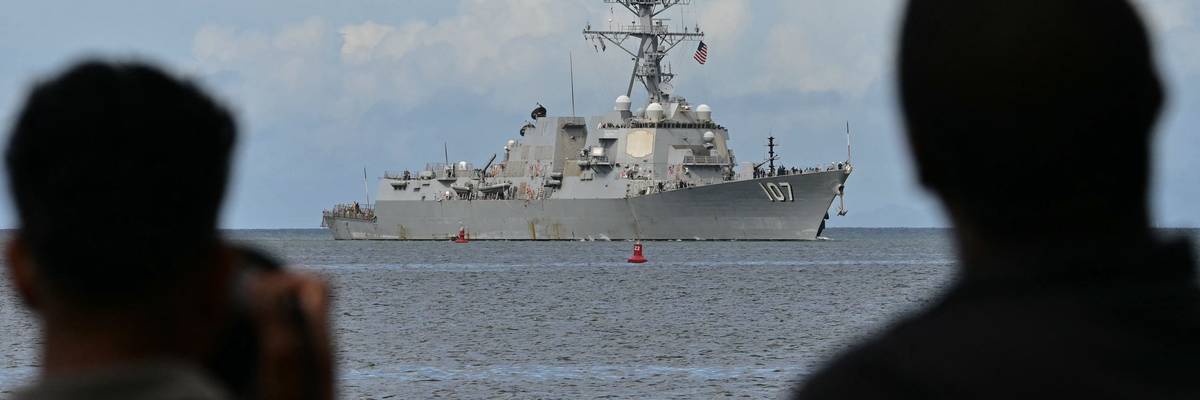
Photographers take pictures as the USS Gravely warship enters the Port of Spain on October 26, 2025.
"None of the individuals on the targeted boats appeared to pose an imminent threat to the lives of others or otherwise justified the use of lethal armed force against them under international law," said Volker Türk.
The United Nations' top human rights official said Friday that US President Donald Trump's deadly strikes on boats in international waters in recent weeks amount to "extrajudicial killing" that must stop immediately, remarks that came as the White House appeared poised to expand the unlawful military campaign to targets inside Venezuela.
Volker Türk, the UN high commissioner for human rights, said of the administration's boat strikes that "these attacks—and their mounting human cost—are unacceptable."
"The US must halt such attacks and take all measures necessary to prevent the extrajudicial killing of people aboard these boats, whatever the criminal conduct alleged against them," said Türk, noting that the administration has not substantiated its claim that those killed by the strikes in waters off Central and South America were smuggling drugs.
The Trump administration has also kept secret a US Justice Department memo purportedly outlining an internal legal justification for the deadly strikes.
Türk noted that "countering the serious issue of illicit trafficking of drugs across international borders is—as has long been agreed among states—a law-enforcement matter, governed by the careful limits on lethal force set out in international human rights law."
"Under international human rights law, the intentional use of lethal force is only permissible as a last resort against individuals who pose an imminent threat to life," said the UN human rights chief. "Based on the very sparse information provided publicly by the US authorities, none of the individuals on the targeted boats appeared to pose an imminent threat to the lives of others or otherwise justified the use of lethal armed force against them under international law."
The Trump administration's strikes have killed more than 60 people thus far. At least one of the targeted vessels appeared to have turned around before the US military bombed it, killing 11 people.
Türk's statement came as the Miami Herald reported that the Trump administration "has made the decision to attack military installations inside Venezuela and the strikes could come at any moment."
Trump has said publicly that land strikes inside Venezuela would be the next phase of the military assault, which he has described as a "war" on drug cartels. The president has not yet received—or even sought—congressional authorization for any of the military actions taken in the Caribbean and Pacific.
In a statement last week, a group of UN experts denounced the Trump administration's strikes and belligerent posturing toward Venezuela as "an extremely dangerous escalation with grave implications for peace and security in the Caribbean region."
"The long history of external interventions in Latin America must not be repeated,” the experts said.
Dear Common Dreams reader, It’s been nearly 30 years since I co-founded Common Dreams with my late wife, Lina Newhouser. We had the radical notion that journalism should serve the public good, not corporate profits. It was clear to us from the outset what it would take to build such a project. No paid advertisements. No corporate sponsors. No millionaire publisher telling us what to think or do. Many people said we wouldn't last a year, but we proved those doubters wrong. Together with a tremendous team of journalists and dedicated staff, we built an independent media outlet free from the constraints of profits and corporate control. Our mission has always been simple: To inform. To inspire. To ignite change for the common good. Building Common Dreams was not easy. Our survival was never guaranteed. When you take on the most powerful forces—Wall Street greed, fossil fuel industry destruction, Big Tech lobbyists, and uber-rich oligarchs who have spent billions upon billions rigging the economy and democracy in their favor—the only bulwark you have is supporters who believe in your work. But here’s the urgent message from me today. It's never been this bad out there. And it's never been this hard to keep us going. At the very moment Common Dreams is most needed, the threats we face are intensifying. We need your support now more than ever. We don't accept corporate advertising and never will. We don't have a paywall because we don't think people should be blocked from critical news based on their ability to pay. Everything we do is funded by the donations of readers like you. When everyone does the little they can afford, we are strong. But if that support retreats or dries up, so do we. Will you donate now to make sure Common Dreams not only survives but thrives? —Craig Brown, Co-founder |
The United Nations' top human rights official said Friday that US President Donald Trump's deadly strikes on boats in international waters in recent weeks amount to "extrajudicial killing" that must stop immediately, remarks that came as the White House appeared poised to expand the unlawful military campaign to targets inside Venezuela.
Volker Türk, the UN high commissioner for human rights, said of the administration's boat strikes that "these attacks—and their mounting human cost—are unacceptable."
"The US must halt such attacks and take all measures necessary to prevent the extrajudicial killing of people aboard these boats, whatever the criminal conduct alleged against them," said Türk, noting that the administration has not substantiated its claim that those killed by the strikes in waters off Central and South America were smuggling drugs.
The Trump administration has also kept secret a US Justice Department memo purportedly outlining an internal legal justification for the deadly strikes.
Türk noted that "countering the serious issue of illicit trafficking of drugs across international borders is—as has long been agreed among states—a law-enforcement matter, governed by the careful limits on lethal force set out in international human rights law."
"Under international human rights law, the intentional use of lethal force is only permissible as a last resort against individuals who pose an imminent threat to life," said the UN human rights chief. "Based on the very sparse information provided publicly by the US authorities, none of the individuals on the targeted boats appeared to pose an imminent threat to the lives of others or otherwise justified the use of lethal armed force against them under international law."
The Trump administration's strikes have killed more than 60 people thus far. At least one of the targeted vessels appeared to have turned around before the US military bombed it, killing 11 people.
Türk's statement came as the Miami Herald reported that the Trump administration "has made the decision to attack military installations inside Venezuela and the strikes could come at any moment."
Trump has said publicly that land strikes inside Venezuela would be the next phase of the military assault, which he has described as a "war" on drug cartels. The president has not yet received—or even sought—congressional authorization for any of the military actions taken in the Caribbean and Pacific.
In a statement last week, a group of UN experts denounced the Trump administration's strikes and belligerent posturing toward Venezuela as "an extremely dangerous escalation with grave implications for peace and security in the Caribbean region."
"The long history of external interventions in Latin America must not be repeated,” the experts said.
The United Nations' top human rights official said Friday that US President Donald Trump's deadly strikes on boats in international waters in recent weeks amount to "extrajudicial killing" that must stop immediately, remarks that came as the White House appeared poised to expand the unlawful military campaign to targets inside Venezuela.
Volker Türk, the UN high commissioner for human rights, said of the administration's boat strikes that "these attacks—and their mounting human cost—are unacceptable."
"The US must halt such attacks and take all measures necessary to prevent the extrajudicial killing of people aboard these boats, whatever the criminal conduct alleged against them," said Türk, noting that the administration has not substantiated its claim that those killed by the strikes in waters off Central and South America were smuggling drugs.
The Trump administration has also kept secret a US Justice Department memo purportedly outlining an internal legal justification for the deadly strikes.
Türk noted that "countering the serious issue of illicit trafficking of drugs across international borders is—as has long been agreed among states—a law-enforcement matter, governed by the careful limits on lethal force set out in international human rights law."
"Under international human rights law, the intentional use of lethal force is only permissible as a last resort against individuals who pose an imminent threat to life," said the UN human rights chief. "Based on the very sparse information provided publicly by the US authorities, none of the individuals on the targeted boats appeared to pose an imminent threat to the lives of others or otherwise justified the use of lethal armed force against them under international law."
The Trump administration's strikes have killed more than 60 people thus far. At least one of the targeted vessels appeared to have turned around before the US military bombed it, killing 11 people.
Türk's statement came as the Miami Herald reported that the Trump administration "has made the decision to attack military installations inside Venezuela and the strikes could come at any moment."
Trump has said publicly that land strikes inside Venezuela would be the next phase of the military assault, which he has described as a "war" on drug cartels. The president has not yet received—or even sought—congressional authorization for any of the military actions taken in the Caribbean and Pacific.
In a statement last week, a group of UN experts denounced the Trump administration's strikes and belligerent posturing toward Venezuela as "an extremely dangerous escalation with grave implications for peace and security in the Caribbean region."
"The long history of external interventions in Latin America must not be repeated,” the experts said.