SUBSCRIBE TO OUR FREE NEWSLETTER
Daily news & progressive opinion—funded by the people, not the corporations—delivered straight to your inbox.
5
#000000
#FFFFFF
To donate by check, phone, or other method, see our More Ways to Give page.
Daily news & progressive opinion—funded by the people, not the corporations—delivered straight to your inbox.
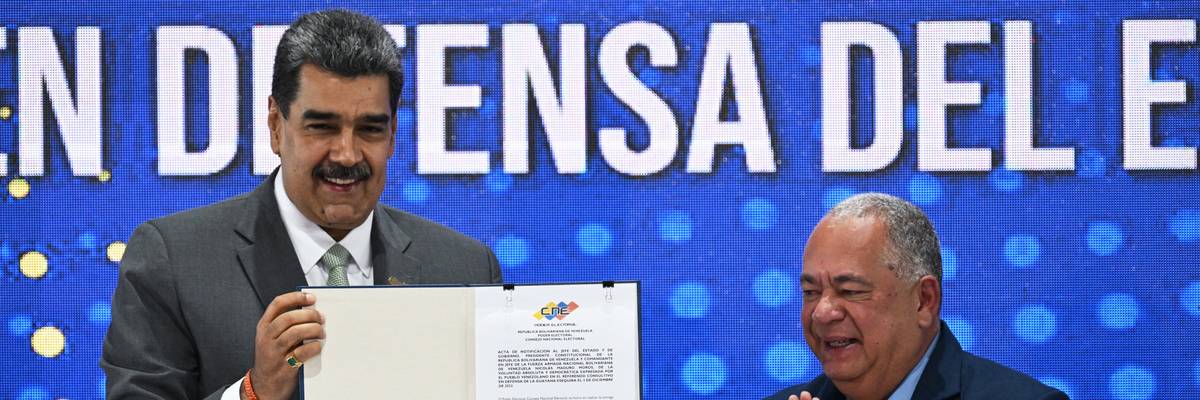
Venezuelan President Nicolás Maduro celebrates passage of a referendum on the disputed territory of Essequibo on December 4, 2023 in Caracas, Venezuela.
Brazilian President Luiz Inácio Lula da Silva offered to help forge a diplomatic solution, saying, "If there's one thing we don't want here in South America, it's war."
U.S. forces held joint military drills within Guyanese airspace on Thursday as a longstanding and intensifying territorial dispute between Venezuela and Guyana sparked fears of war in South America.
At the center of the dispute is Essequibo, an oil-rich region that Guyana has controlled for more than a century. Venezuela has claimed sovereignty over Essequibo for decades, and the two nations agreed in 1966 to resolve the controversy in a way that's "satisfactory" for both sides.
On Sunday, 95% of Venezuelan voters approved a referendum in support of declaring ownership over the disputed territory, and President Nicolás Maduro swiftly "ordered the state oil company to issue licenses for extracting crude in the region," AFP reported.
"The president also gave an ultimatum to oil companies working under concessions issued by Guyana to halt operations within three months," the outlet added.
Irfaan Ali, Guyana's president, called Maduro's moves a "direct threat" and said his country's military forces are on alert.
"Our first line of defense is diplomacy," Ali said in an interview with CBS News on Wednesday. "But we are also preparing for the worst-case scenario... We are preparing with our allies, with our friends, to ensure that we are in a position to defend what is ours."
The United Nations Security Council was scheduled to hold an emergency closed-door meeting on the dispute on Friday at Guyana's request.
"Washington does not have the appetite to deepen its conflict with Venezuela. But ExxonMobil does."
The primary target of Maduro's ultimatum to companies was ExxonMobil, a U.S.-based fossil fuel giant that has made major new oil discoveries in the disputed territory this year. Exxon announced its first oil discovery in Guyana in 2015, and the country's government gave the oil behemoth a green light to drill in disputed waters.
Citing an industry analyst, The Houston Chronicle reported earlier this week that "the roughly 380,000 barrels per day that Exxon produces in Guyana account for roughly 10% of its 4 million barrels per day globally."
"The company plans to expand its production there to more than 1 million barrels per day by the end of the decade," the Chronicle noted.
Escalating tensions over Essequibo have sparked warnings of a possible military conflict in the region. Brazilian President Luiz Inácio Lula da Silva said Thursday that "if there's one thing we don't want here in South America, it's war."
"We have been following the development of the Essequibo issue with growing concern," Lula said, expressing his nation's willingness to assist in negotiations for a diplomatic resolution. "We don't need conflict. We need to build peace."
Brazil shares a border with both Venezuela and Guyana. The BBC reported that Brazil deployed troops to its border with Venezuela following Sunday's referendum vote.
On the same day as Lula's remarks, American forces held joint military drills with Guyana that the U.S. Southern Command (SOUTHCOM) said were part of "routine engagement" aimed at enhancing the two nations' "security partnership."
"The U.S. will continue its commitment as Guyana’s trusted security partner and promoting regional cooperation and interoperability," SOUTHCOM added.
Vladimir Padrino Lopez, Venezuela's defense minister, called the drills an "unfortunate provocation" aimed at protecting the interests of ExxonMobil.
"We warn that we will not be diverted from our future actions for the recovery of the Essequibo," Lopez wrote on social media.
Historian Vijay Prashad argued earlier this week that "war does not seem to be on the horizon," given that the U.S. has recently "withdrawn part of its blockade on Venezuela's oil industry, allowing Chevron to restart several oil projects in the Orinoco Belt and in Lake Maracaibo."
"Washington does not have the appetite to deepen its conflict with Venezuela. But ExxonMobil does," Prashad wrote. "Neither the Venezuelan nor the Guyanese people will benefit from ExxonMobil's political intervention in the region. That is why so many Venezuelans who came to cast their vote on December 3 saw this less as a conflict between Venezuela and Guyana and more as a conflict between ExxonMobil and the people of these two South American countries."
Dear Common Dreams reader, It’s been nearly 30 years since I co-founded Common Dreams with my late wife, Lina Newhouser. We had the radical notion that journalism should serve the public good, not corporate profits. It was clear to us from the outset what it would take to build such a project. No paid advertisements. No corporate sponsors. No millionaire publisher telling us what to think or do. Many people said we wouldn't last a year, but we proved those doubters wrong. Together with a tremendous team of journalists and dedicated staff, we built an independent media outlet free from the constraints of profits and corporate control. Our mission has always been simple: To inform. To inspire. To ignite change for the common good. Building Common Dreams was not easy. Our survival was never guaranteed. When you take on the most powerful forces—Wall Street greed, fossil fuel industry destruction, Big Tech lobbyists, and uber-rich oligarchs who have spent billions upon billions rigging the economy and democracy in their favor—the only bulwark you have is supporters who believe in your work. But here’s the urgent message from me today. It's never been this bad out there. And it's never been this hard to keep us going. At the very moment Common Dreams is most needed, the threats we face are intensifying. We need your support now more than ever. We don't accept corporate advertising and never will. We don't have a paywall because we don't think people should be blocked from critical news based on their ability to pay. Everything we do is funded by the donations of readers like you. When everyone does the little they can afford, we are strong. But if that support retreats or dries up, so do we. Will you donate now to make sure Common Dreams not only survives but thrives? —Craig Brown, Co-founder |
U.S. forces held joint military drills within Guyanese airspace on Thursday as a longstanding and intensifying territorial dispute between Venezuela and Guyana sparked fears of war in South America.
At the center of the dispute is Essequibo, an oil-rich region that Guyana has controlled for more than a century. Venezuela has claimed sovereignty over Essequibo for decades, and the two nations agreed in 1966 to resolve the controversy in a way that's "satisfactory" for both sides.
On Sunday, 95% of Venezuelan voters approved a referendum in support of declaring ownership over the disputed territory, and President Nicolás Maduro swiftly "ordered the state oil company to issue licenses for extracting crude in the region," AFP reported.
"The president also gave an ultimatum to oil companies working under concessions issued by Guyana to halt operations within three months," the outlet added.
Irfaan Ali, Guyana's president, called Maduro's moves a "direct threat" and said his country's military forces are on alert.
"Our first line of defense is diplomacy," Ali said in an interview with CBS News on Wednesday. "But we are also preparing for the worst-case scenario... We are preparing with our allies, with our friends, to ensure that we are in a position to defend what is ours."
The United Nations Security Council was scheduled to hold an emergency closed-door meeting on the dispute on Friday at Guyana's request.
"Washington does not have the appetite to deepen its conflict with Venezuela. But ExxonMobil does."
The primary target of Maduro's ultimatum to companies was ExxonMobil, a U.S.-based fossil fuel giant that has made major new oil discoveries in the disputed territory this year. Exxon announced its first oil discovery in Guyana in 2015, and the country's government gave the oil behemoth a green light to drill in disputed waters.
Citing an industry analyst, The Houston Chronicle reported earlier this week that "the roughly 380,000 barrels per day that Exxon produces in Guyana account for roughly 10% of its 4 million barrels per day globally."
"The company plans to expand its production there to more than 1 million barrels per day by the end of the decade," the Chronicle noted.
Escalating tensions over Essequibo have sparked warnings of a possible military conflict in the region. Brazilian President Luiz Inácio Lula da Silva said Thursday that "if there's one thing we don't want here in South America, it's war."
"We have been following the development of the Essequibo issue with growing concern," Lula said, expressing his nation's willingness to assist in negotiations for a diplomatic resolution. "We don't need conflict. We need to build peace."
Brazil shares a border with both Venezuela and Guyana. The BBC reported that Brazil deployed troops to its border with Venezuela following Sunday's referendum vote.
On the same day as Lula's remarks, American forces held joint military drills with Guyana that the U.S. Southern Command (SOUTHCOM) said were part of "routine engagement" aimed at enhancing the two nations' "security partnership."
"The U.S. will continue its commitment as Guyana’s trusted security partner and promoting regional cooperation and interoperability," SOUTHCOM added.
Vladimir Padrino Lopez, Venezuela's defense minister, called the drills an "unfortunate provocation" aimed at protecting the interests of ExxonMobil.
"We warn that we will not be diverted from our future actions for the recovery of the Essequibo," Lopez wrote on social media.
Historian Vijay Prashad argued earlier this week that "war does not seem to be on the horizon," given that the U.S. has recently "withdrawn part of its blockade on Venezuela's oil industry, allowing Chevron to restart several oil projects in the Orinoco Belt and in Lake Maracaibo."
"Washington does not have the appetite to deepen its conflict with Venezuela. But ExxonMobil does," Prashad wrote. "Neither the Venezuelan nor the Guyanese people will benefit from ExxonMobil's political intervention in the region. That is why so many Venezuelans who came to cast their vote on December 3 saw this less as a conflict between Venezuela and Guyana and more as a conflict between ExxonMobil and the people of these two South American countries."
U.S. forces held joint military drills within Guyanese airspace on Thursday as a longstanding and intensifying territorial dispute between Venezuela and Guyana sparked fears of war in South America.
At the center of the dispute is Essequibo, an oil-rich region that Guyana has controlled for more than a century. Venezuela has claimed sovereignty over Essequibo for decades, and the two nations agreed in 1966 to resolve the controversy in a way that's "satisfactory" for both sides.
On Sunday, 95% of Venezuelan voters approved a referendum in support of declaring ownership over the disputed territory, and President Nicolás Maduro swiftly "ordered the state oil company to issue licenses for extracting crude in the region," AFP reported.
"The president also gave an ultimatum to oil companies working under concessions issued by Guyana to halt operations within three months," the outlet added.
Irfaan Ali, Guyana's president, called Maduro's moves a "direct threat" and said his country's military forces are on alert.
"Our first line of defense is diplomacy," Ali said in an interview with CBS News on Wednesday. "But we are also preparing for the worst-case scenario... We are preparing with our allies, with our friends, to ensure that we are in a position to defend what is ours."
The United Nations Security Council was scheduled to hold an emergency closed-door meeting on the dispute on Friday at Guyana's request.
"Washington does not have the appetite to deepen its conflict with Venezuela. But ExxonMobil does."
The primary target of Maduro's ultimatum to companies was ExxonMobil, a U.S.-based fossil fuel giant that has made major new oil discoveries in the disputed territory this year. Exxon announced its first oil discovery in Guyana in 2015, and the country's government gave the oil behemoth a green light to drill in disputed waters.
Citing an industry analyst, The Houston Chronicle reported earlier this week that "the roughly 380,000 barrels per day that Exxon produces in Guyana account for roughly 10% of its 4 million barrels per day globally."
"The company plans to expand its production there to more than 1 million barrels per day by the end of the decade," the Chronicle noted.
Escalating tensions over Essequibo have sparked warnings of a possible military conflict in the region. Brazilian President Luiz Inácio Lula da Silva said Thursday that "if there's one thing we don't want here in South America, it's war."
"We have been following the development of the Essequibo issue with growing concern," Lula said, expressing his nation's willingness to assist in negotiations for a diplomatic resolution. "We don't need conflict. We need to build peace."
Brazil shares a border with both Venezuela and Guyana. The BBC reported that Brazil deployed troops to its border with Venezuela following Sunday's referendum vote.
On the same day as Lula's remarks, American forces held joint military drills with Guyana that the U.S. Southern Command (SOUTHCOM) said were part of "routine engagement" aimed at enhancing the two nations' "security partnership."
"The U.S. will continue its commitment as Guyana’s trusted security partner and promoting regional cooperation and interoperability," SOUTHCOM added.
Vladimir Padrino Lopez, Venezuela's defense minister, called the drills an "unfortunate provocation" aimed at protecting the interests of ExxonMobil.
"We warn that we will not be diverted from our future actions for the recovery of the Essequibo," Lopez wrote on social media.
Historian Vijay Prashad argued earlier this week that "war does not seem to be on the horizon," given that the U.S. has recently "withdrawn part of its blockade on Venezuela's oil industry, allowing Chevron to restart several oil projects in the Orinoco Belt and in Lake Maracaibo."
"Washington does not have the appetite to deepen its conflict with Venezuela. But ExxonMobil does," Prashad wrote. "Neither the Venezuelan nor the Guyanese people will benefit from ExxonMobil's political intervention in the region. That is why so many Venezuelans who came to cast their vote on December 3 saw this less as a conflict between Venezuela and Guyana and more as a conflict between ExxonMobil and the people of these two South American countries."