5
#000000
#FFFFFF
To donate by check, phone, or other method, see our More Ways to Give page.

An advocacy group tracking the impacts of the unprecedented Medicaid cuts that congressional Republicans and President Donald Trump enacted last year said Monday that at least 900 hospitals, nursing homes, and other healthcare facilities are now shutting down or at risk of closure—a disaster for low-income Americans who lack easy access to care.
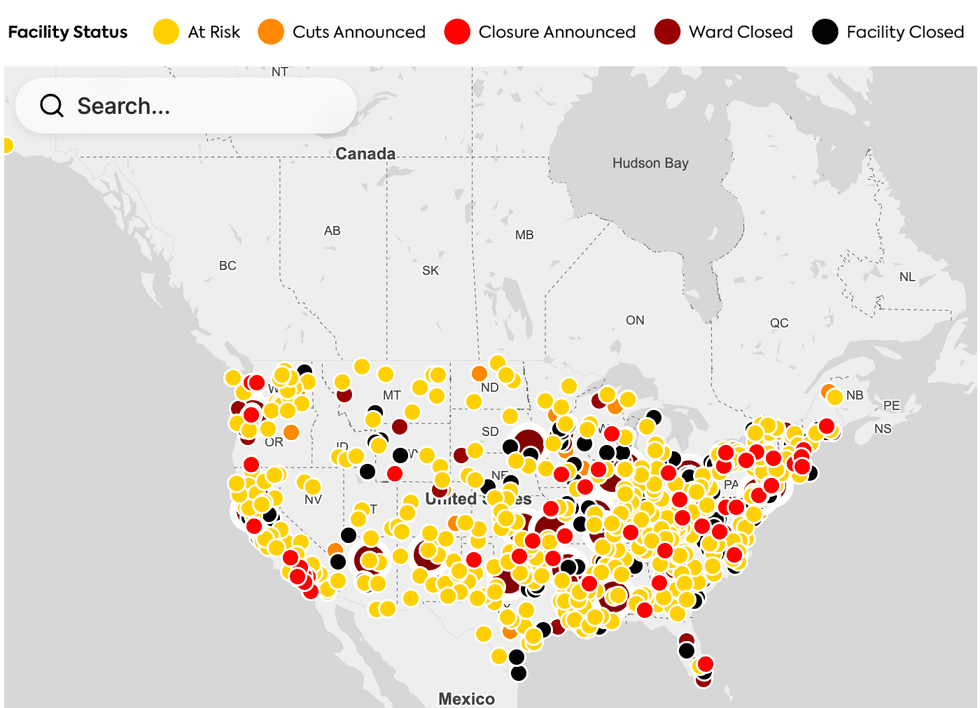
Protect Our Care's Hospital Crisis Watch project has identified healthcare centers that have closed or are at risk of closing, cutting services, and shutting down wards as they grapple with the impacts of the GOP's 2025 budget law, which included over $1 trillion in total healthcare cuts over the next decade. More than $900 billion of the cuts will come from Medicaid, which pays hospitals and other providers for services delivered to low-income patients.
"Hospital Crisis Watch has now reached 900 pins, 900 communities where access to care is evaporating as Republicans’ healthcare cuts ripple across the country,” said Brad Woodhouse, president of Protect Our Care. “Providers are stretched thin, doing everything they can as resources disappear and the system buckles under the pressure of Republicans cutting more than $1 trillion from health care to fund tax breaks for billionaires and big corporations."
"Families are driving further for care, parents are scrambling to find services for their kids, and seniors are being left without the support they need," Woodhouse continued. "Care is getting harder to access, in too many places, disappearing entirely, and communities are left to deal with the consequences."
The impacts of the Trump-GOP Medicaid cuts have been felt in both urban and rural areas, despite Republicans' inclusion of a $50 billion Rural Health Transformation Fund that supporters touted as a way to bolster at-risk healthcare facilities. Critics of the fund have warned from the start that it would not be nearly enough to offset the devastation caused by massive Medicaid cuts. (The Trump-GOP law includes an estimated $137 billion in cuts to Medicaid in rural areas.)
"In Nebraska and other states, rural hospitals are facing across-the-board cuts—and the rural health fund Congress created to offset the impact of Medicaid cuts on rural healthcare is falling short," Adam Searing, an associate professor at the Georgetown University McCourt School of Public Policy’s Center for Children and Families, wrote in a blog post last week.
"What is quickly becoming clear, even at this early stage, is that as a result of the cuts enacted by Congress, healthcare is going to become much harder to access for many people," wrote Searing. "Rural areas and small towns across the country will be particularly affected."
The latest assessments of surging healthcare facility cuts and closures across the US came as Nebraska became the first state to implement the punitive work requirements that the 2025 Republican law imposes on some Medicaid recipients. Early estimates indicate that more than 20,000 Nebraskans could lose Medicaid coverage due to the stringent work requirements and the procedural hurdles the new mandates entail.
States must implement the new work requirements by the start of 2027.
"Everyone who is eligible for Medicaid will be at risk of having their health coverage taken away—whether or not the work requirement applies to them, and whether or not they prove their compliance or exemption status if it does—because the administrative burden of implementing the work requirement strains a state’s entire Medicaid system," Farah Erzouki, a senior policy analyst at the Center on Budget and Policy Priorities, warned last week.
"Without sufficient time and guidance," Erzouki added, "states will be unable to implement these requirements without harming many more eligible people and millions will lose coverage."
An advocacy group tracking the impacts of the unprecedented Medicaid cuts that congressional Republicans and President Donald Trump enacted last year said Monday that at least 900 hospitals, nursing homes, and other healthcare facilities are now shutting down or at risk of closure—a disaster for low-income Americans who lack easy access to care.
Protect Our Care's Hospital Crisis Watch project has identified healthcare centers that have closed or are at risk of closing, cutting services, and shutting down wards as they grapple with the impacts of the GOP's 2025 budget law, which included over $1 trillion in total healthcare cuts over the next decade. More than $900 billion of the cuts will come from Medicaid, which pays hospitals and other providers for services delivered to low-income patients.
"Hospital Crisis Watch has now reached 900 pins, 900 communities where access to care is evaporating as Republicans’ healthcare cuts ripple across the country,” said Brad Woodhouse, president of Protect Our Care. “Providers are stretched thin, doing everything they can as resources disappear and the system buckles under the pressure of Republicans cutting more than $1 trillion from health care to fund tax breaks for billionaires and big corporations."
"Families are driving further for care, parents are scrambling to find services for their kids, and seniors are being left without the support they need," Woodhouse continued. "Care is getting harder to access, in too many places, disappearing entirely, and communities are left to deal with the consequences."
The impacts of the Trump-GOP Medicaid cuts have been felt in both urban and rural areas, despite Republicans' inclusion of a $50 billion Rural Health Transformation Fund that supporters touted as a way to bolster at-risk healthcare facilities. Critics of the fund have warned from the start that it would not be nearly enough to offset the devastation caused by massive Medicaid cuts. (The Trump-GOP law includes an estimated $137 billion in cuts to Medicaid in rural areas.)
"In Nebraska and other states, rural hospitals are facing across-the-board cuts—and the rural health fund Congress created to offset the impact of Medicaid cuts on rural healthcare is falling short," Adam Searing, an associate professor at the Georgetown University McCourt School of Public Policy’s Center for Children and Families, wrote in a blog post last week.
"What is quickly becoming clear, even at this early stage, is that as a result of the cuts enacted by Congress, healthcare is going to become much harder to access for many people," wrote Searing. "Rural areas and small towns across the country will be particularly affected."
The latest assessments of surging healthcare facility cuts and closures across the US came as Nebraska became the first state to implement the punitive work requirements that the 2025 Republican law imposes on some Medicaid recipients. Early estimates indicate that more than 20,000 Nebraskans could lose Medicaid coverage due to the stringent work requirements and the procedural hurdles the new mandates entail.
States must implement the new work requirements by the start of 2027.
"Everyone who is eligible for Medicaid will be at risk of having their health coverage taken away—whether or not the work requirement applies to them, and whether or not they prove their compliance or exemption status if it does—because the administrative burden of implementing the work requirement strains a state’s entire Medicaid system," Farah Erzouki, a senior policy analyst at the Center on Budget and Policy Priorities, warned last week.
"Without sufficient time and guidance," Erzouki added, "states will be unable to implement these requirements without harming many more eligible people and millions will lose coverage."
An advocacy group tracking the impacts of the unprecedented Medicaid cuts that congressional Republicans and President Donald Trump enacted last year said Monday that at least 900 hospitals, nursing homes, and other healthcare facilities are now shutting down or at risk of closure—a disaster for low-income Americans who lack easy access to care.
Protect Our Care's Hospital Crisis Watch project has identified healthcare centers that have closed or are at risk of closing, cutting services, and shutting down wards as they grapple with the impacts of the GOP's 2025 budget law, which included over $1 trillion in total healthcare cuts over the next decade. More than $900 billion of the cuts will come from Medicaid, which pays hospitals and other providers for services delivered to low-income patients.
"Hospital Crisis Watch has now reached 900 pins, 900 communities where access to care is evaporating as Republicans’ healthcare cuts ripple across the country,” said Brad Woodhouse, president of Protect Our Care. “Providers are stretched thin, doing everything they can as resources disappear and the system buckles under the pressure of Republicans cutting more than $1 trillion from health care to fund tax breaks for billionaires and big corporations."
"Families are driving further for care, parents are scrambling to find services for their kids, and seniors are being left without the support they need," Woodhouse continued. "Care is getting harder to access, in too many places, disappearing entirely, and communities are left to deal with the consequences."
The impacts of the Trump-GOP Medicaid cuts have been felt in both urban and rural areas, despite Republicans' inclusion of a $50 billion Rural Health Transformation Fund that supporters touted as a way to bolster at-risk healthcare facilities. Critics of the fund have warned from the start that it would not be nearly enough to offset the devastation caused by massive Medicaid cuts. (The Trump-GOP law includes an estimated $137 billion in cuts to Medicaid in rural areas.)
"In Nebraska and other states, rural hospitals are facing across-the-board cuts—and the rural health fund Congress created to offset the impact of Medicaid cuts on rural healthcare is falling short," Adam Searing, an associate professor at the Georgetown University McCourt School of Public Policy’s Center for Children and Families, wrote in a blog post last week.
"What is quickly becoming clear, even at this early stage, is that as a result of the cuts enacted by Congress, healthcare is going to become much harder to access for many people," wrote Searing. "Rural areas and small towns across the country will be particularly affected."
The latest assessments of surging healthcare facility cuts and closures across the US came as Nebraska became the first state to implement the punitive work requirements that the 2025 Republican law imposes on some Medicaid recipients. Early estimates indicate that more than 20,000 Nebraskans could lose Medicaid coverage due to the stringent work requirements and the procedural hurdles the new mandates entail.
States must implement the new work requirements by the start of 2027.
"Everyone who is eligible for Medicaid will be at risk of having their health coverage taken away—whether or not the work requirement applies to them, and whether or not they prove their compliance or exemption status if it does—because the administrative burden of implementing the work requirement strains a state’s entire Medicaid system," Farah Erzouki, a senior policy analyst at the Center on Budget and Policy Priorities, warned last week.
"Without sufficient time and guidance," Erzouki added, "states will be unable to implement these requirements without harming many more eligible people and millions will lose coverage."