

SUBSCRIBE TO OUR FREE NEWSLETTER
Daily news & progressive opinion—funded by the people, not the corporations—delivered straight to your inbox.
5
#000000
#FFFFFF
To donate by check, phone, or other method, see our More Ways to Give page.
Daily news & progressive opinion—funded by the people, not the corporations—delivered straight to your inbox.
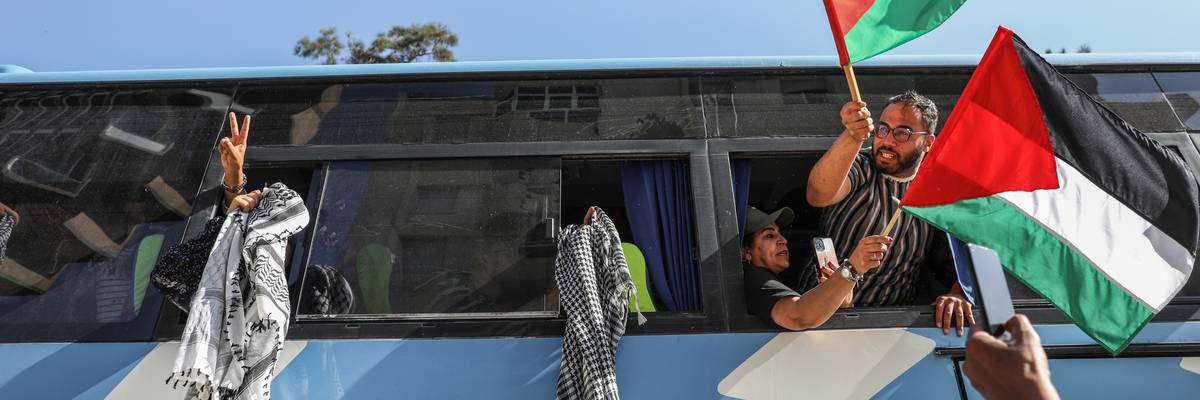
Pro-Palestinian activists wave Palestinian flags and keffiyehs from open bus windows as they, along with around 1,000 other participants in the Sumud or "Resilience" Convoy, depart from Tunis, Tunisia, on June 9, 2025.
"A tsunami of humanity is rising for Gaza."
As Israeli forces unlawfully boarded the Madleen, a boat carrying humanitarian aid to Gaza, and detained the volunteers on the vessel on Monday, approximately 1,000 pro-Palestinian advocates from across Northwest Africa were boarding a convoy of buses and cars in Tunisia—planning to travel for days to the Rafah crossing, where they aim to break Israel's blockade that's starving people across the war-torn enclave.
The Sumud Convoy, whose name means "steadfastness" or "resilience" in Arabic, is carrying aid and being led by the Coordination of Joint Action for Palestine in Tunisia, and has ties to the Global March for Gaza, which includes rights advocates from about 50 countries across the world who were en route to Cairo on Wednesday.
"This is a civil and popular initiative in response to the ongoing genocide in Gaza," Wael Naouar, a member of the organizing team, told The New Arab. "We refuse to remain silent."
The convoy crossed into Libya on Tuesday and has been resting after a full day of travel as organizers wait for permission to cross the eastern part of the divided country.
In Tripoli in the western region, the volunteers have been welcomed by hundreds of locals, and fuel station owners have reportedly said they will provide free gas to all cars, buses, and trucks that join the convoy.
"This visit brings us joy," architect Alaa Abdel Razzaq told Agence France-Presse.
Along with the current delay in receiving approval from eastern Libyan authorities to cross the region, the convoy and the Global March for Gaza could face resistance from the Egyptian government as organizers plan to march for three days from El Arish in the Sinai Peninsula to the Rafah crossing.
Egypt classifies the area between El Arish and Rafah as a military zone and has not released a statement on whether it will allow the march.
If the volunteers make it to the Rafah crossing, they will have to contend with the Israel Defense Forces. In addition to abducting international activists including Swedish climate leader Greta Thunberg and Palestinian-French member of European Parliament Rima Hassan this week, Israeli forces killed 10 activists carrying humanitarian aid to Gaza on a Turkish flotilla in 2010.
Ghaya Ben Mbarek, an independent journalist from Tunis, told Al Jazeera that people in the convoy "are feeling courage and anger" as they head toward the Gaza border.
"The message people here want to send to the world is that even if you stop us by sea, or air, then we will come, by the thousands, by land," Ben Mbarek told Al Jazeera. "We will literally cross deserts... to stop people from dying from hunger."
Fadi Quran of the U.S.-based advocacy group Avaaz said the journey of the convoy—which has been growing as more people have joined since leaving Tunisia—is "one of the most beautiful things humanity has to offer in 2025."
"A tsunami of humanity is rising for Gaza," said Quran. "Amplify it."
The Sumud Convoy is supported by the Tunisian General Labor Union, the National Bar Association, the Tunisian League for Human Rights, and the Tunisian Forum for Economic and Social Rights, while groups including the Palestinian Youth Movement and CodePink are affiliated with the Global March for Gaza.
Advocates from countries including the Netherlands, Canada, and Ireland plan to arrive in Cairo on Thursday, when they hope to begin the three-day march to Rafah.
Canadian Sen. Yuen Pau Woo wrote to the Egyptian government on Tuesday, asking for support for the march.
"I believe that Egypt's support for this humanitarian action would send a powerful message to the international community," said Woo.
Kellie McConnell, a member of Irish Healthcare Workers for Palestine, also expressed hope that the international action will force governments around the world, including those that have backed Israel's bombardment and blockade of Gaza, to "pay attention and do everything in their power" to end the attacks that have killed more than 55,000 Palestinians.
"We can turn the tables in this genocide," said McConnell. "We can stop the absolutely appalling brutalization and desperate treatment of people in Palestine."
If the advocates are blocked at the border like the Madleen was intercepted on Monday, one activist in the Sumud Convoy told The New Arab, "even that will send a message."
"People over power," they said. "If they stop dozens, thousands will rise."
Dear Common Dreams reader, It’s been nearly 30 years since I co-founded Common Dreams with my late wife, Lina Newhouser. We had the radical notion that journalism should serve the public good, not corporate profits. It was clear to us from the outset what it would take to build such a project. No paid advertisements. No corporate sponsors. No millionaire publisher telling us what to think or do. Many people said we wouldn't last a year, but we proved those doubters wrong. Together with a tremendous team of journalists and dedicated staff, we built an independent media outlet free from the constraints of profits and corporate control. Our mission has always been simple: To inform. To inspire. To ignite change for the common good. Building Common Dreams was not easy. Our survival was never guaranteed. When you take on the most powerful forces—Wall Street greed, fossil fuel industry destruction, Big Tech lobbyists, and uber-rich oligarchs who have spent billions upon billions rigging the economy and democracy in their favor—the only bulwark you have is supporters who believe in your work. But here’s the urgent message from me today. It's never been this bad out there. And it's never been this hard to keep us going. At the very moment Common Dreams is most needed, the threats we face are intensifying. We need your support now more than ever. We don't accept corporate advertising and never will. We don't have a paywall because we don't think people should be blocked from critical news based on their ability to pay. Everything we do is funded by the donations of readers like you. When everyone does the little they can afford, we are strong. But if that support retreats or dries up, so do we. Will you donate now to make sure Common Dreams not only survives but thrives? —Craig Brown, Co-founder |
As Israeli forces unlawfully boarded the Madleen, a boat carrying humanitarian aid to Gaza, and detained the volunteers on the vessel on Monday, approximately 1,000 pro-Palestinian advocates from across Northwest Africa were boarding a convoy of buses and cars in Tunisia—planning to travel for days to the Rafah crossing, where they aim to break Israel's blockade that's starving people across the war-torn enclave.
The Sumud Convoy, whose name means "steadfastness" or "resilience" in Arabic, is carrying aid and being led by the Coordination of Joint Action for Palestine in Tunisia, and has ties to the Global March for Gaza, which includes rights advocates from about 50 countries across the world who were en route to Cairo on Wednesday.
"This is a civil and popular initiative in response to the ongoing genocide in Gaza," Wael Naouar, a member of the organizing team, told The New Arab. "We refuse to remain silent."
The convoy crossed into Libya on Tuesday and has been resting after a full day of travel as organizers wait for permission to cross the eastern part of the divided country.
In Tripoli in the western region, the volunteers have been welcomed by hundreds of locals, and fuel station owners have reportedly said they will provide free gas to all cars, buses, and trucks that join the convoy.
"This visit brings us joy," architect Alaa Abdel Razzaq told Agence France-Presse.
Along with the current delay in receiving approval from eastern Libyan authorities to cross the region, the convoy and the Global March for Gaza could face resistance from the Egyptian government as organizers plan to march for three days from El Arish in the Sinai Peninsula to the Rafah crossing.
Egypt classifies the area between El Arish and Rafah as a military zone and has not released a statement on whether it will allow the march.
If the volunteers make it to the Rafah crossing, they will have to contend with the Israel Defense Forces. In addition to abducting international activists including Swedish climate leader Greta Thunberg and Palestinian-French member of European Parliament Rima Hassan this week, Israeli forces killed 10 activists carrying humanitarian aid to Gaza on a Turkish flotilla in 2010.
Ghaya Ben Mbarek, an independent journalist from Tunis, told Al Jazeera that people in the convoy "are feeling courage and anger" as they head toward the Gaza border.
"The message people here want to send to the world is that even if you stop us by sea, or air, then we will come, by the thousands, by land," Ben Mbarek told Al Jazeera. "We will literally cross deserts... to stop people from dying from hunger."
Fadi Quran of the U.S.-based advocacy group Avaaz said the journey of the convoy—which has been growing as more people have joined since leaving Tunisia—is "one of the most beautiful things humanity has to offer in 2025."
"A tsunami of humanity is rising for Gaza," said Quran. "Amplify it."
The Sumud Convoy is supported by the Tunisian General Labor Union, the National Bar Association, the Tunisian League for Human Rights, and the Tunisian Forum for Economic and Social Rights, while groups including the Palestinian Youth Movement and CodePink are affiliated with the Global March for Gaza.
Advocates from countries including the Netherlands, Canada, and Ireland plan to arrive in Cairo on Thursday, when they hope to begin the three-day march to Rafah.
Canadian Sen. Yuen Pau Woo wrote to the Egyptian government on Tuesday, asking for support for the march.
"I believe that Egypt's support for this humanitarian action would send a powerful message to the international community," said Woo.
Kellie McConnell, a member of Irish Healthcare Workers for Palestine, also expressed hope that the international action will force governments around the world, including those that have backed Israel's bombardment and blockade of Gaza, to "pay attention and do everything in their power" to end the attacks that have killed more than 55,000 Palestinians.
"We can turn the tables in this genocide," said McConnell. "We can stop the absolutely appalling brutalization and desperate treatment of people in Palestine."
If the advocates are blocked at the border like the Madleen was intercepted on Monday, one activist in the Sumud Convoy told The New Arab, "even that will send a message."
"People over power," they said. "If they stop dozens, thousands will rise."
As Israeli forces unlawfully boarded the Madleen, a boat carrying humanitarian aid to Gaza, and detained the volunteers on the vessel on Monday, approximately 1,000 pro-Palestinian advocates from across Northwest Africa were boarding a convoy of buses and cars in Tunisia—planning to travel for days to the Rafah crossing, where they aim to break Israel's blockade that's starving people across the war-torn enclave.
The Sumud Convoy, whose name means "steadfastness" or "resilience" in Arabic, is carrying aid and being led by the Coordination of Joint Action for Palestine in Tunisia, and has ties to the Global March for Gaza, which includes rights advocates from about 50 countries across the world who were en route to Cairo on Wednesday.
"This is a civil and popular initiative in response to the ongoing genocide in Gaza," Wael Naouar, a member of the organizing team, told The New Arab. "We refuse to remain silent."
The convoy crossed into Libya on Tuesday and has been resting after a full day of travel as organizers wait for permission to cross the eastern part of the divided country.
In Tripoli in the western region, the volunteers have been welcomed by hundreds of locals, and fuel station owners have reportedly said they will provide free gas to all cars, buses, and trucks that join the convoy.
"This visit brings us joy," architect Alaa Abdel Razzaq told Agence France-Presse.
Along with the current delay in receiving approval from eastern Libyan authorities to cross the region, the convoy and the Global March for Gaza could face resistance from the Egyptian government as organizers plan to march for three days from El Arish in the Sinai Peninsula to the Rafah crossing.
Egypt classifies the area between El Arish and Rafah as a military zone and has not released a statement on whether it will allow the march.
If the volunteers make it to the Rafah crossing, they will have to contend with the Israel Defense Forces. In addition to abducting international activists including Swedish climate leader Greta Thunberg and Palestinian-French member of European Parliament Rima Hassan this week, Israeli forces killed 10 activists carrying humanitarian aid to Gaza on a Turkish flotilla in 2010.
Ghaya Ben Mbarek, an independent journalist from Tunis, told Al Jazeera that people in the convoy "are feeling courage and anger" as they head toward the Gaza border.
"The message people here want to send to the world is that even if you stop us by sea, or air, then we will come, by the thousands, by land," Ben Mbarek told Al Jazeera. "We will literally cross deserts... to stop people from dying from hunger."
Fadi Quran of the U.S.-based advocacy group Avaaz said the journey of the convoy—which has been growing as more people have joined since leaving Tunisia—is "one of the most beautiful things humanity has to offer in 2025."
"A tsunami of humanity is rising for Gaza," said Quran. "Amplify it."
The Sumud Convoy is supported by the Tunisian General Labor Union, the National Bar Association, the Tunisian League for Human Rights, and the Tunisian Forum for Economic and Social Rights, while groups including the Palestinian Youth Movement and CodePink are affiliated with the Global March for Gaza.
Advocates from countries including the Netherlands, Canada, and Ireland plan to arrive in Cairo on Thursday, when they hope to begin the three-day march to Rafah.
Canadian Sen. Yuen Pau Woo wrote to the Egyptian government on Tuesday, asking for support for the march.
"I believe that Egypt's support for this humanitarian action would send a powerful message to the international community," said Woo.
Kellie McConnell, a member of Irish Healthcare Workers for Palestine, also expressed hope that the international action will force governments around the world, including those that have backed Israel's bombardment and blockade of Gaza, to "pay attention and do everything in their power" to end the attacks that have killed more than 55,000 Palestinians.
"We can turn the tables in this genocide," said McConnell. "We can stop the absolutely appalling brutalization and desperate treatment of people in Palestine."
If the advocates are blocked at the border like the Madleen was intercepted on Monday, one activist in the Sumud Convoy told The New Arab, "even that will send a message."
"People over power," they said. "If they stop dozens, thousands will rise."

