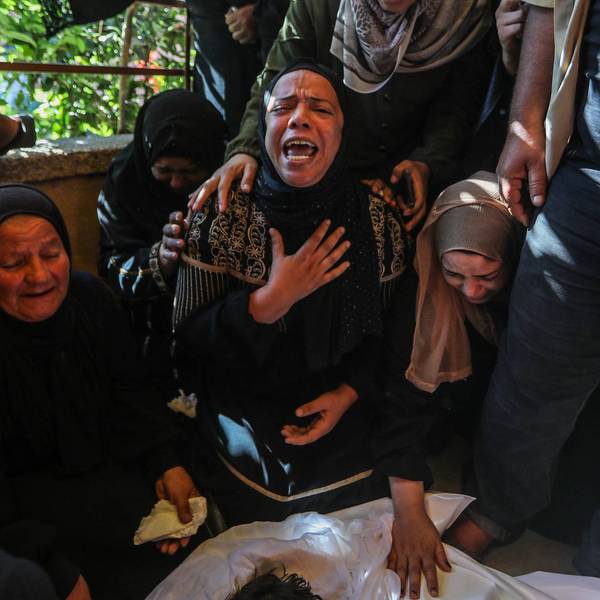
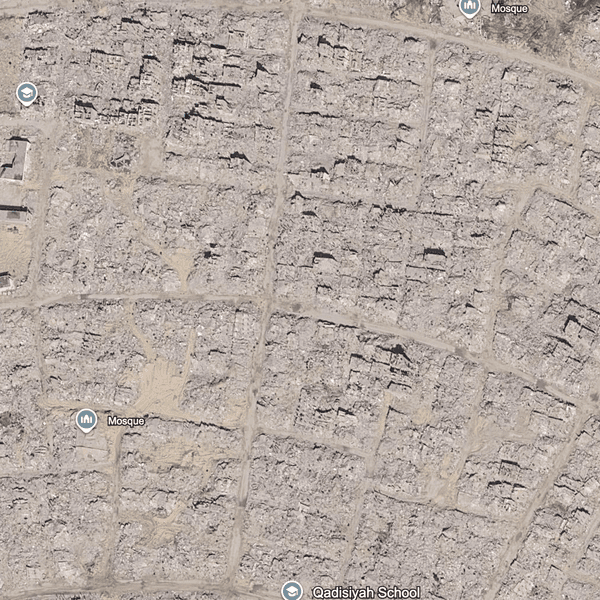
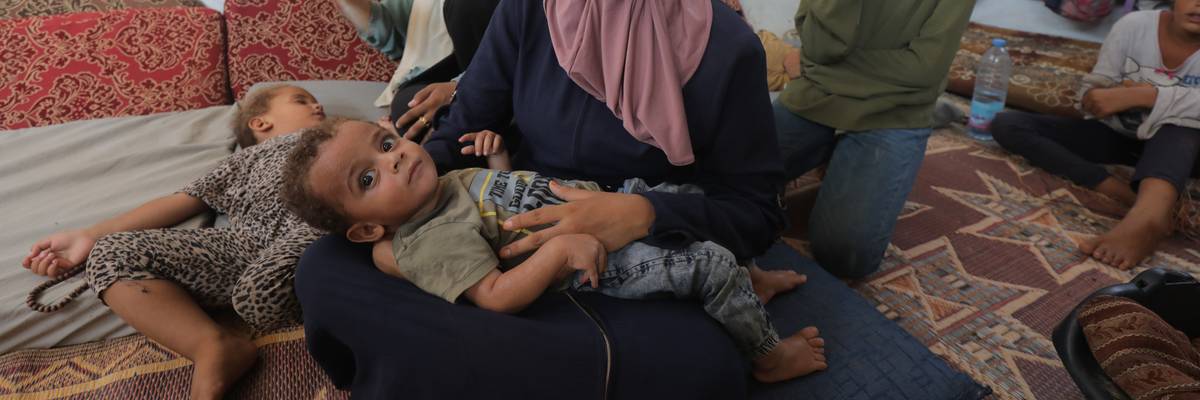
Eleven-month-old Abdul Rahman Abu al-Jidyen, who is suffering from polio, is seen at home with his family in Deir Al Balah, Gaza on August 27, 2024.
UN Expert Fears 'Almost the Entire Population' of Gaza Exterminated If Israel Not Stopped
"The range of presumable direct and indirect deaths could be between 15 and 20% of the population already by the end of this year," said U.N. Special Rapporteur Francesca Albanese.
Reviewing a global public health expert's analysis of the probable ultimate death toll in Gaza from Israel's relentless assault, the United Nations special rapporteur on the occupied Palestinian territories said Friday that without a cease-fire, the Israel Defense Forces "could end up exterminating almost the entire population in Gaza over the next couple of years."
"The range of presumable direct and indirect deaths could be between 15% and 20% of the population already by the end of this year," said Francesca Albanese, citing research by Devi Sridhar, chair of global public health at the University of Edinburgh.
Sridhar wrote in The Guardian about the difficulty of counting the dead on Thursday, days after the first of three planned pauses in fighting began to allow families to get to medical clinics for polio vaccines. Israel agreed to the pauses after one child was diagnosed with paralysis resulting from polio, which was detected in wastewater in Gaza in July, alarming public health experts.
"The discovery of polio in Gaza reminds us that it's becoming increasingly difficult to assess the true cost of the war," wrote Sridhar. "We don't have a sense of how widespread disease and starvation are—so-called 'indirect deaths'—and we are in the dark in terms of total number of deaths. Usually, data is collected from hospitals and morgues, which certify each death and notify the health ministry. Yet these civil registration systems have broken down in Gaza, meaning there is no accurate data on how many deaths have occurred."
As Common Dreams reported on Wednesday, despite Israel's agreement to pauses in fighting to allow children to be vaccinated, bombings by the Israel Defense Forces (IDF) continued this week, with some targeting "locations near the vaccination centers."
Human rights advocates have said since Israel began its bombardment of Gaza last October that along with the threat of bombings and shelling, Palestinians face the ever-growing threat of starvation and disease due to Israel's near-total blockade on humanitarian aid.
"If deaths continue at this rate—about 23,000 a month—there would be an additional 149,500 deaths by the end of the year, some six and half months from the initial mid-June estimate. Using the method, the total deaths since the conflict began would be estimated at about 335,500 in total."
In its regular report on the humanitarian situation in Gaza on Friday, the U.N. Office for the Coordination of Humanitarian Affairs (OCHA) said Israeli evacuation orders in addition to blockades caused daily meals provided to families to drop 35% in July and August.
"The food security situation in the Gaza Strip is deteriorating due to the critical shortages of aid commodities as well as ongoing hostilities, insecurity, damaged roads, access limitation and breakdown of law and order," said the agency, noting that more than 1 million people in southern and central Gaza received no food rations in August.
United Nations experts warned in July that Israel's "targeted starvation campaign" has "resulted in famine across all of Gaza," with at least 34 Palestinians dying of malnutrition as hundreds of aid delivery trucks were stranded in Egypt, unable to cross into the enclave.
The spread of disease is also a continued threat due to "the staggering increase in the cost of basic hygiene items" and attacks on health centers, said OCHA on Friday. The price of soap increased 1,177% in July, compared to July 2023.
"The lack of affordable hygiene items, combined with limited access to clean water and sanitation facilities, poses a growing risk of severe health impacts," said the agency. "This is especially true for families who have been displaced, as they face extreme difficulties maintaining basic hygiene in overcrowded shelters and displacement sites, while critical facilities—such as health centers, community kitchens, child-protection spaces, nutrition centers, and schools—lack the necessary tools to ensure safe and sanitary conditions. These conditions are all likely to deteriorate further during the winter."
Sridhar noted that while at least 40,878 people are confirmed dead in Gaza, "it is estimated that there are more than 10,000 bodies buried under rubble still (meaning they can't be counted), as well as a rising number of unidentifiable bodies."
Israel faces a South Africa-led genocide case at the International Court of Justice.
Sridhar's report came two months after public health experts estimated in The Lancet that even if a cease-fire were agreed to immediately, the true death toll in Gaza could ultimately reach roughly 186,000—nearly 8% of the population.
"If deaths continue at this rate—about 23,000 a month—there would be an additional 149,500 deaths by the end of the year, some six and half months from the initial mid-June estimate," wrote Sridhar. "Using the method, the total deaths since the conflict began would be estimated at about 335,500 in total."
Sridhar urged advocates to not "get lost in these numbers and forget the name and the face behind each one," and to continue pushing for a cease-fire and public health measures like the polio vaccination campaign that could save thousands of children from paralysis.
"Attempts to access the strip by the U.N., like the one resulting in humanitarian pauses for polio vaccinations, save lives," wrote Sridhar. "They make a difference to hundreds of thousands of families, even within the abject horror of war."
Albanese suggested that eventually, the world will have to face the potentially hundreds of thousands of deaths that powerful countries including the United States—the largest funder of Israel's military—allowed to happen.
"Once the dust settles, I can't imagine how the world will go on after having allowed that," said Albanese. "Again."
We are at a crossroads
This country and this world are at a monumental crossroads. In a few short weeks, US voters will have an opportunity to beat back the forces of fascism and confront the billionaires who are rigging the economy, our media system, and our democracy, making it increasingly impossible for ordinary people to get by. We’re not just talking about the election. We’re talking about what must be done once these fascist elements are vanquished from power. We need a bolder set of solutions than what either major party has so far been willing to offer and a working-class movement ready to fight like hell for it. Trump didn't emerge from nowhere. The conditions that fueled MAGA authoritarianism were created by decades of radical neoliberal economic policies and a corrupt political system dominated by corporate interests. They slashed taxes on the super-rich, promising that the benefits would trickle down. They said giveaways to the corporate titans would make life more affordable for the rest of us. It was all bullshit. And when a bitter, betrayed populace searches for someone to blame, right-wing demagogues have little trouble finding scapegoats. People know when they're being lied to, but you won't hear any of this from the corporate media. Only independent journalism—powered and funded by people who believe in building a better world—can deliver truly trustworthy daily news. Our Fall Campaign is underway, and we need your help. To power our newsroom through the rest of the year, we need to raise $125,000 by midnight on October 31. So if you share our vision, please contribute whatever you can to sustain our work. |
Reviewing a global public health expert's analysis of the probable ultimate death toll in Gaza from Israel's relentless assault, the United Nations special rapporteur on the occupied Palestinian territories said Friday that without a cease-fire, the Israel Defense Forces "could end up exterminating almost the entire population in Gaza over the next couple of years."
"The range of presumable direct and indirect deaths could be between 15% and 20% of the population already by the end of this year," said Francesca Albanese, citing research by Devi Sridhar, chair of global public health at the University of Edinburgh.
Sridhar wrote in The Guardian about the difficulty of counting the dead on Thursday, days after the first of three planned pauses in fighting began to allow families to get to medical clinics for polio vaccines. Israel agreed to the pauses after one child was diagnosed with paralysis resulting from polio, which was detected in wastewater in Gaza in July, alarming public health experts.
"The discovery of polio in Gaza reminds us that it's becoming increasingly difficult to assess the true cost of the war," wrote Sridhar. "We don't have a sense of how widespread disease and starvation are—so-called 'indirect deaths'—and we are in the dark in terms of total number of deaths. Usually, data is collected from hospitals and morgues, which certify each death and notify the health ministry. Yet these civil registration systems have broken down in Gaza, meaning there is no accurate data on how many deaths have occurred."
As Common Dreams reported on Wednesday, despite Israel's agreement to pauses in fighting to allow children to be vaccinated, bombings by the Israel Defense Forces (IDF) continued this week, with some targeting "locations near the vaccination centers."
Human rights advocates have said since Israel began its bombardment of Gaza last October that along with the threat of bombings and shelling, Palestinians face the ever-growing threat of starvation and disease due to Israel's near-total blockade on humanitarian aid.
"If deaths continue at this rate—about 23,000 a month—there would be an additional 149,500 deaths by the end of the year, some six and half months from the initial mid-June estimate. Using the method, the total deaths since the conflict began would be estimated at about 335,500 in total."
In its regular report on the humanitarian situation in Gaza on Friday, the U.N. Office for the Coordination of Humanitarian Affairs (OCHA) said Israeli evacuation orders in addition to blockades caused daily meals provided to families to drop 35% in July and August.
"The food security situation in the Gaza Strip is deteriorating due to the critical shortages of aid commodities as well as ongoing hostilities, insecurity, damaged roads, access limitation and breakdown of law and order," said the agency, noting that more than 1 million people in southern and central Gaza received no food rations in August.
United Nations experts warned in July that Israel's "targeted starvation campaign" has "resulted in famine across all of Gaza," with at least 34 Palestinians dying of malnutrition as hundreds of aid delivery trucks were stranded in Egypt, unable to cross into the enclave.
The spread of disease is also a continued threat due to "the staggering increase in the cost of basic hygiene items" and attacks on health centers, said OCHA on Friday. The price of soap increased 1,177% in July, compared to July 2023.
"The lack of affordable hygiene items, combined with limited access to clean water and sanitation facilities, poses a growing risk of severe health impacts," said the agency. "This is especially true for families who have been displaced, as they face extreme difficulties maintaining basic hygiene in overcrowded shelters and displacement sites, while critical facilities—such as health centers, community kitchens, child-protection spaces, nutrition centers, and schools—lack the necessary tools to ensure safe and sanitary conditions. These conditions are all likely to deteriorate further during the winter."
Sridhar noted that while at least 40,878 people are confirmed dead in Gaza, "it is estimated that there are more than 10,000 bodies buried under rubble still (meaning they can't be counted), as well as a rising number of unidentifiable bodies."
Israel faces a South Africa-led genocide case at the International Court of Justice.
Sridhar's report came two months after public health experts estimated in The Lancet that even if a cease-fire were agreed to immediately, the true death toll in Gaza could ultimately reach roughly 186,000—nearly 8% of the population.
"If deaths continue at this rate—about 23,000 a month—there would be an additional 149,500 deaths by the end of the year, some six and half months from the initial mid-June estimate," wrote Sridhar. "Using the method, the total deaths since the conflict began would be estimated at about 335,500 in total."
Sridhar urged advocates to not "get lost in these numbers and forget the name and the face behind each one," and to continue pushing for a cease-fire and public health measures like the polio vaccination campaign that could save thousands of children from paralysis.
"Attempts to access the strip by the U.N., like the one resulting in humanitarian pauses for polio vaccinations, save lives," wrote Sridhar. "They make a difference to hundreds of thousands of families, even within the abject horror of war."
Albanese suggested that eventually, the world will have to face the potentially hundreds of thousands of deaths that powerful countries including the United States—the largest funder of Israel's military—allowed to happen.
"Once the dust settles, I can't imagine how the world will go on after having allowed that," said Albanese. "Again."
- Over 20,000 Children Missing in Gaza, With 'Unknown Number' in Mass Graves: Report ›
- "Are They 'Hamas'?" 12,300 Children Killed by Israeli Forces in Gaza ›
- 'End This War Crime': HRW Says Israel Is Starving Children to Death in Gaza ›
- Gaza Ministry Says 50 Killed in a Day as Israel Bombs Flour Line, Hospital, and Refugee Camps | Common Dreams ›
- UN Expert Urges Medical World to Cut Ties With Israel Amid Attacks on Gaza Hospitals | Common Dreams ›
- Lancet Study Shows Over 3 Million Years of Human Life Lost in Israeli Assault on Gaza | Common Dreams ›
Reviewing a global public health expert's analysis of the probable ultimate death toll in Gaza from Israel's relentless assault, the United Nations special rapporteur on the occupied Palestinian territories said Friday that without a cease-fire, the Israel Defense Forces "could end up exterminating almost the entire population in Gaza over the next couple of years."
"The range of presumable direct and indirect deaths could be between 15% and 20% of the population already by the end of this year," said Francesca Albanese, citing research by Devi Sridhar, chair of global public health at the University of Edinburgh.
Sridhar wrote in The Guardian about the difficulty of counting the dead on Thursday, days after the first of three planned pauses in fighting began to allow families to get to medical clinics for polio vaccines. Israel agreed to the pauses after one child was diagnosed with paralysis resulting from polio, which was detected in wastewater in Gaza in July, alarming public health experts.
"The discovery of polio in Gaza reminds us that it's becoming increasingly difficult to assess the true cost of the war," wrote Sridhar. "We don't have a sense of how widespread disease and starvation are—so-called 'indirect deaths'—and we are in the dark in terms of total number of deaths. Usually, data is collected from hospitals and morgues, which certify each death and notify the health ministry. Yet these civil registration systems have broken down in Gaza, meaning there is no accurate data on how many deaths have occurred."
As Common Dreams reported on Wednesday, despite Israel's agreement to pauses in fighting to allow children to be vaccinated, bombings by the Israel Defense Forces (IDF) continued this week, with some targeting "locations near the vaccination centers."
Human rights advocates have said since Israel began its bombardment of Gaza last October that along with the threat of bombings and shelling, Palestinians face the ever-growing threat of starvation and disease due to Israel's near-total blockade on humanitarian aid.
"If deaths continue at this rate—about 23,000 a month—there would be an additional 149,500 deaths by the end of the year, some six and half months from the initial mid-June estimate. Using the method, the total deaths since the conflict began would be estimated at about 335,500 in total."
In its regular report on the humanitarian situation in Gaza on Friday, the U.N. Office for the Coordination of Humanitarian Affairs (OCHA) said Israeli evacuation orders in addition to blockades caused daily meals provided to families to drop 35% in July and August.
"The food security situation in the Gaza Strip is deteriorating due to the critical shortages of aid commodities as well as ongoing hostilities, insecurity, damaged roads, access limitation and breakdown of law and order," said the agency, noting that more than 1 million people in southern and central Gaza received no food rations in August.
United Nations experts warned in July that Israel's "targeted starvation campaign" has "resulted in famine across all of Gaza," with at least 34 Palestinians dying of malnutrition as hundreds of aid delivery trucks were stranded in Egypt, unable to cross into the enclave.
The spread of disease is also a continued threat due to "the staggering increase in the cost of basic hygiene items" and attacks on health centers, said OCHA on Friday. The price of soap increased 1,177% in July, compared to July 2023.
"The lack of affordable hygiene items, combined with limited access to clean water and sanitation facilities, poses a growing risk of severe health impacts," said the agency. "This is especially true for families who have been displaced, as they face extreme difficulties maintaining basic hygiene in overcrowded shelters and displacement sites, while critical facilities—such as health centers, community kitchens, child-protection spaces, nutrition centers, and schools—lack the necessary tools to ensure safe and sanitary conditions. These conditions are all likely to deteriorate further during the winter."
Sridhar noted that while at least 40,878 people are confirmed dead in Gaza, "it is estimated that there are more than 10,000 bodies buried under rubble still (meaning they can't be counted), as well as a rising number of unidentifiable bodies."
Israel faces a South Africa-led genocide case at the International Court of Justice.
Sridhar's report came two months after public health experts estimated in The Lancet that even if a cease-fire were agreed to immediately, the true death toll in Gaza could ultimately reach roughly 186,000—nearly 8% of the population.
"If deaths continue at this rate—about 23,000 a month—there would be an additional 149,500 deaths by the end of the year, some six and half months from the initial mid-June estimate," wrote Sridhar. "Using the method, the total deaths since the conflict began would be estimated at about 335,500 in total."
Sridhar urged advocates to not "get lost in these numbers and forget the name and the face behind each one," and to continue pushing for a cease-fire and public health measures like the polio vaccination campaign that could save thousands of children from paralysis.
"Attempts to access the strip by the U.N., like the one resulting in humanitarian pauses for polio vaccinations, save lives," wrote Sridhar. "They make a difference to hundreds of thousands of families, even within the abject horror of war."
Albanese suggested that eventually, the world will have to face the potentially hundreds of thousands of deaths that powerful countries including the United States—the largest funder of Israel's military—allowed to happen.
"Once the dust settles, I can't imagine how the world will go on after having allowed that," said Albanese. "Again."
- Over 20,000 Children Missing in Gaza, With 'Unknown Number' in Mass Graves: Report ›
- "Are They 'Hamas'?" 12,300 Children Killed by Israeli Forces in Gaza ›
- 'End This War Crime': HRW Says Israel Is Starving Children to Death in Gaza ›
- Gaza Ministry Says 50 Killed in a Day as Israel Bombs Flour Line, Hospital, and Refugee Camps | Common Dreams ›
- UN Expert Urges Medical World to Cut Ties With Israel Amid Attacks on Gaza Hospitals | Common Dreams ›
- Lancet Study Shows Over 3 Million Years of Human Life Lost in Israeli Assault on Gaza | Common Dreams ›