

SUBSCRIBE TO OUR FREE NEWSLETTER
Daily news & progressive opinion—funded by the people, not the corporations—delivered straight to your inbox.
5
#000000
#FFFFFF
To donate by check, phone, or other method, see our More Ways to Give page.
Daily news & progressive opinion—funded by the people, not the corporations—delivered straight to your inbox.
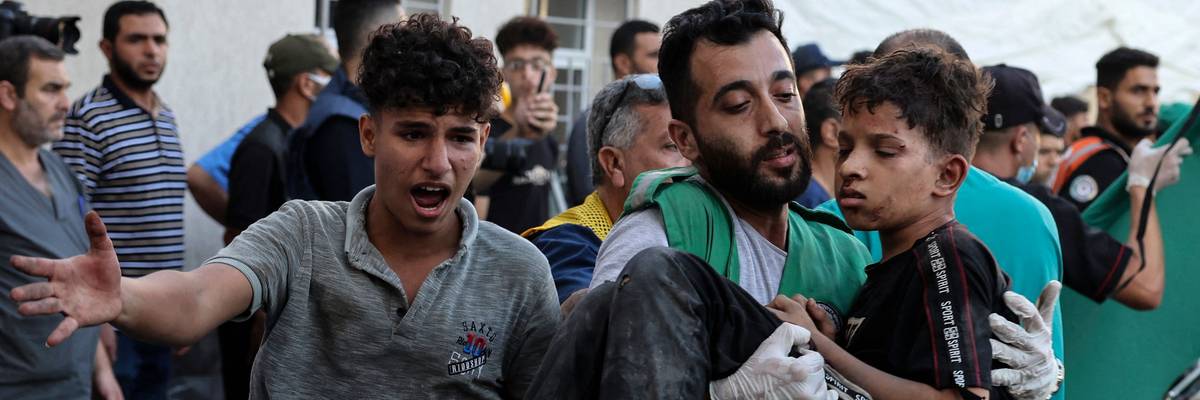
A man carries a child wounded in Israel’s bombardment of Gaza in October 2023.
"If we had a cease-fire for 72 hours, this would mean a thousand children would be safe again for this time," said one UNICEF official.
Desperate to appeal to the Israeli government and its allies, including the United States, for a stop to the bloodshed in Gaza, United Nations officials on Tuesday underscored the toll Israel's assault on the blockaded enclave has taken on the more than 1 million children who live there—at least 3,450 of whom have been killed since October 7.
With Israel blocking humanitarian aid and cutting off Gaza's access to electricity, fuel, and food, the country has killed thousands of children not just by bombing their homes and shelters, but also by causing a collapse of the healthcare system—forcing doctors to avoid necessary surgeries on bombing victims due to a lack of anesthesia equipment and to rely on obsolete antiseptics instead of properly disinfecting medical tools, risking infection.
Infant deaths due to dehydration are "a growing threat," James Elder, a spokesperson for the United Nations Children's Fund (UNICEF), said Tuesday, as Gaza's water production level ran at 5% of the required volume due to inoperable desalination plants.
"Threats go beyond the bombs and mortars," Elder said.
"On behalf of all the children caught in this nightmare, we call on the world to do better. Whether they are young people attending a music festival, or children going about their daily lives in Gaza, they all deserve peace."
In addition to the nearly 3,500 children who have been killed since Israel began its airstrike campaign earlier this month in retaliation for an attack on southern Israel by Hamas, the U.N. Office for the Coordination of Humanitarian Affairs (OCHA) said another 1,000 children "have been reported missing and may be trapped or dead under the rubble, awaiting rescue or recovery."
More than 6,300 have also been injured.
Roughly 1 million children are living under the constant threat of bombing, with Israel issuing evacuation orders and then bombing the areas that displaced Gaza residents have been told are safe.
For those who survive the fighting, Elder said, the costs "will be borne out for decades to come," with children facing lasting trauma.
"When an eight-year-old tells you that she doesn't want to die, it's hard not to feel helpless," Martin Griffiths, under-secretary-general for humanitarian affairs and emergency relief coordinator for OCHA, said on social media Tuesday after speaking with families in Gaza.
The agency declared Gaza a "graveyard" for children as it joined UNICEF in reiterating calls for an immediate cease-fire to allow for humanitarian aid and diplomatic talks.
UNICEF and OCHA issued their calls days after the international humanitarian group Save the Children warned that recently announced "expanded ground operations" by the Israel Defense Forces in Gaza would put children "at heightened risk of loss of life, physical harm, severe emotional distress, and protracted displacement."
A cease-fire of just three days could make a significant difference for children across Gaza, their families, and the medical providers desperate to save as many people as they can amid the humanitarian catastrophe.
"If we had a cease-fire for 72 hours, this would mean a thousand children would be safe again for this time," Elder said, calling for all humanitarian aid access points to be opened.
Over the past 10 days, 143 humanitarian aid trucks have been allowed into Gaza, but OCHA said that amount is "a fraction of what is needed to prevent further deterioration in the already-dire humanitarian situation, including civil unrest."
Speaking to the U.N. Security Council on Monday, UNICEF Executive Director Catherine Russell called on the council to "immediately adopt a resolution that reminds parties of their obligations under international law, calls for a cease-fire, demands that parties allow safe and unimpeded humanitarian access, demands the immediate and safe release of all abducted children, and urges parties to afford children the special protection to which they are entitled."
Only 12 countries joined the U.S. and Israel in rejecting a motion that called for a sustained humanitarian truce at the U.N. General Assembly last week.
The cost of the latest escalation in violence between Israel and Hamas—and the refusal of powerful policymakers including U.S. President Joe Biden to support a halt to the fighting—will ultimately, said Russell, "be measured in children's lives—those lost to the violence and those forever changed by it."
"On behalf of all the children caught in this nightmare, we call on the world to do better," she said. "Whether they are young people attending a music festival, or children going about their daily lives in Gaza, they all deserve peace. Children do not start conflicts, and they are powerless to stop them. They need all of us to put their safety and security at the forefront of our efforts, and to imagine a future where children are healthy, safe, and [educated]. No child deserves any less."
Dear Common Dreams reader, It’s been nearly 30 years since I co-founded Common Dreams with my late wife, Lina Newhouser. We had the radical notion that journalism should serve the public good, not corporate profits. It was clear to us from the outset what it would take to build such a project. No paid advertisements. No corporate sponsors. No millionaire publisher telling us what to think or do. Many people said we wouldn't last a year, but we proved those doubters wrong. Together with a tremendous team of journalists and dedicated staff, we built an independent media outlet free from the constraints of profits and corporate control. Our mission has always been simple: To inform. To inspire. To ignite change for the common good. Building Common Dreams was not easy. Our survival was never guaranteed. When you take on the most powerful forces—Wall Street greed, fossil fuel industry destruction, Big Tech lobbyists, and uber-rich oligarchs who have spent billions upon billions rigging the economy and democracy in their favor—the only bulwark you have is supporters who believe in your work. But here’s the urgent message from me today. It's never been this bad out there. And it's never been this hard to keep us going. At the very moment Common Dreams is most needed, the threats we face are intensifying. We need your support now more than ever. We don't accept corporate advertising and never will. We don't have a paywall because we don't think people should be blocked from critical news based on their ability to pay. Everything we do is funded by the donations of readers like you. When everyone does the little they can afford, we are strong. But if that support retreats or dries up, so do we. Will you donate now to make sure Common Dreams not only survives but thrives? —Craig Brown, Co-founder |
Desperate to appeal to the Israeli government and its allies, including the United States, for a stop to the bloodshed in Gaza, United Nations officials on Tuesday underscored the toll Israel's assault on the blockaded enclave has taken on the more than 1 million children who live there—at least 3,450 of whom have been killed since October 7.
With Israel blocking humanitarian aid and cutting off Gaza's access to electricity, fuel, and food, the country has killed thousands of children not just by bombing their homes and shelters, but also by causing a collapse of the healthcare system—forcing doctors to avoid necessary surgeries on bombing victims due to a lack of anesthesia equipment and to rely on obsolete antiseptics instead of properly disinfecting medical tools, risking infection.
Infant deaths due to dehydration are "a growing threat," James Elder, a spokesperson for the United Nations Children's Fund (UNICEF), said Tuesday, as Gaza's water production level ran at 5% of the required volume due to inoperable desalination plants.
"Threats go beyond the bombs and mortars," Elder said.
"On behalf of all the children caught in this nightmare, we call on the world to do better. Whether they are young people attending a music festival, or children going about their daily lives in Gaza, they all deserve peace."
In addition to the nearly 3,500 children who have been killed since Israel began its airstrike campaign earlier this month in retaliation for an attack on southern Israel by Hamas, the U.N. Office for the Coordination of Humanitarian Affairs (OCHA) said another 1,000 children "have been reported missing and may be trapped or dead under the rubble, awaiting rescue or recovery."
More than 6,300 have also been injured.
Roughly 1 million children are living under the constant threat of bombing, with Israel issuing evacuation orders and then bombing the areas that displaced Gaza residents have been told are safe.
For those who survive the fighting, Elder said, the costs "will be borne out for decades to come," with children facing lasting trauma.
"When an eight-year-old tells you that she doesn't want to die, it's hard not to feel helpless," Martin Griffiths, under-secretary-general for humanitarian affairs and emergency relief coordinator for OCHA, said on social media Tuesday after speaking with families in Gaza.
The agency declared Gaza a "graveyard" for children as it joined UNICEF in reiterating calls for an immediate cease-fire to allow for humanitarian aid and diplomatic talks.
UNICEF and OCHA issued their calls days after the international humanitarian group Save the Children warned that recently announced "expanded ground operations" by the Israel Defense Forces in Gaza would put children "at heightened risk of loss of life, physical harm, severe emotional distress, and protracted displacement."
A cease-fire of just three days could make a significant difference for children across Gaza, their families, and the medical providers desperate to save as many people as they can amid the humanitarian catastrophe.
"If we had a cease-fire for 72 hours, this would mean a thousand children would be safe again for this time," Elder said, calling for all humanitarian aid access points to be opened.
Over the past 10 days, 143 humanitarian aid trucks have been allowed into Gaza, but OCHA said that amount is "a fraction of what is needed to prevent further deterioration in the already-dire humanitarian situation, including civil unrest."
Speaking to the U.N. Security Council on Monday, UNICEF Executive Director Catherine Russell called on the council to "immediately adopt a resolution that reminds parties of their obligations under international law, calls for a cease-fire, demands that parties allow safe and unimpeded humanitarian access, demands the immediate and safe release of all abducted children, and urges parties to afford children the special protection to which they are entitled."
Only 12 countries joined the U.S. and Israel in rejecting a motion that called for a sustained humanitarian truce at the U.N. General Assembly last week.
The cost of the latest escalation in violence between Israel and Hamas—and the refusal of powerful policymakers including U.S. President Joe Biden to support a halt to the fighting—will ultimately, said Russell, "be measured in children's lives—those lost to the violence and those forever changed by it."
"On behalf of all the children caught in this nightmare, we call on the world to do better," she said. "Whether they are young people attending a music festival, or children going about their daily lives in Gaza, they all deserve peace. Children do not start conflicts, and they are powerless to stop them. They need all of us to put their safety and security at the forefront of our efforts, and to imagine a future where children are healthy, safe, and [educated]. No child deserves any less."
Desperate to appeal to the Israeli government and its allies, including the United States, for a stop to the bloodshed in Gaza, United Nations officials on Tuesday underscored the toll Israel's assault on the blockaded enclave has taken on the more than 1 million children who live there—at least 3,450 of whom have been killed since October 7.
With Israel blocking humanitarian aid and cutting off Gaza's access to electricity, fuel, and food, the country has killed thousands of children not just by bombing their homes and shelters, but also by causing a collapse of the healthcare system—forcing doctors to avoid necessary surgeries on bombing victims due to a lack of anesthesia equipment and to rely on obsolete antiseptics instead of properly disinfecting medical tools, risking infection.
Infant deaths due to dehydration are "a growing threat," James Elder, a spokesperson for the United Nations Children's Fund (UNICEF), said Tuesday, as Gaza's water production level ran at 5% of the required volume due to inoperable desalination plants.
"Threats go beyond the bombs and mortars," Elder said.
"On behalf of all the children caught in this nightmare, we call on the world to do better. Whether they are young people attending a music festival, or children going about their daily lives in Gaza, they all deserve peace."
In addition to the nearly 3,500 children who have been killed since Israel began its airstrike campaign earlier this month in retaliation for an attack on southern Israel by Hamas, the U.N. Office for the Coordination of Humanitarian Affairs (OCHA) said another 1,000 children "have been reported missing and may be trapped or dead under the rubble, awaiting rescue or recovery."
More than 6,300 have also been injured.
Roughly 1 million children are living under the constant threat of bombing, with Israel issuing evacuation orders and then bombing the areas that displaced Gaza residents have been told are safe.
For those who survive the fighting, Elder said, the costs "will be borne out for decades to come," with children facing lasting trauma.
"When an eight-year-old tells you that she doesn't want to die, it's hard not to feel helpless," Martin Griffiths, under-secretary-general for humanitarian affairs and emergency relief coordinator for OCHA, said on social media Tuesday after speaking with families in Gaza.
The agency declared Gaza a "graveyard" for children as it joined UNICEF in reiterating calls for an immediate cease-fire to allow for humanitarian aid and diplomatic talks.
UNICEF and OCHA issued their calls days after the international humanitarian group Save the Children warned that recently announced "expanded ground operations" by the Israel Defense Forces in Gaza would put children "at heightened risk of loss of life, physical harm, severe emotional distress, and protracted displacement."
A cease-fire of just three days could make a significant difference for children across Gaza, their families, and the medical providers desperate to save as many people as they can amid the humanitarian catastrophe.
"If we had a cease-fire for 72 hours, this would mean a thousand children would be safe again for this time," Elder said, calling for all humanitarian aid access points to be opened.
Over the past 10 days, 143 humanitarian aid trucks have been allowed into Gaza, but OCHA said that amount is "a fraction of what is needed to prevent further deterioration in the already-dire humanitarian situation, including civil unrest."
Speaking to the U.N. Security Council on Monday, UNICEF Executive Director Catherine Russell called on the council to "immediately adopt a resolution that reminds parties of their obligations under international law, calls for a cease-fire, demands that parties allow safe and unimpeded humanitarian access, demands the immediate and safe release of all abducted children, and urges parties to afford children the special protection to which they are entitled."
Only 12 countries joined the U.S. and Israel in rejecting a motion that called for a sustained humanitarian truce at the U.N. General Assembly last week.
The cost of the latest escalation in violence between Israel and Hamas—and the refusal of powerful policymakers including U.S. President Joe Biden to support a halt to the fighting—will ultimately, said Russell, "be measured in children's lives—those lost to the violence and those forever changed by it."
"On behalf of all the children caught in this nightmare, we call on the world to do better," she said. "Whether they are young people attending a music festival, or children going about their daily lives in Gaza, they all deserve peace. Children do not start conflicts, and they are powerless to stop them. They need all of us to put their safety and security at the forefront of our efforts, and to imagine a future where children are healthy, safe, and [educated]. No child deserves any less."

