SUBSCRIBE TO OUR FREE NEWSLETTER
Daily news & progressive opinion—funded by the people, not the corporations—delivered straight to your inbox.
5
#000000
#FFFFFF
To donate by check, phone, or other method, see our More Ways to Give page.
Daily news & progressive opinion—funded by the people, not the corporations—delivered straight to your inbox.
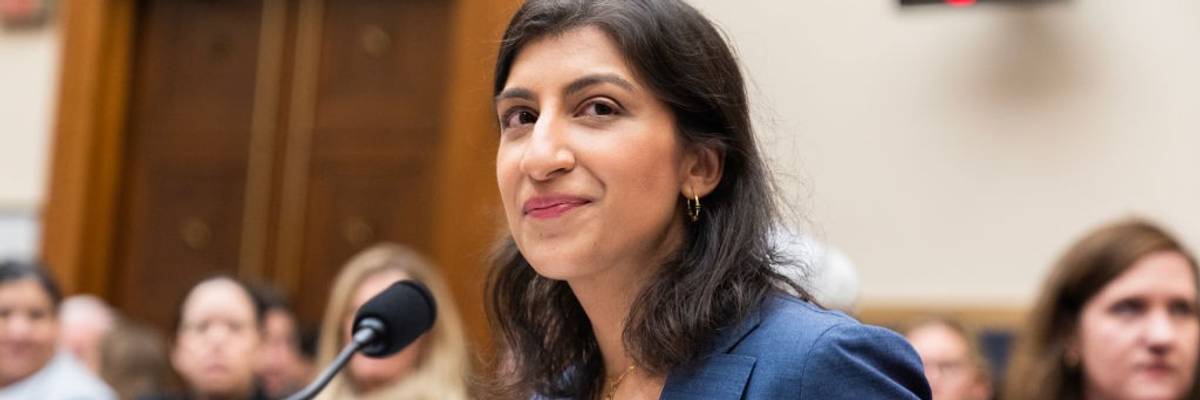
FTC Chair Lina Khan prepares to testify during a congressional hearing in Washington, D.C. on July 13, 2023.
"The proposed Kroger-Albertsons merger would have led to higher prices at the grocery store and harmed workers," said the Vermont senator.
Praise for Federal Trade Commission Chair Lina Khan continued to pour in on Wednesday after a pair of judges blocked the merger of grocery chains Kroger and Albertsons following challenges by the FTC and state attorneys general.
"The proposed Kroger-Albertsons merger would have led to higher prices at the grocery store and harmed workers," said U.S. Sen. Bernie Sanders. "Let me thank FTC Chair Lina Khan for successfully fighting this merger and standing up to corporate greed."
Congressman Mark Pocan (D-Wis.) also welcomed the rulings and sent "a big thank you to Lina Khan and her team at the FTC."
Their comments on Wednesday followed similar applause from Sen. Elizabeth Warren (D-Mass.) and Rep. Pramila Jayapal as well as groups including the American Economic Liberties Project (AELP) and Groundwork Collaborative.
Khan addressed the win during a Tuesday stream with political commentator Hasan Piker, noting that "this is the first time that the FTC has ever sought to block a merger not just because it's gonna be bad for consumers, but also because it's gonna be bad for workers."
Khan, an appointee of outgoing Democratic President Joe Biden, has won praise from progressives for taking on not only grocery giants and other companies trying to build monopolies but also Big Pharma and Big Tech.
Sanders recently called her "the best FTC chair in modern history" and AELP earlier this year published a document detailing how, under Khan's leadership, the agency "has entered a new era of more effective, modern, and democratic enforcement to better protect consumers, workers, and independent businesses."
Examples included in the AELP roundup include Khan's "crackdown on deceptive 'junk fees,'" a ban on noncompete clauses that's being challenged in court, a historic lawsuit against Amazon.com, and a "click-to-cancel" rule that requires sellers to "make it as easy for consumers to cancel their enrollment as it was to sign up."
However, the new era of the FTC is set to soon come to an end. Since President-elect Donald Trump's victory last month, speculation has been building that he would replace Khan with someone who would do the bidding of big business. Amid celebrations of the rulings against the Kroger-Albertsons merger on Tuesday, the Republican announced Andrew Ferguson as his pick for chair.
As Common Dreams reported earlier Wednesday, Basel Musharbash, principal attorney at Antimonopoly Counsel, said that elevating Ferguson, who already sits on the FTC, to chair, "is an affront to the antitrust laws and a gift to the oligarchs and monopolies bleeding this country dry."
Although the agency is expected to be friendlier to mergers under the next Trump administration, Albertsons responded to the Tuesday rulings by bailing on the $24.6 billion deal and suing Kroger for billions of dollars on Wednesday, rather than appealing or moving to in-house FTC hearings.
That move could reflect industry fears of U.S. courts that are willing to block major mergers, as The American Prospect executive editor David Dayen pointed out after the federal court decision on Tuesday.
"The important thing here is not that Biden's enforcers blocked a merger... it's that courts are increasingly comfortable with merger enforcement," he said. "States can sue under the Sherman Act, and they will. The real change to track is in the judiciary. Wall Street, take note."
Dear Common Dreams reader, It’s been nearly 30 years since I co-founded Common Dreams with my late wife, Lina Newhouser. We had the radical notion that journalism should serve the public good, not corporate profits. It was clear to us from the outset what it would take to build such a project. No paid advertisements. No corporate sponsors. No millionaire publisher telling us what to think or do. Many people said we wouldn't last a year, but we proved those doubters wrong. Together with a tremendous team of journalists and dedicated staff, we built an independent media outlet free from the constraints of profits and corporate control. Our mission has always been simple: To inform. To inspire. To ignite change for the common good. Building Common Dreams was not easy. Our survival was never guaranteed. When you take on the most powerful forces—Wall Street greed, fossil fuel industry destruction, Big Tech lobbyists, and uber-rich oligarchs who have spent billions upon billions rigging the economy and democracy in their favor—the only bulwark you have is supporters who believe in your work. But here’s the urgent message from me today. It's never been this bad out there. And it's never been this hard to keep us going. At the very moment Common Dreams is most needed, the threats we face are intensifying. We need your support now more than ever. We don't accept corporate advertising and never will. We don't have a paywall because we don't think people should be blocked from critical news based on their ability to pay. Everything we do is funded by the donations of readers like you. When everyone does the little they can afford, we are strong. But if that support retreats or dries up, so do we. Will you donate now to make sure Common Dreams not only survives but thrives? —Craig Brown, Co-founder |
Praise for Federal Trade Commission Chair Lina Khan continued to pour in on Wednesday after a pair of judges blocked the merger of grocery chains Kroger and Albertsons following challenges by the FTC and state attorneys general.
"The proposed Kroger-Albertsons merger would have led to higher prices at the grocery store and harmed workers," said U.S. Sen. Bernie Sanders. "Let me thank FTC Chair Lina Khan for successfully fighting this merger and standing up to corporate greed."
Congressman Mark Pocan (D-Wis.) also welcomed the rulings and sent "a big thank you to Lina Khan and her team at the FTC."
Their comments on Wednesday followed similar applause from Sen. Elizabeth Warren (D-Mass.) and Rep. Pramila Jayapal as well as groups including the American Economic Liberties Project (AELP) and Groundwork Collaborative.
Khan addressed the win during a Tuesday stream with political commentator Hasan Piker, noting that "this is the first time that the FTC has ever sought to block a merger not just because it's gonna be bad for consumers, but also because it's gonna be bad for workers."
Khan, an appointee of outgoing Democratic President Joe Biden, has won praise from progressives for taking on not only grocery giants and other companies trying to build monopolies but also Big Pharma and Big Tech.
Sanders recently called her "the best FTC chair in modern history" and AELP earlier this year published a document detailing how, under Khan's leadership, the agency "has entered a new era of more effective, modern, and democratic enforcement to better protect consumers, workers, and independent businesses."
Examples included in the AELP roundup include Khan's "crackdown on deceptive 'junk fees,'" a ban on noncompete clauses that's being challenged in court, a historic lawsuit against Amazon.com, and a "click-to-cancel" rule that requires sellers to "make it as easy for consumers to cancel their enrollment as it was to sign up."
However, the new era of the FTC is set to soon come to an end. Since President-elect Donald Trump's victory last month, speculation has been building that he would replace Khan with someone who would do the bidding of big business. Amid celebrations of the rulings against the Kroger-Albertsons merger on Tuesday, the Republican announced Andrew Ferguson as his pick for chair.
As Common Dreams reported earlier Wednesday, Basel Musharbash, principal attorney at Antimonopoly Counsel, said that elevating Ferguson, who already sits on the FTC, to chair, "is an affront to the antitrust laws and a gift to the oligarchs and monopolies bleeding this country dry."
Although the agency is expected to be friendlier to mergers under the next Trump administration, Albertsons responded to the Tuesday rulings by bailing on the $24.6 billion deal and suing Kroger for billions of dollars on Wednesday, rather than appealing or moving to in-house FTC hearings.
That move could reflect industry fears of U.S. courts that are willing to block major mergers, as The American Prospect executive editor David Dayen pointed out after the federal court decision on Tuesday.
"The important thing here is not that Biden's enforcers blocked a merger... it's that courts are increasingly comfortable with merger enforcement," he said. "States can sue under the Sherman Act, and they will. The real change to track is in the judiciary. Wall Street, take note."
Praise for Federal Trade Commission Chair Lina Khan continued to pour in on Wednesday after a pair of judges blocked the merger of grocery chains Kroger and Albertsons following challenges by the FTC and state attorneys general.
"The proposed Kroger-Albertsons merger would have led to higher prices at the grocery store and harmed workers," said U.S. Sen. Bernie Sanders. "Let me thank FTC Chair Lina Khan for successfully fighting this merger and standing up to corporate greed."
Congressman Mark Pocan (D-Wis.) also welcomed the rulings and sent "a big thank you to Lina Khan and her team at the FTC."
Their comments on Wednesday followed similar applause from Sen. Elizabeth Warren (D-Mass.) and Rep. Pramila Jayapal as well as groups including the American Economic Liberties Project (AELP) and Groundwork Collaborative.
Khan addressed the win during a Tuesday stream with political commentator Hasan Piker, noting that "this is the first time that the FTC has ever sought to block a merger not just because it's gonna be bad for consumers, but also because it's gonna be bad for workers."
Khan, an appointee of outgoing Democratic President Joe Biden, has won praise from progressives for taking on not only grocery giants and other companies trying to build monopolies but also Big Pharma and Big Tech.
Sanders recently called her "the best FTC chair in modern history" and AELP earlier this year published a document detailing how, under Khan's leadership, the agency "has entered a new era of more effective, modern, and democratic enforcement to better protect consumers, workers, and independent businesses."
Examples included in the AELP roundup include Khan's "crackdown on deceptive 'junk fees,'" a ban on noncompete clauses that's being challenged in court, a historic lawsuit against Amazon.com, and a "click-to-cancel" rule that requires sellers to "make it as easy for consumers to cancel their enrollment as it was to sign up."
However, the new era of the FTC is set to soon come to an end. Since President-elect Donald Trump's victory last month, speculation has been building that he would replace Khan with someone who would do the bidding of big business. Amid celebrations of the rulings against the Kroger-Albertsons merger on Tuesday, the Republican announced Andrew Ferguson as his pick for chair.
As Common Dreams reported earlier Wednesday, Basel Musharbash, principal attorney at Antimonopoly Counsel, said that elevating Ferguson, who already sits on the FTC, to chair, "is an affront to the antitrust laws and a gift to the oligarchs and monopolies bleeding this country dry."
Although the agency is expected to be friendlier to mergers under the next Trump administration, Albertsons responded to the Tuesday rulings by bailing on the $24.6 billion deal and suing Kroger for billions of dollars on Wednesday, rather than appealing or moving to in-house FTC hearings.
That move could reflect industry fears of U.S. courts that are willing to block major mergers, as The American Prospect executive editor David Dayen pointed out after the federal court decision on Tuesday.
"The important thing here is not that Biden's enforcers blocked a merger... it's that courts are increasingly comfortable with merger enforcement," he said. "States can sue under the Sherman Act, and they will. The real change to track is in the judiciary. Wall Street, take note."