SUBSCRIBE TO OUR FREE NEWSLETTER
Daily news & progressive opinion—funded by the people, not the corporations—delivered straight to your inbox.
5
#000000
#FFFFFF
To donate by check, phone, or other method, see our More Ways to Give page.
Daily news & progressive opinion—funded by the people, not the corporations—delivered straight to your inbox.
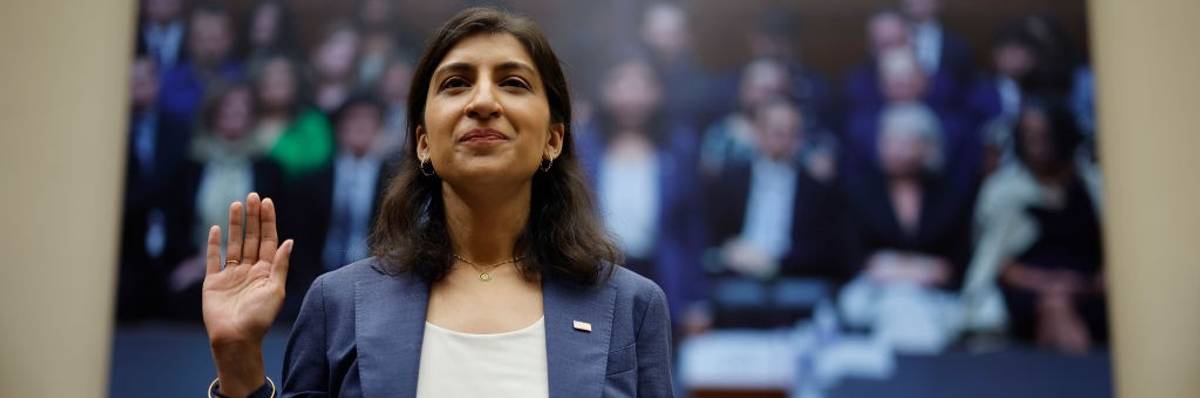
Federal Trade Commission Chair Lina Khan is sworn in before testifying to the House Judiciary Committee in the Rayburn House Office Building on Capitol Hill on July 13, 2023 in Washington, DC.
Heaven forbid the top official in charge of antitrust policy has actually suggested that monopoly power is a problem.
The Federal Trade Commission (FTC) lost a key antitrust case on July 11 after a federal judge rejected the agency’s move to halt Microsoft’s $69 billion acquisition of video game holding company Activision Blizzard.
FTC Chair Lina Khan has argued that, win or lose, the mere act of taking tech behemoths to court would be a partial victory by signaling the pressing need to update antitrust laws for today’s digital economy (New York Times, 12/7/22). But the Times‘ Cecilia Kang (7/11/23) wrote that the latest rulings “raise questions” about Khan’s strategy, with “critics…speaking out more loudly.” As to which critics are raising these questions, the Times buries the lead.
The three critical voices, representing a “tide of criticism,” as the Times described it, represent industry and the right. Adam Kovacevich, chief executive of Chamber of Progress (identified as “a tech trade group”), is quoted, “All these court losses are making their threats look more like a paper tiger.” Chamber of Progress lists among its “partners” companies like Amazon, Google and Meta, each of which have been sued by the FTC on several occasions for monopolistic business practices. The group has been outspoken against government antitrust efforts.
Ashley Baker of the Committee for Justice, identified by the Times as “a conservative think tank,” added that the FTC has “crossed the line to being reckless with the cases they are bringing.” Baker is more relevantly identified as the founder of the Alliance on Antitrust, described by Washington Monthly (5/25/21) as “an organization dedicated to pushing a pro-monopoly line on Republicans.” The Alliance’s member organizations, the Monthly reported, “receive financial support from Big Tech,” as well as “from monopolistic corporations in other sectors such as oil and gas, Big Ag, telecom, banking and pharmaceuticals.”
And Anthony Sabino said, “She’s trying to change a century’s worth of antitrust law overnight, and that’s not necessarily wise.” He’s identified as “a professor of business and law at St. John’s University”—but he’s also a corporate lawyer with a specialty in antitrust law. It’s not surprising that he doesn’t think strengthening antitrust regulation is “necessarily wise.”
The Times made minimal effort to point out the monetary incentives or ideological biases of the people it quoted who supposedly represent growing criticism of the FTC.
Of the four experts quoted in this piece, only one of them is not immediately critical of Khan: Eleanor Fox, a professor emeritus at New York University’s law school, who is inserted at the very end of piece, saying that the FTC chair “is only an outlier in the US, not globally.”
Indeed, other developed countries and blocs are taking a more active role in litigating the US’s Big Tech firms over antitrust concerns. Last month, the European Union charged Google with violating the bloc’s antitrust laws (New York Times, 6/14/23).
To put it simply, this ethics official thought the optics of Khan handling Meta’s case were bad because, as a public figure, she has said that antitrust laws should apply to Big Tech—a position that most Americans have agreed with for quite some time (Vox, 1/26/21). Nonetheless, the “issue” has been seized on by the establishment corporate media, pro-corporate Republicans and companies, like Meta (Reuters, 2/2/23) and Amazon (New York Times, 6/30/21), that feel that Khan’s public statements that the law should apply to them constitute some kind of inherent bias.
Bloomberg (6/16/23) quoted Republican former FTC Chair William Kovacic decrying Khan’s rejection of Pankey’s advice as “playing with fire.” The Wall Street Journal (6/18/23) published yet another editorial criticizing Khan—part of a pattern that has seen an attack on Khan in the Journal an average of once every 11 days over the past two years (FAIR.org, 6/23/23). And the right-wing Washington Examiner (6/28/23) explicitly called for a congressional inquiry into the FTC ethics concerns—a call to action that was quickly heeded.
Meanwhile, the Wall Street Journal (6/30/23) noted that Pankey’s financial disclosures show that she holds between $15,001 and $50,000 in Meta stock—a not-insignificant stake in a company under her purview. But it’s the official who committed the ethical breach of promising to break up Big Tech monopolies who faced congressional grilling—because in Washington, as in corporate media, standing up to corporate power is the real scandal.
Dear Common Dreams reader, It’s been nearly 30 years since I co-founded Common Dreams with my late wife, Lina Newhouser. We had the radical notion that journalism should serve the public good, not corporate profits. It was clear to us from the outset what it would take to build such a project. No paid advertisements. No corporate sponsors. No millionaire publisher telling us what to think or do. Many people said we wouldn't last a year, but we proved those doubters wrong. Together with a tremendous team of journalists and dedicated staff, we built an independent media outlet free from the constraints of profits and corporate control. Our mission has always been simple: To inform. To inspire. To ignite change for the common good. Building Common Dreams was not easy. Our survival was never guaranteed. When you take on the most powerful forces—Wall Street greed, fossil fuel industry destruction, Big Tech lobbyists, and uber-rich oligarchs who have spent billions upon billions rigging the economy and democracy in their favor—the only bulwark you have is supporters who believe in your work. But here’s the urgent message from me today. It's never been this bad out there. And it's never been this hard to keep us going. At the very moment Common Dreams is most needed, the threats we face are intensifying. We need your support now more than ever. We don't accept corporate advertising and never will. We don't have a paywall because we don't think people should be blocked from critical news based on their ability to pay. Everything we do is funded by the donations of readers like you. When everyone does the little they can afford, we are strong. But if that support retreats or dries up, so do we. Will you donate now to make sure Common Dreams not only survives but thrives? —Craig Brown, Co-founder |
The Federal Trade Commission (FTC) lost a key antitrust case on July 11 after a federal judge rejected the agency’s move to halt Microsoft’s $69 billion acquisition of video game holding company Activision Blizzard.
FTC Chair Lina Khan has argued that, win or lose, the mere act of taking tech behemoths to court would be a partial victory by signaling the pressing need to update antitrust laws for today’s digital economy (New York Times, 12/7/22). But the Times‘ Cecilia Kang (7/11/23) wrote that the latest rulings “raise questions” about Khan’s strategy, with “critics…speaking out more loudly.” As to which critics are raising these questions, the Times buries the lead.
The three critical voices, representing a “tide of criticism,” as the Times described it, represent industry and the right. Adam Kovacevich, chief executive of Chamber of Progress (identified as “a tech trade group”), is quoted, “All these court losses are making their threats look more like a paper tiger.” Chamber of Progress lists among its “partners” companies like Amazon, Google and Meta, each of which have been sued by the FTC on several occasions for monopolistic business practices. The group has been outspoken against government antitrust efforts.
Ashley Baker of the Committee for Justice, identified by the Times as “a conservative think tank,” added that the FTC has “crossed the line to being reckless with the cases they are bringing.” Baker is more relevantly identified as the founder of the Alliance on Antitrust, described by Washington Monthly (5/25/21) as “an organization dedicated to pushing a pro-monopoly line on Republicans.” The Alliance’s member organizations, the Monthly reported, “receive financial support from Big Tech,” as well as “from monopolistic corporations in other sectors such as oil and gas, Big Ag, telecom, banking and pharmaceuticals.”
And Anthony Sabino said, “She’s trying to change a century’s worth of antitrust law overnight, and that’s not necessarily wise.” He’s identified as “a professor of business and law at St. John’s University”—but he’s also a corporate lawyer with a specialty in antitrust law. It’s not surprising that he doesn’t think strengthening antitrust regulation is “necessarily wise.”
The Times made minimal effort to point out the monetary incentives or ideological biases of the people it quoted who supposedly represent growing criticism of the FTC.
Of the four experts quoted in this piece, only one of them is not immediately critical of Khan: Eleanor Fox, a professor emeritus at New York University’s law school, who is inserted at the very end of piece, saying that the FTC chair “is only an outlier in the US, not globally.”
Indeed, other developed countries and blocs are taking a more active role in litigating the US’s Big Tech firms over antitrust concerns. Last month, the European Union charged Google with violating the bloc’s antitrust laws (New York Times, 6/14/23).
To put it simply, this ethics official thought the optics of Khan handling Meta’s case were bad because, as a public figure, she has said that antitrust laws should apply to Big Tech—a position that most Americans have agreed with for quite some time (Vox, 1/26/21). Nonetheless, the “issue” has been seized on by the establishment corporate media, pro-corporate Republicans and companies, like Meta (Reuters, 2/2/23) and Amazon (New York Times, 6/30/21), that feel that Khan’s public statements that the law should apply to them constitute some kind of inherent bias.
Bloomberg (6/16/23) quoted Republican former FTC Chair William Kovacic decrying Khan’s rejection of Pankey’s advice as “playing with fire.” The Wall Street Journal (6/18/23) published yet another editorial criticizing Khan—part of a pattern that has seen an attack on Khan in the Journal an average of once every 11 days over the past two years (FAIR.org, 6/23/23). And the right-wing Washington Examiner (6/28/23) explicitly called for a congressional inquiry into the FTC ethics concerns—a call to action that was quickly heeded.
Meanwhile, the Wall Street Journal (6/30/23) noted that Pankey’s financial disclosures show that she holds between $15,001 and $50,000 in Meta stock—a not-insignificant stake in a company under her purview. But it’s the official who committed the ethical breach of promising to break up Big Tech monopolies who faced congressional grilling—because in Washington, as in corporate media, standing up to corporate power is the real scandal.
The Federal Trade Commission (FTC) lost a key antitrust case on July 11 after a federal judge rejected the agency’s move to halt Microsoft’s $69 billion acquisition of video game holding company Activision Blizzard.
FTC Chair Lina Khan has argued that, win or lose, the mere act of taking tech behemoths to court would be a partial victory by signaling the pressing need to update antitrust laws for today’s digital economy (New York Times, 12/7/22). But the Times‘ Cecilia Kang (7/11/23) wrote that the latest rulings “raise questions” about Khan’s strategy, with “critics…speaking out more loudly.” As to which critics are raising these questions, the Times buries the lead.
The three critical voices, representing a “tide of criticism,” as the Times described it, represent industry and the right. Adam Kovacevich, chief executive of Chamber of Progress (identified as “a tech trade group”), is quoted, “All these court losses are making their threats look more like a paper tiger.” Chamber of Progress lists among its “partners” companies like Amazon, Google and Meta, each of which have been sued by the FTC on several occasions for monopolistic business practices. The group has been outspoken against government antitrust efforts.
Ashley Baker of the Committee for Justice, identified by the Times as “a conservative think tank,” added that the FTC has “crossed the line to being reckless with the cases they are bringing.” Baker is more relevantly identified as the founder of the Alliance on Antitrust, described by Washington Monthly (5/25/21) as “an organization dedicated to pushing a pro-monopoly line on Republicans.” The Alliance’s member organizations, the Monthly reported, “receive financial support from Big Tech,” as well as “from monopolistic corporations in other sectors such as oil and gas, Big Ag, telecom, banking and pharmaceuticals.”
And Anthony Sabino said, “She’s trying to change a century’s worth of antitrust law overnight, and that’s not necessarily wise.” He’s identified as “a professor of business and law at St. John’s University”—but he’s also a corporate lawyer with a specialty in antitrust law. It’s not surprising that he doesn’t think strengthening antitrust regulation is “necessarily wise.”
The Times made minimal effort to point out the monetary incentives or ideological biases of the people it quoted who supposedly represent growing criticism of the FTC.
Of the four experts quoted in this piece, only one of them is not immediately critical of Khan: Eleanor Fox, a professor emeritus at New York University’s law school, who is inserted at the very end of piece, saying that the FTC chair “is only an outlier in the US, not globally.”
Indeed, other developed countries and blocs are taking a more active role in litigating the US’s Big Tech firms over antitrust concerns. Last month, the European Union charged Google with violating the bloc’s antitrust laws (New York Times, 6/14/23).
To put it simply, this ethics official thought the optics of Khan handling Meta’s case were bad because, as a public figure, she has said that antitrust laws should apply to Big Tech—a position that most Americans have agreed with for quite some time (Vox, 1/26/21). Nonetheless, the “issue” has been seized on by the establishment corporate media, pro-corporate Republicans and companies, like Meta (Reuters, 2/2/23) and Amazon (New York Times, 6/30/21), that feel that Khan’s public statements that the law should apply to them constitute some kind of inherent bias.
Bloomberg (6/16/23) quoted Republican former FTC Chair William Kovacic decrying Khan’s rejection of Pankey’s advice as “playing with fire.” The Wall Street Journal (6/18/23) published yet another editorial criticizing Khan—part of a pattern that has seen an attack on Khan in the Journal an average of once every 11 days over the past two years (FAIR.org, 6/23/23). And the right-wing Washington Examiner (6/28/23) explicitly called for a congressional inquiry into the FTC ethics concerns—a call to action that was quickly heeded.
Meanwhile, the Wall Street Journal (6/30/23) noted that Pankey’s financial disclosures show that she holds between $15,001 and $50,000 in Meta stock—a not-insignificant stake in a company under her purview. But it’s the official who committed the ethical breach of promising to break up Big Tech monopolies who faced congressional grilling—because in Washington, as in corporate media, standing up to corporate power is the real scandal.