

SUBSCRIBE TO OUR FREE NEWSLETTER
Daily news & progressive opinion—funded by the people, not the corporations—delivered straight to your inbox.
5
#000000
#FFFFFF
To donate by check, phone, or other method, see our More Ways to Give page.
Daily news & progressive opinion—funded by the people, not the corporations—delivered straight to your inbox.
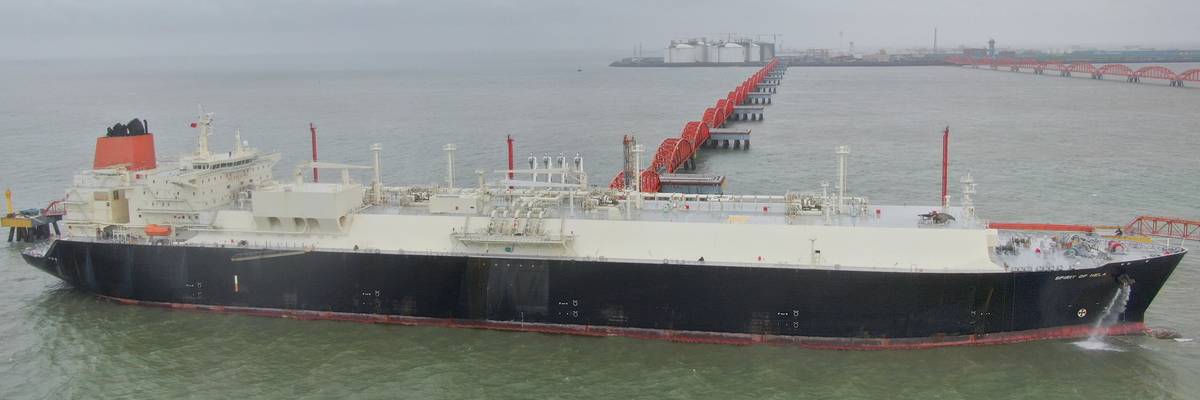
The liquefied natural gas tanker Spirit of Hela is seen transmitting LNG from Papua New Guinea at a reception terminal at Yangkou port in China's Jiangsu province on July 23, 2020.
"Rising sea levels, extreme weather events, and environmental degradation are already threatening many people's existence and threatening our way of life," said one local, warning the project will worsen the climate crisis.
More than two dozen advocacy groups from Papua New Guinea, the Asia Pacific region, and the United States on Tuesday urged the U.S. export credit agency to reject a liquefied natural gas project that they warned "presents significant financial risks and opportunity costs, as well as harmful climate impacts."
The groups—including the Center for Environmental Law and Community Rights Inc. (CELCOR), Food & Water Watch, Friends of the Earth (FOE) United States, Global Witness, Oil Change International (OCI), and Sierra Club—wrote to U.S. Export-Import Bank (EXIM) Chair Reta Jo Lewis about the Papua LNG project led by TotalEnergies.
The coalition argued that approving Papua LNG not only would contradict the Biden administration's 2021 pledge to end new public support for fossil fuel energy projects abroad and "further position the United States as an international laggard on climate, but would further jeopardize international climate goals, risk $13 billion USD in stranded assets, and put Pacific frontline communities at further environmental, social, and economic risk."
Peter Bosip, executive director of the Papua New Guinea-based CELCOR, stressed in a statement Tuesday that "the people of PNG are already facing the full force of climate change."
"Rising sea levels, extreme weather events, and environmental degradation are already threatening many people's existence and threatening our way of life," Bosip said. "Papua LNG will add to and exacerbate this climate crisis—and financiers cannot, and should not, finance it."
"Approving this project risks wasting billions of taxpayer dollars on infrastructure that will become a stranded asset, and worse, further places our climate goals of minimizing global warming to 1.5°C far out of reach."
The fossil fuel project "has not secured any guaranteed sales—with no long-term sales and purchase agreements (SPAs) or nonbinding heads of agreement supply deals," the letter notes. "In addition to these climate and financial risks, Pacific civil society and governments have repeatedly called for the end of all fossil fuels in order to safeguard a habitable climate for the region, as warming above 1.5°C risks the habitability of many Pacific island communities."
Limiting global temperature rise this century to 1.5°C above preindustrial levels is the more ambitious goal of the 2015 Paris agreement. Representatives of countries who have signed on to the deal—including the United States—are set to gather in the United Arab Emirates in November for the next United Nations climate summit, COP28.
"EXIM's potential support for this project signals that the agency and this administration [are] not serious about achieving international climate goals," OCI export finance climate strategist Nina Pusic charged Tuesday. "Approving this project risks wasting billions of taxpayer dollars on infrastructure that will become a stranded asset, and worse, further places our climate goals of minimizing global warming to 1.5°C far out of reach."
The letter points out that "PNG itself does not need fossil gas for its own energy needs—it could dramatically expand its energy usage and still provide 78% of its on-grid energy needs from renewable energy by 2030 were appropriate financing made available."
During the Obama administration—for which President Joe Biden was vice president—EXIM dumped billions of dollars into PNG LNG, a project led by ExxonMobil that, as the letter highlights, "has previously been associated with human rights abuses, escalating tensions, land-related issues, and broken economic promises."
FOE U.S. senior international finance program manager Katie DeAngelis said Tuesday that rather than repeating past mistakes of EXIM "by continually approving support for liquefied natural gas projects" that harm local communities and the climate, the Biden administration should "instead invest in renewables that will help the people of Papua New Guinea transition to a clean energy future."
Along with pressuring EXIM to reject the Papua LNG project due to the "enormous risks" associated with it, the letter concludes by calling on the agency to "take immediate action to implement the Clean Energy Transition Partnership (CEPT), by announcing a fossil fuel exclusion policy which most other high-income signatories of the CEPT have already done."
Dear Common Dreams reader, It’s been nearly 30 years since I co-founded Common Dreams with my late wife, Lina Newhouser. We had the radical notion that journalism should serve the public good, not corporate profits. It was clear to us from the outset what it would take to build such a project. No paid advertisements. No corporate sponsors. No millionaire publisher telling us what to think or do. Many people said we wouldn't last a year, but we proved those doubters wrong. Together with a tremendous team of journalists and dedicated staff, we built an independent media outlet free from the constraints of profits and corporate control. Our mission has always been simple: To inform. To inspire. To ignite change for the common good. Building Common Dreams was not easy. Our survival was never guaranteed. When you take on the most powerful forces—Wall Street greed, fossil fuel industry destruction, Big Tech lobbyists, and uber-rich oligarchs who have spent billions upon billions rigging the economy and democracy in their favor—the only bulwark you have is supporters who believe in your work. But here’s the urgent message from me today. It's never been this bad out there. And it's never been this hard to keep us going. At the very moment Common Dreams is most needed, the threats we face are intensifying. We need your support now more than ever. We don't accept corporate advertising and never will. We don't have a paywall because we don't think people should be blocked from critical news based on their ability to pay. Everything we do is funded by the donations of readers like you. When everyone does the little they can afford, we are strong. But if that support retreats or dries up, so do we. Will you donate now to make sure Common Dreams not only survives but thrives? —Craig Brown, Co-founder |
More than two dozen advocacy groups from Papua New Guinea, the Asia Pacific region, and the United States on Tuesday urged the U.S. export credit agency to reject a liquefied natural gas project that they warned "presents significant financial risks and opportunity costs, as well as harmful climate impacts."
The groups—including the Center for Environmental Law and Community Rights Inc. (CELCOR), Food & Water Watch, Friends of the Earth (FOE) United States, Global Witness, Oil Change International (OCI), and Sierra Club—wrote to U.S. Export-Import Bank (EXIM) Chair Reta Jo Lewis about the Papua LNG project led by TotalEnergies.
The coalition argued that approving Papua LNG not only would contradict the Biden administration's 2021 pledge to end new public support for fossil fuel energy projects abroad and "further position the United States as an international laggard on climate, but would further jeopardize international climate goals, risk $13 billion USD in stranded assets, and put Pacific frontline communities at further environmental, social, and economic risk."
Peter Bosip, executive director of the Papua New Guinea-based CELCOR, stressed in a statement Tuesday that "the people of PNG are already facing the full force of climate change."
"Rising sea levels, extreme weather events, and environmental degradation are already threatening many people's existence and threatening our way of life," Bosip said. "Papua LNG will add to and exacerbate this climate crisis—and financiers cannot, and should not, finance it."
"Approving this project risks wasting billions of taxpayer dollars on infrastructure that will become a stranded asset, and worse, further places our climate goals of minimizing global warming to 1.5°C far out of reach."
The fossil fuel project "has not secured any guaranteed sales—with no long-term sales and purchase agreements (SPAs) or nonbinding heads of agreement supply deals," the letter notes. "In addition to these climate and financial risks, Pacific civil society and governments have repeatedly called for the end of all fossil fuels in order to safeguard a habitable climate for the region, as warming above 1.5°C risks the habitability of many Pacific island communities."
Limiting global temperature rise this century to 1.5°C above preindustrial levels is the more ambitious goal of the 2015 Paris agreement. Representatives of countries who have signed on to the deal—including the United States—are set to gather in the United Arab Emirates in November for the next United Nations climate summit, COP28.
"EXIM's potential support for this project signals that the agency and this administration [are] not serious about achieving international climate goals," OCI export finance climate strategist Nina Pusic charged Tuesday. "Approving this project risks wasting billions of taxpayer dollars on infrastructure that will become a stranded asset, and worse, further places our climate goals of minimizing global warming to 1.5°C far out of reach."
The letter points out that "PNG itself does not need fossil gas for its own energy needs—it could dramatically expand its energy usage and still provide 78% of its on-grid energy needs from renewable energy by 2030 were appropriate financing made available."
During the Obama administration—for which President Joe Biden was vice president—EXIM dumped billions of dollars into PNG LNG, a project led by ExxonMobil that, as the letter highlights, "has previously been associated with human rights abuses, escalating tensions, land-related issues, and broken economic promises."
FOE U.S. senior international finance program manager Katie DeAngelis said Tuesday that rather than repeating past mistakes of EXIM "by continually approving support for liquefied natural gas projects" that harm local communities and the climate, the Biden administration should "instead invest in renewables that will help the people of Papua New Guinea transition to a clean energy future."
Along with pressuring EXIM to reject the Papua LNG project due to the "enormous risks" associated with it, the letter concludes by calling on the agency to "take immediate action to implement the Clean Energy Transition Partnership (CEPT), by announcing a fossil fuel exclusion policy which most other high-income signatories of the CEPT have already done."
More than two dozen advocacy groups from Papua New Guinea, the Asia Pacific region, and the United States on Tuesday urged the U.S. export credit agency to reject a liquefied natural gas project that they warned "presents significant financial risks and opportunity costs, as well as harmful climate impacts."
The groups—including the Center for Environmental Law and Community Rights Inc. (CELCOR), Food & Water Watch, Friends of the Earth (FOE) United States, Global Witness, Oil Change International (OCI), and Sierra Club—wrote to U.S. Export-Import Bank (EXIM) Chair Reta Jo Lewis about the Papua LNG project led by TotalEnergies.
The coalition argued that approving Papua LNG not only would contradict the Biden administration's 2021 pledge to end new public support for fossil fuel energy projects abroad and "further position the United States as an international laggard on climate, but would further jeopardize international climate goals, risk $13 billion USD in stranded assets, and put Pacific frontline communities at further environmental, social, and economic risk."
Peter Bosip, executive director of the Papua New Guinea-based CELCOR, stressed in a statement Tuesday that "the people of PNG are already facing the full force of climate change."
"Rising sea levels, extreme weather events, and environmental degradation are already threatening many people's existence and threatening our way of life," Bosip said. "Papua LNG will add to and exacerbate this climate crisis—and financiers cannot, and should not, finance it."
"Approving this project risks wasting billions of taxpayer dollars on infrastructure that will become a stranded asset, and worse, further places our climate goals of minimizing global warming to 1.5°C far out of reach."
The fossil fuel project "has not secured any guaranteed sales—with no long-term sales and purchase agreements (SPAs) or nonbinding heads of agreement supply deals," the letter notes. "In addition to these climate and financial risks, Pacific civil society and governments have repeatedly called for the end of all fossil fuels in order to safeguard a habitable climate for the region, as warming above 1.5°C risks the habitability of many Pacific island communities."
Limiting global temperature rise this century to 1.5°C above preindustrial levels is the more ambitious goal of the 2015 Paris agreement. Representatives of countries who have signed on to the deal—including the United States—are set to gather in the United Arab Emirates in November for the next United Nations climate summit, COP28.
"EXIM's potential support for this project signals that the agency and this administration [are] not serious about achieving international climate goals," OCI export finance climate strategist Nina Pusic charged Tuesday. "Approving this project risks wasting billions of taxpayer dollars on infrastructure that will become a stranded asset, and worse, further places our climate goals of minimizing global warming to 1.5°C far out of reach."
The letter points out that "PNG itself does not need fossil gas for its own energy needs—it could dramatically expand its energy usage and still provide 78% of its on-grid energy needs from renewable energy by 2030 were appropriate financing made available."
During the Obama administration—for which President Joe Biden was vice president—EXIM dumped billions of dollars into PNG LNG, a project led by ExxonMobil that, as the letter highlights, "has previously been associated with human rights abuses, escalating tensions, land-related issues, and broken economic promises."
FOE U.S. senior international finance program manager Katie DeAngelis said Tuesday that rather than repeating past mistakes of EXIM "by continually approving support for liquefied natural gas projects" that harm local communities and the climate, the Biden administration should "instead invest in renewables that will help the people of Papua New Guinea transition to a clean energy future."
Along with pressuring EXIM to reject the Papua LNG project due to the "enormous risks" associated with it, the letter concludes by calling on the agency to "take immediate action to implement the Clean Energy Transition Partnership (CEPT), by announcing a fossil fuel exclusion policy which most other high-income signatories of the CEPT have already done."

