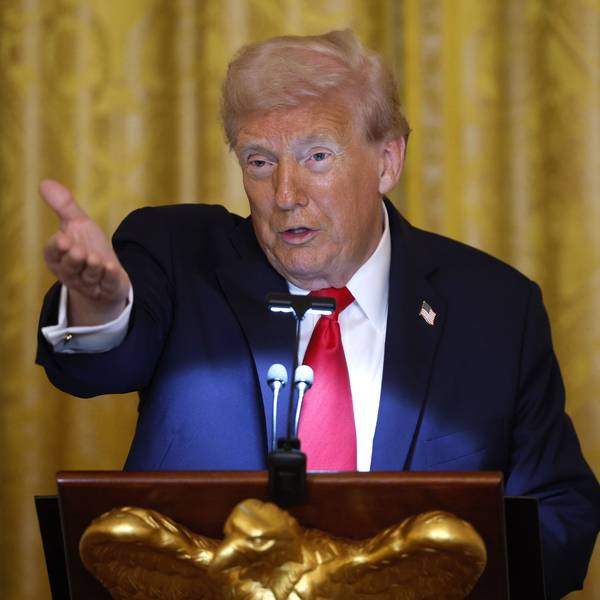
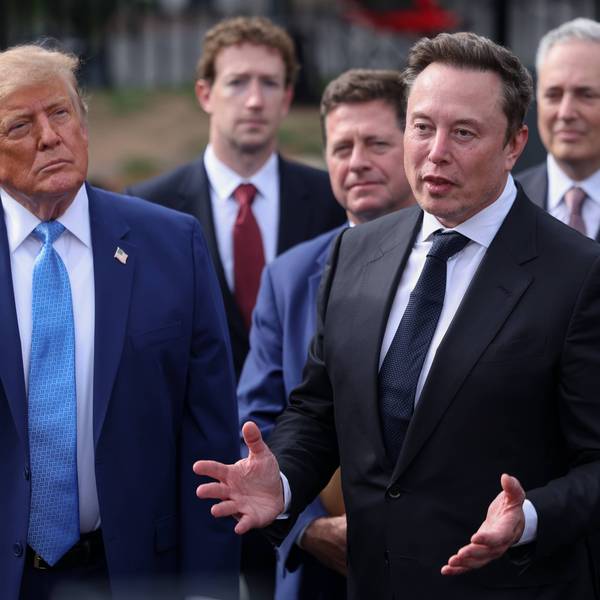

Elon Musk arrives to attend Donald Trump's inauguration on January 20, 2025 in Washington, D.C.
Federal Judge Restricts Musk Cronies' Access to Treasury Payment System
"We're pleased that the court acted quickly to put in safeguards to protect people's personal information until the facts are sorted out," said an attorney with the Public Citizen Litigation Group.
A federal judge on Thursday issued an interim order limiting access to a critical U.S. Treasury Department payment system that members of billionaire Elon Musk's team infiltrated last week with the blessing of President Donald Trump's handpicked Treasury chief, sparking widespread alarm and backlash.
The order came after the Alliance for Retired Americans and a pair of labor unions sued the Treasury Department on Monday for giving Musk lieutenants the keys to the vital payment system—access they reportedly attempted to use to cut off all U.S. Agency for International Development spending.
The lawsuit challenged Musk's team's access to the payment system on privacy grounds, and one observer described it as "one of the most important lawsuits in the history of the United States."
In her order on Thursday, Judge Colleen Kollar-Kotelly of the U.S. District Court for the District of Columbia restricted "access to any payment record or payment system of records maintained by or within the Bureau of the Fiscal Service" to a select group, including Tom Krause and Marko Elez—both of whom have ties to Musk's Department of Government Efficiency (DOGE) team—and regular Treasury Department employees.
An attorney for the U.S. Justice Department said during a court hearing earlier this week that Krause and Elez were made "special employees" of the Treasury Department.
Critically, the federal judge's order limits Krause and Elez to "read only" permissions, meaning they can view records and data but not make any changes.
Writer and researcher Nathan Tankus reported Thursday that Elez—a 25-year-old engineer who previously worked for two Musk-owned companies, SpaceX and the social media platform X—was at one point given both "read and write" privileges.
"None of this should be happening and it's only going to get worse the longer 'DOGE' is here and the more they learn about what they can do and get away with."
One unnamed source familiar with the situation told Tankus that Elez "shouldn't have access to this almost $5 trillion payment flow, even if it's 'read-only.'"
"He shouldn't even be at Fiscal Service," the source added. "None of this should be happening and it's only going to get worse the longer 'DOGE' is here and the more they learn about what they can do and get away with."
Kollar-Kotelly's order will remain in effect until the court rules on a preliminary injunction motion from the Alliance for Retired Americans, the American Federation of Government Employees, and the Service Employees International Union.
Nandan Joshi, an attorney with the Public Citizen Litigation Group—which is representing the plaintiffs in the ongoing legal fight over access to the vital Treasury system—said in a statement Thursday that "we're pleased that the court acted quickly to put in safeguards to protect people's personal information until the facts are sorted out."
"Americans who rely on Social Security and similar programs should be able to trust their government to handle their sensitive information with the utmost care," said Joshi. "No one should ever face having their personal information used for improper purposes without their consent, which is why we've brought this case."
We are at a crossroads
This country and this world are at a monumental crossroads. In a few short weeks, US voters will have an opportunity to beat back the forces of fascism and confront the billionaires who are rigging the economy, our media system, and our democracy, making it increasingly impossible for ordinary people to get by. We’re not just talking about the election. We’re talking about what must be done once these fascist elements are vanquished from power. We need a bolder set of solutions than what either major party has so far been willing to offer and a working-class movement ready to fight like hell for it. Trump didn't emerge from nowhere. The conditions that fueled MAGA authoritarianism were created by decades of radical neoliberal economic policies and a corrupt political system dominated by corporate interests. They slashed taxes on the super-rich, promising that the benefits would trickle down. They said giveaways to the corporate titans would make life more affordable for the rest of us. It was all bullshit. And when a bitter, betrayed populace searches for someone to blame, right-wing demagogues have little trouble finding scapegoats. People know when they're being lied to, but you won't hear any of this from the corporate media. Only independent journalism—powered and funded by people who believe in building a better world—can deliver truly trustworthy daily news. Our Fall Campaign is underway, and we need your help. To power our newsroom through the rest of the year, we need to raise $125,000 by midnight on October 31. So if you share our vision, please contribute whatever you can to sustain our work. |
A federal judge on Thursday issued an interim order limiting access to a critical U.S. Treasury Department payment system that members of billionaire Elon Musk's team infiltrated last week with the blessing of President Donald Trump's handpicked Treasury chief, sparking widespread alarm and backlash.
The order came after the Alliance for Retired Americans and a pair of labor unions sued the Treasury Department on Monday for giving Musk lieutenants the keys to the vital payment system—access they reportedly attempted to use to cut off all U.S. Agency for International Development spending.
The lawsuit challenged Musk's team's access to the payment system on privacy grounds, and one observer described it as "one of the most important lawsuits in the history of the United States."
In her order on Thursday, Judge Colleen Kollar-Kotelly of the U.S. District Court for the District of Columbia restricted "access to any payment record or payment system of records maintained by or within the Bureau of the Fiscal Service" to a select group, including Tom Krause and Marko Elez—both of whom have ties to Musk's Department of Government Efficiency (DOGE) team—and regular Treasury Department employees.
An attorney for the U.S. Justice Department said during a court hearing earlier this week that Krause and Elez were made "special employees" of the Treasury Department.
Critically, the federal judge's order limits Krause and Elez to "read only" permissions, meaning they can view records and data but not make any changes.
Writer and researcher Nathan Tankus reported Thursday that Elez—a 25-year-old engineer who previously worked for two Musk-owned companies, SpaceX and the social media platform X—was at one point given both "read and write" privileges.
"None of this should be happening and it's only going to get worse the longer 'DOGE' is here and the more they learn about what they can do and get away with."
One unnamed source familiar with the situation told Tankus that Elez "shouldn't have access to this almost $5 trillion payment flow, even if it's 'read-only.'"
"He shouldn't even be at Fiscal Service," the source added. "None of this should be happening and it's only going to get worse the longer 'DOGE' is here and the more they learn about what they can do and get away with."
Kollar-Kotelly's order will remain in effect until the court rules on a preliminary injunction motion from the Alliance for Retired Americans, the American Federation of Government Employees, and the Service Employees International Union.
Nandan Joshi, an attorney with the Public Citizen Litigation Group—which is representing the plaintiffs in the ongoing legal fight over access to the vital Treasury system—said in a statement Thursday that "we're pleased that the court acted quickly to put in safeguards to protect people's personal information until the facts are sorted out."
"Americans who rely on Social Security and similar programs should be able to trust their government to handle their sensitive information with the utmost care," said Joshi. "No one should ever face having their personal information used for improper purposes without their consent, which is why we've brought this case."
A federal judge on Thursday issued an interim order limiting access to a critical U.S. Treasury Department payment system that members of billionaire Elon Musk's team infiltrated last week with the blessing of President Donald Trump's handpicked Treasury chief, sparking widespread alarm and backlash.
The order came after the Alliance for Retired Americans and a pair of labor unions sued the Treasury Department on Monday for giving Musk lieutenants the keys to the vital payment system—access they reportedly attempted to use to cut off all U.S. Agency for International Development spending.
The lawsuit challenged Musk's team's access to the payment system on privacy grounds, and one observer described it as "one of the most important lawsuits in the history of the United States."
In her order on Thursday, Judge Colleen Kollar-Kotelly of the U.S. District Court for the District of Columbia restricted "access to any payment record or payment system of records maintained by or within the Bureau of the Fiscal Service" to a select group, including Tom Krause and Marko Elez—both of whom have ties to Musk's Department of Government Efficiency (DOGE) team—and regular Treasury Department employees.
An attorney for the U.S. Justice Department said during a court hearing earlier this week that Krause and Elez were made "special employees" of the Treasury Department.
Critically, the federal judge's order limits Krause and Elez to "read only" permissions, meaning they can view records and data but not make any changes.
Writer and researcher Nathan Tankus reported Thursday that Elez—a 25-year-old engineer who previously worked for two Musk-owned companies, SpaceX and the social media platform X—was at one point given both "read and write" privileges.
"None of this should be happening and it's only going to get worse the longer 'DOGE' is here and the more they learn about what they can do and get away with."
One unnamed source familiar with the situation told Tankus that Elez "shouldn't have access to this almost $5 trillion payment flow, even if it's 'read-only.'"
"He shouldn't even be at Fiscal Service," the source added. "None of this should be happening and it's only going to get worse the longer 'DOGE' is here and the more they learn about what they can do and get away with."
Kollar-Kotelly's order will remain in effect until the court rules on a preliminary injunction motion from the Alliance for Retired Americans, the American Federation of Government Employees, and the Service Employees International Union.
Nandan Joshi, an attorney with the Public Citizen Litigation Group—which is representing the plaintiffs in the ongoing legal fight over access to the vital Treasury system—said in a statement Thursday that "we're pleased that the court acted quickly to put in safeguards to protect people's personal information until the facts are sorted out."
"Americans who rely on Social Security and similar programs should be able to trust their government to handle their sensitive information with the utmost care," said Joshi. "No one should ever face having their personal information used for improper purposes without their consent, which is why we've brought this case."