SUBSCRIBE TO OUR FREE NEWSLETTER
Daily news & progressive opinion—funded by the people, not the corporations—delivered straight to your inbox.
5
#000000
#FFFFFF
To donate by check, phone, or other method, see our More Ways to Give page.
Daily news & progressive opinion—funded by the people, not the corporations—delivered straight to your inbox.
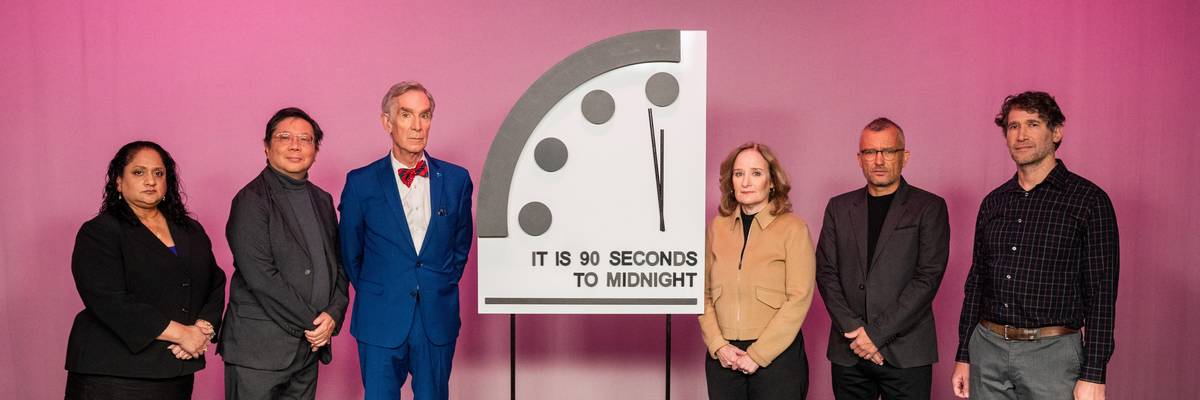
The Doomsday Clock was reset at 90 seconds to midnight on January 23, 2024.
"Humanity continues to face an unprecedented level of danger," says The Bulletin of the Atomic Scientists. "Leaders and citizens around the world should take this statement as a stark warning and respond urgently."
"Ominous trends continue to point the world toward global catastrophe," The Bulletin of the Atomic Scientists warned Tuesday, explaining why the Doomsday Clock remains at 90 seconds to midnight.
Since its 1947 debut, the Doomsday Clock has represented how close humanity is to destroying the world. While it was initially created in response to nuclear arms risks, in 2024, the climate emergency, biological threats, and disruptive technologies including artificial intelligence (AI) also factor into the clock's position.
The Bulletin's new statement says that "the members of the Science and Security Board have been deeply worried about the deteriorating state of the world. That is why we set the Doomsday Clock at two minutes to midnight in 2019 and at 100 seconds to midnight in 2022."
"Last year, we expressed our heightened concern by moving the clock to 90 seconds to midnight—the closest to global catastrophe it has ever been—in large part because of Russian threats to use nuclear weapons in the war in Ukraine," the publication continues. "Today, we once again set the Doomsday Clock at 90 seconds to midnight because humanity continues to face an unprecedented level of danger."
"Our decision should not be taken as a sign that the international security situation has eased," the statement stresses. "Instead, leaders and citizens around the world should take this statement as a stark warning and respond urgently, as if today were the most dangerous moment in modern history. Because it may well be."
Nearly two years since the invasion, "a durable end to Russia's war in Ukraine seems distant, and the use of nuclear weapons by Russia in that conflict remains a serious possibility," the document states. However, Russia is just one of the world's nine nuclear-armed nations.
"Spending programs in the three largest nuclear powers—China, Russia, and the United States—threaten to trigger a three-way nuclear arms race as the world's arms control architecture collapses," the statement notes. "And the war in Gaza between Israel and Hamas has the potential to escalate into a wider Middle Eastern conflict that could pose unpredictable threats, regionally and globally."
On the climate front, "the world in 2023 entered uncharted territory as it suffered its hottest year on record and global greenhouse gas emissions continued to rise," the publication highlights. "Current efforts to reduce greenhouse gas emissions are grossly insufficient to avoid dangerous human and economic impacts from climate change, which disproportionately affect the poorest people in the world."
The statement also points out that "the revolution in life sciences and associated technologies continued to expand in scope last year," and "the convergence of emerging artificial intelligence tools and biological technologies may radically empower individuals to misuse biology."
Other AI-related concerns include the "great potential to magnify disinformation" as well as military uses. The statement says that "decisions to put AI in control of important physical systems—in particular, nuclear weapons—could indeed pose a direct existential threat to humanity."
While sounding the alarm about the world's top threats on Tuesday, the Bulletin also emphasized that it's possible to turn back the clock.
"For decades, scientists have been warning us of the dangers facing humankind," said science communicator Bill Nye, who participated in the 2024 Doomsday Clock announcement. "We could be facing catastrophe unless we better manage the technologies we've created. It's time to act."
The Bulletin's executive chair, former Democratic California Gov. Jerry Brown, asserted that "only the big powers like China, America, and Russia can pull us back. Despite deep antagonisms, they must cooperate—or we are doomed."
Outside organizations, including the U.K.-based Campaign for Nuclear Disarmament (CND), also issued calls to action.
"The Doomsday Clock remaining at 90 seconds to midnight must be a wake-up call for the entire world," said the group's general secretary, Kate Hudson. "We're fast approaching the point of no return. CND calls on all those who want peace to prevail to join us in doing everything we can to turn back the clock."
Dear Common Dreams reader, It’s been nearly 30 years since I co-founded Common Dreams with my late wife, Lina Newhouser. We had the radical notion that journalism should serve the public good, not corporate profits. It was clear to us from the outset what it would take to build such a project. No paid advertisements. No corporate sponsors. No millionaire publisher telling us what to think or do. Many people said we wouldn't last a year, but we proved those doubters wrong. Together with a tremendous team of journalists and dedicated staff, we built an independent media outlet free from the constraints of profits and corporate control. Our mission has always been simple: To inform. To inspire. To ignite change for the common good. Building Common Dreams was not easy. Our survival was never guaranteed. When you take on the most powerful forces—Wall Street greed, fossil fuel industry destruction, Big Tech lobbyists, and uber-rich oligarchs who have spent billions upon billions rigging the economy and democracy in their favor—the only bulwark you have is supporters who believe in your work. But here’s the urgent message from me today. It's never been this bad out there. And it's never been this hard to keep us going. At the very moment Common Dreams is most needed, the threats we face are intensifying. We need your support now more than ever. We don't accept corporate advertising and never will. We don't have a paywall because we don't think people should be blocked from critical news based on their ability to pay. Everything we do is funded by the donations of readers like you. When everyone does the little they can afford, we are strong. But if that support retreats or dries up, so do we. Will you donate now to make sure Common Dreams not only survives but thrives? —Craig Brown, Co-founder |
"Ominous trends continue to point the world toward global catastrophe," The Bulletin of the Atomic Scientists warned Tuesday, explaining why the Doomsday Clock remains at 90 seconds to midnight.
Since its 1947 debut, the Doomsday Clock has represented how close humanity is to destroying the world. While it was initially created in response to nuclear arms risks, in 2024, the climate emergency, biological threats, and disruptive technologies including artificial intelligence (AI) also factor into the clock's position.
The Bulletin's new statement says that "the members of the Science and Security Board have been deeply worried about the deteriorating state of the world. That is why we set the Doomsday Clock at two minutes to midnight in 2019 and at 100 seconds to midnight in 2022."
"Last year, we expressed our heightened concern by moving the clock to 90 seconds to midnight—the closest to global catastrophe it has ever been—in large part because of Russian threats to use nuclear weapons in the war in Ukraine," the publication continues. "Today, we once again set the Doomsday Clock at 90 seconds to midnight because humanity continues to face an unprecedented level of danger."
"Our decision should not be taken as a sign that the international security situation has eased," the statement stresses. "Instead, leaders and citizens around the world should take this statement as a stark warning and respond urgently, as if today were the most dangerous moment in modern history. Because it may well be."
Nearly two years since the invasion, "a durable end to Russia's war in Ukraine seems distant, and the use of nuclear weapons by Russia in that conflict remains a serious possibility," the document states. However, Russia is just one of the world's nine nuclear-armed nations.
"Spending programs in the three largest nuclear powers—China, Russia, and the United States—threaten to trigger a three-way nuclear arms race as the world's arms control architecture collapses," the statement notes. "And the war in Gaza between Israel and Hamas has the potential to escalate into a wider Middle Eastern conflict that could pose unpredictable threats, regionally and globally."
On the climate front, "the world in 2023 entered uncharted territory as it suffered its hottest year on record and global greenhouse gas emissions continued to rise," the publication highlights. "Current efforts to reduce greenhouse gas emissions are grossly insufficient to avoid dangerous human and economic impacts from climate change, which disproportionately affect the poorest people in the world."
The statement also points out that "the revolution in life sciences and associated technologies continued to expand in scope last year," and "the convergence of emerging artificial intelligence tools and biological technologies may radically empower individuals to misuse biology."
Other AI-related concerns include the "great potential to magnify disinformation" as well as military uses. The statement says that "decisions to put AI in control of important physical systems—in particular, nuclear weapons—could indeed pose a direct existential threat to humanity."
While sounding the alarm about the world's top threats on Tuesday, the Bulletin also emphasized that it's possible to turn back the clock.
"For decades, scientists have been warning us of the dangers facing humankind," said science communicator Bill Nye, who participated in the 2024 Doomsday Clock announcement. "We could be facing catastrophe unless we better manage the technologies we've created. It's time to act."
The Bulletin's executive chair, former Democratic California Gov. Jerry Brown, asserted that "only the big powers like China, America, and Russia can pull us back. Despite deep antagonisms, they must cooperate—or we are doomed."
Outside organizations, including the U.K.-based Campaign for Nuclear Disarmament (CND), also issued calls to action.
"The Doomsday Clock remaining at 90 seconds to midnight must be a wake-up call for the entire world," said the group's general secretary, Kate Hudson. "We're fast approaching the point of no return. CND calls on all those who want peace to prevail to join us in doing everything we can to turn back the clock."
"Ominous trends continue to point the world toward global catastrophe," The Bulletin of the Atomic Scientists warned Tuesday, explaining why the Doomsday Clock remains at 90 seconds to midnight.
Since its 1947 debut, the Doomsday Clock has represented how close humanity is to destroying the world. While it was initially created in response to nuclear arms risks, in 2024, the climate emergency, biological threats, and disruptive technologies including artificial intelligence (AI) also factor into the clock's position.
The Bulletin's new statement says that "the members of the Science and Security Board have been deeply worried about the deteriorating state of the world. That is why we set the Doomsday Clock at two minutes to midnight in 2019 and at 100 seconds to midnight in 2022."
"Last year, we expressed our heightened concern by moving the clock to 90 seconds to midnight—the closest to global catastrophe it has ever been—in large part because of Russian threats to use nuclear weapons in the war in Ukraine," the publication continues. "Today, we once again set the Doomsday Clock at 90 seconds to midnight because humanity continues to face an unprecedented level of danger."
"Our decision should not be taken as a sign that the international security situation has eased," the statement stresses. "Instead, leaders and citizens around the world should take this statement as a stark warning and respond urgently, as if today were the most dangerous moment in modern history. Because it may well be."
Nearly two years since the invasion, "a durable end to Russia's war in Ukraine seems distant, and the use of nuclear weapons by Russia in that conflict remains a serious possibility," the document states. However, Russia is just one of the world's nine nuclear-armed nations.
"Spending programs in the three largest nuclear powers—China, Russia, and the United States—threaten to trigger a three-way nuclear arms race as the world's arms control architecture collapses," the statement notes. "And the war in Gaza between Israel and Hamas has the potential to escalate into a wider Middle Eastern conflict that could pose unpredictable threats, regionally and globally."
On the climate front, "the world in 2023 entered uncharted territory as it suffered its hottest year on record and global greenhouse gas emissions continued to rise," the publication highlights. "Current efforts to reduce greenhouse gas emissions are grossly insufficient to avoid dangerous human and economic impacts from climate change, which disproportionately affect the poorest people in the world."
The statement also points out that "the revolution in life sciences and associated technologies continued to expand in scope last year," and "the convergence of emerging artificial intelligence tools and biological technologies may radically empower individuals to misuse biology."
Other AI-related concerns include the "great potential to magnify disinformation" as well as military uses. The statement says that "decisions to put AI in control of important physical systems—in particular, nuclear weapons—could indeed pose a direct existential threat to humanity."
While sounding the alarm about the world's top threats on Tuesday, the Bulletin also emphasized that it's possible to turn back the clock.
"For decades, scientists have been warning us of the dangers facing humankind," said science communicator Bill Nye, who participated in the 2024 Doomsday Clock announcement. "We could be facing catastrophe unless we better manage the technologies we've created. It's time to act."
The Bulletin's executive chair, former Democratic California Gov. Jerry Brown, asserted that "only the big powers like China, America, and Russia can pull us back. Despite deep antagonisms, they must cooperate—or we are doomed."
Outside organizations, including the U.K.-based Campaign for Nuclear Disarmament (CND), also issued calls to action.
"The Doomsday Clock remaining at 90 seconds to midnight must be a wake-up call for the entire world," said the group's general secretary, Kate Hudson. "We're fast approaching the point of no return. CND calls on all those who want peace to prevail to join us in doing everything we can to turn back the clock."