SUBSCRIBE TO OUR FREE NEWSLETTER
Daily news & progressive opinion—funded by the people, not the corporations—delivered straight to your inbox.
5
#000000
#FFFFFF
To donate by check, phone, or other method, see our More Ways to Give page.
Daily news & progressive opinion—funded by the people, not the corporations—delivered straight to your inbox.
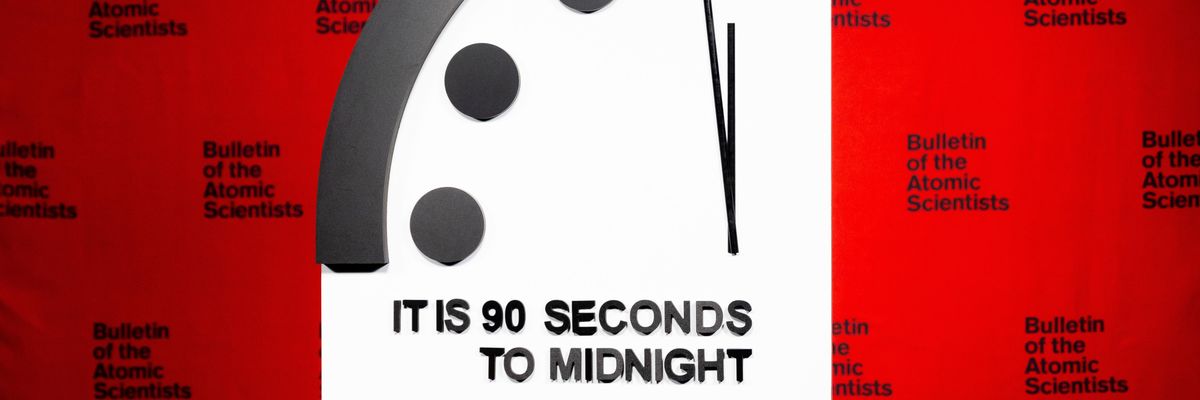
The Doomsday Clock was set at 90 seconds to midnight on January 24, 2023.
"The Doomsday Clock is sounding an alarm for the whole of humanity," said the Elders chair. "We are on the brink of a precipice. But our leaders are not acting at sufficient speed or scale to secure a peaceful and liveable planet."
"We are living in a time of unprecedented danger, and the Doomsday Clock time reflects that reality."
That's what Bulletin of the Atomic Scientists president and CEO Rachel Bronson said in a statement Tuesday about the historic symbol being set at 90 seconds to midnight, or global catastrophe, after three years at 100 seconds to midnight.
As the bulletin's annual statement explains, the clock—created in 1947—has reached its current position due to "an exceedingly dangerous nuclear situation," largely from Russia's war on Ukraine; inadequate global action to tackle the climate emergency; a "daunting array" of biological threats, exemplified by the Covid-19 pandemic; and "disruptive" technologies enabling the spread of disinformation.
"90 seconds to midnight is the closest the clock has ever been set to midnight, and it's a decision our experts do not take lightly," Bronson noted. "The U.S. government, its NATO allies, and Ukraine have a multitude of channels for dialogue; we urge leaders to explore all of them to their fullest ability to turn back the clock."
Watch the full announcement:
While the nearly yearlong Russian invasion—with fighting over a nuclear power plant and thinly veiled threats of using weapons of mass destruction—is a primary reason humanity is now closer than ever to apocalypse, experts from across the globe emphasized that it's far from the only threat.
The Elders chair Mary Robinson, a former president of Ireland and U.N. high commissioner for human rights, stressed that "the Doomsday Clock is sounding an alarm for the whole of humanity. We are on the brink of a precipice. But our leaders are not acting at sufficient speed or scale to secure a peaceful and liveable planet."
"From cutting carbon emissions to strengthening arms control treaties and investing in pandemic preparedness, we know what needs to be done," she said. "The science is clear, but the political will is lacking. This must change in 2023 if we are to avert catastrophe. We are facing multiple, existential crises. Leaders need a crisis mindset."
Dear Common Dreams reader, It’s been nearly 30 years since I co-founded Common Dreams with my late wife, Lina Newhouser. We had the radical notion that journalism should serve the public good, not corporate profits. It was clear to us from the outset what it would take to build such a project. No paid advertisements. No corporate sponsors. No millionaire publisher telling us what to think or do. Many people said we wouldn't last a year, but we proved those doubters wrong. Together with a tremendous team of journalists and dedicated staff, we built an independent media outlet free from the constraints of profits and corporate control. Our mission has always been simple: To inform. To inspire. To ignite change for the common good. Building Common Dreams was not easy. Our survival was never guaranteed. When you take on the most powerful forces—Wall Street greed, fossil fuel industry destruction, Big Tech lobbyists, and uber-rich oligarchs who have spent billions upon billions rigging the economy and democracy in their favor—the only bulwark you have is supporters who believe in your work. But here’s the urgent message from me today. It's never been this bad out there. And it's never been this hard to keep us going. At the very moment Common Dreams is most needed, the threats we face are intensifying. We need your support now more than ever. We don't accept corporate advertising and never will. We don't have a paywall because we don't think people should be blocked from critical news based on their ability to pay. Everything we do is funded by the donations of readers like you. When everyone does the little they can afford, we are strong. But if that support retreats or dries up, so do we. Will you donate now to make sure Common Dreams not only survives but thrives? —Craig Brown, Co-founder |
"We are living in a time of unprecedented danger, and the Doomsday Clock time reflects that reality."
That's what Bulletin of the Atomic Scientists president and CEO Rachel Bronson said in a statement Tuesday about the historic symbol being set at 90 seconds to midnight, or global catastrophe, after three years at 100 seconds to midnight.
As the bulletin's annual statement explains, the clock—created in 1947—has reached its current position due to "an exceedingly dangerous nuclear situation," largely from Russia's war on Ukraine; inadequate global action to tackle the climate emergency; a "daunting array" of biological threats, exemplified by the Covid-19 pandemic; and "disruptive" technologies enabling the spread of disinformation.
"90 seconds to midnight is the closest the clock has ever been set to midnight, and it's a decision our experts do not take lightly," Bronson noted. "The U.S. government, its NATO allies, and Ukraine have a multitude of channels for dialogue; we urge leaders to explore all of them to their fullest ability to turn back the clock."
Watch the full announcement:
While the nearly yearlong Russian invasion—with fighting over a nuclear power plant and thinly veiled threats of using weapons of mass destruction—is a primary reason humanity is now closer than ever to apocalypse, experts from across the globe emphasized that it's far from the only threat.
The Elders chair Mary Robinson, a former president of Ireland and U.N. high commissioner for human rights, stressed that "the Doomsday Clock is sounding an alarm for the whole of humanity. We are on the brink of a precipice. But our leaders are not acting at sufficient speed or scale to secure a peaceful and liveable planet."
"From cutting carbon emissions to strengthening arms control treaties and investing in pandemic preparedness, we know what needs to be done," she said. "The science is clear, but the political will is lacking. This must change in 2023 if we are to avert catastrophe. We are facing multiple, existential crises. Leaders need a crisis mindset."
"We are living in a time of unprecedented danger, and the Doomsday Clock time reflects that reality."
That's what Bulletin of the Atomic Scientists president and CEO Rachel Bronson said in a statement Tuesday about the historic symbol being set at 90 seconds to midnight, or global catastrophe, after three years at 100 seconds to midnight.
As the bulletin's annual statement explains, the clock—created in 1947—has reached its current position due to "an exceedingly dangerous nuclear situation," largely from Russia's war on Ukraine; inadequate global action to tackle the climate emergency; a "daunting array" of biological threats, exemplified by the Covid-19 pandemic; and "disruptive" technologies enabling the spread of disinformation.
"90 seconds to midnight is the closest the clock has ever been set to midnight, and it's a decision our experts do not take lightly," Bronson noted. "The U.S. government, its NATO allies, and Ukraine have a multitude of channels for dialogue; we urge leaders to explore all of them to their fullest ability to turn back the clock."
Watch the full announcement:
While the nearly yearlong Russian invasion—with fighting over a nuclear power plant and thinly veiled threats of using weapons of mass destruction—is a primary reason humanity is now closer than ever to apocalypse, experts from across the globe emphasized that it's far from the only threat.
The Elders chair Mary Robinson, a former president of Ireland and U.N. high commissioner for human rights, stressed that "the Doomsday Clock is sounding an alarm for the whole of humanity. We are on the brink of a precipice. But our leaders are not acting at sufficient speed or scale to secure a peaceful and liveable planet."
"From cutting carbon emissions to strengthening arms control treaties and investing in pandemic preparedness, we know what needs to be done," she said. "The science is clear, but the political will is lacking. This must change in 2023 if we are to avert catastrophe. We are facing multiple, existential crises. Leaders need a crisis mindset."