SUBSCRIBE TO OUR FREE NEWSLETTER
Daily news & progressive opinion—funded by the people, not the corporations—delivered straight to your inbox.
5
#000000
#FFFFFF
To donate by check, phone, or other method, see our More Ways to Give page.
Daily news & progressive opinion—funded by the people, not the corporations—delivered straight to your inbox.
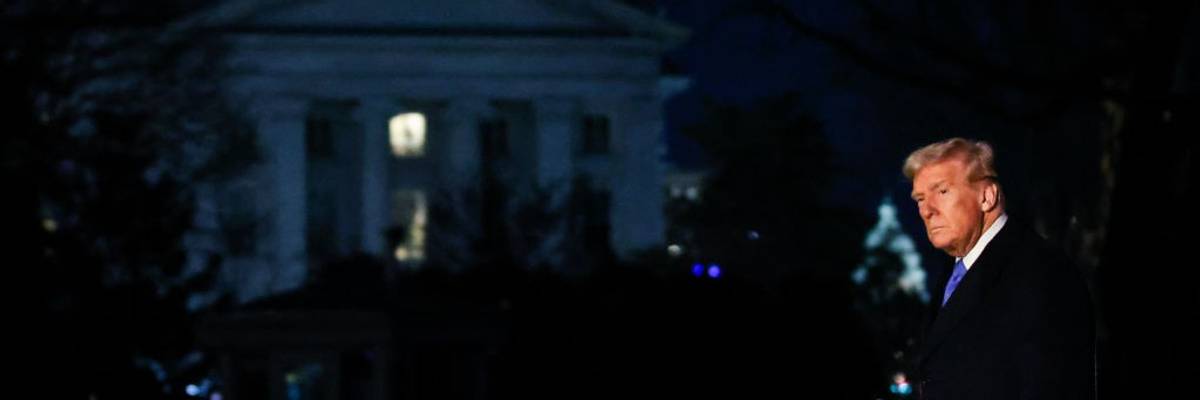
U.S. President Donald Trump walks to the White House on March 9, 2025.
"While a recession may not be fully baked into the cards at this point, the risk is evident and it's almost entirely coming from Donald Trump's policies."
As U.S. financial markets continued their downward spiral on Monday amid rapidly mounting concerns about the impacts of President Donald Trump's erratic and destructive tariff policies, one economist argued that the president has almost single-handedly engineered economic conditions that could result in a recession in the near future.
"Past recessions have been the result of policy errors or disasters," Dean Baker, senior economist at the Center for Economic and Policy Research, wrote Monday. "The most typical policy error is when the Federal Reserve Board raises interest rates too much to counter inflation. That was clearly the story in the 1974-75 recession as well as the 1980-82 double-dip recession."
"Then we have recessions caused by collapsing financial bubbles, the 2001 recession following the collapse of the stock bubble and the 2008-09 recession following the collapse of the housing bubble. And of course, we had the 2020 recession because of the Covid pandemic," he added. "But now Donald Trump is threatening us with a recession, not because of something that is any way unavoidable, but rather because as president he has the power to bring on a recession."
Baker pointed specifically to Trump's decision to impose sweeping tariffs on imports from Canada, Mexico, and China, which the economist estimates will cost Americans roughly $2,000 per household as companies push the costs of the tariffs onto consumers in the form of higher prices.
Trump is going to give us a recession, because he can cepr.net/publications...
[image or embed]
— Dean Baker (@deanbaker13.bsky.social) March 10, 2025 at 12:04 PM
Retaliatory measures are also likely to inflict pain on Americans: On Monday, Ontario announced it would charge 25% more for the electricity it provides to Minnesota, New York, and Michigan in response to Trump's tariffs on Canadian imports, a move that's expected to hike electricity bills significantly for ratepayers in those states.
China, meanwhile, hit back at Trump Monday with an additional 15% tariff on U.S. farm products, including chicken, pork, soybeans, and beef.
Trump's tariff policies, and the widespread confusion surrounding their implementation, have sparked a sell-off on Wall Street and broader fears about the state of the U.S. economy as the labor market shows signs of stalling and consumer confidence plunges.
"While a recession may not be fully baked into the cards at this point, the risk is evident and it's almost entirely coming from Donald Trump's policies," Baker argued, noting that while the recession threat is "first and foremost" driven by tariffs, they "are just one possible route."
"The other is Elon Musk's DOGE team attack on the government. If there was ever any doubt, it is now clear that this outfit has nothing to do with increasing government efficiency," Baker wrote. "The direct impact of Musk's job cuts on both the budget and the economy is likely to be small. The bigger impact is the uncertainty they have created in large sectors of the economy."
"In short, Donald Trump has good reasons for telling us that his MAGA policies might give us a recession," he added. "It's hard to know how bad this recession would be, but it will definitely be the 'Donald J. Trump recession.'"
"Will the Trump slump turn into a recession? How will Trump lie and cheat his way out of it? Stay tuned."
Baker's assessment came a day after Trump declined to rule out the possibility of an economic recession in the U.S. this year and downplayed the effects of his tariffs, claiming without a shred of evidence that they will make the country "so rich you're not going to know where to spend all that money."
Trump previously insisted that the U.S. stock sell-off was attributable not to his chaotic tariff announcements, but to "globalists that see how rich our country is going to be and they don't like it."
Former U.S. Labor Secretary Robert Reich wrote Monday that just seven weeks after Trump's inauguration, "the bottom is falling out" of the U.S. economy.
"Stocks are plunging. Treasury yields are falling. Consumer confidence is dropping. Inflation is picking up," Reich wrote. "The cost of living—the single biggest problem identified by consumers over the last several years—is going up, not down. Trump's tariffs on steel and aluminum, and his threatened 25% tariffs on Canada and Mexico, are playing havoc with supply chains inside and outside America."
"Even before this Trump slump, only the richest 10% of Americans had enough purchasing power to keep the economy going with their spending. The bottom 90%—including most Trump voters—were barely getting by. The next eighteen months could be rough on millions of people," he continued. "Will the Trump slump turn into a recession? How will Trump lie and cheat his way out of it? Stay tuned."
Dear Common Dreams reader, It’s been nearly 30 years since I co-founded Common Dreams with my late wife, Lina Newhouser. We had the radical notion that journalism should serve the public good, not corporate profits. It was clear to us from the outset what it would take to build such a project. No paid advertisements. No corporate sponsors. No millionaire publisher telling us what to think or do. Many people said we wouldn't last a year, but we proved those doubters wrong. Together with a tremendous team of journalists and dedicated staff, we built an independent media outlet free from the constraints of profits and corporate control. Our mission has always been simple: To inform. To inspire. To ignite change for the common good. Building Common Dreams was not easy. Our survival was never guaranteed. When you take on the most powerful forces—Wall Street greed, fossil fuel industry destruction, Big Tech lobbyists, and uber-rich oligarchs who have spent billions upon billions rigging the economy and democracy in their favor—the only bulwark you have is supporters who believe in your work. But here’s the urgent message from me today. It's never been this bad out there. And it's never been this hard to keep us going. At the very moment Common Dreams is most needed, the threats we face are intensifying. We need your support now more than ever. We don't accept corporate advertising and never will. We don't have a paywall because we don't think people should be blocked from critical news based on their ability to pay. Everything we do is funded by the donations of readers like you. When everyone does the little they can afford, we are strong. But if that support retreats or dries up, so do we. Will you donate now to make sure Common Dreams not only survives but thrives? —Craig Brown, Co-founder |
As U.S. financial markets continued their downward spiral on Monday amid rapidly mounting concerns about the impacts of President Donald Trump's erratic and destructive tariff policies, one economist argued that the president has almost single-handedly engineered economic conditions that could result in a recession in the near future.
"Past recessions have been the result of policy errors or disasters," Dean Baker, senior economist at the Center for Economic and Policy Research, wrote Monday. "The most typical policy error is when the Federal Reserve Board raises interest rates too much to counter inflation. That was clearly the story in the 1974-75 recession as well as the 1980-82 double-dip recession."
"Then we have recessions caused by collapsing financial bubbles, the 2001 recession following the collapse of the stock bubble and the 2008-09 recession following the collapse of the housing bubble. And of course, we had the 2020 recession because of the Covid pandemic," he added. "But now Donald Trump is threatening us with a recession, not because of something that is any way unavoidable, but rather because as president he has the power to bring on a recession."
Baker pointed specifically to Trump's decision to impose sweeping tariffs on imports from Canada, Mexico, and China, which the economist estimates will cost Americans roughly $2,000 per household as companies push the costs of the tariffs onto consumers in the form of higher prices.
Trump is going to give us a recession, because he can cepr.net/publications...
[image or embed]
— Dean Baker (@deanbaker13.bsky.social) March 10, 2025 at 12:04 PM
Retaliatory measures are also likely to inflict pain on Americans: On Monday, Ontario announced it would charge 25% more for the electricity it provides to Minnesota, New York, and Michigan in response to Trump's tariffs on Canadian imports, a move that's expected to hike electricity bills significantly for ratepayers in those states.
China, meanwhile, hit back at Trump Monday with an additional 15% tariff on U.S. farm products, including chicken, pork, soybeans, and beef.
Trump's tariff policies, and the widespread confusion surrounding their implementation, have sparked a sell-off on Wall Street and broader fears about the state of the U.S. economy as the labor market shows signs of stalling and consumer confidence plunges.
"While a recession may not be fully baked into the cards at this point, the risk is evident and it's almost entirely coming from Donald Trump's policies," Baker argued, noting that while the recession threat is "first and foremost" driven by tariffs, they "are just one possible route."
"The other is Elon Musk's DOGE team attack on the government. If there was ever any doubt, it is now clear that this outfit has nothing to do with increasing government efficiency," Baker wrote. "The direct impact of Musk's job cuts on both the budget and the economy is likely to be small. The bigger impact is the uncertainty they have created in large sectors of the economy."
"In short, Donald Trump has good reasons for telling us that his MAGA policies might give us a recession," he added. "It's hard to know how bad this recession would be, but it will definitely be the 'Donald J. Trump recession.'"
"Will the Trump slump turn into a recession? How will Trump lie and cheat his way out of it? Stay tuned."
Baker's assessment came a day after Trump declined to rule out the possibility of an economic recession in the U.S. this year and downplayed the effects of his tariffs, claiming without a shred of evidence that they will make the country "so rich you're not going to know where to spend all that money."
Trump previously insisted that the U.S. stock sell-off was attributable not to his chaotic tariff announcements, but to "globalists that see how rich our country is going to be and they don't like it."
Former U.S. Labor Secretary Robert Reich wrote Monday that just seven weeks after Trump's inauguration, "the bottom is falling out" of the U.S. economy.
"Stocks are plunging. Treasury yields are falling. Consumer confidence is dropping. Inflation is picking up," Reich wrote. "The cost of living—the single biggest problem identified by consumers over the last several years—is going up, not down. Trump's tariffs on steel and aluminum, and his threatened 25% tariffs on Canada and Mexico, are playing havoc with supply chains inside and outside America."
"Even before this Trump slump, only the richest 10% of Americans had enough purchasing power to keep the economy going with their spending. The bottom 90%—including most Trump voters—were barely getting by. The next eighteen months could be rough on millions of people," he continued. "Will the Trump slump turn into a recession? How will Trump lie and cheat his way out of it? Stay tuned."
As U.S. financial markets continued their downward spiral on Monday amid rapidly mounting concerns about the impacts of President Donald Trump's erratic and destructive tariff policies, one economist argued that the president has almost single-handedly engineered economic conditions that could result in a recession in the near future.
"Past recessions have been the result of policy errors or disasters," Dean Baker, senior economist at the Center for Economic and Policy Research, wrote Monday. "The most typical policy error is when the Federal Reserve Board raises interest rates too much to counter inflation. That was clearly the story in the 1974-75 recession as well as the 1980-82 double-dip recession."
"Then we have recessions caused by collapsing financial bubbles, the 2001 recession following the collapse of the stock bubble and the 2008-09 recession following the collapse of the housing bubble. And of course, we had the 2020 recession because of the Covid pandemic," he added. "But now Donald Trump is threatening us with a recession, not because of something that is any way unavoidable, but rather because as president he has the power to bring on a recession."
Baker pointed specifically to Trump's decision to impose sweeping tariffs on imports from Canada, Mexico, and China, which the economist estimates will cost Americans roughly $2,000 per household as companies push the costs of the tariffs onto consumers in the form of higher prices.
Trump is going to give us a recession, because he can cepr.net/publications...
[image or embed]
— Dean Baker (@deanbaker13.bsky.social) March 10, 2025 at 12:04 PM
Retaliatory measures are also likely to inflict pain on Americans: On Monday, Ontario announced it would charge 25% more for the electricity it provides to Minnesota, New York, and Michigan in response to Trump's tariffs on Canadian imports, a move that's expected to hike electricity bills significantly for ratepayers in those states.
China, meanwhile, hit back at Trump Monday with an additional 15% tariff on U.S. farm products, including chicken, pork, soybeans, and beef.
Trump's tariff policies, and the widespread confusion surrounding their implementation, have sparked a sell-off on Wall Street and broader fears about the state of the U.S. economy as the labor market shows signs of stalling and consumer confidence plunges.
"While a recession may not be fully baked into the cards at this point, the risk is evident and it's almost entirely coming from Donald Trump's policies," Baker argued, noting that while the recession threat is "first and foremost" driven by tariffs, they "are just one possible route."
"The other is Elon Musk's DOGE team attack on the government. If there was ever any doubt, it is now clear that this outfit has nothing to do with increasing government efficiency," Baker wrote. "The direct impact of Musk's job cuts on both the budget and the economy is likely to be small. The bigger impact is the uncertainty they have created in large sectors of the economy."
"In short, Donald Trump has good reasons for telling us that his MAGA policies might give us a recession," he added. "It's hard to know how bad this recession would be, but it will definitely be the 'Donald J. Trump recession.'"
"Will the Trump slump turn into a recession? How will Trump lie and cheat his way out of it? Stay tuned."
Baker's assessment came a day after Trump declined to rule out the possibility of an economic recession in the U.S. this year and downplayed the effects of his tariffs, claiming without a shred of evidence that they will make the country "so rich you're not going to know where to spend all that money."
Trump previously insisted that the U.S. stock sell-off was attributable not to his chaotic tariff announcements, but to "globalists that see how rich our country is going to be and they don't like it."
Former U.S. Labor Secretary Robert Reich wrote Monday that just seven weeks after Trump's inauguration, "the bottom is falling out" of the U.S. economy.
"Stocks are plunging. Treasury yields are falling. Consumer confidence is dropping. Inflation is picking up," Reich wrote. "The cost of living—the single biggest problem identified by consumers over the last several years—is going up, not down. Trump's tariffs on steel and aluminum, and his threatened 25% tariffs on Canada and Mexico, are playing havoc with supply chains inside and outside America."
"Even before this Trump slump, only the richest 10% of Americans had enough purchasing power to keep the economy going with their spending. The bottom 90%—including most Trump voters—were barely getting by. The next eighteen months could be rough on millions of people," he continued. "Will the Trump slump turn into a recession? How will Trump lie and cheat his way out of it? Stay tuned."