SUBSCRIBE TO OUR FREE NEWSLETTER
Daily news & progressive opinion—funded by the people, not the corporations—delivered straight to your inbox.
5
#000000
#FFFFFF
To donate by check, phone, or other method, see our More Ways to Give page.
Daily news & progressive opinion—funded by the people, not the corporations—delivered straight to your inbox.
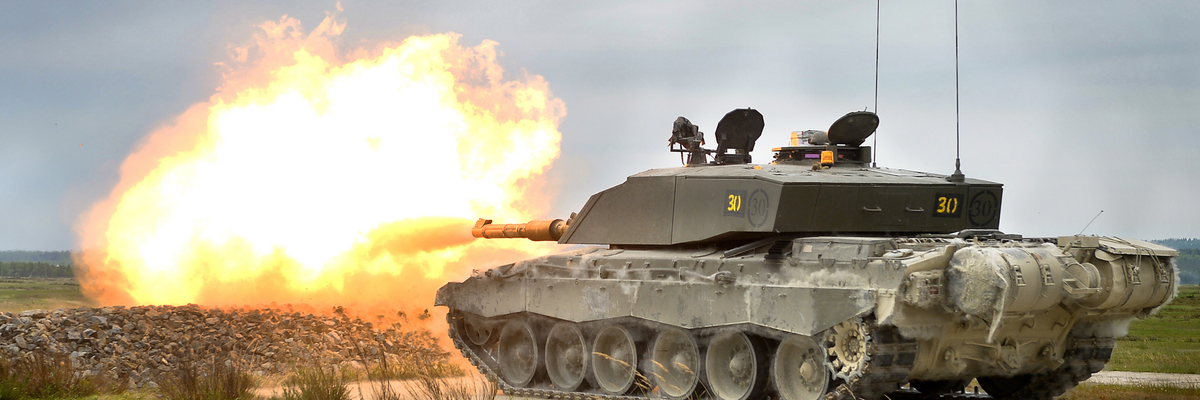
A Challenger 2 main battle tank takes part in a live-fire training exercise in Germany.
"Look at Fallujah. Look at Yugoslavia. Long after the end of the Ukraine war, the use of depleted uranium will give Ukrainians cancer and birth defects for decades," said one journalist.
The Biden administration is expected to equip Ukrainian homeland defenders with armor-piercing depleted uranium munitions for their U.S.-supplied Abrams main battle tanks, The Wall Street Journal reported Tuesday, prompting Russian President Vladimir Putin to threaten to retaliate with DU rounds—which are linked to birth defects, miscarriages, and cancer.
Citing an unnamed senior Biden administration official, the Journal reported that "there appear to be no major obstacles to approving" the shipment of the highly controversial ammunition to Ukrainian forces as they launch a counteroffensive against Russian troops entrenched along a vast front in the eastern and southern regions of the country.
The new reporting comes four months after The Redacted's Dan Cohen reported the U.S. would send DU rounds to Ukraine.
In February, a top British defense official announced that the United Kingdom would supply Ukrainian forces with DU rounds, dismissing warnings from Moscow that the Russian government would regard the deployment of such weapons as an act of nuclear war.
Reacting to news that the U.S. will likely supply Ukraine with DU munitions, Putin said Tuesday that "we have many such weapons, and if they use them, we will also reserve the right to use similar munitions," according to the state news agency TASS.
"There's nothing good about it, but, if need be, we can do it," he added. "We don't need to do it."
The Journal report prompted warnings from anti-war voices about the dangers of DU munitions.
"If you love Ukraine, if you care about Ukraine, depleted uranium is the last thing you would tell them to use," British journalist Richard Medhurst said on his video podcast Tuesday. "If you look at what the United States has done, everywhere they've used depleted uranium, it's like dropping a nuclear bomb."
Medhurst added that in Fallujah, Iraq—where U.S. forces used DU rounds during two attempts to capture the city in 2004—"you have higher rates of birth defects and congenital heart disease... than you did in Hiroshima and Nagasaki."
DU rounds are highly effective at penetrating the armor of most modern tanks and armored fighting vehicles. The U.S. Abrams, British Challenger 2, and German Leopard 2 main battle tanks, along with U.S. Bradley Fighting Vehicles that are being sent to Ukraine, can all fire DU munitions. The ammunition can also be fired from warplanes or field artillery.
However, exploding DU shells produce radioactive dust that contaminates soil, water, and air for many years after their use. U.S. Army training manuals caution that DU contamination "will make food and water unsafe for consumption" and require soldiers to wear protective clothing when in or near contaminated areas.
U.S. and allied forces used DU munitions during the 1991 and 2003-11 invasions of Iraq, and in Syria during the war against Islamic State militants. Miscarriages, birth defects, and cancers soared in Iraq after both wars.
According to one study, more than half of the babies born in Fallujah between 2007 and 2010 had birth defects. Among pregnant women in the study, over 45% experienced miscarriages in the two-year period following the battles for Fallujah. Geiger counter measurements of DU-contaminated sites in Iraqi cities have consistently shown radiation levels 1,000 to 1,900 times greater than normal.
The U.S.-led NATO coalition that waged the 1999 air war against Yugoslavia also used DU munitions, which experts believe are responsible for a surge in leukemia in the region, both among the local population and foreign troops deployed in the war zone.
Peace groups have long campaigned for a ban on DU munitions. Last September, the United Nations General Assembly approved an Indonesian draft resolution urging further research of the "health risks and environmental impact" of DU weapons and calling for a "cautionary approach" to their use.
The resolution was approved by 147 nations. The U.S., U.K., France, and Israel voted against the proposal.
Dear Common Dreams reader, It’s been nearly 30 years since I co-founded Common Dreams with my late wife, Lina Newhouser. We had the radical notion that journalism should serve the public good, not corporate profits. It was clear to us from the outset what it would take to build such a project. No paid advertisements. No corporate sponsors. No millionaire publisher telling us what to think or do. Many people said we wouldn't last a year, but we proved those doubters wrong. Together with a tremendous team of journalists and dedicated staff, we built an independent media outlet free from the constraints of profits and corporate control. Our mission has always been simple: To inform. To inspire. To ignite change for the common good. Building Common Dreams was not easy. Our survival was never guaranteed. When you take on the most powerful forces—Wall Street greed, fossil fuel industry destruction, Big Tech lobbyists, and uber-rich oligarchs who have spent billions upon billions rigging the economy and democracy in their favor—the only bulwark you have is supporters who believe in your work. But here’s the urgent message from me today. It's never been this bad out there. And it's never been this hard to keep us going. At the very moment Common Dreams is most needed, the threats we face are intensifying. We need your support now more than ever. We don't accept corporate advertising and never will. We don't have a paywall because we don't think people should be blocked from critical news based on their ability to pay. Everything we do is funded by the donations of readers like you. When everyone does the little they can afford, we are strong. But if that support retreats or dries up, so do we. Will you donate now to make sure Common Dreams not only survives but thrives? —Craig Brown, Co-founder |
The Biden administration is expected to equip Ukrainian homeland defenders with armor-piercing depleted uranium munitions for their U.S.-supplied Abrams main battle tanks, The Wall Street Journal reported Tuesday, prompting Russian President Vladimir Putin to threaten to retaliate with DU rounds—which are linked to birth defects, miscarriages, and cancer.
Citing an unnamed senior Biden administration official, the Journal reported that "there appear to be no major obstacles to approving" the shipment of the highly controversial ammunition to Ukrainian forces as they launch a counteroffensive against Russian troops entrenched along a vast front in the eastern and southern regions of the country.
The new reporting comes four months after The Redacted's Dan Cohen reported the U.S. would send DU rounds to Ukraine.
In February, a top British defense official announced that the United Kingdom would supply Ukrainian forces with DU rounds, dismissing warnings from Moscow that the Russian government would regard the deployment of such weapons as an act of nuclear war.
Reacting to news that the U.S. will likely supply Ukraine with DU munitions, Putin said Tuesday that "we have many such weapons, and if they use them, we will also reserve the right to use similar munitions," according to the state news agency TASS.
"There's nothing good about it, but, if need be, we can do it," he added. "We don't need to do it."
The Journal report prompted warnings from anti-war voices about the dangers of DU munitions.
"If you love Ukraine, if you care about Ukraine, depleted uranium is the last thing you would tell them to use," British journalist Richard Medhurst said on his video podcast Tuesday. "If you look at what the United States has done, everywhere they've used depleted uranium, it's like dropping a nuclear bomb."
Medhurst added that in Fallujah, Iraq—where U.S. forces used DU rounds during two attempts to capture the city in 2004—"you have higher rates of birth defects and congenital heart disease... than you did in Hiroshima and Nagasaki."
DU rounds are highly effective at penetrating the armor of most modern tanks and armored fighting vehicles. The U.S. Abrams, British Challenger 2, and German Leopard 2 main battle tanks, along with U.S. Bradley Fighting Vehicles that are being sent to Ukraine, can all fire DU munitions. The ammunition can also be fired from warplanes or field artillery.
However, exploding DU shells produce radioactive dust that contaminates soil, water, and air for many years after their use. U.S. Army training manuals caution that DU contamination "will make food and water unsafe for consumption" and require soldiers to wear protective clothing when in or near contaminated areas.
U.S. and allied forces used DU munitions during the 1991 and 2003-11 invasions of Iraq, and in Syria during the war against Islamic State militants. Miscarriages, birth defects, and cancers soared in Iraq after both wars.
According to one study, more than half of the babies born in Fallujah between 2007 and 2010 had birth defects. Among pregnant women in the study, over 45% experienced miscarriages in the two-year period following the battles for Fallujah. Geiger counter measurements of DU-contaminated sites in Iraqi cities have consistently shown radiation levels 1,000 to 1,900 times greater than normal.
The U.S.-led NATO coalition that waged the 1999 air war against Yugoslavia also used DU munitions, which experts believe are responsible for a surge in leukemia in the region, both among the local population and foreign troops deployed in the war zone.
Peace groups have long campaigned for a ban on DU munitions. Last September, the United Nations General Assembly approved an Indonesian draft resolution urging further research of the "health risks and environmental impact" of DU weapons and calling for a "cautionary approach" to their use.
The resolution was approved by 147 nations. The U.S., U.K., France, and Israel voted against the proposal.
The Biden administration is expected to equip Ukrainian homeland defenders with armor-piercing depleted uranium munitions for their U.S.-supplied Abrams main battle tanks, The Wall Street Journal reported Tuesday, prompting Russian President Vladimir Putin to threaten to retaliate with DU rounds—which are linked to birth defects, miscarriages, and cancer.
Citing an unnamed senior Biden administration official, the Journal reported that "there appear to be no major obstacles to approving" the shipment of the highly controversial ammunition to Ukrainian forces as they launch a counteroffensive against Russian troops entrenched along a vast front in the eastern and southern regions of the country.
The new reporting comes four months after The Redacted's Dan Cohen reported the U.S. would send DU rounds to Ukraine.
In February, a top British defense official announced that the United Kingdom would supply Ukrainian forces with DU rounds, dismissing warnings from Moscow that the Russian government would regard the deployment of such weapons as an act of nuclear war.
Reacting to news that the U.S. will likely supply Ukraine with DU munitions, Putin said Tuesday that "we have many such weapons, and if they use them, we will also reserve the right to use similar munitions," according to the state news agency TASS.
"There's nothing good about it, but, if need be, we can do it," he added. "We don't need to do it."
The Journal report prompted warnings from anti-war voices about the dangers of DU munitions.
"If you love Ukraine, if you care about Ukraine, depleted uranium is the last thing you would tell them to use," British journalist Richard Medhurst said on his video podcast Tuesday. "If you look at what the United States has done, everywhere they've used depleted uranium, it's like dropping a nuclear bomb."
Medhurst added that in Fallujah, Iraq—where U.S. forces used DU rounds during two attempts to capture the city in 2004—"you have higher rates of birth defects and congenital heart disease... than you did in Hiroshima and Nagasaki."
DU rounds are highly effective at penetrating the armor of most modern tanks and armored fighting vehicles. The U.S. Abrams, British Challenger 2, and German Leopard 2 main battle tanks, along with U.S. Bradley Fighting Vehicles that are being sent to Ukraine, can all fire DU munitions. The ammunition can also be fired from warplanes or field artillery.
However, exploding DU shells produce radioactive dust that contaminates soil, water, and air for many years after their use. U.S. Army training manuals caution that DU contamination "will make food and water unsafe for consumption" and require soldiers to wear protective clothing when in or near contaminated areas.
U.S. and allied forces used DU munitions during the 1991 and 2003-11 invasions of Iraq, and in Syria during the war against Islamic State militants. Miscarriages, birth defects, and cancers soared in Iraq after both wars.
According to one study, more than half of the babies born in Fallujah between 2007 and 2010 had birth defects. Among pregnant women in the study, over 45% experienced miscarriages in the two-year period following the battles for Fallujah. Geiger counter measurements of DU-contaminated sites in Iraqi cities have consistently shown radiation levels 1,000 to 1,900 times greater than normal.
The U.S.-led NATO coalition that waged the 1999 air war against Yugoslavia also used DU munitions, which experts believe are responsible for a surge in leukemia in the region, both among the local population and foreign troops deployed in the war zone.
Peace groups have long campaigned for a ban on DU munitions. Last September, the United Nations General Assembly approved an Indonesian draft resolution urging further research of the "health risks and environmental impact" of DU weapons and calling for a "cautionary approach" to their use.
The resolution was approved by 147 nations. The U.S., U.K., France, and Israel voted against the proposal.