SUBSCRIBE TO OUR FREE NEWSLETTER
Daily news & progressive opinion—funded by the people, not the corporations—delivered straight to your inbox.
5
#000000
#FFFFFF
To donate by check, phone, or other method, see our More Ways to Give page.
Daily news & progressive opinion—funded by the people, not the corporations—delivered straight to your inbox.

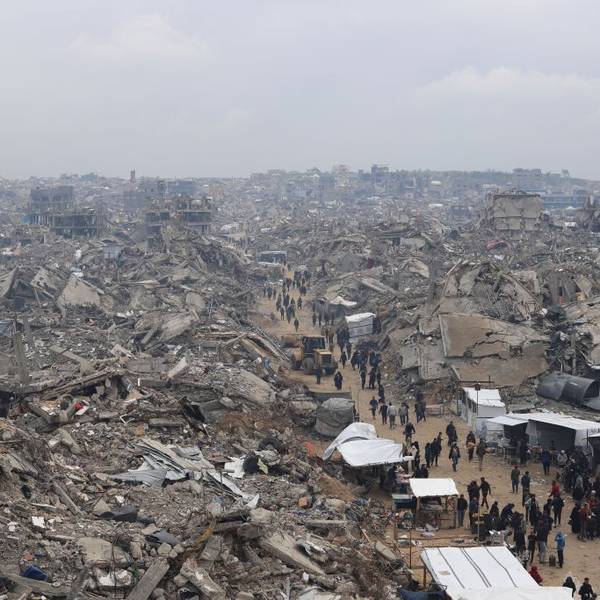
Palestinians inspect the damage to the Al-Sussi Mosque and their homes following Israeli air strikes in the Al-Shati Palestinian refugee camp on October 9, 2023 in Gaza City.
"As countries need to replenish their weapons, we do think defense companies will do very well," said one expert.
"War is good for business."
That's what one defense executive said at a London arms conference last month, and what the stock market reflected on Monday, as Israel blockaded and bombarded the Gaza Strip—bombing the occupied Palestinian territory's main university, residential buildings, a refugee camp, and a major hospital—in response to Hamas' weekend attack that killed hundreds of Israelis.
The United States, which already gives Israel $3.8 billion in annual military assistance, is now preparing to send additional weaponry and other support. Meanwhile, the stocks of U.S. and European firms that make money off of war soared on Monday.
U.S. companies including Lockheed Martin, Northrop Grumman, and RTX—previously known as Raytheon—were all affected, as were top British, French, Germany, and Italian firms, according to The Wall Street Journal.
Fox Business reported that "shares of General Dynamics, which makes submarines and combat vehicles, rose the most since March 2020 when it gained over 9%."
"Lockheed Martin's stock jump Monday was the biggest for the U.S.' largest defense contractor on a non-earnings day since March 2020, narrowly topping the gains it notched immediately after Russia launched its full-scale invasion of Ukraine," Forbes noted. "Northrop Grumman shares also had their best day since 2020."
Barron's pointed out that "separately, Lockheed's board on Friday approved the expansion of Lockheed's stock repurchase program by $6 billion, and the company raised its quarterly dividend to $3.15 a share from $3."
Commenting on the bloodshed in Israel and Gaza over the past few days, Sameer Samana, senior global market strategist at Wells Fargo Investment Institute, told MarketWatch that "clearly it's a huge human tragedy."
"It seems like we're entering a different phase globally with respect to geopolitics," he added, with conflicts appearing more likely compared with recent decades. "As countries need to replenish their weapons, we do think defense companies will do very well."
Less than two months after Russia's invasion last year, William Hartung, a senior research fellow at the Quincy Institute for Responsible Statecraft, highlighted how such conflicts benefit the arms industry, writing for TomDispatch that "the war in Ukraine will indeed be a bonanza for the likes of Raytheon and Lockheed Martin."
"First of all, there will be the contracts to resupply weapons like Raytheon's Stinger anti-aircraft missile and the Raytheon/Lockheed Martin-produced Javelin anti-tank missile that Washington has already provided to Ukraine by the thousands," he explained. "The bigger stream of profits, however, will come from assured post-conflict increases in national security spending here and in Europe justified, at least in part, by the Russian invasion and the disaster that's followed."
Last December, in Forbes, Hartung warned against using the Russia-Ukraine war to permanently expand the weapons industry:
Plans that have been floated so far include building new weapons factories, dramatically boosting production of ammunition, anti-tank weapons, and other systems, and easing oversight of weapons procurement. These changes will come at a cost that over time will run into tens of billions of dollars above current spending plans, and possibly more—much more.
This drive to rapidly expand the size and reach of the military-industrial complex is both unnecessary and unwise. The rush to do so while reducing existing safeguards against waste and poor performance risks promoting price gouging and substandard production even as it ties up funds that could be used more effectively on other urgent priorities.
Oil prices also climbed on Monday in response to the violence in the Middle East.
The Associated Press explained that "the area under conflict is not home to major oil production, but fears that the fighting could spill into the politics around the crude market sent a barrel of U.S. oil up 4.1% to $86.16. Brent crude, the international standard, rose 3.9% to $87.91 per barrel."
Dear Common Dreams reader, It’s been nearly 30 years since I co-founded Common Dreams with my late wife, Lina Newhouser. We had the radical notion that journalism should serve the public good, not corporate profits. It was clear to us from the outset what it would take to build such a project. No paid advertisements. No corporate sponsors. No millionaire publisher telling us what to think or do. Many people said we wouldn't last a year, but we proved those doubters wrong. Together with a tremendous team of journalists and dedicated staff, we built an independent media outlet free from the constraints of profits and corporate control. Our mission has always been simple: To inform. To inspire. To ignite change for the common good. Building Common Dreams was not easy. Our survival was never guaranteed. When you take on the most powerful forces—Wall Street greed, fossil fuel industry destruction, Big Tech lobbyists, and uber-rich oligarchs who have spent billions upon billions rigging the economy and democracy in their favor—the only bulwark you have is supporters who believe in your work. But here’s the urgent message from me today. It's never been this bad out there. And it's never been this hard to keep us going. At the very moment Common Dreams is most needed, the threats we face are intensifying. We need your support now more than ever. We don't accept corporate advertising and never will. We don't have a paywall because we don't think people should be blocked from critical news based on their ability to pay. Everything we do is funded by the donations of readers like you. When everyone does the little they can afford, we are strong. But if that support retreats or dries up, so do we. Will you donate now to make sure Common Dreams not only survives but thrives? —Craig Brown, Co-founder |
"War is good for business."
That's what one defense executive said at a London arms conference last month, and what the stock market reflected on Monday, as Israel blockaded and bombarded the Gaza Strip—bombing the occupied Palestinian territory's main university, residential buildings, a refugee camp, and a major hospital—in response to Hamas' weekend attack that killed hundreds of Israelis.
The United States, which already gives Israel $3.8 billion in annual military assistance, is now preparing to send additional weaponry and other support. Meanwhile, the stocks of U.S. and European firms that make money off of war soared on Monday.
U.S. companies including Lockheed Martin, Northrop Grumman, and RTX—previously known as Raytheon—were all affected, as were top British, French, Germany, and Italian firms, according to The Wall Street Journal.
Fox Business reported that "shares of General Dynamics, which makes submarines and combat vehicles, rose the most since March 2020 when it gained over 9%."
"Lockheed Martin's stock jump Monday was the biggest for the U.S.' largest defense contractor on a non-earnings day since March 2020, narrowly topping the gains it notched immediately after Russia launched its full-scale invasion of Ukraine," Forbes noted. "Northrop Grumman shares also had their best day since 2020."
Barron's pointed out that "separately, Lockheed's board on Friday approved the expansion of Lockheed's stock repurchase program by $6 billion, and the company raised its quarterly dividend to $3.15 a share from $3."
Commenting on the bloodshed in Israel and Gaza over the past few days, Sameer Samana, senior global market strategist at Wells Fargo Investment Institute, told MarketWatch that "clearly it's a huge human tragedy."
"It seems like we're entering a different phase globally with respect to geopolitics," he added, with conflicts appearing more likely compared with recent decades. "As countries need to replenish their weapons, we do think defense companies will do very well."
Less than two months after Russia's invasion last year, William Hartung, a senior research fellow at the Quincy Institute for Responsible Statecraft, highlighted how such conflicts benefit the arms industry, writing for TomDispatch that "the war in Ukraine will indeed be a bonanza for the likes of Raytheon and Lockheed Martin."
"First of all, there will be the contracts to resupply weapons like Raytheon's Stinger anti-aircraft missile and the Raytheon/Lockheed Martin-produced Javelin anti-tank missile that Washington has already provided to Ukraine by the thousands," he explained. "The bigger stream of profits, however, will come from assured post-conflict increases in national security spending here and in Europe justified, at least in part, by the Russian invasion and the disaster that's followed."
Last December, in Forbes, Hartung warned against using the Russia-Ukraine war to permanently expand the weapons industry:
Plans that have been floated so far include building new weapons factories, dramatically boosting production of ammunition, anti-tank weapons, and other systems, and easing oversight of weapons procurement. These changes will come at a cost that over time will run into tens of billions of dollars above current spending plans, and possibly more—much more.
This drive to rapidly expand the size and reach of the military-industrial complex is both unnecessary and unwise. The rush to do so while reducing existing safeguards against waste and poor performance risks promoting price gouging and substandard production even as it ties up funds that could be used more effectively on other urgent priorities.
Oil prices also climbed on Monday in response to the violence in the Middle East.
The Associated Press explained that "the area under conflict is not home to major oil production, but fears that the fighting could spill into the politics around the crude market sent a barrel of U.S. oil up 4.1% to $86.16. Brent crude, the international standard, rose 3.9% to $87.91 per barrel."
"War is good for business."
That's what one defense executive said at a London arms conference last month, and what the stock market reflected on Monday, as Israel blockaded and bombarded the Gaza Strip—bombing the occupied Palestinian territory's main university, residential buildings, a refugee camp, and a major hospital—in response to Hamas' weekend attack that killed hundreds of Israelis.
The United States, which already gives Israel $3.8 billion in annual military assistance, is now preparing to send additional weaponry and other support. Meanwhile, the stocks of U.S. and European firms that make money off of war soared on Monday.
U.S. companies including Lockheed Martin, Northrop Grumman, and RTX—previously known as Raytheon—were all affected, as were top British, French, Germany, and Italian firms, according to The Wall Street Journal.
Fox Business reported that "shares of General Dynamics, which makes submarines and combat vehicles, rose the most since March 2020 when it gained over 9%."
"Lockheed Martin's stock jump Monday was the biggest for the U.S.' largest defense contractor on a non-earnings day since March 2020, narrowly topping the gains it notched immediately after Russia launched its full-scale invasion of Ukraine," Forbes noted. "Northrop Grumman shares also had their best day since 2020."
Barron's pointed out that "separately, Lockheed's board on Friday approved the expansion of Lockheed's stock repurchase program by $6 billion, and the company raised its quarterly dividend to $3.15 a share from $3."
Commenting on the bloodshed in Israel and Gaza over the past few days, Sameer Samana, senior global market strategist at Wells Fargo Investment Institute, told MarketWatch that "clearly it's a huge human tragedy."
"It seems like we're entering a different phase globally with respect to geopolitics," he added, with conflicts appearing more likely compared with recent decades. "As countries need to replenish their weapons, we do think defense companies will do very well."
Less than two months after Russia's invasion last year, William Hartung, a senior research fellow at the Quincy Institute for Responsible Statecraft, highlighted how such conflicts benefit the arms industry, writing for TomDispatch that "the war in Ukraine will indeed be a bonanza for the likes of Raytheon and Lockheed Martin."
"First of all, there will be the contracts to resupply weapons like Raytheon's Stinger anti-aircraft missile and the Raytheon/Lockheed Martin-produced Javelin anti-tank missile that Washington has already provided to Ukraine by the thousands," he explained. "The bigger stream of profits, however, will come from assured post-conflict increases in national security spending here and in Europe justified, at least in part, by the Russian invasion and the disaster that's followed."
Last December, in Forbes, Hartung warned against using the Russia-Ukraine war to permanently expand the weapons industry:
Plans that have been floated so far include building new weapons factories, dramatically boosting production of ammunition, anti-tank weapons, and other systems, and easing oversight of weapons procurement. These changes will come at a cost that over time will run into tens of billions of dollars above current spending plans, and possibly more—much more.
This drive to rapidly expand the size and reach of the military-industrial complex is both unnecessary and unwise. The rush to do so while reducing existing safeguards against waste and poor performance risks promoting price gouging and substandard production even as it ties up funds that could be used more effectively on other urgent priorities.
Oil prices also climbed on Monday in response to the violence in the Middle East.
The Associated Press explained that "the area under conflict is not home to major oil production, but fears that the fighting could spill into the politics around the crude market sent a barrel of U.S. oil up 4.1% to $86.16. Brent crude, the international standard, rose 3.9% to $87.91 per barrel."