SUBSCRIBE TO OUR FREE NEWSLETTER
Daily news & progressive opinion—funded by the people, not the corporations—delivered straight to your inbox.
5
#000000
#FFFFFF
To donate by check, phone, or other method, see our More Ways to Give page.
Daily news & progressive opinion—funded by the people, not the corporations—delivered straight to your inbox.
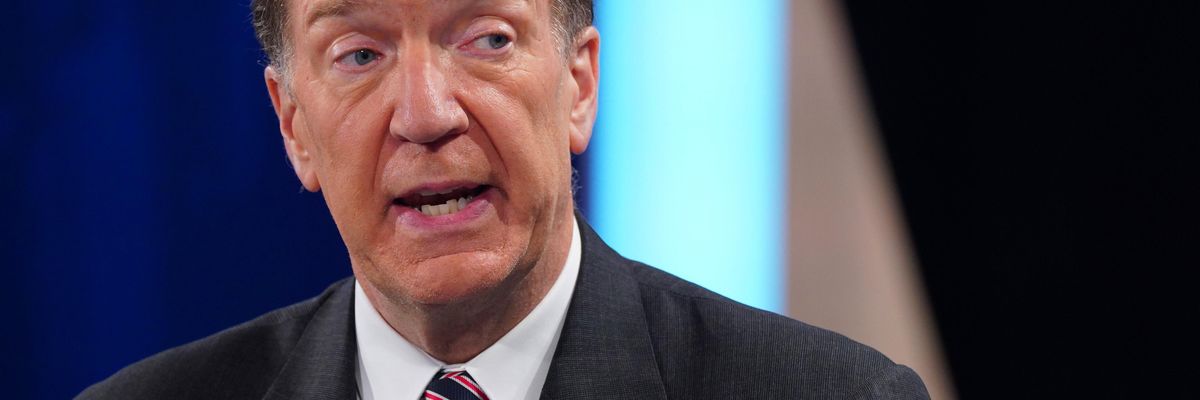
World Bank President David Malpass speaks at the Concordia Annual Summit on September 19, 2022 in New York City.
The move could open the way "for serious climate finance," said 350.org co-founder Bill McKibben.
In a move cheered by climate advocates, World Bank President David Malpass—who sparked outrage last year by refusing to affirm that burning fossil fuels is heating the planet—said Wednesday that he would step down from his post by the end of June, nearly a year ahead of schedule.
"Serving as president of the World Bank Group has been my enormous honor and privilege," Malpass said in a LinkedIn post announcing his decision. "We've worked hard together to reduce poverty, increase economic growth, reduce government debt burdens, and improve living standards across the full range of human development, including education, health, social protection and jobs, gender, and access to clean water and electricity."
Malpass—who was nominated by then-U.S. President Donald Trump in 2019—also touted "new records in financing levels, including climate financing."
However, climate campaigners and progressives noted Malpass' fossil-friendly tenure while welcoming his impending resignation, which will enable U.S. President Joe Biden to nominate a replacement.
"His support for fossil fuels and abject failure to fund climate action is unacceptable."
"Under David Malpass, the World Bank lost valuable time in fighting climate change, which put the bank further behind on its mission of ending poverty and ensuring shared prosperity," Luisa Abbott-Galvao, senior international policy campaigner at Friends of the Earth U.S., said in a statement.
"Malpass not only failed to stop actions that fuel climate chaos and injustice, he pushed for Wall Street-friendly policies that go against the public interest," Abbott-Galvao added.
Andrew Nazdin, director of Glasgow Action Teams, said that "we need a 21st-century bank, ready to tackle 21st-century problems. Malpass' position had become untenable, and his resignation is a golden opportunity to get leadership in place that's ready to tackle the climate crisis."
"It's time to end the gentleman's agreement that's given the U.S. a stranglehold on the World Bank presidency," Nazdin added, referring to the policy of always having an American World Bank president and a European International Monetary Fund chief.
In a statement, Oil Change International public finance campaign co-manager Bronwen Tucker asserted that "despite David Malpass’ departure, the World Bank Group is still far from its stated aim of being a climate leader."
"The World Bank Group still funds more fossil fuels than any other multilateral development bank," Tucker noted. "Ending this support for oil, gas, and coal needs to be priority number one in the next six weeks ahead of the bank's Spring Meetings."
U.S. Sen. Ed Markey (D-Mass.)—one of many congressional Democrats who urged Biden to push for Malpass' removal—tweeted: "I'm glad David Malpass has heeded my calls to resign as World Bank president. His support for fossil fuels and abject failure to fund climate action is unacceptable."
"Now," added Markey, "the World Bank must make up for his missteps and get ready to be part of the solution for a livable future."
This country and this world are at a monumental crossroads. US voters have an opportunity to beat back the forces of fascism and confront the billionaires who are rigging the economy, our media system, and our democracy, making it increasingly impossible for ordinary people to get by. We’re not just talking about the election. We’re talking about what must be done once these fascist elements are vanquished from power. We need a bolder set of solutions than what either major party has so far been willing to offer and a working-class movement ready to fight like hell for it. Trump didn't emerge from nowhere. The conditions that fueled MAGA authoritarianism were created by decades of radical neoliberal economic policies and a corrupt political system dominated by corporate interests. They slashed taxes on the super-rich, promising that the benefits would trickle down. They said giveaways to the corporate titans would make life more affordable for the rest of us. It was all bullshit. And when a bitter, betrayed populace searches for someone to blame, right-wing demagogues have little trouble finding scapegoats. People know when they're being lied to, but you won't hear any of this from the corporate media. Only independent journalism—powered and funded by people who believe in building a better world—can deliver truly trustworthy daily news. If you share our vision, please contribute whatever you can to sustain our work. |
In a move cheered by climate advocates, World Bank President David Malpass—who sparked outrage last year by refusing to affirm that burning fossil fuels is heating the planet—said Wednesday that he would step down from his post by the end of June, nearly a year ahead of schedule.
"Serving as president of the World Bank Group has been my enormous honor and privilege," Malpass said in a LinkedIn post announcing his decision. "We've worked hard together to reduce poverty, increase economic growth, reduce government debt burdens, and improve living standards across the full range of human development, including education, health, social protection and jobs, gender, and access to clean water and electricity."
Malpass—who was nominated by then-U.S. President Donald Trump in 2019—also touted "new records in financing levels, including climate financing."
However, climate campaigners and progressives noted Malpass' fossil-friendly tenure while welcoming his impending resignation, which will enable U.S. President Joe Biden to nominate a replacement.
"His support for fossil fuels and abject failure to fund climate action is unacceptable."
"Under David Malpass, the World Bank lost valuable time in fighting climate change, which put the bank further behind on its mission of ending poverty and ensuring shared prosperity," Luisa Abbott-Galvao, senior international policy campaigner at Friends of the Earth U.S., said in a statement.
"Malpass not only failed to stop actions that fuel climate chaos and injustice, he pushed for Wall Street-friendly policies that go against the public interest," Abbott-Galvao added.
Andrew Nazdin, director of Glasgow Action Teams, said that "we need a 21st-century bank, ready to tackle 21st-century problems. Malpass' position had become untenable, and his resignation is a golden opportunity to get leadership in place that's ready to tackle the climate crisis."
"It's time to end the gentleman's agreement that's given the U.S. a stranglehold on the World Bank presidency," Nazdin added, referring to the policy of always having an American World Bank president and a European International Monetary Fund chief.
In a statement, Oil Change International public finance campaign co-manager Bronwen Tucker asserted that "despite David Malpass’ departure, the World Bank Group is still far from its stated aim of being a climate leader."
"The World Bank Group still funds more fossil fuels than any other multilateral development bank," Tucker noted. "Ending this support for oil, gas, and coal needs to be priority number one in the next six weeks ahead of the bank's Spring Meetings."
U.S. Sen. Ed Markey (D-Mass.)—one of many congressional Democrats who urged Biden to push for Malpass' removal—tweeted: "I'm glad David Malpass has heeded my calls to resign as World Bank president. His support for fossil fuels and abject failure to fund climate action is unacceptable."
"Now," added Markey, "the World Bank must make up for his missteps and get ready to be part of the solution for a livable future."