

SUBSCRIBE TO OUR FREE NEWSLETTER
Daily news & progressive opinion—funded by the people, not the corporations—delivered straight to your inbox.
5
#000000
#FFFFFF
To donate by check, phone, or other method, see our More Ways to Give page.
Daily news & progressive opinion—funded by the people, not the corporations—delivered straight to your inbox.
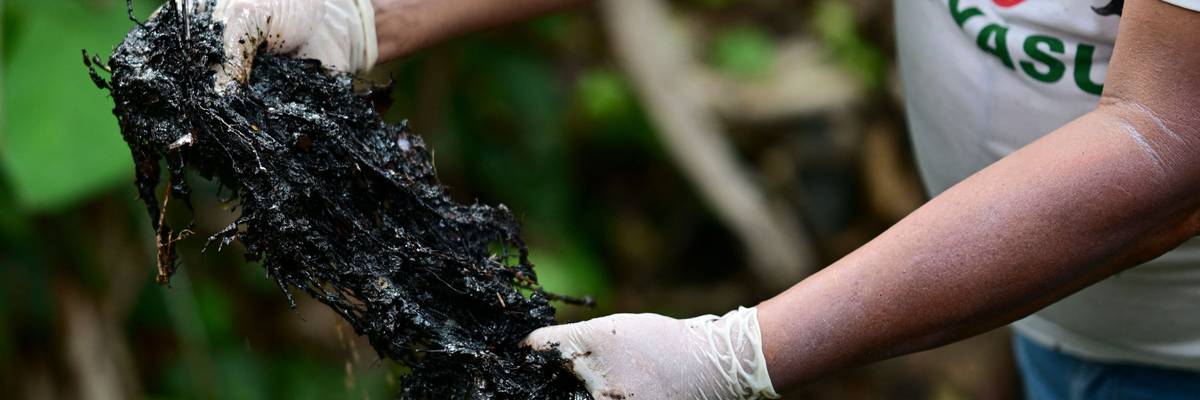
Ecuadorian activist Donald Moncayo Jimenez, chief coordinator of the Union of People Affected by Texaco, shows hydrocarbon waste over an outdoor pool used in the oil drilling process in Lago Agrio, Ecuador, on January 14, 2023.
"A debt is not owed to Chevron. A debt is owed to the Amazonian families still waiting for truth, justice, and full reparation."
A US advocacy group, American human rights lawyer Steven Donziger, and the group in Ecuador behind a historic legal battle against Chevron over its dumping of toxic waste in the Amazon rainforest are condemning the Ecuadorian government's plans to pay the oil giant hundreds of millions of dollars due to an arbitration ruling.
In response to the legal fight in Ecuador that led to a $9.5 billion judgment against Chevron—which bought Texaco—the fossil fuel company turned to the investor-state dispute settlement (ISDS) system, suing the South American country in the Hague-based Permanent Court of Arbitration. As part of the latter case, Ecuadorian Attorney General Diana Salazar Méndez's office announced Monday that the government would pay the US company only around $220 million, rather than the over $3 billion Chevron sought.
While Chevron said in a statement that it was "pleased with the resolution of this matter" and claimed the decision "strengthened the rule of law globally," and Salazar Méndez's office celebrated the dramatically lower figure, and the Union of Peoples Affected by Chevron-Texaco (UDAPT)—the group that began the case against oil company in 1993—pushed back against the government's framing of the reduction "as if it was a success and an economic achievement."
"The reality is it is a defeat for justice," UDAPT argued in a Tuesday statement. "For 32 years, UDAPT has documented pollution, environmental crime, and lives broken by Chevron, proving what should be obvious: Communities have not recovered, health has not been restored, clean water has not returned, and the territories that sustain life remain contaminated. A debt is not owed to Chevron. A debt is owed to the Amazonian families still waiting for truth, justice, and full reparation."
Amazon Watch deputy director Paul Paz y Miño similarly said Tuesday that "this illegitimate arbitration process is nothing more than Chevron abusing the law to escape accountability for one of the worst oil disasters in history."
"Ecuador's courts ruled correctly and based largely on Chevron's own evidence, that Chevron deliberately poisoned Indigenous and rural communities, leaving behind a mass cancer zone in the Amazon," the campaigner continued. "Adding insult to injury, the idea that Ecuador's people should now pay a US oil company that admitted to deliberate pollution is the epitome of environmental racism."
Ecuadorian President Daniel Noboa "must not honor this ISDS award, and the international community must stand behind the victims of Chevron's crimes and demand that the company clean up Ecuador once and for all," Paz y Miño added. "Amazon Watch stands with the affected Indigenous peoples and communities of the Ecuadorian Amazon. We urge President Noboa to reject this illegitimate award, disclose any negotiations with Chevron, and enforce Ecuadorian law by ensuring Chevron pays its debt to those it poisoned."
Donziger—who was detained in the United States for nearly 1,000 days after Chevron went after him in the American legal system for representing Big Oil's victims in Ecuador—was also sharply critical, saying Tuesday that "the decision by a so-called private corporate arbitration panel that claims to absolve Chevron of its massive pollution liability in Ecuador has no legitimacy and does not affect the historic $9.5 billion damages judgment won by Amazonian communities."
"That judgment still stands as the definitive public court ruling in the case," he said. "The private arbitral panel has no authority over the six public appellate courts, including the Supreme Courts of Ecuador and Canada, that issued unanimous decisions against Chevron and confirmed the extensive evidence that the company devastated local communities by deliberately dumping billions of gallons of cancer-causing oil waste into rivers and streams used by thousands of people for drinking, bathing, and fishing."
"I also strongly condemn President Daniel Noboa for his plans to betray his own people by agreeing to send $220 million from the public treasury to Chevron, a company that owes Ecuador billions under multiple court orders for poisoning vulnerable Indigenous peoples with toxic oil waste," Donziger added. "Noboa would effectively grant Chevron a taxpayer-funded bailout financed by the same citizens who remain victims of the company's pollution. This would be an outrageous dereliction of duty and a violation of his oath of office, warranting removal."
Dear Common Dreams reader, It’s been nearly 30 years since I co-founded Common Dreams with my late wife, Lina Newhouser. We had the radical notion that journalism should serve the public good, not corporate profits. It was clear to us from the outset what it would take to build such a project. No paid advertisements. No corporate sponsors. No millionaire publisher telling us what to think or do. Many people said we wouldn't last a year, but we proved those doubters wrong. Together with a tremendous team of journalists and dedicated staff, we built an independent media outlet free from the constraints of profits and corporate control. Our mission has always been simple: To inform. To inspire. To ignite change for the common good. Building Common Dreams was not easy. Our survival was never guaranteed. When you take on the most powerful forces—Wall Street greed, fossil fuel industry destruction, Big Tech lobbyists, and uber-rich oligarchs who have spent billions upon billions rigging the economy and democracy in their favor—the only bulwark you have is supporters who believe in your work. But here’s the urgent message from me today. It's never been this bad out there. And it's never been this hard to keep us going. At the very moment Common Dreams is most needed, the threats we face are intensifying. We need your support now more than ever. We don't accept corporate advertising and never will. We don't have a paywall because we don't think people should be blocked from critical news based on their ability to pay. Everything we do is funded by the donations of readers like you. When everyone does the little they can afford, we are strong. But if that support retreats or dries up, so do we. Will you donate now to make sure Common Dreams not only survives but thrives? —Craig Brown, Co-founder |
A US advocacy group, American human rights lawyer Steven Donziger, and the group in Ecuador behind a historic legal battle against Chevron over its dumping of toxic waste in the Amazon rainforest are condemning the Ecuadorian government's plans to pay the oil giant hundreds of millions of dollars due to an arbitration ruling.
In response to the legal fight in Ecuador that led to a $9.5 billion judgment against Chevron—which bought Texaco—the fossil fuel company turned to the investor-state dispute settlement (ISDS) system, suing the South American country in the Hague-based Permanent Court of Arbitration. As part of the latter case, Ecuadorian Attorney General Diana Salazar Méndez's office announced Monday that the government would pay the US company only around $220 million, rather than the over $3 billion Chevron sought.
While Chevron said in a statement that it was "pleased with the resolution of this matter" and claimed the decision "strengthened the rule of law globally," and Salazar Méndez's office celebrated the dramatically lower figure, and the Union of Peoples Affected by Chevron-Texaco (UDAPT)—the group that began the case against oil company in 1993—pushed back against the government's framing of the reduction "as if it was a success and an economic achievement."
"The reality is it is a defeat for justice," UDAPT argued in a Tuesday statement. "For 32 years, UDAPT has documented pollution, environmental crime, and lives broken by Chevron, proving what should be obvious: Communities have not recovered, health has not been restored, clean water has not returned, and the territories that sustain life remain contaminated. A debt is not owed to Chevron. A debt is owed to the Amazonian families still waiting for truth, justice, and full reparation."
Amazon Watch deputy director Paul Paz y Miño similarly said Tuesday that "this illegitimate arbitration process is nothing more than Chevron abusing the law to escape accountability for one of the worst oil disasters in history."
"Ecuador's courts ruled correctly and based largely on Chevron's own evidence, that Chevron deliberately poisoned Indigenous and rural communities, leaving behind a mass cancer zone in the Amazon," the campaigner continued. "Adding insult to injury, the idea that Ecuador's people should now pay a US oil company that admitted to deliberate pollution is the epitome of environmental racism."
Ecuadorian President Daniel Noboa "must not honor this ISDS award, and the international community must stand behind the victims of Chevron's crimes and demand that the company clean up Ecuador once and for all," Paz y Miño added. "Amazon Watch stands with the affected Indigenous peoples and communities of the Ecuadorian Amazon. We urge President Noboa to reject this illegitimate award, disclose any negotiations with Chevron, and enforce Ecuadorian law by ensuring Chevron pays its debt to those it poisoned."
Donziger—who was detained in the United States for nearly 1,000 days after Chevron went after him in the American legal system for representing Big Oil's victims in Ecuador—was also sharply critical, saying Tuesday that "the decision by a so-called private corporate arbitration panel that claims to absolve Chevron of its massive pollution liability in Ecuador has no legitimacy and does not affect the historic $9.5 billion damages judgment won by Amazonian communities."
"That judgment still stands as the definitive public court ruling in the case," he said. "The private arbitral panel has no authority over the six public appellate courts, including the Supreme Courts of Ecuador and Canada, that issued unanimous decisions against Chevron and confirmed the extensive evidence that the company devastated local communities by deliberately dumping billions of gallons of cancer-causing oil waste into rivers and streams used by thousands of people for drinking, bathing, and fishing."
"I also strongly condemn President Daniel Noboa for his plans to betray his own people by agreeing to send $220 million from the public treasury to Chevron, a company that owes Ecuador billions under multiple court orders for poisoning vulnerable Indigenous peoples with toxic oil waste," Donziger added. "Noboa would effectively grant Chevron a taxpayer-funded bailout financed by the same citizens who remain victims of the company's pollution. This would be an outrageous dereliction of duty and a violation of his oath of office, warranting removal."
A US advocacy group, American human rights lawyer Steven Donziger, and the group in Ecuador behind a historic legal battle against Chevron over its dumping of toxic waste in the Amazon rainforest are condemning the Ecuadorian government's plans to pay the oil giant hundreds of millions of dollars due to an arbitration ruling.
In response to the legal fight in Ecuador that led to a $9.5 billion judgment against Chevron—which bought Texaco—the fossil fuel company turned to the investor-state dispute settlement (ISDS) system, suing the South American country in the Hague-based Permanent Court of Arbitration. As part of the latter case, Ecuadorian Attorney General Diana Salazar Méndez's office announced Monday that the government would pay the US company only around $220 million, rather than the over $3 billion Chevron sought.
While Chevron said in a statement that it was "pleased with the resolution of this matter" and claimed the decision "strengthened the rule of law globally," and Salazar Méndez's office celebrated the dramatically lower figure, and the Union of Peoples Affected by Chevron-Texaco (UDAPT)—the group that began the case against oil company in 1993—pushed back against the government's framing of the reduction "as if it was a success and an economic achievement."
"The reality is it is a defeat for justice," UDAPT argued in a Tuesday statement. "For 32 years, UDAPT has documented pollution, environmental crime, and lives broken by Chevron, proving what should be obvious: Communities have not recovered, health has not been restored, clean water has not returned, and the territories that sustain life remain contaminated. A debt is not owed to Chevron. A debt is owed to the Amazonian families still waiting for truth, justice, and full reparation."
Amazon Watch deputy director Paul Paz y Miño similarly said Tuesday that "this illegitimate arbitration process is nothing more than Chevron abusing the law to escape accountability for one of the worst oil disasters in history."
"Ecuador's courts ruled correctly and based largely on Chevron's own evidence, that Chevron deliberately poisoned Indigenous and rural communities, leaving behind a mass cancer zone in the Amazon," the campaigner continued. "Adding insult to injury, the idea that Ecuador's people should now pay a US oil company that admitted to deliberate pollution is the epitome of environmental racism."
Ecuadorian President Daniel Noboa "must not honor this ISDS award, and the international community must stand behind the victims of Chevron's crimes and demand that the company clean up Ecuador once and for all," Paz y Miño added. "Amazon Watch stands with the affected Indigenous peoples and communities of the Ecuadorian Amazon. We urge President Noboa to reject this illegitimate award, disclose any negotiations with Chevron, and enforce Ecuadorian law by ensuring Chevron pays its debt to those it poisoned."
Donziger—who was detained in the United States for nearly 1,000 days after Chevron went after him in the American legal system for representing Big Oil's victims in Ecuador—was also sharply critical, saying Tuesday that "the decision by a so-called private corporate arbitration panel that claims to absolve Chevron of its massive pollution liability in Ecuador has no legitimacy and does not affect the historic $9.5 billion damages judgment won by Amazonian communities."
"That judgment still stands as the definitive public court ruling in the case," he said. "The private arbitral panel has no authority over the six public appellate courts, including the Supreme Courts of Ecuador and Canada, that issued unanimous decisions against Chevron and confirmed the extensive evidence that the company devastated local communities by deliberately dumping billions of gallons of cancer-causing oil waste into rivers and streams used by thousands of people for drinking, bathing, and fishing."
"I also strongly condemn President Daniel Noboa for his plans to betray his own people by agreeing to send $220 million from the public treasury to Chevron, a company that owes Ecuador billions under multiple court orders for poisoning vulnerable Indigenous peoples with toxic oil waste," Donziger added. "Noboa would effectively grant Chevron a taxpayer-funded bailout financed by the same citizens who remain victims of the company's pollution. This would be an outrageous dereliction of duty and a violation of his oath of office, warranting removal."

