

SUBSCRIBE TO OUR FREE NEWSLETTER
Daily news & progressive opinion—funded by the people, not the corporations—delivered straight to your inbox.
5
#000000
#FFFFFF
To donate by check, phone, or other method, see our More Ways to Give page.
Daily news & progressive opinion—funded by the people, not the corporations—delivered straight to your inbox.
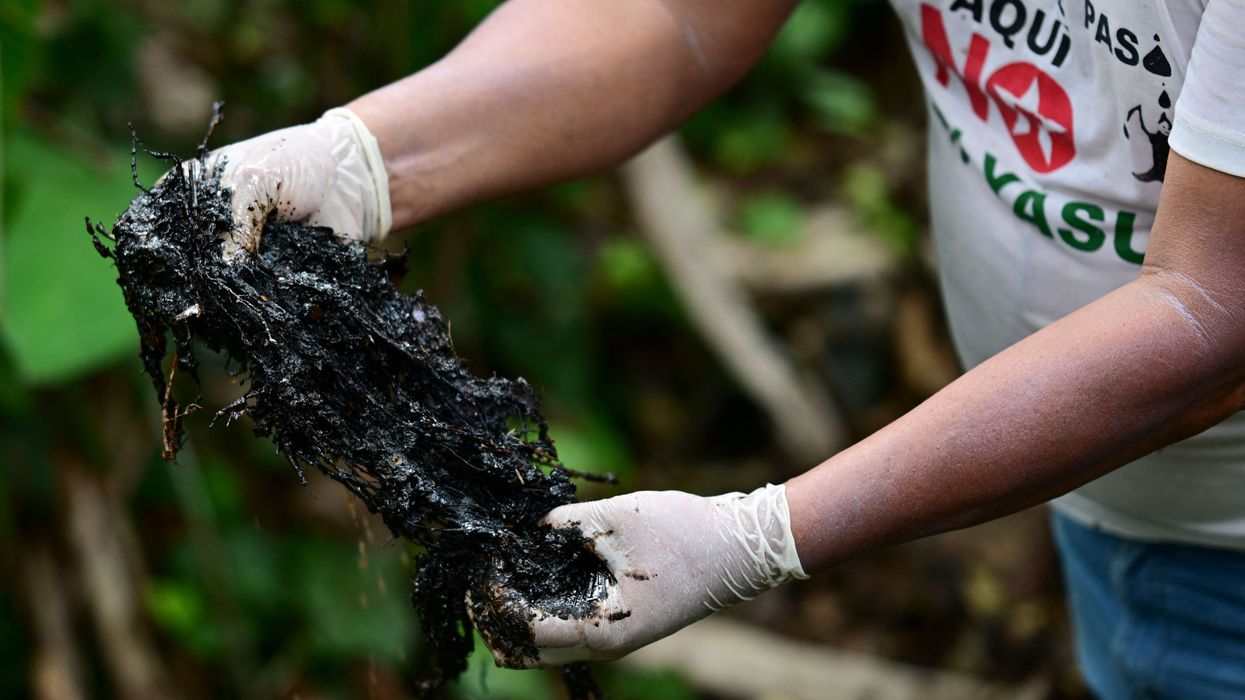
"A debt is not owed to Chevron. A debt is owed to the Amazonian families still waiting for truth, justice, and full reparation."
A US advocacy group, American human rights lawyer Steven Donziger, and the group in Ecuador behind a historic legal battle against Chevron over its dumping of toxic waste in the Amazon rainforest are condemning the Ecuadorian government's plans to pay the oil giant hundreds of millions of dollars due to an arbitration ruling.
In response to the legal fight in Ecuador that led to a $9.5 billion judgment against Chevron—which bought Texaco—the fossil fuel company turned to the investor-state dispute settlement (ISDS) system, suing the South American country in the Hague-based Permanent Court of Arbitration. As part of the latter case, Ecuadorian Attorney General Diana Salazar Méndez's office announced Monday that the government would pay the US company only around $220 million, rather than the over $3 billion Chevron sought.
While Chevron said in a statement that it was "pleased with the resolution of this matter" and claimed the decision "strengthened the rule of law globally," and Salazar Méndez's office celebrated the dramatically lower figure, and the Union of Peoples Affected by Chevron-Texaco (UDAPT)—the group that began the case against oil company in 1993—pushed back against the government's framing of the reduction "as if it was a success and an economic achievement."
"The reality is it is a defeat for justice," UDAPT argued in a Tuesday statement. "For 32 years, UDAPT has documented pollution, environmental crime, and lives broken by Chevron, proving what should be obvious: Communities have not recovered, health has not been restored, clean water has not returned, and the territories that sustain life remain contaminated. A debt is not owed to Chevron. A debt is owed to the Amazonian families still waiting for truth, justice, and full reparation."
Amazon Watch deputy director Paul Paz y Miño similarly said Tuesday that "this illegitimate arbitration process is nothing more than Chevron abusing the law to escape accountability for one of the worst oil disasters in history."
"Ecuador's courts ruled correctly and based largely on Chevron's own evidence, that Chevron deliberately poisoned Indigenous and rural communities, leaving behind a mass cancer zone in the Amazon," the campaigner continued. "Adding insult to injury, the idea that Ecuador's people should now pay a US oil company that admitted to deliberate pollution is the epitome of environmental racism."
Ecuadorian President Daniel Noboa "must not honor this ISDS award, and the international community must stand behind the victims of Chevron's crimes and demand that the company clean up Ecuador once and for all," Paz y Miño added. "Amazon Watch stands with the affected Indigenous peoples and communities of the Ecuadorian Amazon. We urge President Noboa to reject this illegitimate award, disclose any negotiations with Chevron, and enforce Ecuadorian law by ensuring Chevron pays its debt to those it poisoned."
Donziger—who was detained in the United States for nearly 1,000 days after Chevron went after him in the American legal system for representing Big Oil's victims in Ecuador—was also sharply critical, saying Tuesday that "the decision by a so-called private corporate arbitration panel that claims to absolve Chevron of its massive pollution liability in Ecuador has no legitimacy and does not affect the historic $9.5 billion damages judgment won by Amazonian communities."
"That judgment still stands as the definitive public court ruling in the case," he said. "The private arbitral panel has no authority over the six public appellate courts, including the Supreme Courts of Ecuador and Canada, that issued unanimous decisions against Chevron and confirmed the extensive evidence that the company devastated local communities by deliberately dumping billions of gallons of cancer-causing oil waste into rivers and streams used by thousands of people for drinking, bathing, and fishing."
"I also strongly condemn President Daniel Noboa for his plans to betray his own people by agreeing to send $220 million from the public treasury to Chevron, a company that owes Ecuador billions under multiple court orders for poisoning vulnerable Indigenous peoples with toxic oil waste," Donziger added. "Noboa would effectively grant Chevron a taxpayer-funded bailout financed by the same citizens who remain victims of the company's pollution. This would be an outrageous dereliction of duty and a violation of his oath of office, warranting removal."
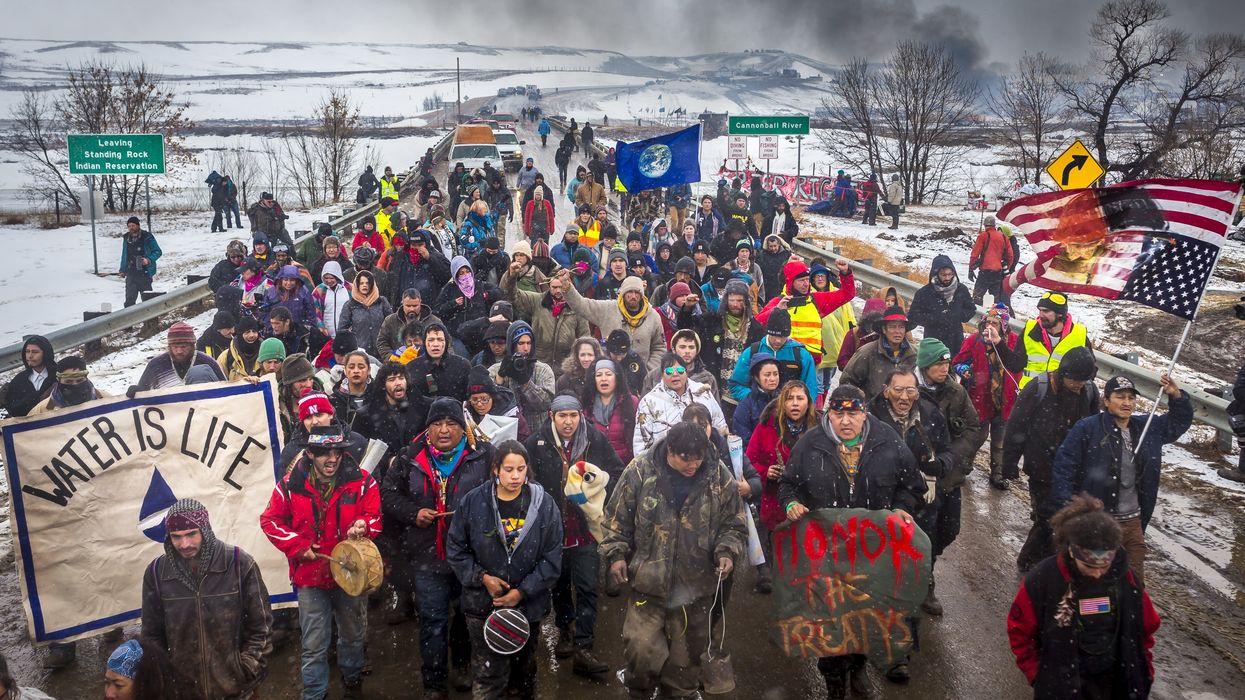
A lawsuit against Greenpeace in North Dakota threatens the existence of all nonprofits.
Imagine a world without effective nonprofit advocacy. When a corporation exploits a local community, no one speaks up or resists. Everyone is too afraid of the weaponized legal system, too vulnerable to liability. The ultra-wealthy take whatever they want and leave others to pick up the pieces. Opposition and resistance have been extinguished.
Those are the risks of a lawsuit against Greenpeace, now going to trial in North Dakota after a seven-year legal battle. Energy Transfer, the company behind the Dakota Access Pipeline, is seeking $300 million for tort damages, including defamation. Energy Transfer’s previous attempt to sue Greenpeace under federal anti-racketeering laws was blocked by the courts. But the state charges have been upheld, with a trial beginning on February 24, and free-speech advocates are raising alarms about the dangerous precedent that would follow a loss for Greenpeace, or even from the trial proceeding at all.
I recently spoke with Scott W. Badenoch, Jr., a visiting attorney at the Environmental Law Institute. He’s part of a team of distinguished international legal scholars, including Steven Donziger and Jeanne Mirer, who have launched a Trial Monitoring Committee to ensure the case against Greenpeace proceeds fairly and transparently.
While the Trial Monitors and some activists will be on the ground in North Dakota, we need to make noise online and in the media, ensuring that as many people as possible know what’s at stake.
As Badenoch described it, the court is trying to maintain “as much of a black box as you could possibly create in the U.S. court system.” Judge James Gion recently denied a motion to allow live streaming of the trial proceedings.
Instead, Badenoch said the case should be dismissed immediately. The allegations attempt to hold Greenpeace responsible for the actions of activists and volunteers unaffiliated with the group. Legal advocates and climate organizers have called it an unconstitutional SLAPP suit, intended to burden Greenpeace with costly legal fees, shut them down, and restrict the free speech of nonprofits more broadly. “There is absolutely no justification for this trial happening in this court, at this time, with this judge,” Badenoch said. “Just none.”
In a press release from the Trial Monitoring Committee, Steven Donziger pointed to recent trends, writing that “this appears to be part of a broader strategy by the fossil fuel industry to weaponize the courts against activists and weaken organizations like Greenpeace in retaliation for their advocacy.”
While the trial itself presents dangers, the recent actions of Energy Transfer have also brought accusations of jury-tampering. In October, residents of rural Morton County, North Dakota, where the trial will be set, received what appeared to be a legitimate newspaper. However, it contained almost exclusively critical attacks on Greenpeace and the pipeline protests, while praising Energy Transfer. The “newspaper” was actually a political mailer from a company called Metric Media, with links to electioneering and fossil fuel companies, as reported in the North Dakota News Cooperative. Even more concerning, financial records link the CEO of Energy Transfer, Texas billionaire Kelcy Warren, to the creation of the fake newspaper. It looks a like blatant attempt to taint the jury pool. Despite this, Judge Gion refused to allow Greenpeace to investigate the origins of the biased mailer.
The crucial role of the Trial Monitoring Committee is to bring attention to these abuses of due process. “We are going to monitor this case one way or the other,” Badenoch told me. “But the more that [Judge Gion] withholds transparency and access from us, the more obvious it is that something is going on that they don’t want people to see.”
Meanwhile, the stakes of the case extend far beyond Greenpeace. If Energy Transfer is successful, Badenoch said, the precedent would be cataclysmic for nonprofit advocacy. An organization could be held liable for any actions by any activists, however tenuously affiliated. “Literally every social justice, climate justice, civil rights, human rights organization across the country—and maybe the planet—is at risk of legal murder in a courtroom, where an organization is put to death by a SLAPP suit.”
As members of the public, that means we all have a responsibility to advocate for transparency, fairness, and ideally dismissal of Energy Transfer’s lawsuit. While the Trial Monitors and some activists will be on the ground in North Dakota, we need to make noise online and in the media, ensuring that as many people as possible know what’s at stake. Badenoch was emphatic about this: “The number one thing is to bring attention to the case. Don’t let Greenpeace die with a whimper.”
In a time of chaos and distraction, it’s all too easy to let cases like this one go unnoticed. But the risks are simply too dire to ignore. “It’s absolutely terrifying for advocacy in this country and beyond. The risks are really hard to overstate,” Badenoch told me. “If Greenpeace is allowed to die in this field in North Dakota, then every single nonprofit is next in line.”
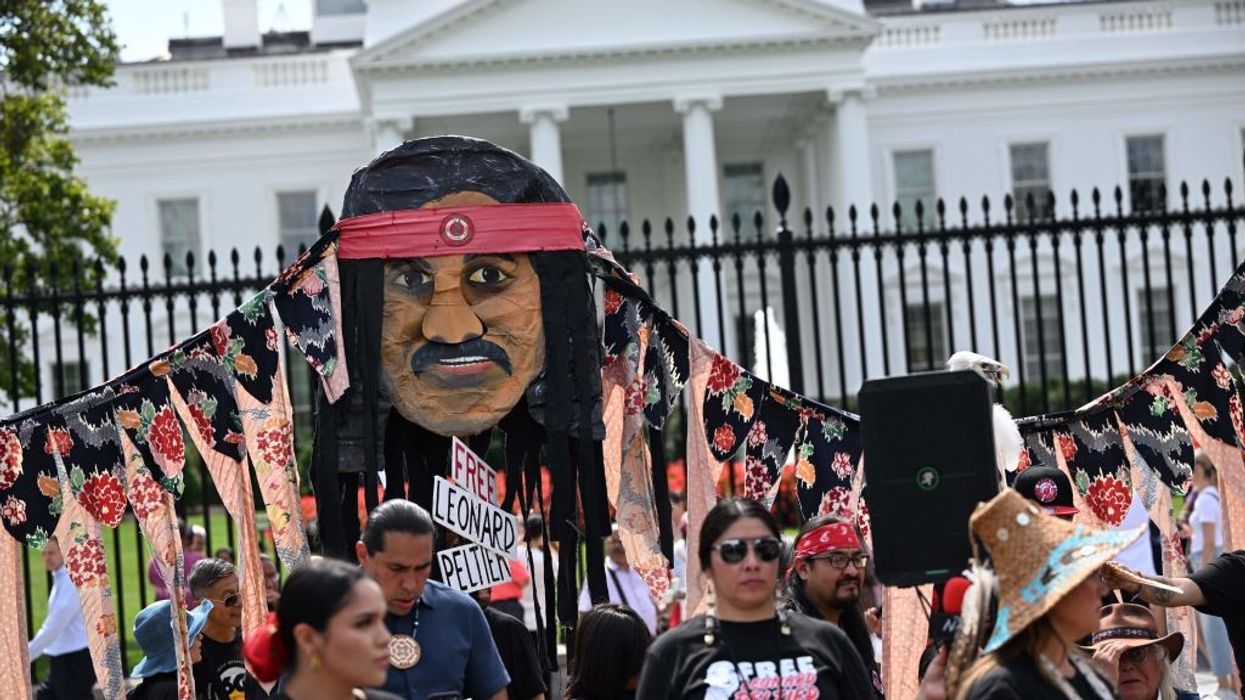
"The victory of freeing Leonard Peltier is a symbol of our collective strength—and our resistance will never stop," vowed one Indigenous organizer.
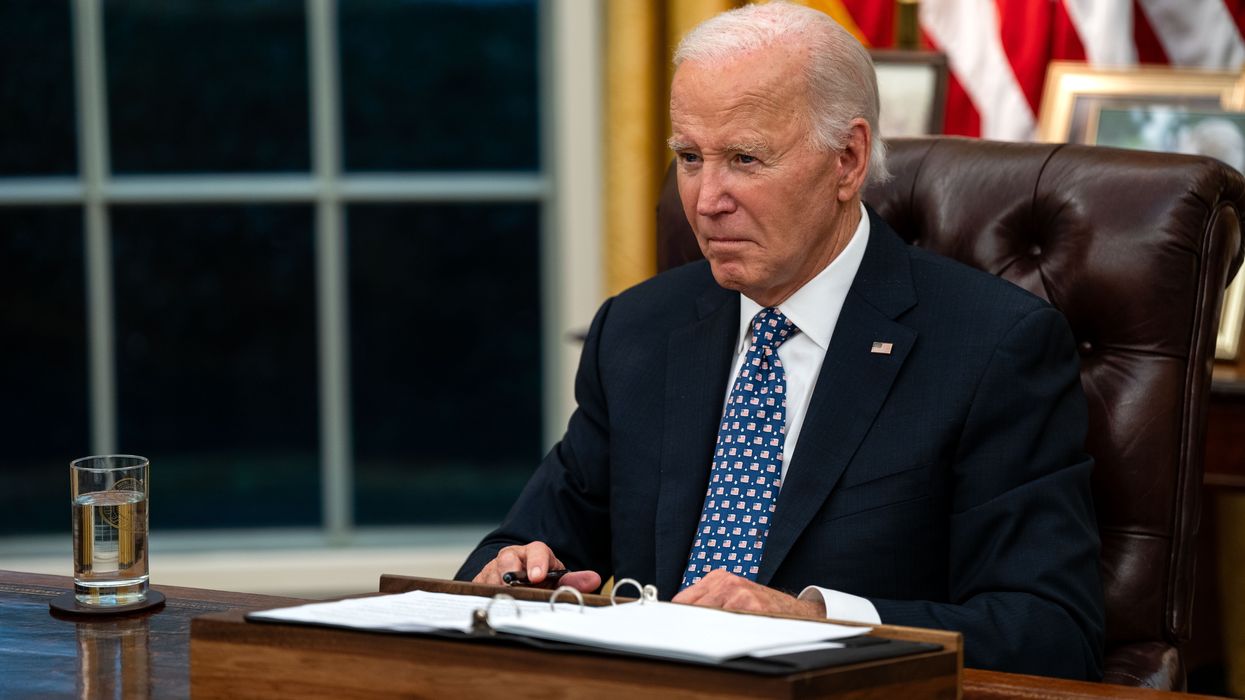
Just minutes before leaving office, Joe Biden on Monday commuted the life prison sentence of Leonard Peltier, the elderly American Indian Movement activist who supporters say was framed for the murder of two federal agents during a 1975 reservation shootout.
"It's finally over, I'm going home," Peltier, who is 80 years old, said in a statement released by the Indigenous-led activist group NDN Collective. "I want to show the world I'm a good person with a good heart. I want to help the people, just like my grandmother taught me."
While not the full pardon for which he and his defenders have long fought, the outgoing Democratic president's commutation will allow Peltier—who has been imprisoned for nearly a half-century—to "spend his remaining days in home confinement," according to Biden's statement, which was no longer posted on the White House website after Republican President Donald Trump took office Monday afternoon.
🚨BREAKING🚨 Leonard Peltier Granted Executive Clemency After 50 years of unjust incarceration and the tireless efforts of intergenerational grassroots organizing and advocacy, our elder and relative Leonard Peltier has been granted executive clemency.
[image or embed]
— NDN Collective ( @ndncollective.bsky.social) January 20, 2025 at 9:02 AM
"Tribal Nations, Nobel Peace laureates, former law enforcement officials (including the former U.S. attorney whose office oversaw Mr. Peltier's prosecution and appeal), dozens of lawmakers, and human rights organizations strongly support granting Mr. Peltier clemency, citing his advanced age, illnesses, his close ties to and leadership in the Native American community, and the substantial length of time he has already spent in prison," Biden explained.
Biden Interior Secretary Deb Haaland, the first Indigenous cabinet secretary in U.S. history, said in a statement: "I am beyond words about the commutation of Leonard Peltier. His release from prison signifies a measure of justice that has long evaded so many Native Americans for so many decades. I am grateful that Leonard can now go home to his family. I applaud President Biden for this action and understanding what this means to Indian Country."
Congressman Raúl Grijalva (D-Ariz.), who last month led 34 U.S. lawmakers in a letter urging clemency for Peltier, said in a statement that "for too long, Mr. Peltier has been denied both justice and the pursuit of a full, healthy life at the hands of the U.S. government, but today, he is finally able to go home."
"President Biden's decision is not just the right, merciful, and decent one—it is a testament to Mr. Peltier's resilience and the unwavering support of the countless global leaders, Indigenous voices, civil rights and legal experts, and so many others who have advocated so tirelessly for his release," Grijalva added. "While there is still much work to be done to fix the system that allowed this wrong and so many others against Indian Country, especially as we face the coming years, let us today celebrate Mr. Peltier's return home."
NDN Collective founder and CEO Nick Tilsen said Monday that "Leonard Peltier's freedom today is the result of 50 years of intergenerational resistance, organizing, and advocacy."
"Leonard Peltier's liberation is our liberation—we will honor him by bringing him back to his homelands to live out the rest of his days surrounded by loved ones, healing, and reconnecting with his land and culture," Tilsen continued.
"Let Leonard's freedom be a reminder that the entire so-called United States is built on the stolen lands of Indigenous people—and that Indigenous people have successfully resisted every attempt to oppress, silence, and colonize us," Tilsen added. "The victory of freeing Leonard Peltier is a symbol of our collective strength—and our resistance will never stop."
Amnesty International USA executive director Paul O'Brien said that "President Biden was right to commute the life sentence of Indigenous elder and activist Leonard Peltier given the serious human rights concerns about the fairness of his trial."
While Peltier admits to having participated in the June 26, 1975 gunfight at the Oglala Sioux Reservation at Pine Ridge, South Dakota, he denies killing Federal Bureau of Investigation agents Jack Coler and Ronald Williams.
As HuffPost senior political reporter Jennifer Bendery recapped Monday:
There was never evidence that Peltier committed a crime, and the U.S. government never did figure out who shot those agents. But federal officials needed someone to take the fall. The FBI had just lost two agents, and Peltier's co-defendants were all acquitted based on self-defense. So, Peltier became their guy.
His trial was rife with misconduct. The FBI threatened and coerced witnesses into lying. Federal prosecutors hid evidence that exonerated Peltier. A juror acknowledged on the second day of the trial that she had "prejudice against Indians," but she was kept on anyway.
The government's case fell apart after these revelations, so it simply revised its charges against Peltier to "aiding and abetting" whoever did kill the agents—based entirely on the fact that he was one of dozens of people present when the shootout took place. Peltier was convicted and sentenced to two consecutive life terms.
American Indian Movement (AIM) activist Joe Stuntz Killsright was also killed at Pine Ridge when a U.S. Bureau of Indian Affairs agent sniper shot him in the head after Coler and Williams were killed. Stuntz' death has never been investigated.
Some Indigenous activists welcomed Peltier's commutation while also remembering Annie Mae Pictou Aquash, an Mi'kmaq activist who was kidnapped and murdered at Pine Ridge in December 1975 by her fellow AIM members. Some of Aquash's defenders believe her killing to be an assassination ordered by AIM leaders who feared she was an FBI informant.
Before leaving office, Biden issued a flurry of eleventh-hour preemptive pardons meant to protect numerous relatives and government officials whom Trump and his allies have threatened with politically motivated legal action.
However, the outgoing president dashed the hopes of figures including Steven Donziger, Charles Littlejohn, and descendants of Ethel Rosenberg, who were
seeking last-minute pardons or commutations.
There are only a few days left for Biden to heed calls for clemency coming from a diverse array of rights groups.
Outgoing U.S. President Joe Biden announced commutations on Friday for approximately 2,500 people who have been convicted of non-violence drug crimes—a move that was cheered by rights groups and brings his total number of pardons and commutations to the highest of any president.
But Biden has so far stopped short of granting clemency to a number of high profile individuals whose cases—while all very different—have generated significant public interest and sympathy. They include: the former IRS contractor Charles Littlejohn, the environmental lawyer Steven Donziger, Indigenous activist Leonard Peltier, and WikiLeaks founder Julian Assange.
The cases have prompted a flurry of calls from various groups for Biden to take action on the cases before he hands over the White House to President-elect Donald Trump on January 20.
Littlejohn was sentenced in January 2024 to the five years in prison for unauthorized disclosure of tax information to the media. In 2020, The New York Times published a story based on information leaked by Littlejohn revealing that Trump paid only $750 in federal income taxes the year he won the presidency and in 2017. Later, journalists at ProPublica used documents made available by Littlejohn to report on how the wealthiest 25 individuals in America were able to get away with paying very little in income tax between 2014 and 2018.
Given the nature of his case, Kenny Stancil of the Revolving Door Project and Bob Lord of the Institute for Policy Studies, wrote in December that Littlejohn "very well could be on Trump's enemies list" and urged Biden to commute his sentence.
"The longer Littlejohn languishes in jail, the more he is at risk of retribution from Trump," wrote Stancil and Lord, who also highlight that Littlejohn was given the statutory maximum sentence for his crime.
On Thursday, millionaire Abigail Disney penned a defense of Littlejohn, writing that Biden should commute his sentence because he "did the nation a great service by spotlighting the urgent need for tax reform in a country being ripped apart by extreme and rising inequality."
Indigenous leaders and the human rights organization Amnesty International are calling for clemency for another man who is currently behind bars: the Indigenous rights activist Leonard Peltier, who was convicted in 1977 of having murdered two FBI agents and has spent the majority of his life in prison, despite concerns about the fairness of his trial and conviction.
Peltier had his request for parole and compassionate release denied last year, meaning clemency is "likely his only chance for freedom," according to Amnesty International.
"All of us see a little bit of ourselves in Leonard Peltier, and that's why we fight so hard for him," said Nick Tilsen, the founder and CEO of NDN Collective, an Indigenous rights group. "This is about paving a path forward that gives us the opportunity to have justice and begin to heal the relationship between the United States government and Indian people. And so, this decision is massive."
Meanwhile, 50 human rights and environmental groups sent a letter in early January to President Biden, urging him to pardon U.S. human rights lawyer Steven Donziger, who secured a multibillion settlement for Indigenous plaintiffs against Texaco (later acquired by Chevron) in an Ecuadoran court over the company's destructive oil pollution in the Amazon, but was later charged with criminal contempt of court in the U.S. for withholding evidence in a countersuit brought by Chevron. Donziger was disbarred in 2018, and then spent time in both prison and under house arrest.
Rep. Jim McGovern (D-Mass.), who has called for Donziger's pardon, recently told Democracy Now! that "Chevron has spent countless millions and millions of dollars going after Steven Donziger and not helping a single person in Ecuador deal with what they left behind. We have to stand up to corporate excesses in this country."
"If President Biden would pardon him, I think that would be a signal that maybe things are beginning to change," he added.
Also this week, press freedom and civil liberties organizations demanded that Biden pardon WikiLeaks founder and publisher Julian Assange, who last year—as a way to avoid extradition to the U.S. after languishing for years in a British prison—pleaded guilty to a felony charge under the U.S. Espionage Act of conspiring to obtain and disclose classified national military documents. Per the terms of the plea deal, he was allowed to return to his native Australia and is no longer incarcerated.
Freedom of the Press Foundation director of advocacy Seth Stern said in a statement Thursday that Assange's case "normalized the criminalization of work national security journalists do every day—talking to sources, obtaining documents from them, and publishing those documents."
"A pardon won't undo the harm the case has done to the free press or the chilling effect on journalists who now know their work can land them behind bars at the whim of the Department of Justice. But it will help reduce the damage," he said.

"It would send a signal that President Biden, who claims to be a climate president and a rule of law president, can walk the walk, not just do the talk," said human rights attorney Steven Donziger.
With Joe Biden's White House term ending in less than two weeks, human rights attorney Steven Donziger on Tuesday urged the outgoing president to send a message to Chevron and other oil giants around the world by granting him a pardon.
"I think it would bring enormous recognition that this is just fundamentally wrong and a violation of the Constitution," Donziger said of a pardon in an interview with Amnesty International, one of many advocacy organizations backing his petition to the president. "But more importantly, it would send a signal that President Biden, who claims to be a climate president and a rule of law president, can walk the walk, not just do the talk. And it would be a really important opportunity for him to stand up for the principles that he purports."
Donziger faced a yearslong legal assault from Chevron after he helped win a $9.5 billion settlement against the company in 2011 over oil dumped on Indigenous lands in the Amazon rainforest in Ecuador.
Donziger has spent more than 1,000 days in prison or under house arrest since 2019, when he was charged with six counts of criminal contempt of court—charges for which he was found guilty in 2021 by Loretta Preska, a judge who has served on the advisory board of the Chevron-funded Federalist Society.
The United Nations condemned Donziger's prosecution and prolonged detention as violations of international law.
Donziger, who walked free in 2022, has said he is "the only person in U.S. history to be privately prosecuted by a corporation."
"More specifically," he wrote in a blog post last year, "the government (via a pro-corporate judge) gave a giant oil company (Chevron) the power to prosecute and lock up its leading critic."
In his interview with Amnesty volunteer Elizabeth Haight, Donziger argued that "there was no basis to charge me with contempt, either civil or criminal."
"But even if there was, this was handled in an extremely irregular, and I would argue, questionable, if not outright corrupt, way," he continued. "In my case, the prosecutor looked at the evidence and refused to take the case forward. That should have been the end of it. Instead, this judge appointed a private corporate law firm to step into the shoes of the U.S. government and prosecute me directly."
Donziger said that while "the case in Ecuador does not depend on me getting a pardon... a pardon would make it clear, or even more clear, to any judge in any country who might consider enforcing the judgment against Chevron, that Chevron's entire theory that somehow they were the ones victimized by the people of Ecuador rather than the other way around, is a completely false and manufactured narrative."
With time running out, Donziger urged people to sign his petition to the Biden White House calling for a pardon—a demand backed by dozens of U.S. lawmakers.
"Sign the petition to the White House, donate—as I can't work and am reliant on the goodwill of people all over the world to help pay my legal fees and keep me and this work moving—and call the White House at +1-202-456-1111," Donziger said. "What that means is, when the operator at the White House answers, you simply say, 'I'm calling to urge President Biden to pardon Steven Donziger, this is a grave injustice, this is a stain on the reputation of our country, and it must be corrected.'"
"It's a big slap in the face for us once again," said one of the disgraced judge's victims.
Victims of a scheme in which a pair of Pennsylvania judges conspired to funnel thousands of children into private detention centers in exchange for millions of dollars in kickbacks expressed outrage following U.S. President Joe Biden's Thursday commutation of one of the men's sentences.
In 2010, former Luzerne County Judge Michael Conahan pleaded guilty to federal racketeering charges and was sentenced to more than 17 years in prison after he and co-conspirator Mark Ciavarella shut down a county-run juvenile detention facility and then took nearly $3 million in payments from the builder and co-owner of for-profit lockups, into which the judges sent children as young as 8 years old.
"It's a big slap in the face for us once again," Amanda Lorah—who was sentenced by Conahan to five years of juvenile detention over a high school fight—told WBRE.
Sandy Fonzo, whose son killed himself after being sentenced to juvenile detention, said in a statement: "I am shocked and I am hurt. Conahan's actions destroyed families, including mine, and my son's death is a tragic reminder of the consequences of his abuse of power."
"This pardon feels like an injustice for all of us who still suffer," Fonzo added. "Right now I am processing and doing the best I can to cope with the pain that this has brought back."
Many of Conahan's victims were first-time or low-level offenders. The Pennsylvania Supreme Court would later throw out thousands of cases adjudicated by the Conahan and Ciaverella, the latter of whom is serving a 28-year sentence for his role in the scheme.
Conahan—who is 72 and had been under house arrest since being transferred from prison during the Covid-19 pandemic—was one of around 1,500 people who received commutations or pardons from Biden on Thursday. While the sweeping move was welcomed by criminal justice reform advocates, many also decried the president's decision to not grant clemency to any of the 40 men with federal death sentences.
Others have called on Biden—who earlier this month pardoned his son Hunter Biden after promising he wouldn't—to grant clemency to people including Indigenous activist Leonard Peltier and environmental lawyer Steven Donziger.
"There's never going to be any closure for us."
"So he wants to talk about Conahan and everybody else, but what is Joe Biden doing for all of these kids who absolutely got nothing, and almost no justice in this whole thing that happened?" said Lorah. "So it's nothing for us, but it seems that Conahan is just getting a slap on the wrist every which way he possibly could still today."
"There's never going to be any closure for us," she added. "There's never going to be, somehow, some way, these two men are always going to pop up, but now, when you think about the president of the United States letting him get away with this, who even wants to live in this country at this point? I'm totally shocked, I can't believe this."
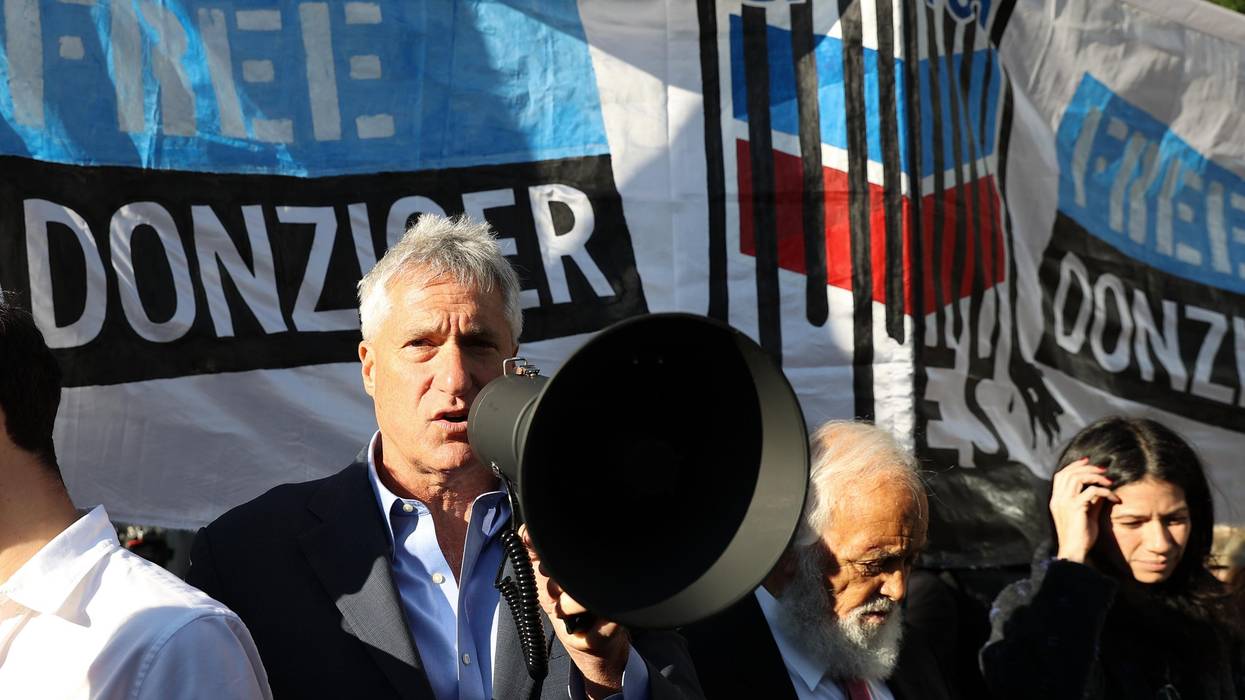
"We are deeply concerned about the chilling effect this case will have on all advocates working on behalf of other frontline communities, victims of human rights violations, and those seeking environmental justice."
More than 30 Democratic members of Congress on Wednesday called on outgoing U.S. President Joe Biden to pardon environmental and human rights lawyer Steven Donziger, who endured nearly 1,000 days in prison and house arrest after successfully representing Ecuadoreans harmed by Big Oil's pollution of the Amazon rainforest.
In a
letter to Biden led by Rep. Jim McGovern, (D-Mass.), 33 House and Senate Democrats plus Independent U.S. Sen. Bernie Sanders of Vermont noted the "troubling legal irregularities" in Donziger's case, which have been "criticized as unconstitutional or illegal by three federal judges, 68 Nobel laureates, and five high-level jurists from the Working Group on Arbitrary Detention of the United Nations."
Donziger represented a group of Ecuadorean farmers and Indigenous people in a 1990s lawsuit against Texaco—which was later acquired by Chevron—over the oil company's deliberate dumping of billions of gallons of carcinogenic waste into the Amazon. He played a key role in winning a $9.5 billion settlement against Chevron in Ecuadorian courts.
However, Chevron fought Donziger in the U.S. court system, and when the attorney refused to disclose privileged client information to the company, federal District Judge Lewis Kaplan—who was invested in Chevron—held him in misdemeanor contempt of court. Loretta Preska, Kaplan's handpicked judge to preside over Donziger's contempt trial, is affiliated with the Chevron-funded Federalist Society.
Donziger's case drew worldwide attention and solidarity, with human rights experts and free speech groups joining progressive U.S. lawmakers in demanding his release. He was released in April 2022 after 993 days in prison and house arrest.
"Donziger is the only lawyer in U.S. history to be subject to any period of detention on a misdemeanor contempt of court charge," the 34 lawmakers wrote. "We believe that the legal case against Mr. Donziger, as well as the excessively harsh nature of the punishment against him, are directly tied to his prior work against Chevron. We do not make this accusation lightly or without evidentiary support."
The legislators warned:
Notwithstanding the personal hardship, this unprecedented legal process has imposed on Mr. Donziger and his family, we are deeply concerned about the chilling effect this case will have on all advocates working on behalf of other frontline communities, victims of human rights violations, and those seeking environmental justice. Those who try to help vulnerable communities will feel as though tactics of intimidation—at the hands of powerful corporate interests, and, most troublingly, the U.S. courts—can succeed in stifling robust legal representation when it is needed most. This is a dangerous signal to send.
"Pardoning Mr. Donziger," the lawmakers added, "would send a powerful message to the world that billion-dollar corporations cannot act with impunity against lawyers and their clients who defend the public interest."
The lawmakers join more than 100 environmental and human rights groups that have urged Biden to pardon Donziger.
In an April opinion piece published by Common Dreams, Donziger contended that "I need this pardon because I am the only person in U.S. history to be privately prosecuted by a corporation."
"More specifically, the government (via a pro-corporate judge) gave a giant oil company (Chevron) the power to prosecute and lock up its leading critic," he continued. "As a result of this unprecedented and frightening private prosecution, I still cannot travel out of the country and I have been prohibited from meeting with clients I have represented for over three decades. Nor can I practice law, maintain a bank account, or earn a livelihood."
"No matter where one stands on the political spectrum," Donziger added, "we should all be able to agree that what happened to me should not happen to anybody in any country that adheres to the rule of law."
The appeal for a Donziger pardon comes amid a
wave of eleventh-hour pleas from lawmakers for Biden to grant clemency to figures ranging from WikiLeaks founder Julian Assange and National Security Agency whistleblower Edward Snowden to Indigenous activist Leonard Peltier—often described as the nation's longest-jailed political prisoner—and federal death row inmates including Billie Jerome Allen, who advocates say was wrongly convicted of murder.
No matter where one stands on the political spectrum, we should all be able to agree that what happened to me should not happen to anybody in any country that adheres to the rule of law.
About a month ago, a group of 14 prominent lawyers from the United Stateslaunched a global campaign to demand a pardon from President Joe Biden for my misdemeanor contempt conviction after I helped Amazon communities in Ecuador win a landmark $10 billion pollution judgement against Chevron. While I want a pardon for personal reasons—including the restoration of my freedom to travel and to earn a livelihood—this request is also a major opportunity for the White House to uphold its stated commitments on climate justice, human rights, and corporate accountability.
First, the personal.
I need this pardon because I am the only person in U.S. history to be privately prosecuted by a corporation. More specifically, the government (via a pro-corporate judge) gave a giant oil company (Chevron) the power to prosecute and lock up its leading critic. As a result of this unprecedented and frightening private prosecution, I still cannot travel out of the country and I have been prohibited from meeting with clients I have represented for over three decades. Nor can I practice law, maintain a bank account, or earn a livelihood. I am largely dependent for my survival on the support of people around the world who have contributed to my defense fund, which also pays my hefty legal fees to deal with Chevron’s attacks. I have no bank account because Chevron essentially stole (they would say “garnished”) all of my assets after a judge ordered me to reimburse the company millions of dollars for legal fees they spent trying to destroy me.
This obviously matters deeply to me, to my clients in Ecuador who are deeply suffering from the impacts of Chevron’s pollution, and to anyone who cares about ending corporate retaliation against the climate movement.
The fact 14 highly credible lawyers—among them Marty Garbus, Natali Segovia, and Michael Tigar—are representing me pro bono attests to the merits of the pardon request. To understand the the powerful arguments on our side, I would urge everyone to read the 12-page pardon letter in full, available here.
The private prosecution was carried out by Chevron and two of its U.S.-based corporate law firms, Gibson Dunn & Crutcher and Seward & Kissel. It happened after Judge Lewis A. Kaplan charged me with criminal contempt after I appealed a clearly illegal order that I turn over my computer and confidential case file to Chevron. This unprecedented order would have forced me as an attorney to violate my ethical duties to my clients and would have put their lives in danger. (The ostensible basis of the order was to allow Chevron to search my computer for supposed hidden bank accounts that might contain money to pay the company the roughly $5 million in legal fees Kaplan ordered that I pay them; the reality is that the reason was manufactured to give the judge a reason to lock me up.)
Significantly, Kaplan’s criminal contempt charges were rejected for prosecution by the regular federal prosecutor in New York, Geoffrey Berman. That decision prompted the judge to illegally appoint the Chevron law firm to act in place of the government prosecutor. Not only was the appointment of a private prosecutor in a case already rejected by the government entirely inappropriate, neither Kaplan nor the law firm ever disclosed to our team that Chevron had been a client until we discovered it months later. Because Chevron had wrested complete control of a public prosecution rejected by the government, I ended up detained for 993 days on a petty misdemeanor charge with a maximum sentence of 180 days. That time included six weeks in a federal prison during a Covid-19 lockdown. Before me, no lawyer had ever been locked up even one day on such a charge.
The entire prosecution was condemned as illegal by the United Nation’s Working Group On Arbitrary Detention ( decision here) and in a detailed report issued by a team of international trial monitors led by former U.S. Ambassador for War Crimes Stephen A. Rapp and Canadian human rights scholar Catherine Morris. It also was condemned as unconstitutional by three U.S. federal judges, including two from the Supreme Court (decision here). In addition, dozens of Nobel Laureates (see article) supported my campaign along with 120 civil society groups, among them Amnesty International and Global Witness (see letter).
No matter where one stands on the political spectrum, we should all be able to agree that what happened to me should not happen to anybody in any country that adheres to the rule of law.
The petition to President Biden from the 14 lawyers states that “a pardon would bring a measure of justice to a prosecution that has been widely criticized as a violation of international law... and as a grave threat to free speech.” It adds: “This pardon is not only critical to protect the First Amendment rights of all advocates regardless of their political orientation, but also is vital to protect the climate justice movement both in the U.S. and around the world.”
Natali Segovia, one of the leading Indigenous rights lawyers in the world, has taken the lead in organizing the lawyers to push for the pardon. This is what she said in our press release announcing the campaign:
Around the world, human rights defenders like Steven Donziger are targeted and even killed for their advocacy and work on Indigenous rights and environmental justice issues. Such extrajudicial human rights violations have come to be expected occurrences in the Global South and “developing” nations at the hands of powerful corporations and extractive corporations who act with impunity and collusion from state governments; for Indigenous peoples and allies that stand to protect the Earth, this is a known assumption of risk. Steven’s case, however, is emblematic of the weaponization of the law by a powerful corporation against a human rights defender—an attorney, to be exact—and sets a dangerous precedent. We know the criminalization of Water Protectors and Land Defenders is on the rise, now we are seeing the rise of corporate-sponsored prosecution, RICO, and SLAPP tactics. If it could happen to Steven, a Harvard-trained human rights lawyer, it could happen to anyone on climate frontlines. This is what we are guarding against. This is why a pardon for Steven barely hits the tip of the iceberg to reverse course, but is a necessary step in ensuring fundamental rights of due process and human rights in the United States.
Others representing me include Jeanne Mirer, the president of the International Association of Democratic Lawyers; Nadine Strossen, the former president of the American Civil Liberties Union; Beher Azmy, the legal director of the Center for Constitutional Rights; Terrance P. Collingsworth, a leading international human rights lawyer and the director of International Rights Advocates; Jeffrey Haas, the longtime civil rights lawyer who successfully represented the family of Fred Hampton after he was killed by Chicago police; Nadia Ahmad, a visiting professor at Yale and a leading environmental and corporate accountability lawyer; and Scott Badenoch, Jr., an environmental justice attorney and a visiting scholar at the Environmental Law institute.
Our operating assumption is that it is absolutely possible to obtain a pardon if we fight for it. That means creating massive public pressure on why this is so needed not just for one person and his family, but for all justice advocates in our country and across the globe. This obviously matters deeply to me, to my clients in Ecuador who are deeply suffering from the impacts of Chevron’s pollution, and to anyone who cares about ending corporate retaliation against the climate movement.
The best way to support the pardon campaign is to donate at our new crowdfunding site here and to sign the petition here.
This piece originally ran on Steven Donziger’s SubStack, Donziger on Justice. You can also support his campaign by subscribing to his SubStack or visiting his campaign website.
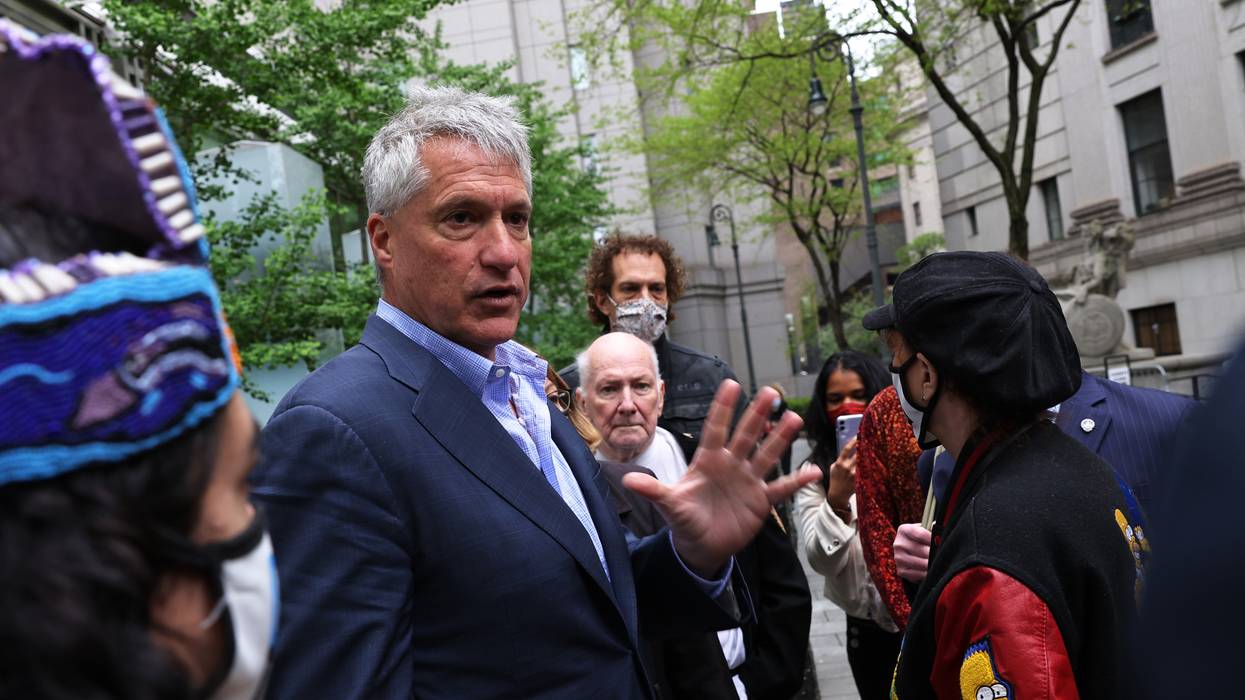
"A pardon would bring a measure of justice to a prosecution that has been widely criticized as a violation of international law... and as a grave threat to free speech," said 14 attorneys backing the climate justice lawyer's request.
After exhausting his options in the judicial system, American attorney Steven Donziger on Wednesday launched a campaign seeking a pardon from U.S. President Joe Biden for his misdemeanor conviction—the result of a process that experts worldwide have condemned as retaliatory for his climate justice work and an abuse of the nation's judiciary.
"No matter where one stands on the political spectrum, we should all be able to agree that what happened to me in the United States should not happen to anybody in any country that adheres to the rule of law," Donziger said in a statement announcing a letter to Biden signed by 14 prominent lawyers and a leader at the advocacy group Amazon Watch.
"Corporations should not be allowed to take direct control of a public prosecution from the government and lock up their critics, as happened to me," asserted Donziger, who spent 993 days in federal prison and on house arrest. "It's an outrageous abuse of power that not only wrecked me and my family's life for three years but also embarrassed our country in the eyes of the world."
"As far as we can tell, this was the nation's first private corporate prosecution and is an obvious violation of the rule of law."
Donziger is a Harvard Law School graduate known globally for representing farmers and Indigenous people in a lawsuit targeting Chevron for polluting communities in Ecuador that resulted in a $9.5 billion judgment against the oil giant. After nearly two decades of battling the attorney in Ecuadorian courts, the company went after him directly in U.S. federal court.
The attorneys backing his pardon request detailed in their letter how Donziger endured a "patently biased prosecution by a group of three Chevron-linked lawyers" for refusing to comply with an order from a U.S. judge—an ex-corporate attorney with investments in the oil giant—to turn over his electronics and client communications to the company.
"As far as we can tell, this was the nation's first private corporate prosecution and is an obvious violation of the rule of law," they wrote to Biden. "As a result of the private prosecution, Mr. Donziger, a resident of New York City, spent close to three years in detention at home and in prison even though the maximum sentence under the law for his misdemeanor offense level was 180 days."
"A pardon would bring a measure of justice to a prosecution that has been widely criticized as a violation of international law by respected international and U.S.-based jurists, and as a grave threat to free speech by a multitude of political leaders and over 120 respected civil society organizations including Amnesty International, Global Witness, and Greenpeace," the lawyers argued.
Critics of the process that resulted in his conviction include the United Nations Working Group on Arbitrary Detention; a team of international trial observers led by Stephen A. Rapp, U.S. ambassador for war crimes under the Obama administration; Judge Steven Menashi, appointed to U.S. Court of Appeals for the 2nd Circuit by former President Donald Trump; and right-wing U.S. Supreme Court Justices Neil Gorsuch and Brett Kavanaugh, who dissented from a decision not to take his case.
"I am inspired by Steven's courage, resilience, and determination," said Paul Paz y Miño of Amazon Watch, who signed the 12-page letter along with the group of attorneys. "That's why Chevron wants to destroy him. Steven's very existence creates enormous financial risk to Chevron and to the oil industry generally. Every fossil fuel industry lawyer in this country fears Steven."
"More broadly, Chevron's outrageous abuse of power and manipulation of the federal judiciary to target Steven should deeply concern every advocate in the country, particularly those who engage in protest," Paz y Miño warned. "What happened to Steven is a central component of the fossil fuel industry's playbook to silence public opposition."
Water Protector Legal Collective director Natali Segovia, one of the lawyers who signed on, similarly condemned legal tactics used by corporations to target environmental campaigners.
"Around the world, human rights defenders like Steven Donziger are targeted and even killed for their advocacy and work on Indigenous rights and environmental justice issues," Segovia said. "Steven's case, however, is emblematic of the weaponization of the law by a powerful corporation against a human rights defender—an attorney, to be exact—and sets a dangerous precedent."
"If it could happen to Steven, a Harvard-trained human rights lawyer, it could happen to anyone on climate frontlines."
"If it could happen to Steven, a Harvard-trained human rights lawyer, it could happen to anyone on climate frontlines," Segovia stressed. "This is what we are guarding against. This is why a pardon for Steven barely hits the tip of the iceberg to reverse course, but is a necessary step in ensuring fundamental rights of due process and human rights in the United States."
The other lawyers supporting Donziger—who hail from prestigious universities and groups such as the Center for Constitutional Rights—are Nadia Ahmad, Baher Azmy, Scott Wilson Badenoch, Terrence Collingsworth, Aaron Fellmeth, Richard Friedman, Martin Garbus, Jeffrey Haas, Ronald Kuby, Jeanne Mirer, Aaron Marr Page, Nadine Strossen, and Michael Tigar.
Along with thanking "from the bottom of my heart the many distinguished lawyers who have agreed to represent me in this campaign," Donziger called on the Biden administration to investigate Chevron for abusing the U.S. legal system.
Donziger also said that it remains "critical that people focus on what is of paramount importance, which is the plight of the thousands of people in Ecuador who face a serious risk of death if Chevron does not comply with the rule of law."

"Politicians don't have the right to intimidate artists and their fans by banning performances," the outspoken human rights activist and Pink Floyd co-founder has said.
A German court on Monday ruled that the city of Frankfurt cannot cancel an upcoming Roger Waters concert amid accusations of antisemitism stemming from the Pink Floyd co-founder's outspoken criticism of Israeli apartheid and other crimes against Palestinians.
Deutsche Welle reports an administrative court in Frankfurt ruled that concert organizer Messe Frankfurt, the state of Hesse, and the city are obliged "to make it possible for Waters to stage the concert"—part of the 79-year-old English rocker's "This Is Not a Drill!" tour—on May 29 as contractually agreed. The city and state had ordered Mess Frankfurt to cancel the show, calling Waters one of the "world's most influential antisemites."
"Politicians don't have the right to intimidate artists and their fans by banning performances," Waters said before the case. "I am fighting for all of our human rights, including the right to free speech."
"I want to state for the record and once and for all that I am not and never have been antisemitic and nothing that anyone can say or publish will alter that," Waters wrote last month. "My well-publicized views relate entirely to the policies and actions of the Israeli government and not with the peoples of Israel."
While Josef Schuster, president of the Central Council of Jews in Germany, said he was "baffled" by the court's ruling, Waters' supporters hailed what human rights defender Steven Donziger called "a win for artistic freedom."
Palestinian rights activist Sarah Wilkinson said the decision represents "an epic fail for the Israel lobby."
In suing to stop the Frankfurt concert, state and city officials cited the artist's support for the nonviolent Boycott, Divestment, and Sanctions (BDS) movement for Palestinian human rights—many of whose prominent members are Jewish—as well as his display of a pig-shaped balloon marked with a Star of David during his shows and his comparisons of Israel with apartheid-era South Africa as justification for canceling the performance.
Senior South African officials have condemned Israeli apartheid, which is being acknowledged by a growing number of human rights groups around the world, including in Israel.
While the court found that it may be in "especially poor taste" to let Waters perform at the Frankfurt Festhalle—where 3,000 Jews were imprisoned before being shipped off to concentration camps during the Holocaust—the tribunal said the concert would "not be injurious to the human dignity of those people."
The court also said that although Waters' concerts feature "symbolism manifestly based on that of the National Socialist regime," the shows can be "viewed as a work of art" that "did not glorify or relativize the crimes of the Nazis or identify with Nazi racist ideology."
In an opinion piece published last month by Common Dreams, Vijay Prashad and Katie Halper—who launched a petition in support of Waters signed by more than 36,000 people—wrote that "in a more civilized world," Frankfurt "would be giving the well-known musician an award for his courage, not trying to silence him with state censorship for his criticism of Israeli apartheid."