SUBSCRIBE TO OUR FREE NEWSLETTER
Daily news & progressive opinion—funded by the people, not the corporations—delivered straight to your inbox.
5
#000000
#FFFFFF
To donate by check, phone, or other method, see our More Ways to Give page.
Daily news & progressive opinion—funded by the people, not the corporations—delivered straight to your inbox.
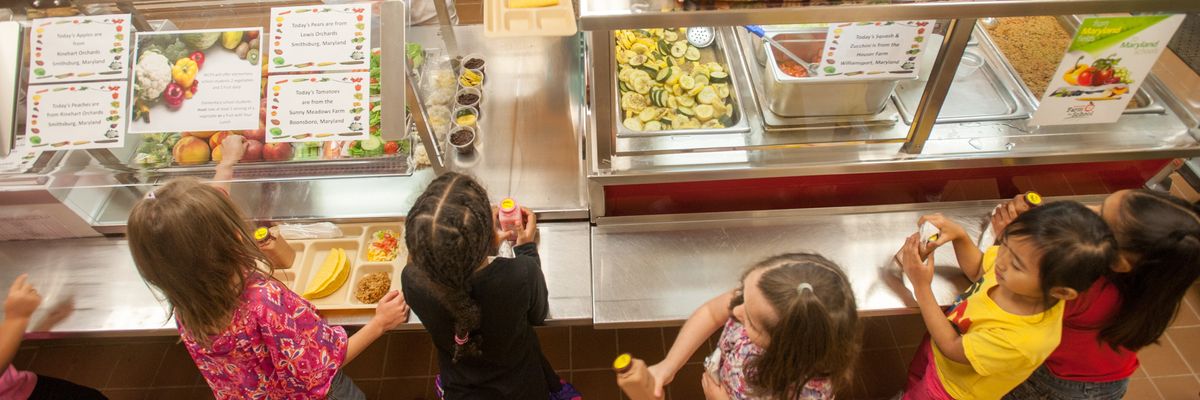
Elementary school children line up in a cafeteria during lunchtime Hagerstown, Maryland on September 22, 2013.
U.S. Sen. John Fetterman said the aim of the bill is to "stop humiliating kids and penalizing hunger."
As children across the United States have started a new academic year over the past month, many families have had to contend with federal lawmakers' refusal to guarantee universal free meals and the resulting "lunch shaming"—which three U.S. Senate Democrats hope to partially combat with new legislation to cancel student lunch debt nationwide.
"'School lunch debt' is a term so absurd that it shouldn't even exist," Sen. John Fetterman (D-Pa.) declared in a statement Monday. "That's why I'm proud to introduce this bill to cancel the nation's student meal debt and stop humiliating kids and penalizing hunger."
"It's time to come together and stop playing political games with Americans' access to food," he added. "September is Hunger Action Month and I'm proud to be introducing this bill to help working families now, while we work to move our other priorities to combat food insecurity in our nation."
Fetterman—who chairs the Senate Committee on Agriculture, Nutrition, and Forestry's Subcommittee on Food and Nutrition, Specialty Crops, Organics, and Research—is leading the fight for the School Lunch Debt Cancellation Act with Sens. Sheldon Whitehouse (D-R.I.) and Peter Welch (D-Vt.).
"No child in Rhode Island—or anywhere in America—should be penalized for not being able to afford school lunch. It's that simple," asserted Whitehouse. "Our legislation will eliminate lunch debt in schools, supporting every child's access to a healthy meal and positioning them for long-term success."
Welch agreed, saying: "Our students shouldn't have to worry about how they're paying for lunch—full stop. I'm proud to partner with my colleagues Sen. Fetterman and Whitehouse on this commonsense bill, and urge my colleagues to stand with us."
Congress initially responded to the Covid-19 pandemic by enabling public schools to provide free breakfast and lunch to all 50 million children nationwide, but Republicans blocked the continuation that policy last year. Instead, lawmakers passed the Keep Kids Fed Act, a bipartisan compromise that increased federal reimbursement rates for programs serving low-income students. However, as Common Dreams reported in January, only around a quarter of districts that responded to a survey from the School Nutrition Association said those levels are sufficient, and 99.2% had concerns about raised rates expiring.
Further burdening American families trying to feed children amid food companies' price gouging, congressional Republicans and right-wing Sen. Joe Manchin (D-W.Va.) also killed the pandemic-era expansion of the child tax credit—a move that contributed to the U.S. child poverty rate more than doubling in 2022 compared with the previous year, according to data released this month.
"Prior to the pandemic, some schools had resorted to tactics that embarrassed kids, such as stamping their hands to remind parents of unpaid bills and substituting cold cheese sandwiches for hot meals," Civil Eats reported Monday. "Sometimes meals were thrown out in front of the children. And while experts say that fewer districts have resumed these practices—often dubbed 'lunch shaming'—they haven't gone away entirely either."
Crystal FitzSimons, director of school and out-of-school time programs at the Research and Action Center (FRAC), told the outlet, "Schools, families, and states really did not want to go back to having the complicated school nutrition operations where some kids have access to free meals and other kids do not, and they have to struggle with unpaid debt."
The families of almost half a million food insecure children in Pennsylvania collectively owe nearly $80 million in public school lunch debt, according to Fetterman's office. Nationally, more than 30 million kids can't afford their school meals and the total debt is $262 million annually.
California, Colorado, Maine, Massachusetts, Minnesota, New Mexico, and Vermont have all guaranteed universal free school meals, and Michigan and Nevada have programs in place for the 2023-24 school year. While lawmakers in other states are working to pass similar bills, advocates have called for federal legislation to ensure all schoolchildren are fed.
In addition to the new debt cancellation bill, Fetterman is among the co-sponsors of the Universal School Meals Program Act, reintroduced in May by Sen. Bernie Sanders (I-Vt.) and Rep. Ilhan Omar (D-Minn.).
"It is downright cruel that we are letting our children in America go hungry," Fetterman said at the time. "No child in America should be worried about if they are going to be able to get breakfast, lunch, or dinner. I am proud and honored to co-sponsor this bill that will finally make sure that our children are fed."
This post has been updated with the latest details about programs in Michigan and Nevada.
Dear Common Dreams reader, It’s been nearly 30 years since I co-founded Common Dreams with my late wife, Lina Newhouser. We had the radical notion that journalism should serve the public good, not corporate profits. It was clear to us from the outset what it would take to build such a project. No paid advertisements. No corporate sponsors. No millionaire publisher telling us what to think or do. Many people said we wouldn't last a year, but we proved those doubters wrong. Together with a tremendous team of journalists and dedicated staff, we built an independent media outlet free from the constraints of profits and corporate control. Our mission has always been simple: To inform. To inspire. To ignite change for the common good. Building Common Dreams was not easy. Our survival was never guaranteed. When you take on the most powerful forces—Wall Street greed, fossil fuel industry destruction, Big Tech lobbyists, and uber-rich oligarchs who have spent billions upon billions rigging the economy and democracy in their favor—the only bulwark you have is supporters who believe in your work. But here’s the urgent message from me today. It's never been this bad out there. And it's never been this hard to keep us going. At the very moment Common Dreams is most needed, the threats we face are intensifying. We need your support now more than ever. We don't accept corporate advertising and never will. We don't have a paywall because we don't think people should be blocked from critical news based on their ability to pay. Everything we do is funded by the donations of readers like you. When everyone does the little they can afford, we are strong. But if that support retreats or dries up, so do we. Will you donate now to make sure Common Dreams not only survives but thrives? —Craig Brown, Co-founder |
As children across the United States have started a new academic year over the past month, many families have had to contend with federal lawmakers' refusal to guarantee universal free meals and the resulting "lunch shaming"—which three U.S. Senate Democrats hope to partially combat with new legislation to cancel student lunch debt nationwide.
"'School lunch debt' is a term so absurd that it shouldn't even exist," Sen. John Fetterman (D-Pa.) declared in a statement Monday. "That's why I'm proud to introduce this bill to cancel the nation's student meal debt and stop humiliating kids and penalizing hunger."
"It's time to come together and stop playing political games with Americans' access to food," he added. "September is Hunger Action Month and I'm proud to be introducing this bill to help working families now, while we work to move our other priorities to combat food insecurity in our nation."
Fetterman—who chairs the Senate Committee on Agriculture, Nutrition, and Forestry's Subcommittee on Food and Nutrition, Specialty Crops, Organics, and Research—is leading the fight for the School Lunch Debt Cancellation Act with Sens. Sheldon Whitehouse (D-R.I.) and Peter Welch (D-Vt.).
"No child in Rhode Island—or anywhere in America—should be penalized for not being able to afford school lunch. It's that simple," asserted Whitehouse. "Our legislation will eliminate lunch debt in schools, supporting every child's access to a healthy meal and positioning them for long-term success."
Welch agreed, saying: "Our students shouldn't have to worry about how they're paying for lunch—full stop. I'm proud to partner with my colleagues Sen. Fetterman and Whitehouse on this commonsense bill, and urge my colleagues to stand with us."
Congress initially responded to the Covid-19 pandemic by enabling public schools to provide free breakfast and lunch to all 50 million children nationwide, but Republicans blocked the continuation that policy last year. Instead, lawmakers passed the Keep Kids Fed Act, a bipartisan compromise that increased federal reimbursement rates for programs serving low-income students. However, as Common Dreams reported in January, only around a quarter of districts that responded to a survey from the School Nutrition Association said those levels are sufficient, and 99.2% had concerns about raised rates expiring.
Further burdening American families trying to feed children amid food companies' price gouging, congressional Republicans and right-wing Sen. Joe Manchin (D-W.Va.) also killed the pandemic-era expansion of the child tax credit—a move that contributed to the U.S. child poverty rate more than doubling in 2022 compared with the previous year, according to data released this month.
"Prior to the pandemic, some schools had resorted to tactics that embarrassed kids, such as stamping their hands to remind parents of unpaid bills and substituting cold cheese sandwiches for hot meals," Civil Eats reported Monday. "Sometimes meals were thrown out in front of the children. And while experts say that fewer districts have resumed these practices—often dubbed 'lunch shaming'—they haven't gone away entirely either."
Crystal FitzSimons, director of school and out-of-school time programs at the Research and Action Center (FRAC), told the outlet, "Schools, families, and states really did not want to go back to having the complicated school nutrition operations where some kids have access to free meals and other kids do not, and they have to struggle with unpaid debt."
The families of almost half a million food insecure children in Pennsylvania collectively owe nearly $80 million in public school lunch debt, according to Fetterman's office. Nationally, more than 30 million kids can't afford their school meals and the total debt is $262 million annually.
California, Colorado, Maine, Massachusetts, Minnesota, New Mexico, and Vermont have all guaranteed universal free school meals, and Michigan and Nevada have programs in place for the 2023-24 school year. While lawmakers in other states are working to pass similar bills, advocates have called for federal legislation to ensure all schoolchildren are fed.
In addition to the new debt cancellation bill, Fetterman is among the co-sponsors of the Universal School Meals Program Act, reintroduced in May by Sen. Bernie Sanders (I-Vt.) and Rep. Ilhan Omar (D-Minn.).
"It is downright cruel that we are letting our children in America go hungry," Fetterman said at the time. "No child in America should be worried about if they are going to be able to get breakfast, lunch, or dinner. I am proud and honored to co-sponsor this bill that will finally make sure that our children are fed."
This post has been updated with the latest details about programs in Michigan and Nevada.
As children across the United States have started a new academic year over the past month, many families have had to contend with federal lawmakers' refusal to guarantee universal free meals and the resulting "lunch shaming"—which three U.S. Senate Democrats hope to partially combat with new legislation to cancel student lunch debt nationwide.
"'School lunch debt' is a term so absurd that it shouldn't even exist," Sen. John Fetterman (D-Pa.) declared in a statement Monday. "That's why I'm proud to introduce this bill to cancel the nation's student meal debt and stop humiliating kids and penalizing hunger."
"It's time to come together and stop playing political games with Americans' access to food," he added. "September is Hunger Action Month and I'm proud to be introducing this bill to help working families now, while we work to move our other priorities to combat food insecurity in our nation."
Fetterman—who chairs the Senate Committee on Agriculture, Nutrition, and Forestry's Subcommittee on Food and Nutrition, Specialty Crops, Organics, and Research—is leading the fight for the School Lunch Debt Cancellation Act with Sens. Sheldon Whitehouse (D-R.I.) and Peter Welch (D-Vt.).
"No child in Rhode Island—or anywhere in America—should be penalized for not being able to afford school lunch. It's that simple," asserted Whitehouse. "Our legislation will eliminate lunch debt in schools, supporting every child's access to a healthy meal and positioning them for long-term success."
Welch agreed, saying: "Our students shouldn't have to worry about how they're paying for lunch—full stop. I'm proud to partner with my colleagues Sen. Fetterman and Whitehouse on this commonsense bill, and urge my colleagues to stand with us."
Congress initially responded to the Covid-19 pandemic by enabling public schools to provide free breakfast and lunch to all 50 million children nationwide, but Republicans blocked the continuation that policy last year. Instead, lawmakers passed the Keep Kids Fed Act, a bipartisan compromise that increased federal reimbursement rates for programs serving low-income students. However, as Common Dreams reported in January, only around a quarter of districts that responded to a survey from the School Nutrition Association said those levels are sufficient, and 99.2% had concerns about raised rates expiring.
Further burdening American families trying to feed children amid food companies' price gouging, congressional Republicans and right-wing Sen. Joe Manchin (D-W.Va.) also killed the pandemic-era expansion of the child tax credit—a move that contributed to the U.S. child poverty rate more than doubling in 2022 compared with the previous year, according to data released this month.
"Prior to the pandemic, some schools had resorted to tactics that embarrassed kids, such as stamping their hands to remind parents of unpaid bills and substituting cold cheese sandwiches for hot meals," Civil Eats reported Monday. "Sometimes meals were thrown out in front of the children. And while experts say that fewer districts have resumed these practices—often dubbed 'lunch shaming'—they haven't gone away entirely either."
Crystal FitzSimons, director of school and out-of-school time programs at the Research and Action Center (FRAC), told the outlet, "Schools, families, and states really did not want to go back to having the complicated school nutrition operations where some kids have access to free meals and other kids do not, and they have to struggle with unpaid debt."
The families of almost half a million food insecure children in Pennsylvania collectively owe nearly $80 million in public school lunch debt, according to Fetterman's office. Nationally, more than 30 million kids can't afford their school meals and the total debt is $262 million annually.
California, Colorado, Maine, Massachusetts, Minnesota, New Mexico, and Vermont have all guaranteed universal free school meals, and Michigan and Nevada have programs in place for the 2023-24 school year. While lawmakers in other states are working to pass similar bills, advocates have called for federal legislation to ensure all schoolchildren are fed.
In addition to the new debt cancellation bill, Fetterman is among the co-sponsors of the Universal School Meals Program Act, reintroduced in May by Sen. Bernie Sanders (I-Vt.) and Rep. Ilhan Omar (D-Minn.).
"It is downright cruel that we are letting our children in America go hungry," Fetterman said at the time. "No child in America should be worried about if they are going to be able to get breakfast, lunch, or dinner. I am proud and honored to co-sponsor this bill that will finally make sure that our children are fed."
This post has been updated with the latest details about programs in Michigan and Nevada.