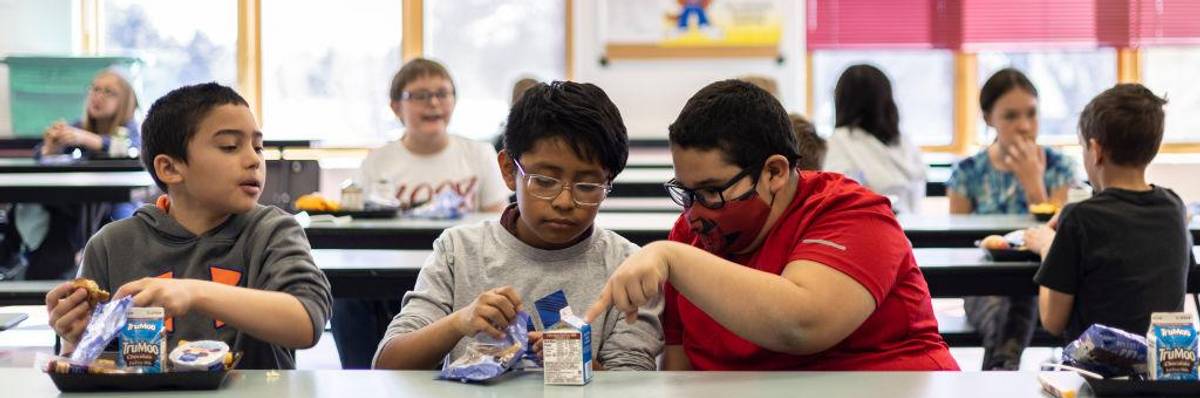
Students eat lunch at Palmer Lake Elementary School on February 28, 2022 in Monument, Colorado.
Soaring School Lunch Debt Shows Need for Universal Free Meals
"Access to good nutrition should not depend on where a child lives or their family finances!" said one group.
Congress initially responded to the Covid-19 pandemic by enabling U.S. public schools to provide free breakfast and lunch to all 50 million children, but Republicans blocked a continuation of the program last summer—and now, districts and kids are suffering.
Halfway through the academic year, the nonprofit School Nutrition Association (SNA) on Wednesday released the results of a November survey that shows school meal programs are struggling with increasing costs, staff and menu item shortages, and unpaid charges.
"Congress has an opportunity to protect this critical lifeline."
Last June, Congress passed the Keep Kids Fed Act, bipartisan compromise legislation that increased the federal reimbursement rates for the National School Lunch Program (NSLP) by 40 cents and the School Breakfast Program (SBP) by 15 cents for the 2022-23 school year.
However, only around a quarter of the 1,230 districts that responded to SNA's survey said those levels are sufficient, and 99.2% of them have moderate or serious concern about the raised rates expiring.
Additionally, a majority of districts that charge for meals said that the loss of the federal pandemic waiver enabling them to feed all students led to a rise in unpaid meal debt (96.3%), complaints and concerns from families (86.8%), administrative burden (86.5%), and stigma for low-income students (66.8%).
Over two-thirds of the districts reported unpaid meal debt collectively totaling $19.2 million. By district, debt ranged from just $15 to $1.7 million, but the median was $5,164.
A new position paper outlines SNA's primary recommendations:
- Make permanent the Keep Kids Fed Act reimbursement rates;
- Expand NSLP/SBP to offer healthy school meals for all students at no charge;
- Ensure the U.S. Department of Agriculture maintains current nutrition standards; and
- Reduce administrative and regulatory burdens.
"School meal programs are at a tipping point as rising costs, persistent supply chain issues, and labor shortages jeopardize their long-term sustainability," said SNA president Lori Adkins. "Congress has an opportunity to protect this critical lifeline by making reimbursement increases permanent and allowing us to offer free meals to ensure all students are nourished during the school day."
SNA is far from alone in demanding congressional action—though the dynamic on Capitol Hill is even more complicated now than it was last summer, since a divided Republican Party took narrow control of the U.S. House of Representatives last week.
"We are experiencing cost increases in food, supplies, and labor like we have never seen before, and the meal reimbursement rate is not sufficient to cover the costs," Katie Wilson, executive director of the Urban School Food Alliance, a nonprofit created by school food service professionals, told The Washington Post, which reported on the SNA survey.
"We are witnessing large negative balances in schools since free meals have been discontinued," Wilson added, noting that some districts have started giving children with certain levels of debt alternate, lesser meals.
Highlighting that school meal policies vary by state and district, Wilson's organization
tweeted Wednesday that "access to good nutrition should not depend on where a child lives or their family finances!"
As USA Today—which also reported on SNA's survey Wednesday—detailed:
After pandemic-era waivers granting universal schools meal expired at the start of the school year, some states effectively extended them this school year, including Massachusetts, Nevada, Vermont, and Pennsylvania.
California, Maine, and now Colorado are the only states with laws ensuring permanent universal meal programs for all children, regardless of parents' income.
A few districts, including Chicago and New York City, also offer free meals to kids.
However, Donna Martin, nutrition director for the Burke County school district in Georgia, warned the Post that "doing universal school meals state by state is way too piecemeal and will ultimately leave needy students out."
"School districts are incurring hundreds of thousands of dollars in school meal debt that the school districts' budgets—not school nutrition—will eventually have to cover," Martin stressed. "This takes dollars away from teaching and learning."
Elliot Haspel, author of Crawling Behind: America's Child Care Crisis and How to Fix It, said in a series of tweets Wednesday that "I, too, dislike the state-by-state approach. HOWEVER, given the political makeup of Congress, I think every state that can needs to be passing universal school meals (at solid reimbursement rates) during the '23 legislative session."
We are at a crossroads
This country and this world are at a monumental crossroads. In a few short weeks, US voters will have an opportunity to beat back the forces of fascism and confront the billionaires who are rigging the economy, our media system, and our democracy, making it increasingly impossible for ordinary people to get by. We’re not just talking about the election. We’re talking about what must be done once these fascist elements are vanquished from power. We need a bolder set of solutions than what either major party has so far been willing to offer and a working-class movement ready to fight like hell for it. Trump didn't emerge from nowhere. The conditions that fueled MAGA authoritarianism were created by decades of radical neoliberal economic policies and a corrupt political system dominated by corporate interests. They slashed taxes on the super-rich, promising that the benefits would trickle down. They said giveaways to the corporate titans would make life more affordable for the rest of us. It was all bullshit. And when a bitter, betrayed populace searches for someone to blame, right-wing demagogues have little trouble finding scapegoats. People know when they're being lied to, but you won't hear any of this from the corporate media. Only independent journalism—powered and funded by people who believe in building a better world—can deliver truly trustworthy daily news. Our Fall Campaign is underway, and we need your help. To power our newsroom through the rest of the year, we need to raise $125,000 by midnight on October 31. So if you share our vision, please contribute whatever you can to sustain our work. |
Congress initially responded to the Covid-19 pandemic by enabling U.S. public schools to provide free breakfast and lunch to all 50 million children, but Republicans blocked a continuation of the program last summer—and now, districts and kids are suffering.
Halfway through the academic year, the nonprofit School Nutrition Association (SNA) on Wednesday released the results of a November survey that shows school meal programs are struggling with increasing costs, staff and menu item shortages, and unpaid charges.
"Congress has an opportunity to protect this critical lifeline."
Last June, Congress passed the Keep Kids Fed Act, bipartisan compromise legislation that increased the federal reimbursement rates for the National School Lunch Program (NSLP) by 40 cents and the School Breakfast Program (SBP) by 15 cents for the 2022-23 school year.
However, only around a quarter of the 1,230 districts that responded to SNA's survey said those levels are sufficient, and 99.2% of them have moderate or serious concern about the raised rates expiring.
Additionally, a majority of districts that charge for meals said that the loss of the federal pandemic waiver enabling them to feed all students led to a rise in unpaid meal debt (96.3%), complaints and concerns from families (86.8%), administrative burden (86.5%), and stigma for low-income students (66.8%).
Over two-thirds of the districts reported unpaid meal debt collectively totaling $19.2 million. By district, debt ranged from just $15 to $1.7 million, but the median was $5,164.
A new position paper outlines SNA's primary recommendations:
- Make permanent the Keep Kids Fed Act reimbursement rates;
- Expand NSLP/SBP to offer healthy school meals for all students at no charge;
- Ensure the U.S. Department of Agriculture maintains current nutrition standards; and
- Reduce administrative and regulatory burdens.
"School meal programs are at a tipping point as rising costs, persistent supply chain issues, and labor shortages jeopardize their long-term sustainability," said SNA president Lori Adkins. "Congress has an opportunity to protect this critical lifeline by making reimbursement increases permanent and allowing us to offer free meals to ensure all students are nourished during the school day."
SNA is far from alone in demanding congressional action—though the dynamic on Capitol Hill is even more complicated now than it was last summer, since a divided Republican Party took narrow control of the U.S. House of Representatives last week.
"We are experiencing cost increases in food, supplies, and labor like we have never seen before, and the meal reimbursement rate is not sufficient to cover the costs," Katie Wilson, executive director of the Urban School Food Alliance, a nonprofit created by school food service professionals, told The Washington Post, which reported on the SNA survey.
"We are witnessing large negative balances in schools since free meals have been discontinued," Wilson added, noting that some districts have started giving children with certain levels of debt alternate, lesser meals.
Highlighting that school meal policies vary by state and district, Wilson's organization
tweeted Wednesday that "access to good nutrition should not depend on where a child lives or their family finances!"
As USA Today—which also reported on SNA's survey Wednesday—detailed:
After pandemic-era waivers granting universal schools meal expired at the start of the school year, some states effectively extended them this school year, including Massachusetts, Nevada, Vermont, and Pennsylvania.
California, Maine, and now Colorado are the only states with laws ensuring permanent universal meal programs for all children, regardless of parents' income.
A few districts, including Chicago and New York City, also offer free meals to kids.
However, Donna Martin, nutrition director for the Burke County school district in Georgia, warned the Post that "doing universal school meals state by state is way too piecemeal and will ultimately leave needy students out."
"School districts are incurring hundreds of thousands of dollars in school meal debt that the school districts' budgets—not school nutrition—will eventually have to cover," Martin stressed. "This takes dollars away from teaching and learning."
Elliot Haspel, author of Crawling Behind: America's Child Care Crisis and How to Fix It, said in a series of tweets Wednesday that "I, too, dislike the state-by-state approach. HOWEVER, given the political makeup of Congress, I think every state that can needs to be passing universal school meals (at solid reimbursement rates) during the '23 legislative session."
- Paul and Blackburn Among GOP Senators Opposing Extension of School Meal Program ›
- Free School Meal Waivers Set to Expire as Senate Pushes $857 Billion Military Budget ›
- 'Disaster for Millions of Kids' Looms as GOP Obstruction Threatens School Meal Programs ›
- 'This Is Evil': McConnell Blocking Extension of Free School Lunch Waivers ›
- Calls Mount for US to Provide Free School Meals to All Children ›
- 'Not on My Watch': Dems Vow To Oppose GOP Attack on Free School Meals ›
- Senate Dems Want to Cancel All Student Lunch Debt—A 'Term So Absurd That It Shouldn't Even Exist' ›
- School lunch debt: How widespread is it in the US? - BBC News ›
- Student School Meal Debt Is Ballooning in Many Districts. Here's Why ›
- 75% of US school districts report student meal debt. Here's what ... ›
- Schools are swamped by unpaid lunch debt, nutrition group says ›
- School lunch debt returns as federal meal program comes to a halt ›
Congress initially responded to the Covid-19 pandemic by enabling U.S. public schools to provide free breakfast and lunch to all 50 million children, but Republicans blocked a continuation of the program last summer—and now, districts and kids are suffering.
Halfway through the academic year, the nonprofit School Nutrition Association (SNA) on Wednesday released the results of a November survey that shows school meal programs are struggling with increasing costs, staff and menu item shortages, and unpaid charges.
"Congress has an opportunity to protect this critical lifeline."
Last June, Congress passed the Keep Kids Fed Act, bipartisan compromise legislation that increased the federal reimbursement rates for the National School Lunch Program (NSLP) by 40 cents and the School Breakfast Program (SBP) by 15 cents for the 2022-23 school year.
However, only around a quarter of the 1,230 districts that responded to SNA's survey said those levels are sufficient, and 99.2% of them have moderate or serious concern about the raised rates expiring.
Additionally, a majority of districts that charge for meals said that the loss of the federal pandemic waiver enabling them to feed all students led to a rise in unpaid meal debt (96.3%), complaints and concerns from families (86.8%), administrative burden (86.5%), and stigma for low-income students (66.8%).
Over two-thirds of the districts reported unpaid meal debt collectively totaling $19.2 million. By district, debt ranged from just $15 to $1.7 million, but the median was $5,164.
A new position paper outlines SNA's primary recommendations:
- Make permanent the Keep Kids Fed Act reimbursement rates;
- Expand NSLP/SBP to offer healthy school meals for all students at no charge;
- Ensure the U.S. Department of Agriculture maintains current nutrition standards; and
- Reduce administrative and regulatory burdens.
"School meal programs are at a tipping point as rising costs, persistent supply chain issues, and labor shortages jeopardize their long-term sustainability," said SNA president Lori Adkins. "Congress has an opportunity to protect this critical lifeline by making reimbursement increases permanent and allowing us to offer free meals to ensure all students are nourished during the school day."
SNA is far from alone in demanding congressional action—though the dynamic on Capitol Hill is even more complicated now than it was last summer, since a divided Republican Party took narrow control of the U.S. House of Representatives last week.
"We are experiencing cost increases in food, supplies, and labor like we have never seen before, and the meal reimbursement rate is not sufficient to cover the costs," Katie Wilson, executive director of the Urban School Food Alliance, a nonprofit created by school food service professionals, told The Washington Post, which reported on the SNA survey.
"We are witnessing large negative balances in schools since free meals have been discontinued," Wilson added, noting that some districts have started giving children with certain levels of debt alternate, lesser meals.
Highlighting that school meal policies vary by state and district, Wilson's organization
tweeted Wednesday that "access to good nutrition should not depend on where a child lives or their family finances!"
As USA Today—which also reported on SNA's survey Wednesday—detailed:
After pandemic-era waivers granting universal schools meal expired at the start of the school year, some states effectively extended them this school year, including Massachusetts, Nevada, Vermont, and Pennsylvania.
California, Maine, and now Colorado are the only states with laws ensuring permanent universal meal programs for all children, regardless of parents' income.
A few districts, including Chicago and New York City, also offer free meals to kids.
However, Donna Martin, nutrition director for the Burke County school district in Georgia, warned the Post that "doing universal school meals state by state is way too piecemeal and will ultimately leave needy students out."
"School districts are incurring hundreds of thousands of dollars in school meal debt that the school districts' budgets—not school nutrition—will eventually have to cover," Martin stressed. "This takes dollars away from teaching and learning."
Elliot Haspel, author of Crawling Behind: America's Child Care Crisis and How to Fix It, said in a series of tweets Wednesday that "I, too, dislike the state-by-state approach. HOWEVER, given the political makeup of Congress, I think every state that can needs to be passing universal school meals (at solid reimbursement rates) during the '23 legislative session."
- Paul and Blackburn Among GOP Senators Opposing Extension of School Meal Program ›
- Free School Meal Waivers Set to Expire as Senate Pushes $857 Billion Military Budget ›
- 'Disaster for Millions of Kids' Looms as GOP Obstruction Threatens School Meal Programs ›
- 'This Is Evil': McConnell Blocking Extension of Free School Lunch Waivers ›
- Calls Mount for US to Provide Free School Meals to All Children ›
- 'Not on My Watch': Dems Vow To Oppose GOP Attack on Free School Meals ›
- Senate Dems Want to Cancel All Student Lunch Debt—A 'Term So Absurd That It Shouldn't Even Exist' ›
- School lunch debt: How widespread is it in the US? - BBC News ›
- Student School Meal Debt Is Ballooning in Many Districts. Here's Why ›
- 75% of US school districts report student meal debt. Here's what ... ›
- Schools are swamped by unpaid lunch debt, nutrition group says ›
- School lunch debt returns as federal meal program comes to a halt ›