

SUBSCRIBE TO OUR FREE NEWSLETTER
Daily news & progressive opinion—funded by the people, not the corporations—delivered straight to your inbox.
5
#000000
#FFFFFF
To donate by check, phone, or other method, see our More Ways to Give page.
Daily news & progressive opinion—funded by the people, not the corporations—delivered straight to your inbox.
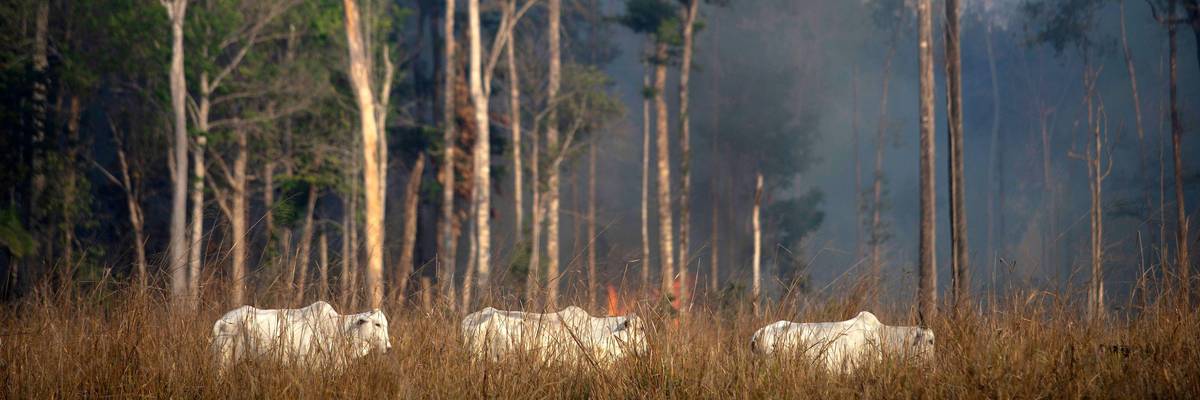
This photo shows cattle with fire behind them in the Amazon rainforest near Novo Progresso, Pará state, Brazil, on August 25, 2019.
"The invaders and their main business partners—loggers and meatpacking companies—make the profits their own while passing on to society the costs of environmental damage," notes one of numerous lawsuits.
A Brazilian judge on Thursday ordered two slaughterhouses and three ranchers to pay $764,000 in combined penalties for trading cattle raised in a protected area of the Amazon rainforest.
The decision by Judge Inês Moreira da Costa in Rondônia—the most severely deforested state in the Brazilian Amazon—came in response to a flurry of lawsuits filed by green groups seeking millions of dollars in damages from defendants including Distriboi and Frigon, two meat processing firms accused of trading cattle in the Jaci-Parana protected zone.
"When a slaughterhouse, whether by negligence or intent, buys and resells products from invaded and illegally deforested reserves, it is clear that it is directly benefiting from these illegal activities," the plaintiffs' complaint states. "In such cases, there is an undeniable connection between the company's actions and the environmental damage caused by the illegal exploitation."
The slaughterhouses and ranchers are but two of numerous parties being sued, including other ranchers and JBS, the Brazilian meat giant that bills itself as the world's largest protein producer.
According to The Associated Press—whose reporting on the cattle trading documents prompted the lawsuits:
Brazilian law forbids commercial cattle inside a protected area, yet some 210,000 head are being grazed inside Jaci-Parana, according to the state animal division. With almost 80% of its forest destroyed, it ranks as the most ravaged conservation unit in the Brazilian Amazon. A court filing pegs damages in the reserve at some $1 billion.
The plaintiffs in the lawsuits are seeking to put a price on the destruction of old-growth rainforest, asserting that "the invaders and their main business partners—loggers and meatpacking companies—make the profits their own while passing on to society the costs of environmental damage."
The Amazon rainforest is one of the world's most biodiverse ecosystems and is a crucial carbon sink, meaning it absorbs carbon dioxide from the atmosphere.
The world lost around 3.7 million hectares of primary tropical forests last year—a rate of approximately 10 soccer fields per minute, according to data from the University of Maryland's Global Land Analysis and Discover laboratory. While this marked a 9% reduction in deforestation compared with 2022, the overall deforestation rate is roughly the same as in 2019 and 2021. Felling trees released 2.4 metric gigatons of climate pollution into the atmosphere in 2023, or almost half of all annual U.S. emissions from burning fossil fuels.
In Brazil, the government of leftist President Luiz Inácio Lula da Silva has taken steps to combat deforestation, resulting in a more than one-third reduction in forest loss. Progress in reversing the rampant forest destruction wrought by the previous far-right administration of former Brazilian President Jair Bolsonaro—who was nicknamed "Captain Chainsaw"—were partially offset by a 43% spike in deforestation in the Cerrado region last year.
Earlier this year, Marcel Gomes—a Brazilian journalist who worked with colleagues at Repórter Brasil to coordinate "a complex, international campaign that directly linked beef from JBS... to illegal deforestation"—was one of seven winners of the prestigious Goldman Environmental Prize.
Dear Common Dreams reader, It’s been nearly 30 years since I co-founded Common Dreams with my late wife, Lina Newhouser. We had the radical notion that journalism should serve the public good, not corporate profits. It was clear to us from the outset what it would take to build such a project. No paid advertisements. No corporate sponsors. No millionaire publisher telling us what to think or do. Many people said we wouldn't last a year, but we proved those doubters wrong. Together with a tremendous team of journalists and dedicated staff, we built an independent media outlet free from the constraints of profits and corporate control. Our mission has always been simple: To inform. To inspire. To ignite change for the common good. Building Common Dreams was not easy. Our survival was never guaranteed. When you take on the most powerful forces—Wall Street greed, fossil fuel industry destruction, Big Tech lobbyists, and uber-rich oligarchs who have spent billions upon billions rigging the economy and democracy in their favor—the only bulwark you have is supporters who believe in your work. But here’s the urgent message from me today. It's never been this bad out there. And it's never been this hard to keep us going. At the very moment Common Dreams is most needed, the threats we face are intensifying. We need your support now more than ever. We don't accept corporate advertising and never will. We don't have a paywall because we don't think people should be blocked from critical news based on their ability to pay. Everything we do is funded by the donations of readers like you. When everyone does the little they can afford, we are strong. But if that support retreats or dries up, so do we. Will you donate now to make sure Common Dreams not only survives but thrives? —Craig Brown, Co-founder |
A Brazilian judge on Thursday ordered two slaughterhouses and three ranchers to pay $764,000 in combined penalties for trading cattle raised in a protected area of the Amazon rainforest.
The decision by Judge Inês Moreira da Costa in Rondônia—the most severely deforested state in the Brazilian Amazon—came in response to a flurry of lawsuits filed by green groups seeking millions of dollars in damages from defendants including Distriboi and Frigon, two meat processing firms accused of trading cattle in the Jaci-Parana protected zone.
"When a slaughterhouse, whether by negligence or intent, buys and resells products from invaded and illegally deforested reserves, it is clear that it is directly benefiting from these illegal activities," the plaintiffs' complaint states. "In such cases, there is an undeniable connection between the company's actions and the environmental damage caused by the illegal exploitation."
The slaughterhouses and ranchers are but two of numerous parties being sued, including other ranchers and JBS, the Brazilian meat giant that bills itself as the world's largest protein producer.
According to The Associated Press—whose reporting on the cattle trading documents prompted the lawsuits:
Brazilian law forbids commercial cattle inside a protected area, yet some 210,000 head are being grazed inside Jaci-Parana, according to the state animal division. With almost 80% of its forest destroyed, it ranks as the most ravaged conservation unit in the Brazilian Amazon. A court filing pegs damages in the reserve at some $1 billion.
The plaintiffs in the lawsuits are seeking to put a price on the destruction of old-growth rainforest, asserting that "the invaders and their main business partners—loggers and meatpacking companies—make the profits their own while passing on to society the costs of environmental damage."
The Amazon rainforest is one of the world's most biodiverse ecosystems and is a crucial carbon sink, meaning it absorbs carbon dioxide from the atmosphere.
The world lost around 3.7 million hectares of primary tropical forests last year—a rate of approximately 10 soccer fields per minute, according to data from the University of Maryland's Global Land Analysis and Discover laboratory. While this marked a 9% reduction in deforestation compared with 2022, the overall deforestation rate is roughly the same as in 2019 and 2021. Felling trees released 2.4 metric gigatons of climate pollution into the atmosphere in 2023, or almost half of all annual U.S. emissions from burning fossil fuels.
In Brazil, the government of leftist President Luiz Inácio Lula da Silva has taken steps to combat deforestation, resulting in a more than one-third reduction in forest loss. Progress in reversing the rampant forest destruction wrought by the previous far-right administration of former Brazilian President Jair Bolsonaro—who was nicknamed "Captain Chainsaw"—were partially offset by a 43% spike in deforestation in the Cerrado region last year.
Earlier this year, Marcel Gomes—a Brazilian journalist who worked with colleagues at Repórter Brasil to coordinate "a complex, international campaign that directly linked beef from JBS... to illegal deforestation"—was one of seven winners of the prestigious Goldman Environmental Prize.
A Brazilian judge on Thursday ordered two slaughterhouses and three ranchers to pay $764,000 in combined penalties for trading cattle raised in a protected area of the Amazon rainforest.
The decision by Judge Inês Moreira da Costa in Rondônia—the most severely deforested state in the Brazilian Amazon—came in response to a flurry of lawsuits filed by green groups seeking millions of dollars in damages from defendants including Distriboi and Frigon, two meat processing firms accused of trading cattle in the Jaci-Parana protected zone.
"When a slaughterhouse, whether by negligence or intent, buys and resells products from invaded and illegally deforested reserves, it is clear that it is directly benefiting from these illegal activities," the plaintiffs' complaint states. "In such cases, there is an undeniable connection between the company's actions and the environmental damage caused by the illegal exploitation."
The slaughterhouses and ranchers are but two of numerous parties being sued, including other ranchers and JBS, the Brazilian meat giant that bills itself as the world's largest protein producer.
According to The Associated Press—whose reporting on the cattle trading documents prompted the lawsuits:
Brazilian law forbids commercial cattle inside a protected area, yet some 210,000 head are being grazed inside Jaci-Parana, according to the state animal division. With almost 80% of its forest destroyed, it ranks as the most ravaged conservation unit in the Brazilian Amazon. A court filing pegs damages in the reserve at some $1 billion.
The plaintiffs in the lawsuits are seeking to put a price on the destruction of old-growth rainforest, asserting that "the invaders and their main business partners—loggers and meatpacking companies—make the profits their own while passing on to society the costs of environmental damage."
The Amazon rainforest is one of the world's most biodiverse ecosystems and is a crucial carbon sink, meaning it absorbs carbon dioxide from the atmosphere.
The world lost around 3.7 million hectares of primary tropical forests last year—a rate of approximately 10 soccer fields per minute, according to data from the University of Maryland's Global Land Analysis and Discover laboratory. While this marked a 9% reduction in deforestation compared with 2022, the overall deforestation rate is roughly the same as in 2019 and 2021. Felling trees released 2.4 metric gigatons of climate pollution into the atmosphere in 2023, or almost half of all annual U.S. emissions from burning fossil fuels.
In Brazil, the government of leftist President Luiz Inácio Lula da Silva has taken steps to combat deforestation, resulting in a more than one-third reduction in forest loss. Progress in reversing the rampant forest destruction wrought by the previous far-right administration of former Brazilian President Jair Bolsonaro—who was nicknamed "Captain Chainsaw"—were partially offset by a 43% spike in deforestation in the Cerrado region last year.
Earlier this year, Marcel Gomes—a Brazilian journalist who worked with colleagues at Repórter Brasil to coordinate "a complex, international campaign that directly linked beef from JBS... to illegal deforestation"—was one of seven winners of the prestigious Goldman Environmental Prize.

