

SUBSCRIBE TO OUR FREE NEWSLETTER
Daily news & progressive opinion—funded by the people, not the corporations—delivered straight to your inbox.
5
#000000
#FFFFFF
To donate by check, phone, or other method, see our More Ways to Give page.
Daily news & progressive opinion—funded by the people, not the corporations—delivered straight to your inbox.
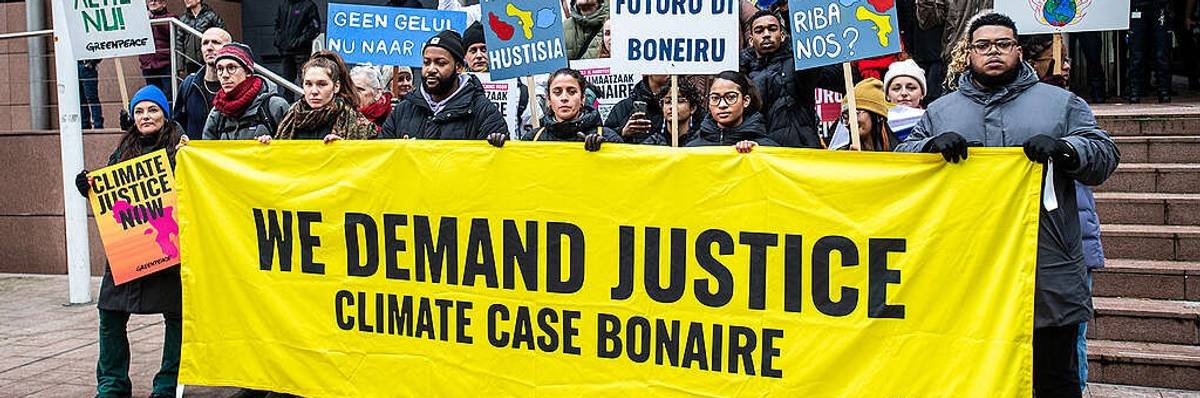
Climate activists demonstrate in support of a climate liability lawsuit brought by the island of Bonaire against the Netherlands.
"There are plans in place to protect the European Netherlands against sea-level rise and other consequences of the climate crisis, but for Bonaire this is not yet the case," one plaintiff said.
Eight residents of the Caribbean island of Bonaire sued the government of the Netherlands Thursday for not doing enough to protect the Dutch municipality from the climate emergency.
In the lawsuit, filed alongside Greenpeace Netherlands, the islanders demand that the Netherlands work with Bonaire to make a plan to protect it from the impacts of the climate crisis and that it do its "fair share" to limit global temperature rise to 1.5°C by reaching net-zero by 2040 instead of 2050.
"The time for talking is over, we have to act," plaintiff Kjelld Kroon, a 28-year-old program creator, said in a statement. "I don't want to have to wait any longer, and that's why I'm taking action today."
As a low-lying Caribbean island, Bonaire is especially vulnerable to the climate crisis. A study commissioned by Greenpeace found that sea-level rise could cause permanent flooding on parts of the island by 2050 and submerge one-fifth of it by 2100. Rising temperatures would also devastate the coral reefs that the island relies on for tourism, fishing, and protection from storms; damage infrastructure and cultural heritage; and harm public health through more frequent heatwaves and vector-born diseases.
"Climate change is happening right now on Bonaire. It's getting increasingly hot and the rain showers are more frequent and more extreme. These downpours are causing flooding, inundating many houses. Including my mother's house," Kroon said.
Despite these risks, the plaintiffs say that the Netherlands has violated their human rights by not doing enough to protect Bonaire from the impact of rising temperatures caused primarily by the burning of fossil fuels. The Netherlands has maintained a presence on Bonaire for nearly 400 years, and the island became a special municipality in 2010.
"It shouldn't matter whether you live on Bonaire, on Ameland, or in Valkenburg. It's the Dutch government's duty to protect all of us from the consequences of the climate crisis."
"The Caribbean Netherlands has been forgotten for too long," plaintiff Danique Martis, a 25-year-old social worker, said in a statement. "There are plans in place to protect the European Netherlands against sea-level rise and other consequences of the climate crisis, but for Bonaire this is not yet the case. It saddens me to see how, despite knowing their responsibility, the Dutch government has chosen to push our right to safety aside. For this reason, we are going to the court, so they have no choice but to act."
The plaintiffs sent a pre-trial letter to the Dutch government in May of 2023 to give it a chance to resolve their concerns without a trial, The Guardian reported.
However, the Netherlands responded that its net-zero timeline was sufficient. Plaintiffs also were not satisfied with meetings concerning adaptations.
"It shouldn't matter whether you live on Bonaire, on Ameland, or in Valkenburg. It's the Dutch government's duty to protect all of us from the consequences of the climate crisis," Andy Palmen, executive director of Greenpeace Netherland, said in a statement.
The lawsuit was delivered to the district court in the Hague Thursday as part of a protest march from the prime minister's office, according to Greenpeace. At the same time, plaintiffs held a press conference in the capital of Bonaire.
"The government has a duty to reduce global warming as much as possible, and right now it's failing to do so," Palmen said. "We demand more protective measures for Bonaire, and we want the Dutch government to speed up the reduction of carbon emissions from the whole of the Netherlands. This is in the interest of all of us."
Dear Common Dreams reader, It’s been nearly 30 years since I co-founded Common Dreams with my late wife, Lina Newhouser. We had the radical notion that journalism should serve the public good, not corporate profits. It was clear to us from the outset what it would take to build such a project. No paid advertisements. No corporate sponsors. No millionaire publisher telling us what to think or do. Many people said we wouldn't last a year, but we proved those doubters wrong. Together with a tremendous team of journalists and dedicated staff, we built an independent media outlet free from the constraints of profits and corporate control. Our mission has always been simple: To inform. To inspire. To ignite change for the common good. Building Common Dreams was not easy. Our survival was never guaranteed. When you take on the most powerful forces—Wall Street greed, fossil fuel industry destruction, Big Tech lobbyists, and uber-rich oligarchs who have spent billions upon billions rigging the economy and democracy in their favor—the only bulwark you have is supporters who believe in your work. But here’s the urgent message from me today. It's never been this bad out there. And it's never been this hard to keep us going. At the very moment Common Dreams is most needed, the threats we face are intensifying. We need your support now more than ever. We don't accept corporate advertising and never will. We don't have a paywall because we don't think people should be blocked from critical news based on their ability to pay. Everything we do is funded by the donations of readers like you. When everyone does the little they can afford, we are strong. But if that support retreats or dries up, so do we. Will you donate now to make sure Common Dreams not only survives but thrives? —Craig Brown, Co-founder |
Eight residents of the Caribbean island of Bonaire sued the government of the Netherlands Thursday for not doing enough to protect the Dutch municipality from the climate emergency.
In the lawsuit, filed alongside Greenpeace Netherlands, the islanders demand that the Netherlands work with Bonaire to make a plan to protect it from the impacts of the climate crisis and that it do its "fair share" to limit global temperature rise to 1.5°C by reaching net-zero by 2040 instead of 2050.
"The time for talking is over, we have to act," plaintiff Kjelld Kroon, a 28-year-old program creator, said in a statement. "I don't want to have to wait any longer, and that's why I'm taking action today."
As a low-lying Caribbean island, Bonaire is especially vulnerable to the climate crisis. A study commissioned by Greenpeace found that sea-level rise could cause permanent flooding on parts of the island by 2050 and submerge one-fifth of it by 2100. Rising temperatures would also devastate the coral reefs that the island relies on for tourism, fishing, and protection from storms; damage infrastructure and cultural heritage; and harm public health through more frequent heatwaves and vector-born diseases.
"Climate change is happening right now on Bonaire. It's getting increasingly hot and the rain showers are more frequent and more extreme. These downpours are causing flooding, inundating many houses. Including my mother's house," Kroon said.
Despite these risks, the plaintiffs say that the Netherlands has violated their human rights by not doing enough to protect Bonaire from the impact of rising temperatures caused primarily by the burning of fossil fuels. The Netherlands has maintained a presence on Bonaire for nearly 400 years, and the island became a special municipality in 2010.
"It shouldn't matter whether you live on Bonaire, on Ameland, or in Valkenburg. It's the Dutch government's duty to protect all of us from the consequences of the climate crisis."
"The Caribbean Netherlands has been forgotten for too long," plaintiff Danique Martis, a 25-year-old social worker, said in a statement. "There are plans in place to protect the European Netherlands against sea-level rise and other consequences of the climate crisis, but for Bonaire this is not yet the case. It saddens me to see how, despite knowing their responsibility, the Dutch government has chosen to push our right to safety aside. For this reason, we are going to the court, so they have no choice but to act."
The plaintiffs sent a pre-trial letter to the Dutch government in May of 2023 to give it a chance to resolve their concerns without a trial, The Guardian reported.
However, the Netherlands responded that its net-zero timeline was sufficient. Plaintiffs also were not satisfied with meetings concerning adaptations.
"It shouldn't matter whether you live on Bonaire, on Ameland, or in Valkenburg. It's the Dutch government's duty to protect all of us from the consequences of the climate crisis," Andy Palmen, executive director of Greenpeace Netherland, said in a statement.
The lawsuit was delivered to the district court in the Hague Thursday as part of a protest march from the prime minister's office, according to Greenpeace. At the same time, plaintiffs held a press conference in the capital of Bonaire.
"The government has a duty to reduce global warming as much as possible, and right now it's failing to do so," Palmen said. "We demand more protective measures for Bonaire, and we want the Dutch government to speed up the reduction of carbon emissions from the whole of the Netherlands. This is in the interest of all of us."
Eight residents of the Caribbean island of Bonaire sued the government of the Netherlands Thursday for not doing enough to protect the Dutch municipality from the climate emergency.
In the lawsuit, filed alongside Greenpeace Netherlands, the islanders demand that the Netherlands work with Bonaire to make a plan to protect it from the impacts of the climate crisis and that it do its "fair share" to limit global temperature rise to 1.5°C by reaching net-zero by 2040 instead of 2050.
"The time for talking is over, we have to act," plaintiff Kjelld Kroon, a 28-year-old program creator, said in a statement. "I don't want to have to wait any longer, and that's why I'm taking action today."
As a low-lying Caribbean island, Bonaire is especially vulnerable to the climate crisis. A study commissioned by Greenpeace found that sea-level rise could cause permanent flooding on parts of the island by 2050 and submerge one-fifth of it by 2100. Rising temperatures would also devastate the coral reefs that the island relies on for tourism, fishing, and protection from storms; damage infrastructure and cultural heritage; and harm public health through more frequent heatwaves and vector-born diseases.
"Climate change is happening right now on Bonaire. It's getting increasingly hot and the rain showers are more frequent and more extreme. These downpours are causing flooding, inundating many houses. Including my mother's house," Kroon said.
Despite these risks, the plaintiffs say that the Netherlands has violated their human rights by not doing enough to protect Bonaire from the impact of rising temperatures caused primarily by the burning of fossil fuels. The Netherlands has maintained a presence on Bonaire for nearly 400 years, and the island became a special municipality in 2010.
"It shouldn't matter whether you live on Bonaire, on Ameland, or in Valkenburg. It's the Dutch government's duty to protect all of us from the consequences of the climate crisis."
"The Caribbean Netherlands has been forgotten for too long," plaintiff Danique Martis, a 25-year-old social worker, said in a statement. "There are plans in place to protect the European Netherlands against sea-level rise and other consequences of the climate crisis, but for Bonaire this is not yet the case. It saddens me to see how, despite knowing their responsibility, the Dutch government has chosen to push our right to safety aside. For this reason, we are going to the court, so they have no choice but to act."
The plaintiffs sent a pre-trial letter to the Dutch government in May of 2023 to give it a chance to resolve their concerns without a trial, The Guardian reported.
However, the Netherlands responded that its net-zero timeline was sufficient. Plaintiffs also were not satisfied with meetings concerning adaptations.
"It shouldn't matter whether you live on Bonaire, on Ameland, or in Valkenburg. It's the Dutch government's duty to protect all of us from the consequences of the climate crisis," Andy Palmen, executive director of Greenpeace Netherland, said in a statement.
The lawsuit was delivered to the district court in the Hague Thursday as part of a protest march from the prime minister's office, according to Greenpeace. At the same time, plaintiffs held a press conference in the capital of Bonaire.
"The government has a duty to reduce global warming as much as possible, and right now it's failing to do so," Palmen said. "We demand more protective measures for Bonaire, and we want the Dutch government to speed up the reduction of carbon emissions from the whole of the Netherlands. This is in the interest of all of us."

