SUBSCRIBE TO OUR FREE NEWSLETTER
Daily news & progressive opinion—funded by the people, not the corporations—delivered straight to your inbox.
5
#000000
#FFFFFF
To donate by check, phone, or other method, see our More Ways to Give page.
Daily news & progressive opinion—funded by the people, not the corporations—delivered straight to your inbox.
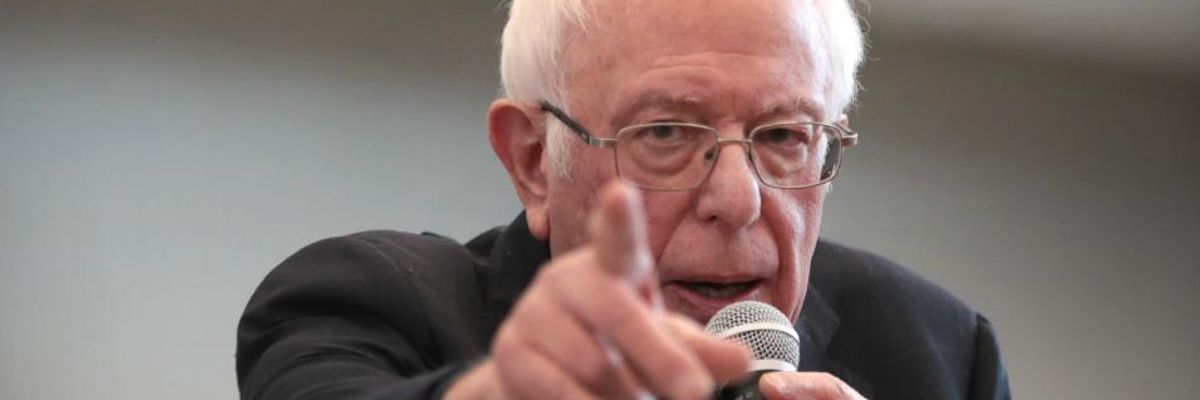
Sen. Bernie Sanders (I-Vt.) speaks to guests during a campaign stop on January 11, 2020 in Newton, Iowa.
"Virtually all Democrats talk about the need for campaign finance reform," wrote Sanders. "Talk is easy. Now it's time to walk the walk."
Ahead of the Democratic National Committee's annual Winter Meeting in Philadelphia, Sen. Bernie Sanders on Tuesday called on the party to end super PAC spending in primary races, saying the Democrats should take the event as an opportunity to show their commitment to protecting democracy.
Twelve years after the U.S. Supreme Court ruled on Citizens United v. Federal Election Commission, the Vermont Independent senator wrote, the last election cycle illustrated how the "disastrous" decision is "undermining American democracy," as super PACs spent roughly $1.3 billion on campaigning—including more than $460 million spent by Democratic groups.
Millions of dollars were spent by billionaires "against progressive candidates in competitive primaries," Sanders wrote, with super PACs funding "outrageous and dishonest attack ads."
"When we talk about billionaires buying elections, this is exactly what we are talking about."
Notably, a super PAC created by the American Israel Public Affairs Committee (AIPAC) spent millions of dollars in competitive races in North Carolina, Texas, and Pennsylvania last year, running attack ads against progressives who are critical of the United States' support for Israel's violent anti-Palestinian policies. One ad accused Rep. Summer Lee (D-Pa.) of being disloyal to the Democratic Party.
"When we talk about billionaires buying elections, this is exactly what we are talking about," wrote Sanders, who caucuses with Senate Democrats.
The 2010 Citizens United ruling allowed corporations and special interest groups to create super PACs, which can accept unlimited donations and spend unlimited money on campaigns. The ruling has been condemned for years by Democratic lawmakers including Rep. Adam Schiff (D-Calif.), who earlier this month introduced legislation to overturn Citizens United.
The party could make clear that it opposes the corporate takeover of campaigning by banning super PAC spending in its primaries, said Sanders, noting that the issue was not permitted to come up for a vote at last year's DNC meeting when he proposed it there.
"Virtually all Democrats talk about the need for campaign finance reform," wrote Sanders. "Talk is easy. Now it's time to walk the walk. Let's stand up for democracy."
Dear Common Dreams reader, It’s been nearly 30 years since I co-founded Common Dreams with my late wife, Lina Newhouser. We had the radical notion that journalism should serve the public good, not corporate profits. It was clear to us from the outset what it would take to build such a project. No paid advertisements. No corporate sponsors. No millionaire publisher telling us what to think or do. Many people said we wouldn't last a year, but we proved those doubters wrong. Together with a tremendous team of journalists and dedicated staff, we built an independent media outlet free from the constraints of profits and corporate control. Our mission has always been simple: To inform. To inspire. To ignite change for the common good. Building Common Dreams was not easy. Our survival was never guaranteed. When you take on the most powerful forces—Wall Street greed, fossil fuel industry destruction, Big Tech lobbyists, and uber-rich oligarchs who have spent billions upon billions rigging the economy and democracy in their favor—the only bulwark you have is supporters who believe in your work. But here’s the urgent message from me today. It's never been this bad out there. And it's never been this hard to keep us going. At the very moment Common Dreams is most needed, the threats we face are intensifying. We need your support now more than ever. We don't accept corporate advertising and never will. We don't have a paywall because we don't think people should be blocked from critical news based on their ability to pay. Everything we do is funded by the donations of readers like you. When everyone does the little they can afford, we are strong. But if that support retreats or dries up, so do we. Will you donate now to make sure Common Dreams not only survives but thrives? —Craig Brown, Co-founder |
Ahead of the Democratic National Committee's annual Winter Meeting in Philadelphia, Sen. Bernie Sanders on Tuesday called on the party to end super PAC spending in primary races, saying the Democrats should take the event as an opportunity to show their commitment to protecting democracy.
Twelve years after the U.S. Supreme Court ruled on Citizens United v. Federal Election Commission, the Vermont Independent senator wrote, the last election cycle illustrated how the "disastrous" decision is "undermining American democracy," as super PACs spent roughly $1.3 billion on campaigning—including more than $460 million spent by Democratic groups.
Millions of dollars were spent by billionaires "against progressive candidates in competitive primaries," Sanders wrote, with super PACs funding "outrageous and dishonest attack ads."
"When we talk about billionaires buying elections, this is exactly what we are talking about."
Notably, a super PAC created by the American Israel Public Affairs Committee (AIPAC) spent millions of dollars in competitive races in North Carolina, Texas, and Pennsylvania last year, running attack ads against progressives who are critical of the United States' support for Israel's violent anti-Palestinian policies. One ad accused Rep. Summer Lee (D-Pa.) of being disloyal to the Democratic Party.
"When we talk about billionaires buying elections, this is exactly what we are talking about," wrote Sanders, who caucuses with Senate Democrats.
The 2010 Citizens United ruling allowed corporations and special interest groups to create super PACs, which can accept unlimited donations and spend unlimited money on campaigns. The ruling has been condemned for years by Democratic lawmakers including Rep. Adam Schiff (D-Calif.), who earlier this month introduced legislation to overturn Citizens United.
The party could make clear that it opposes the corporate takeover of campaigning by banning super PAC spending in its primaries, said Sanders, noting that the issue was not permitted to come up for a vote at last year's DNC meeting when he proposed it there.
"Virtually all Democrats talk about the need for campaign finance reform," wrote Sanders. "Talk is easy. Now it's time to walk the walk. Let's stand up for democracy."
Ahead of the Democratic National Committee's annual Winter Meeting in Philadelphia, Sen. Bernie Sanders on Tuesday called on the party to end super PAC spending in primary races, saying the Democrats should take the event as an opportunity to show their commitment to protecting democracy.
Twelve years after the U.S. Supreme Court ruled on Citizens United v. Federal Election Commission, the Vermont Independent senator wrote, the last election cycle illustrated how the "disastrous" decision is "undermining American democracy," as super PACs spent roughly $1.3 billion on campaigning—including more than $460 million spent by Democratic groups.
Millions of dollars were spent by billionaires "against progressive candidates in competitive primaries," Sanders wrote, with super PACs funding "outrageous and dishonest attack ads."
"When we talk about billionaires buying elections, this is exactly what we are talking about."
Notably, a super PAC created by the American Israel Public Affairs Committee (AIPAC) spent millions of dollars in competitive races in North Carolina, Texas, and Pennsylvania last year, running attack ads against progressives who are critical of the United States' support for Israel's violent anti-Palestinian policies. One ad accused Rep. Summer Lee (D-Pa.) of being disloyal to the Democratic Party.
"When we talk about billionaires buying elections, this is exactly what we are talking about," wrote Sanders, who caucuses with Senate Democrats.
The 2010 Citizens United ruling allowed corporations and special interest groups to create super PACs, which can accept unlimited donations and spend unlimited money on campaigns. The ruling has been condemned for years by Democratic lawmakers including Rep. Adam Schiff (D-Calif.), who earlier this month introduced legislation to overturn Citizens United.
The party could make clear that it opposes the corporate takeover of campaigning by banning super PAC spending in its primaries, said Sanders, noting that the issue was not permitted to come up for a vote at last year's DNC meeting when he proposed it there.
"Virtually all Democrats talk about the need for campaign finance reform," wrote Sanders. "Talk is easy. Now it's time to walk the walk. Let's stand up for democracy."