
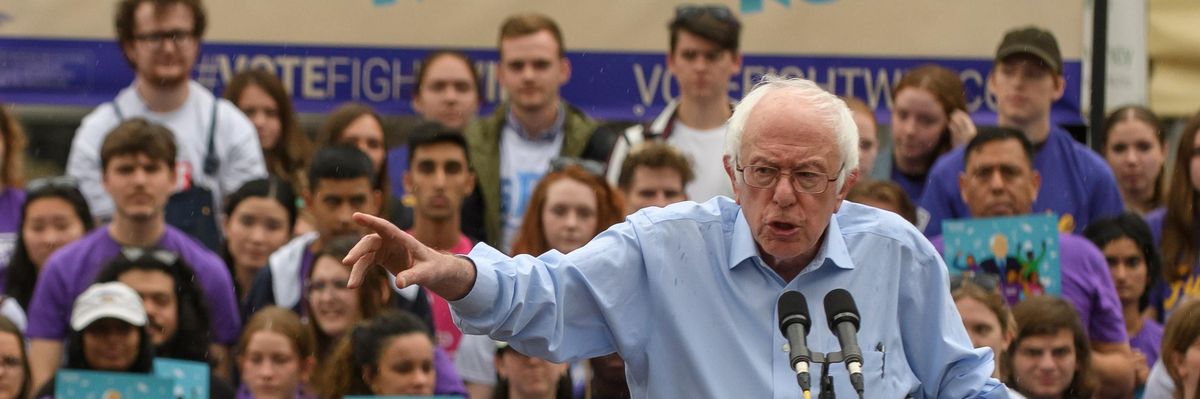
U.S. Sen. Bernie Sanders (I-Vt.) speaks during a campaign on November 6, 2022 in Pittsburgh, Pennsylvania.
Sanders Backs Renewed Push for Ban on Dark Money in Democratic Primaries
"If Democrats really believe in democracy and campaign finance reform, we must ban super PACs in primaries," said Sen. Bernie Sanders.
Sen. Bernie Sanders on Thursday voiced support for a renewed progressive push at the Democratic National Committee to ban dark money donations in the party's primaries, an effort that comes months after the DNC Resolutions Committee refused to allow a vote on the proposal.
"Billionaires and their super PACs must not be able to buy Democratic Party primaries," Sanders (I-Vt.) wrote on social media. "If Democrats really believe in democracy and campaign finance reform, we must ban super PACs in primaries. I stand with progressive reformers advocating for this change."
James Zogby, a longtime DNC member who helped craft the resolution, welcomed Sanders' continued support, writing that "Democrats mustn't let billionaires buy campaigns and our politics with deceitful ads."
"We introduced a resolution to ban dark money at the last DNC meeting," Zogby tweeted Thursday. "They wouldn't let it be discussed or come to a vote. We're bringing it back again."
The 2022 midterms were the most expensive on record, with billionaire-backed super PACs pumping torrents of cash into congressional races across the country.
During last year's Democratic primaries, a number of progressive candidates—including Summer Lee in Pennsylvania, who won her race, and Nida Allam in North Carolina, who lost—faced massive opposition spending from super PACs, including at least one bankrolled by Republican billionaires.
Super PACs, entities that are allowed to spend unlimited sums advocating for or against political candidates, are an outgrowth of the Supreme Court's Citizens United ruling, which unleashed an avalanche of corporate cash into the U.S. political system.
Though they are legally required to disclose their donors, some super PACs "are effectively dark money outlets when the bulk of their funding cannot be traced back to the original donor," OpenSecrets explains.
"While Citizens United may allow for unlimited corporate money in general elections, that Supreme Court ruling does not govern Democratic Party rules."
Appalled by the growing influence of super PACs on Democratic races, progressive DNC members led by Nevada Democratic Party Chair Judith Whitmer proposed a resolution late last year that would have prohibited dark money funding "during any and all Democratic primary elections" and set up "procedures for the investigation of 'dark money' use by candidate committees as well as possible disciplinary action."
But during a September meeting, the DNC Resolutions Committee didn't allow the measure to come up for a vote even though it had the support of dozens of DNC members, spotlighting the committee's increasingly undemocratic procedures and emboldening progressives who vowed to keep fighting for a full floor vote on the dark money ban.
"It was absolutely stunning," Zogby said in an interview after the meeting. "The resolution was never even considered. I know how that works. I was chair of the resolutions committee for 10 years. I was a member of the resolutions committee for 20 years. It means that staff whipped the members and said, 'Don't you dare.'"
"I went up to folks afterwards who I've known," Zogby added. "I mean, you know, they've served on the committee with me. And I said, 'Why? Why did this happen?' They wouldn't look me in the eye."
In a column for In These Times on Thursday, Our Revolution board chair and DNC member Larry Cohen wrote that "while Citizens United may allow for unlimited corporate money in general elections, that Supreme Court ruling does not govern Democratic Party rules."
However, Cohen added, "it is likely that in February, for the second time, the resolutions committee (which determines which proposals move forward) will refuse to report out the dark money ban—despite the significant support it has received from DNC members in about 20 states."
"Increasingly, both the DNC and political leadership in the Biden White House appear interested in preventing party discussion and debate," Cohen wrote. "The good news is that the number of progressives at the DNC is growing, slowly but surely, and grassroots activists increasingly understand that without change within the Democratic Party, we won't win the advances in healthcare, childcare, workers' rights, and climate change that are desperately needed."
We are at a crossroads
This country and this world are at a monumental crossroads. In a few short weeks, US voters will have an opportunity to beat back the forces of fascism and confront the billionaires who are rigging the economy, our media system, and our democracy, making it increasingly impossible for ordinary people to get by. We’re not just talking about the election. We’re talking about what must be done once these fascist elements are vanquished from power. We need a bolder set of solutions than what either major party has so far been willing to offer and a working-class movement ready to fight like hell for it. Trump didn't emerge from nowhere. The conditions that fueled MAGA authoritarianism were created by decades of radical neoliberal economic policies and a corrupt political system dominated by corporate interests. They slashed taxes on the super-rich, promising that the benefits would trickle down. They said giveaways to the corporate titans would make life more affordable for the rest of us. It was all bullshit. And when a bitter, betrayed populace searches for someone to blame, right-wing demagogues have little trouble finding scapegoats. People know when they're being lied to, but you won't hear any of this from the corporate media. Only independent journalism—powered and funded by people who believe in building a better world—can deliver truly trustworthy daily news. Our Fall Campaign is underway, and we need your help. To power our newsroom through the rest of the year, we need to raise $125,000 by midnight on October 31. So if you share our vision, please contribute whatever you can to sustain our work. |
Sen. Bernie Sanders on Thursday voiced support for a renewed progressive push at the Democratic National Committee to ban dark money donations in the party's primaries, an effort that comes months after the DNC Resolutions Committee refused to allow a vote on the proposal.
"Billionaires and their super PACs must not be able to buy Democratic Party primaries," Sanders (I-Vt.) wrote on social media. "If Democrats really believe in democracy and campaign finance reform, we must ban super PACs in primaries. I stand with progressive reformers advocating for this change."
James Zogby, a longtime DNC member who helped craft the resolution, welcomed Sanders' continued support, writing that "Democrats mustn't let billionaires buy campaigns and our politics with deceitful ads."
"We introduced a resolution to ban dark money at the last DNC meeting," Zogby tweeted Thursday. "They wouldn't let it be discussed or come to a vote. We're bringing it back again."
The 2022 midterms were the most expensive on record, with billionaire-backed super PACs pumping torrents of cash into congressional races across the country.
During last year's Democratic primaries, a number of progressive candidates—including Summer Lee in Pennsylvania, who won her race, and Nida Allam in North Carolina, who lost—faced massive opposition spending from super PACs, including at least one bankrolled by Republican billionaires.
Super PACs, entities that are allowed to spend unlimited sums advocating for or against political candidates, are an outgrowth of the Supreme Court's Citizens United ruling, which unleashed an avalanche of corporate cash into the U.S. political system.
Though they are legally required to disclose their donors, some super PACs "are effectively dark money outlets when the bulk of their funding cannot be traced back to the original donor," OpenSecrets explains.
"While Citizens United may allow for unlimited corporate money in general elections, that Supreme Court ruling does not govern Democratic Party rules."
Appalled by the growing influence of super PACs on Democratic races, progressive DNC members led by Nevada Democratic Party Chair Judith Whitmer proposed a resolution late last year that would have prohibited dark money funding "during any and all Democratic primary elections" and set up "procedures for the investigation of 'dark money' use by candidate committees as well as possible disciplinary action."
But during a September meeting, the DNC Resolutions Committee didn't allow the measure to come up for a vote even though it had the support of dozens of DNC members, spotlighting the committee's increasingly undemocratic procedures and emboldening progressives who vowed to keep fighting for a full floor vote on the dark money ban.
"It was absolutely stunning," Zogby said in an interview after the meeting. "The resolution was never even considered. I know how that works. I was chair of the resolutions committee for 10 years. I was a member of the resolutions committee for 20 years. It means that staff whipped the members and said, 'Don't you dare.'"
"I went up to folks afterwards who I've known," Zogby added. "I mean, you know, they've served on the committee with me. And I said, 'Why? Why did this happen?' They wouldn't look me in the eye."
In a column for In These Times on Thursday, Our Revolution board chair and DNC member Larry Cohen wrote that "while Citizens United may allow for unlimited corporate money in general elections, that Supreme Court ruling does not govern Democratic Party rules."
However, Cohen added, "it is likely that in February, for the second time, the resolutions committee (which determines which proposals move forward) will refuse to report out the dark money ban—despite the significant support it has received from DNC members in about 20 states."
"Increasingly, both the DNC and political leadership in the Biden White House appear interested in preventing party discussion and debate," Cohen wrote. "The good news is that the number of progressives at the DNC is growing, slowly but surely, and grassroots activists increasingly understand that without change within the Democratic Party, we won't win the advances in healthcare, childcare, workers' rights, and climate change that are desperately needed."
Sen. Bernie Sanders on Thursday voiced support for a renewed progressive push at the Democratic National Committee to ban dark money donations in the party's primaries, an effort that comes months after the DNC Resolutions Committee refused to allow a vote on the proposal.
"Billionaires and their super PACs must not be able to buy Democratic Party primaries," Sanders (I-Vt.) wrote on social media. "If Democrats really believe in democracy and campaign finance reform, we must ban super PACs in primaries. I stand with progressive reformers advocating for this change."
James Zogby, a longtime DNC member who helped craft the resolution, welcomed Sanders' continued support, writing that "Democrats mustn't let billionaires buy campaigns and our politics with deceitful ads."
"We introduced a resolution to ban dark money at the last DNC meeting," Zogby tweeted Thursday. "They wouldn't let it be discussed or come to a vote. We're bringing it back again."
The 2022 midterms were the most expensive on record, with billionaire-backed super PACs pumping torrents of cash into congressional races across the country.
During last year's Democratic primaries, a number of progressive candidates—including Summer Lee in Pennsylvania, who won her race, and Nida Allam in North Carolina, who lost—faced massive opposition spending from super PACs, including at least one bankrolled by Republican billionaires.
Super PACs, entities that are allowed to spend unlimited sums advocating for or against political candidates, are an outgrowth of the Supreme Court's Citizens United ruling, which unleashed an avalanche of corporate cash into the U.S. political system.
Though they are legally required to disclose their donors, some super PACs "are effectively dark money outlets when the bulk of their funding cannot be traced back to the original donor," OpenSecrets explains.
"While Citizens United may allow for unlimited corporate money in general elections, that Supreme Court ruling does not govern Democratic Party rules."
Appalled by the growing influence of super PACs on Democratic races, progressive DNC members led by Nevada Democratic Party Chair Judith Whitmer proposed a resolution late last year that would have prohibited dark money funding "during any and all Democratic primary elections" and set up "procedures for the investigation of 'dark money' use by candidate committees as well as possible disciplinary action."
But during a September meeting, the DNC Resolutions Committee didn't allow the measure to come up for a vote even though it had the support of dozens of DNC members, spotlighting the committee's increasingly undemocratic procedures and emboldening progressives who vowed to keep fighting for a full floor vote on the dark money ban.
"It was absolutely stunning," Zogby said in an interview after the meeting. "The resolution was never even considered. I know how that works. I was chair of the resolutions committee for 10 years. I was a member of the resolutions committee for 20 years. It means that staff whipped the members and said, 'Don't you dare.'"
"I went up to folks afterwards who I've known," Zogby added. "I mean, you know, they've served on the committee with me. And I said, 'Why? Why did this happen?' They wouldn't look me in the eye."
In a column for In These Times on Thursday, Our Revolution board chair and DNC member Larry Cohen wrote that "while Citizens United may allow for unlimited corporate money in general elections, that Supreme Court ruling does not govern Democratic Party rules."
However, Cohen added, "it is likely that in February, for the second time, the resolutions committee (which determines which proposals move forward) will refuse to report out the dark money ban—despite the significant support it has received from DNC members in about 20 states."
"Increasingly, both the DNC and political leadership in the Biden White House appear interested in preventing party discussion and debate," Cohen wrote. "The good news is that the number of progressives at the DNC is growing, slowly but surely, and grassroots activists increasingly understand that without change within the Democratic Party, we won't win the advances in healthcare, childcare, workers' rights, and climate change that are desperately needed."